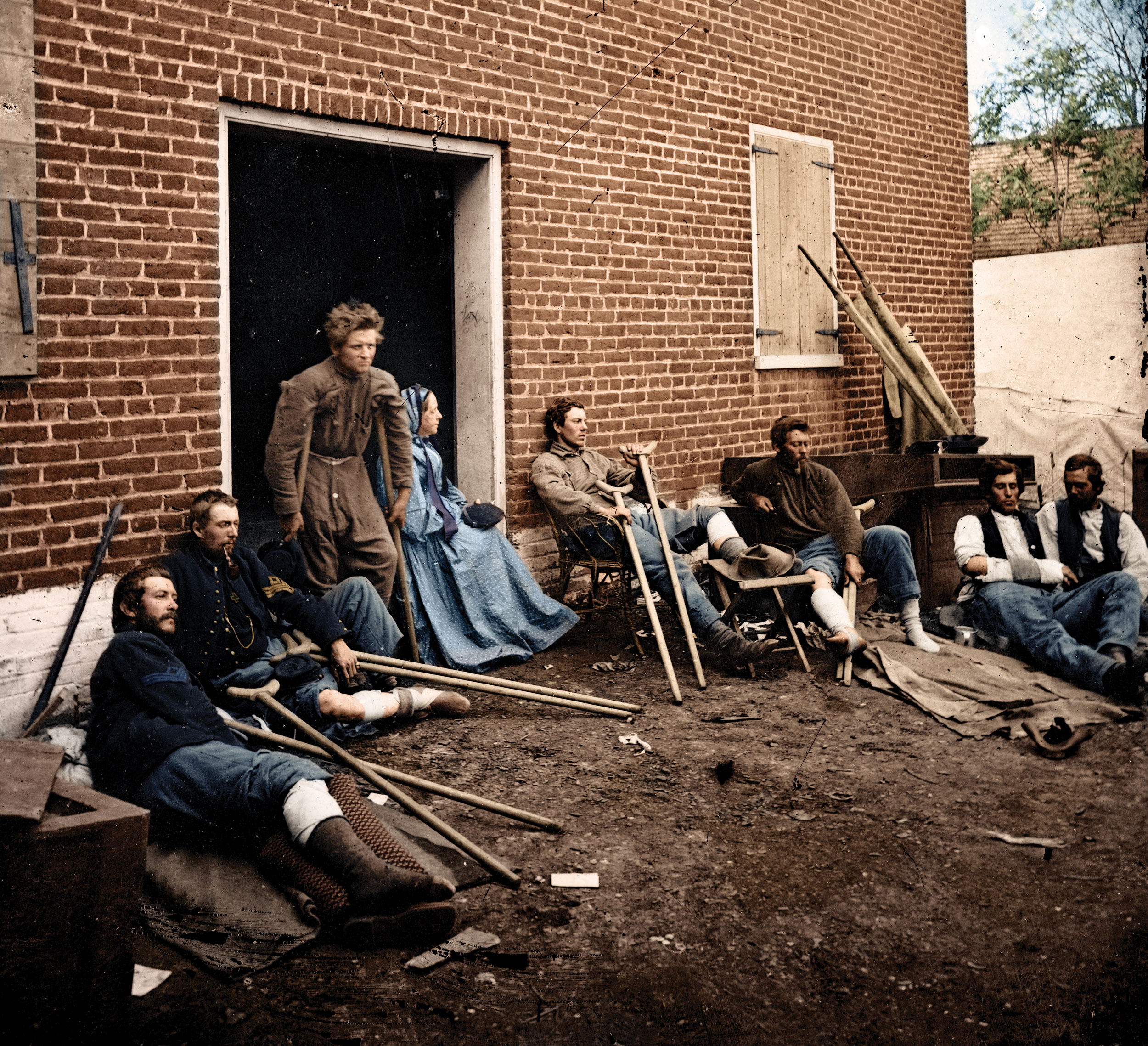
 Library of Congress (colorized by Mads Madsen of Colorized History)
Wounded Union soldiers rest outside a hospital established by the U.S. Sanitary Commission in Fredericksburg, Virginia, in 1864. These and countless others—soldier and civilian—would learn to grin and bear the hardships and confusion wrought by the Civil War.
grin•and•bear•it / grın ænd ber ıt | idiom | To accept or endure misfortune without complaint (originated in 18th-century Britain).
In 1860, and again in 1864, Americans went to the polls; some cast their votes for peace, but none of their candidates—John C. Breckenridge, John Bell, Stephen Douglas, George B. McClellan—became president. Instead, Abraham Lincoln was twice elected to office and under his leadership the Civil War commenced and continued. Some men wanted to fight while the reluctant others were conscripted into the ranks. Once on the battlefield, a competent commanding officer was a godsend, while an incompetent one felt like an unsummoned death wish. Conditions in camp were not predictable. Food might be poorly cooked, rancid, or absent. Shoddy uniform pants frayed in the backside and canvas tents leaked at the seams. Heavy rain, wet snow, deep mud, unbearable heat—all of it vexed soldiers and they complained at length about it and everything else in their letters home.
What could a soldier do? He certainly could not single-handedly stop the war, oust the president, end conscription, fire a general, eliminate bloat from bureaucracy, or improve the weather. He was, after all, only a man and not God.
Civil War soldiers had only two options: they could skedaddle, risking dishonor at best or recapture and execution at worst, or they could shoulder their fates and make the best of a bad situation. Most chose the latter and adjusted to the rigors of army life. They amended their expectations, adapted to hardships, and psychologically embraced the unknown and unknowable.
In short, soldiers chose to “grin and bear it.” In August 1862, it “raind like blaises” for two days and two nights, but the men of the 35th North Carolina Infantry soldiered on, or, as A. Pinkney Ward wrote, “wee grin and bear it.” Georgian James A. McMurtrey longed to see his “Sweet Willie,” “but I know there is no chance and for that reason as the saying is I grin and endure and hope the day will come when I shal be at home with my Dear ones one time more.”1
Which brings us to this installment’s phrase: grin and bear it. The nation had to grin and bear the Civil War’s cruel misfortunes and absurd uncertainties.
Americans did not frequently grin and bear it during the first half of the 19th century. To be sure, they endured assorted hardships at home and at work, but few used that expression to describe their mindset. Instead, antebellum women suffered abuse and bore physical pain while men persevered in trying times and overcame adversity.
Our stoic cousins across the pond, however, were grinning and bearing it long before us. The phrase first appeared as grin and abide in the banter of 18th-century British seamen—men very probably impressed into military or merchant service against their wills, subjected to severe corporal punishments, and trapped with no recourse on undersupplied vessels in the middle of an ocean. That would seem to define a moment where one can only grin and bear it. In 1775, William Hickey, a well-heeled and well-traveled English lawyer, offered a bit of advice to a terrified friend while the two endured a rough sea voyage. Hickey said, “I recommend you to grin and bear it (an expression used by sailors after a long continuance of bad weather).”2 Hickey’s vignette introduced the idiom into the English vocabulary.
The British quickly took note, though the Americans did not. The Library of Congress’ Chronicling America database has but nine mentions of the phrase prior to 1840. The term became popular in the 1850s, as the nation barreled toward war. Bleeding Kansas, the Dred Scott decision, and John Brown’s raid on Harpers Ferry were all events that few had direct control of but which indirectly affected many. Average Americans felt powerless in the face of such overwhelming disruptions, and the war only magnified that sensation. Our Civil War helped popularize the British expression as it accurately represented the attitude felt by many soldiers and civilians.
Like the British seamen before them, 19th-century Americans dragooned by the Civil War’s uncertainties and miseries grinned and bore it, bolstering themselves and our language in the process. 
Tracy L. Barnett is visiting assistant professor of History at Old Dominion University in Norfolk, Virginia. She earned her doctorate in American History from the University of Georgia this year. Firearms—their meaning to men and their availability in 19th-century America—are at the center of her scholarship.
Notes
1. A. Pinkney Ward to Eliza Whitner, August 7, 1862, Private Voices; James A. McMurtrey to Lucinda McMurtrey, March 10, 1863, Private Voices.
2. Alfred Spencer, ed., The Memoirs of William Hickey, Volume 1 (New York, 1923), 196.