 Battles and Leaders of The Civil War
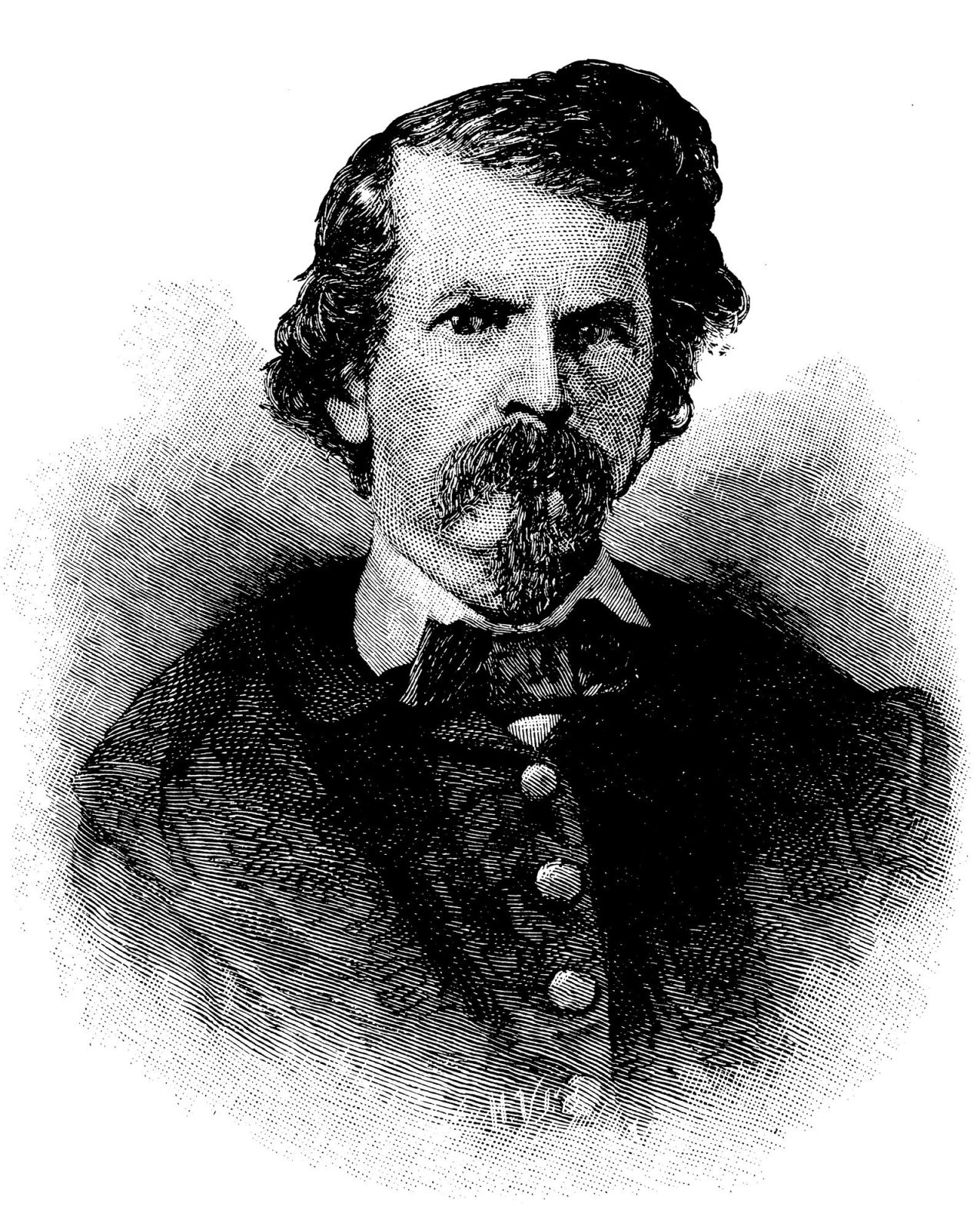
Earl Van Dorn, Confederate general and “terror of ugly husbands.”
General Earl Van Dorn had just completed the last swoop of his signature when he heard the high crack of a parlor pistol behind him. When his adjutants burst in, they saw him sprawled across his desk, “his left arm was in his lap, blood was flowing from the back of his head…and he was convulsively shuddering.” Soon enough, he lay perfectly still.1
As news of the murder rippled out, most concluded it “served him right.” Van Dorn had a fearsome reputation as a womanizer, and the assassin was said to have been an “indignant husband” “grossly wronged.” Union newspapers gleefully pounced on the story; the moral inferiority of the Rebels, always assumed, could now be underscored in a tale of a Confederate general killed by his own turpitude. Twisting the knife in Van Dorn’s memory, the St. Louis Republican lamented only that he hadn’t been a better soldier. “As a rebel officer we liked Van Dorn,” the editor chortled, “for he never gave the federals half the trouble that almost any other would have.”2
Van Dorn fared little better in the Confederate South. Losses at Pea Ridge, Corinth and Iuka had tarnished his reputation as a fighter; his reputation as a lover had preceded him. (He had fathered three illegitimate children while stationed in Texas before the war.) Embedded with the Army of Tennessee, Sir Arthur Fremantle noted that “[Van Dorn’s] loss does not seem to be much regretted…. In such a case as Van Dorn’s…his life belongs to the aggrieved husband, and ‘shooting down’ is universally esteemed the correct thing.” Even the Richmond Enquirer glumly moralized in its eulogy: “He always sacrificed his business to his pleasure. He was never at his post when he ought to be. He was either tied to a woman’s apron string or heated with wine.”3
But the truth is, Van Dorn’s reputation greatly exceeded him. He liked women, certainly, and he liked to be liked by them, but he flirted and flattered far more than he philandered. A month before his death, a Nashville newspaper perceptively dubbed him “the terror of ugly husbands.” The author did not mean that Van Dorn slept with other men’s wives; he meant the greater terror—that other men’s wives wanted to sleep with Van Dorn. And this is the problem: The circumstances of his death have tended to reverse the polarity of Van Dorn’s magnetism, making him seem somehow repulsive. But clearly he had been enormously attractive in his time. “He was a knightly fellow to look at,” remembered one witness. “His hair was a clear golden color, and in natural ringlets it fell around his shoulders and neck and looked like a King Charles wig.” He was “the beau ideal of a cavalry officer,” said another, and had a windswept look that made it seem as if he had ridden down a Comanche war party moments before taking his seat at the piano. “[Van Dorn] was one of the few men in either army that could sing and play musical instruments with a sweet, rich voice and accomplished hand,” noted Louis Dupre in his memoir. “He wrote poetry. In his dress he was neat as a pin. As soon as he entered a household his bearing attracted, his address delighted, his accomplishments made the women worship him…. Wherever he went, they gave way.”4
The problem with being a soldier is not merely where you are—bored in camp or terrified on the battlefield—but where you are not: at home keeping an eye on things. This is why, even in the South, men were inclined to believe the worst of Van Dorn. He embodied their greatest fear—that they were losing their wives as they fought for their country. War is a change agent; war elasticizes. The unthinkable becomes all you think about: Where is she right now? What is she doing? And with whom is she doing it? In the paranoid soldier’s mind, every hometown is awash in Van Dorns—the sexual war profiteers.
And male paranoia and possessiveness, it turns out, lay at the root of the Van Dorn murder. The account of his adjutant, unearthed in 1999, paints a persuasive picture not of a notorious roué but of a man who walked unwittingly into a marital minefield and became the subsequent victim of a national rush to judgment.5
The trouble began in mid-April 1863, when Van Dorn and his staff rode out to the Peters Plantation near Spring Hill, Tennessee, looking for a place to camp. The mistress of the plantation, Jessie Peters, turned out to be an attractive young woman who not only agreed to bivouac troops on the property but offered Van Dorn the use of a cabin for his headquarters. “This plantation belongs to me,” she said pointedly, “not my husband.”6
The subject of property was evidently just one source of friction in the Peters marriage. Jessie’s husband, Dr. George Boddie Peters, was an older man, twice a widower, with a sullen disposition. He had owned a plantation of his own before the war, but it had been captured by the Yankees. Now he was dependent on his wife for his support, and it rankled. She was young and sunny and wealthy, and she liked company. He was brooding, propertyless, and vengeful.
Over the next weeks, Jessie and Van Dorn became friends. He loved company as much as she did, and they took several carriage rides together. To neighbors they appeared to be flaunting themselves, and the stories that made it back to George, who was often in town seeing patients, were undoubtedly grist for his dark mental mill.
George’s crime was meticulously crafted, especially the embellished motive. Before murdering Van Dorn in his headquarters, he had the fence rails taken down all along his escape route and arranged for horses to be waiting for him at relay points. He fled all the way to Union lines (on Van Dorn’s own pass—the very one he was signing when he was killed). Once among the Yankees, George told a story he knew would be believed: that the terror of ugly husbands had struck again. Van Dorn had been pulled from the bed and chased out of the bedroom; he had cowered beneath the porch and been pulled out feet first. With a pistol to his temple, he had agreed to write out his confession. But when he refused to sign it, Peters had gunned the man down.
The story was believed because it was every man’s perverse fantasy of what he would do in the same situation. But Peters was lying: He had murdered Van Dorn because his wife had insulted him for the last time, and because, having assassinated a Confederate general, he might get his property back from the Yankees (which he did). Mostly he had done it because he wanted he and his wife to be even again. Van Dorn had just been a prop in their marital drama and a victim of fate. It was a case, said his adjutant, of “one buggy ride too many.”7
The Civil War is rightly famous for the many letters of love and longing sent by soldiers and their sweethearts. But time and pressure, distance and damage, rarely consolidate a marriage; they are more apt to expose its seams. How many “Dear John” letters were sent during the war? How many other marital minefields were created? War is fought within an emotional landscape of sexual paranoia. And in every soldier’s mental knapsack there is an unwanted piece of equipment: the fear that he is replaceable, expendable, even in the hearts of those he loves. This collective fear helped to murder Van Dorn and to mar his memory, and he too should be counted a casualty of war.
Stephen Berry is associate professor of history at the University of Georgia. He is the author or editor of four books on America in the Civil War era, including House of Abraham: Lincoln and the Todds, A Family Divided by War (Houghton Mifflin Harcourt, 2007).
Notes
1. Arthur B. Carter, The Tarnished Cavalier: Major General Earl Van Dorn, C.S.A. (Knoxville, 1999), 187.
2. Farmer’s Cabinet (New Hampshire), May 28, 1863 (reprinting an earlier article from the St. Louis Republican).
3. Sir Arthur James Lyon Fremantle, Three Months in the Southern States: April–June 1863 (Mobile, 1864), 75-76.
4. Louis J. Dupre, Fagots from the Campfire (Washington, D.C., 1881), 118-119.
5. Carter, Tarnished Cavalier, 181-82. In researching Van Dorn, Carter contacted descendents of his adjutants and discovered an account of Manning Kimmel, as relayed by his son, describing the events in the month leading up to Van Dorn’s murder. Carter’s final chapter, based in part on that account, is an exquisite piece of historical detection.
6. Ibid., 182.
7. Ibid., 192.