 Library of Congress
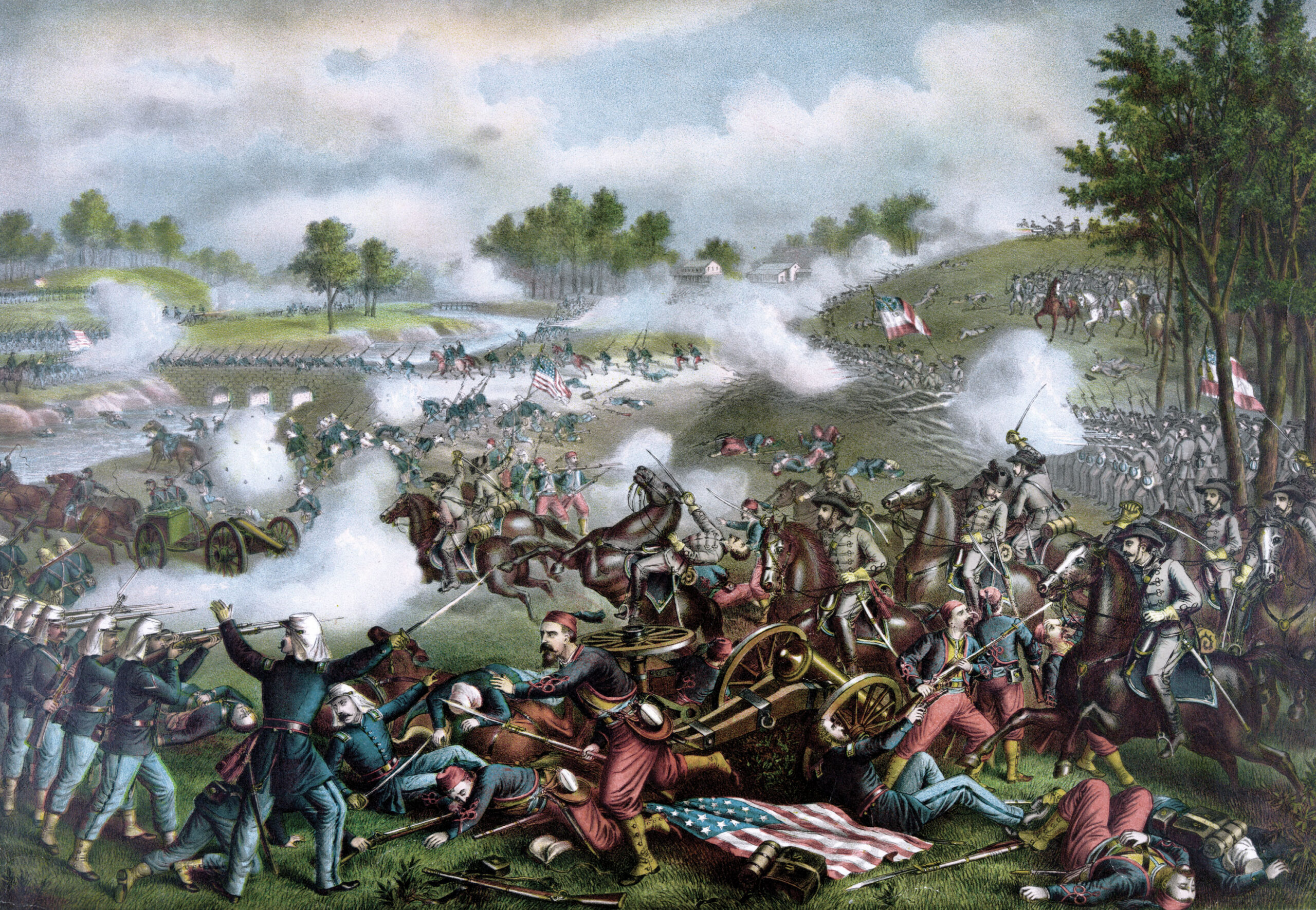
Union soldiers flee in the face of heavy Confederate fire in this depiction of the Battle of Bull Run by Kurz & Allison. Before long, Civil War troops would devise a new word—skedaddle—to capture both the gravity and absurdity of retreating from the conflict’s battlefields.
ske • dad • dle /ske’dadl/ | verb | To run away, flee, make a hasty retreat; to desert (unknown origin, first used at the beginning of the Civil War).1
One sure way to measure a catastrophe’s impact is to mark its effect on the language. COVID-19 has given us social distancing, shelter in place, and self-quarantine.
World War II gave us genocide, kamikaze, radar, and spam. Jeep was just a slurring of GP, which meant a general-purpose vehicle. And lest we forget snafu, with its F-bomb wearing military camouflage: s(ituation) n(ormal) a(ll) f(—–) u(p).
World War I was equally generous to language, originating or popularizing such words and terms as tank, sniper, over the top, shrapnel, cootie, zero hour, storm trooper, blimp, air raid, shell shock, tailspin, unknown soldier, having a chat (originally, men gathering around to pick one another’s lice), and the ironic phrase war to end all wars.2
The literary historian Paul Fussell famously noted that all wars are ironic because they never conform to expectations. A war’s novel circumstances and experiences leave their mark on the language and remind us that, if we want to discover a war’s essence, we should study its vocabulary. Fighting Words is a new column for the Monitor devoted to Civil War language. In each installment we will take up a word, term, or phrase the war invented or reinvented, popularized or repurposed, and plumb its mysteries. For this inaugural the word is “skedaddle.”
Before 1861, virtually no one had ever skedaddled. After 1861 people were skedaddling all the time. What happened?3
Let’s start with the obvious. Terms are invented to capture new phenomena and new feelings, and there was nothing new about an army being routed. As commander of the Continental Army, George Washington ran away a lot after defeats. One of his soldiers said of the Battle of Long Island: “I can’t describe the confusion and the horror of the scene. Artillery flying, our men running in every direction, and everywhere we turn we meet the British or the Hessians. Men up to their knees in mud, screaming for help, everyone else running to save their own skins.” This witness is clearly describing something like skedaddling, but no one knew the word then because no one had invented it yet and no one would invent anything like it until 1861 when, lo and behold, Americans were desperate to skedaddle. Civil War soldiers were retreating in a new way, or had new feelings about the way they were retreating. They needed a term that gave them an ironic distance from what they and the enemy were doing—something that went beyond retreat or flight, exodus or evacuation.
This brings us to a second obvious point: Skedaddle is a funny word. In contemporary newspapers, it is variously spelled “skidaddle” or “skadaddle,” suggesting that it originated as a spoken word, probably in army camps, and only later was written down. Like most onomatopoeic words—cuckoo, honk, zap, boing—there’s a silliness to it. To skedaddle is to make not just a chaotic but an almost comic retreat, and by 1861 volunteer soldiers had developed deeper levels of cynicism and ironic deflection than had the men who fought with Washington.
The expression “seeing the elephant” can be a metaphor for getting a taste of battle, but what if we examine it closely? Seeing the elephant marries a weird sort of joie de guerre, or joy of battle, with the more disturbing idea that war is an obscene circus. Less well known are expressions such as “I seen the monkey show” or “I seen the monkey dance.” On April 6, 1862, John Ingraham, a soldier in the 25th Indiana Infantry, wrote home: “I guess you hav herd before this time that I hav see the monkey dance I did not enjoy the 6 of April as well as I before this time that I hav see the monkey dance I did not enjoy the 6 of April as well as I hav enjoyed some Sundays.” He’s talking here about the Battle of Shiloh, the war’s first bloodbath.
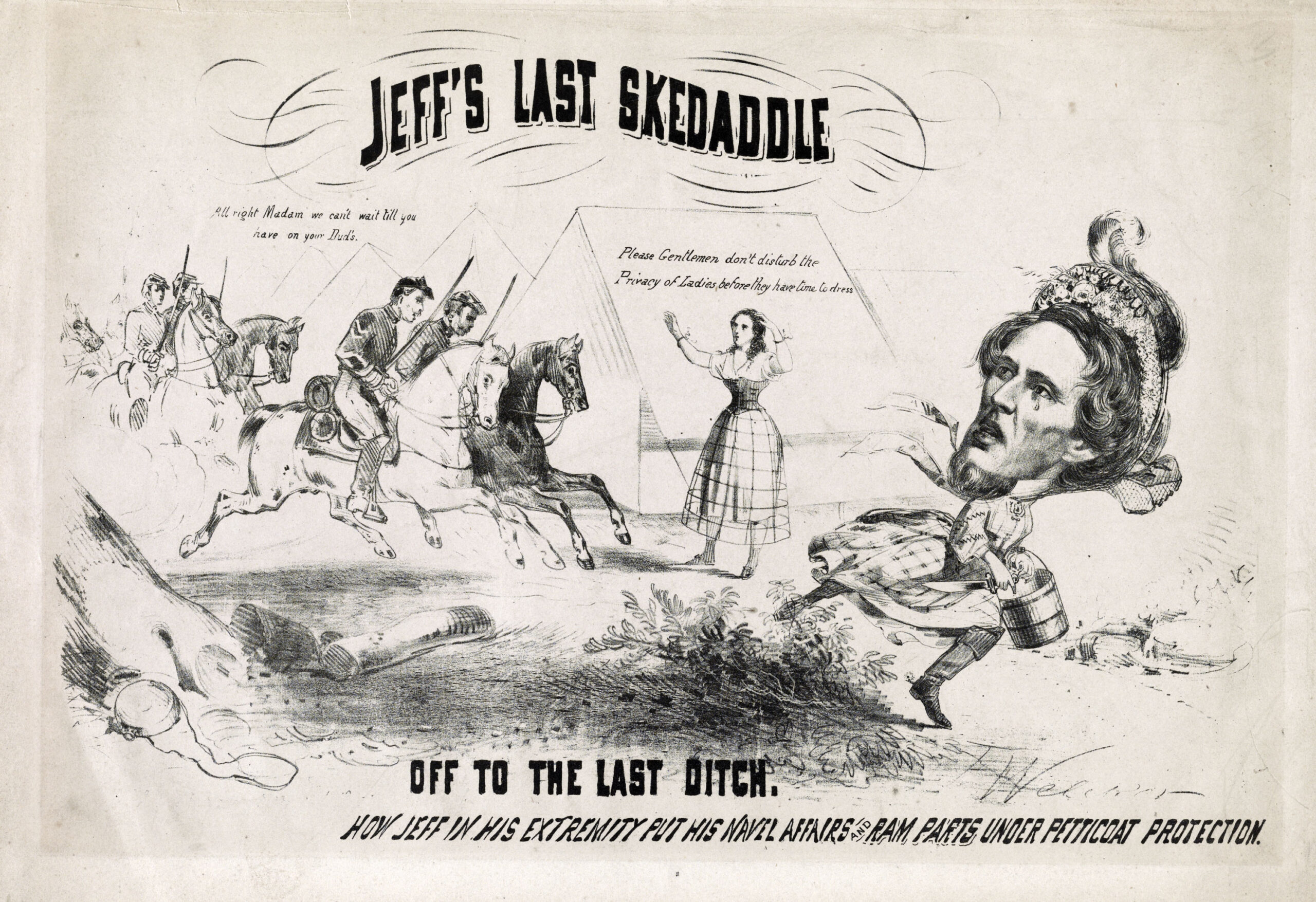 Library of Congress
In this 1865 cartoon by artist F. Welcker titled “Jeff’s Last Skedaddle,” Confederate president Jefferson Davis attempts to avoid capture by Union troops as his wife looks on. By war’s end, skedaddle had become a word used to describe retreats of various kinds.
Skedaddle was invented because it had the kind of ironic minimalization and misdirection that Civil War soldiers needed psychologically to do their work. Of the many Civil War synonyms for desertion, half of them are repurposed military terms: flank out, run the blockade, take a North Carolina discharge, press a furlough, or break the guard. While soldiers accepted the discipline that victory would require, they couldn’t help making fun of it. They couldn’t help but see the ludicrousness of what they were doing.
On a grueling 125 mile retreat, one South Carolina soldier wrote home that they’d “bin skedadling for 8 days.” Watching 32 new recruits come into camp, John Campbell of the 1st Rhode Island Infantry knew many of them would never stay: “After thay get there Bounty most of them will skedaddle as a good meny has done,” he wrote home.4
“For the benefit of future etymologists,” noted the Washington Star in 1861, “we here define [a] new term…. The word [skedaddle] is used throughout the whole army of the Potomac, and means ‘to cut stick,’ ‘vamoose the ranch,’ ‘slope,’ ‘cut your lucky,’ or ‘clear out.’”5
If new words are created by new experiences, the word skedaddle answered a soldier’s need to capture being simultaneously terrified and made to feel ludicrous by the largeness and smallness of his circumstances. Dying in government-issue underwear that was three sizes too big. Ordered to take a hill that was obviously impregnable. Civil War soldiers could be gravely serious about their cause and comrades, but if they couldn’t let the air out of both, they knew they would never survive.
Which brings us to “The Great Skedaddle,” the tragicomic initiation into the war—the First Battle of Bull Run. Most Civil War enthusiasts know the stories of the picnickers and looky-loos who were caught up in the Union’s disorderly retreat from the conflict’s first major battlefield. But imagine being a U.S. senator, driving out to distribute sandwiches to the troops only to find your sandwich truck blown apart by a shell as you escape bareback on a stray mule. Or imagine you are the president of the United States, overseeing your first important campaign as commander in chief, and receiving a telegram that reads simply: “The day is lost. Save Washington and the remnants of this army.” Tragicomedy was the Civil War soldier’s stock in trade. Riding to ignominy on a mule or crumpling in your hand the silliest, saddest telegram ever written was part of the war experience. Such feelings were hard to express. They demanded an elasticity to the language. They demanded new words. “As our case is new, so we must think anew, and act anew,” Abraham Lincoln told Congress in 1862.6
Fighting Words is dedicated to the proposition that when our case is new, we also speak anew.
Stephen Berry is Gregory Professor of the Civil War Era at the University of Georgia. He is the author or editor of six books on the Civil War Era. He is co-director, with Michael Ellis (Professor Emeritus in the Department of English at Missouri State University), of Private Voices, a website devoted to Civil War language.
Notes
1. “Skedaddle,” from “Gone Up the Spout,” Private Voices.
2. Martin Pegler, Soldiers’ Songs and Slang of the Great War (Oxford, 2014); Peter Doyle, Trench Talk: Words of the First World War (Cheltenham, 2011); “100 Words that Define the First World War,” Oxford English Dictionary, 2014; Gary Nunn, “War of the words: the global conflict that helped shape our language,” The Guardian, September 26, 2014; Philip Gooden and Peter Lewis, The World at War: World War Two in 100 Phrases (London, 2014); Philip Gooden, Idiomantics: The Weird World of Popular Phrases (London, 2012).
3. Skedaddle’s first appearance in print was in the New-York Tribune, August 10, 1861: “No sooner did the traitors discover their approach than they ‘skiddaddled’ (a phrase the Union boys up here apply to the good use the seceshers make of their legs in time of danger).”
4. See “Gone Up the Spout,” Private Voices.
5. “Skadaddle,” Washington Evening Star, October 22, 1861, p. 2 (reprinted from the New York Post).
6. Abraham Lincoln, “Annual Message to the Congress,” December 1, 1862.