“I beg to ask, most respectfully, your intervention in my application to the President, because … I desire to put my case before him upon its merits unwarped and unencumbered by political or party passion, and … because I seek to be judged as a soldier, by soldiers whose judgment the country will respect, and history accept as true and final.” So wrote Fitz John Porter to William T. Sherman in June 1869, shortly after Sherman was appointed commanding general of the U.S. Army, replacing Ulysses S. Grant, who had been elected president the previous November. Seven years earlier, Porter, a major general in command of a Union army corps, faced court-martial for his performance at the Second Battle of Bull Run. Found guilty of disobedience and misconduct, he was dismissed from the army, his military career abruptly over.
For years afterward, Porter pushed to clear his name from what he was convinced had been a politically motivated and biased prosecution and verdict. As he noted in his letter to Sherman, “I am prepared to … [show] that my sentence was unjust. I have newly discovered evidence which conclusively establishes how false was the principal accusation.” It was not until 1886—nearly a quarter century after the battle in which he was accused of misconduct—that Porter was able to get his sentence commuted and his U.S. Army commission restored.
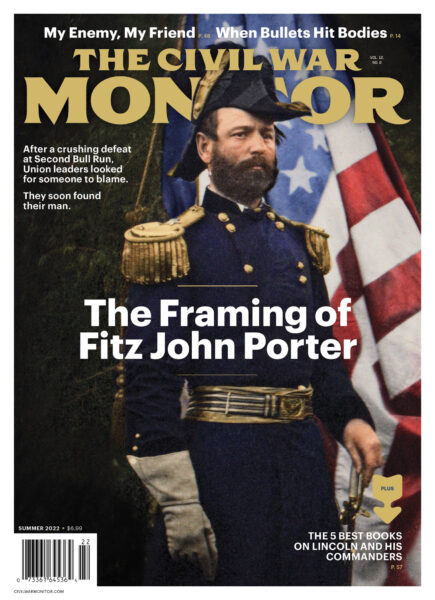
In this issue’s cover story, “The Framing of Fitz John Porter” (page 24), William Marvel examines Porter’s trial in detail, laying bare the motivations and conduct of the powerful military officers and politicians who pushed for Porter’s conviction. Was the outcome justified, or was Porter right to think that he had been wronged? You be the judge.
Want to share your thoughts on this or other articles in the issue? Send your emails to [email protected].
* * *
Congratulations to Caroline Janney, who was recently announced as the recipient of the 2022 Gilder Lehrman Lincoln Prize—given annually for the finest scholarly work in English on Abraham Lincoln, the American Civil War soldier, or a subject relating to their era—for her excellent book Ends of War: The Unfinished Fight of Lee’s Army after Appomattox, which served as the basis for her feature article in our Fall 2021 issue, “Treason in Our Midst.” An honor well deserved!