BRINGING DOWN PORTER
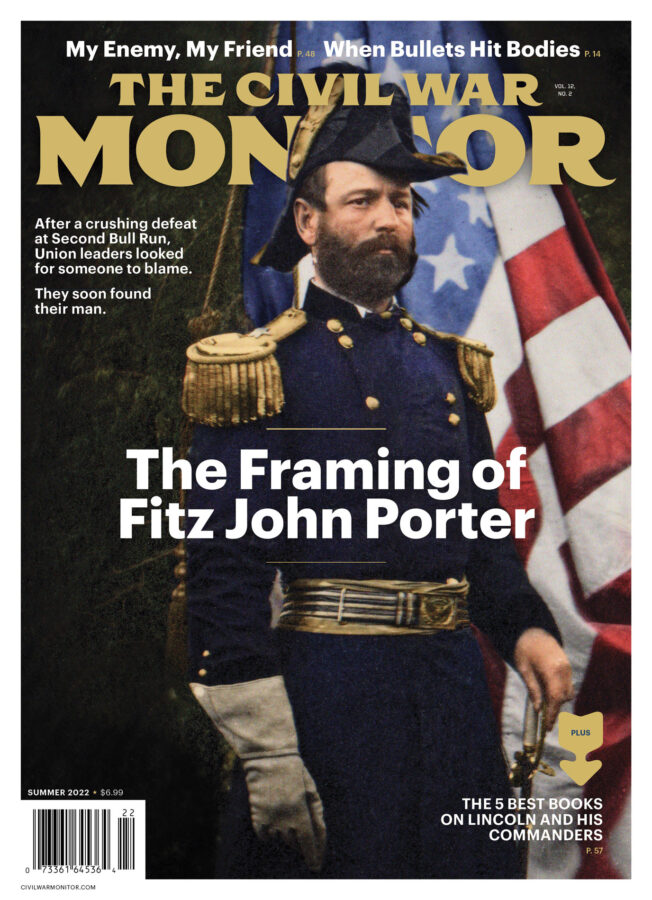
In “The Framing of Fitz John Porter” [Vol. 12, No. 2], William Marvel convincingly shows how Fitz John Porter was convicted of John Pope’s trumped-up charges regarding his actions at Second Bull Run by what essentially was a rigged court-martial process. A few additional points are in order. While Porter’s retrial before the Schofield Board in 1879 did “exonerate” the former general on all charges, the board’s report also censured him for his pre-battle correspondence with Ambrose Burnside in which he disparaged his “superior” Pope. The board concluded that the correspondence “cannot be defended” and that the perception of Porter’s conduct during the battle that led to Pope’s charges “was due, in very great measure,” to that correspondence. Second, Porter’s exoneration established that he was a victim—but not that he was some sort of hero. John Hennessy’s definitive study of the Second Manassas Campaign, Return to Bull Run (1993), describes Porter as an “average officer of limited initiative and energy” whose performance at Second Bull Run was “pedestrian.” Finally, although Porter’s actions at Second Bull Run did not warrant a court-martial, his correspondence while on active duty with the vehemently anti-administration newspaper editor Manton Marble may have. In his recent biography of Porter, Radical Sacrifice (2021), Marvel generously describes those letters as only “seditious-sounding.” Ultimately, wrongly cashiered or not, the Union war effort was better off without Fitz John Porter.
John Foskett
Westwood, Massachusetts
FRATERNIZATION STORIES
Having looked forward to reading Lauren K. Thompson’s article in the Summer issue [“My Enemy, My Friend,” Vol. 12, No. 2], I was disheartened to see it dissolve into a woke culture cliche, equating memories of humanity as “racism and white supremacy.” As a great-grandson of a white Confederate who was aided by a black Union soldier, it is sad that there are some who see racism behind every memory, rather than simply admitting that even in time of war, there can be compassion and kindness and the desire to help another human being.
From my experience, most soldiers tend to speak of the “good memories,” and leave the horrors buried deep inside. There is no political agenda involved, simply remembering and coping. To equate this with racism and white supremacy is beneath the dignity of The Civil War Monitor, as well as all of humanity.
Art Hoffner
Spring Valley, California
* * *
Regarding Lauren K. Thompson’s article in the Summer issue, it reminds me of those archconservatives from the 1960s who saw a communist behind every bush. Thompson appears to see a Lost Causer behind every reminiscence and war story. Like all veterans, I have my share of war stories, many of them accurate. But Thompson impugns these fraternization stories not for their accuracy (mostly) but more for their perceived support of a Lost Cause narrative.
Yet her logic for finding such a connection appears to be wholly absent. Her article suggests that in retelling such relatively benign stories as soldiers trading for tobacco and coffee, such persons are ignoring the “causes and consequences” of slavery. That is quite a stretch. Such a claim demands some explanation. But the author provides none. She points to various fraternization stories across the decades, most of which seem to have been spread by white southerners. She suggests without real explanation that they were motivated by support of the Lost Cause.
In my business, if I went into court arguing in essence that “all white southerners discriminate during this time period, judge, therefore they must have discriminated against my client,” the judge would fuss at me for filing a frivolous lawsuit. I, too, file cases that require me to show mental intent on the part of some accused person. I, too, often rely on circumstantial evidence to discern that intent. But if I did as Thompson has done—go into court with nothing more than stereotypes about white southerners of a certain time period—I would likely receive some sort of sanction. Judges do not like lawsuits wholly lacking in evidence.
The challenge with showing mental intent to commit some act is that there may be other desires equally at play. Those Southern Historical Society Papers editors had every reason to appreciate the fraternization stories for many reasons wholly unrelated to the Lost Cause. It is just as likely the authors simply enjoyed the thought decades after violent combat that there was some measure of decency on both sides. Unless Thompson can disprove to some degree the alternative explanations, her thesis is quite weak. Or so have several judges told me in court.
Thomas J. Crane
San Antonio, Texas
* * *
I must admit, after reading just a few paragraphs of Lauren K. Thompson’s article, “My Enemy, My Friend,” I assumed the professor must be a founding member of the “Secret Society of Cynics.” Make no mistake, she is smarter than I could ever dream to be and has the academic credentials to back it up. But I would ask her, is it really that difficult to believe competing soldiers fraternized during the war and that after the war, they sometimes became friends? I’m thinking of the English–German Christmas Truce in WWI. Or think of the many wars the United States has been involved in. This country was essentially created by a civil war with Great Britain and today they are our greatest ally. We have had two World Wars with Germany, whose atrocities in WWII are arguably equal to or even greater than those that brought about our Civil War, yet today Germany is a strong friend and ally. Same with Japan after WWII. If there is a common thread with the United States and its soldiers, it is that after wars, no matter how bad they were and why they were fought, many tend to become friends with our previous enemies in short order. So, the idea that soldiers of the North and South reconciled after the war seems nothing but normal to me.
Did all veterans of the Civil War reconcile? Of course not. Many championed the Lost Cause narrative or had what Thompson describes as the “Confederates committed treason against the United States” mindset. But for the soldiers who fought the war, when it came to reconciling after the bitter conflict, I believe many northern veterans cared little if their former southern opponents believed in the Lost Cause or if (in their northern opinion) they had committed treason. Veterans could agree to disagree and just connect at a human level after a horrible situation. They really are not thinking about the political aspects of the war at that moment.
And that’s where I differ with Thompson’s opinion. She seems to want to say that we should never, no matter what, report stories where soldiers from competing sides have come together and have decided to let bygones be bygones. Because the reason for the war, fighting for slavery in the Confederates’ case, is so abhorrent that there should never be any “good” stories told. I think that’s where you forget one of our most basic human qualities, those of forgiveness and the difference between tolerance and acceptance. We tolerate that someone fought for the Confederacy, Nazi Germany, Imperial Japan, etc. We don’t accept the reasons why they fought, but as time heals most wounds, we move forward. Yet we always remember the reason for the wars.
Either way, keep up the good work, Professor Thompson. While I may not agree with you on this one, it’s always good to have different opinions and thought-provoking discussions.
Jason Sims
Franklin, Tennessee
Ed. Thanks Art, Thomas, and Jason for your feedback on Lauren Thompson’s article. In my mind, her thesis was clear and well argued: that while there exist many documented incidents of actual fraternization between Union and Confederate troops—most of them written about during the war in soldiers’ diaries and letters home—a great many others, specifically those printed decades after the conflict in publications either owned by or targeted to veterans, were of dubious origin. It was this latter group of fraternization tales that Thompson views, I’d argue convincingly, as an extension of the Lost Cause movement’s effort at the time to push romanticized tales of a conflict that had nothing to do with slavery. For a much deeper analysis, I’d highly recommend that you pick up a copy of Thompson’s book on the subject, Friendly Enemies: Soldier Fraternization During the American Civil War (University of Nebraska Press, 2020).
KUDOS
I wanted to take a moment to congratulate The Civil War Monitor and the team that produces it. I have been receiving the Monitor since its launch and it continues to get better with each issue. Each issue brings so much knowledge, history, and enjoyment; the writing, the photographs, and the sketches are awesome. Even the quality of the paper used in producing the Monitor is like no other, very rich. Any Civil War buff who does not receive this magazine is really and truly missing out. I will continue to subscribe to the Monitor as long as it is printed. I hope people will read this and take it from me, it’s the best publication on the market today on the Civil War. Please keep up the great work!
Tony Ostrowski
Chicopee, Massachusetts