 National Archives
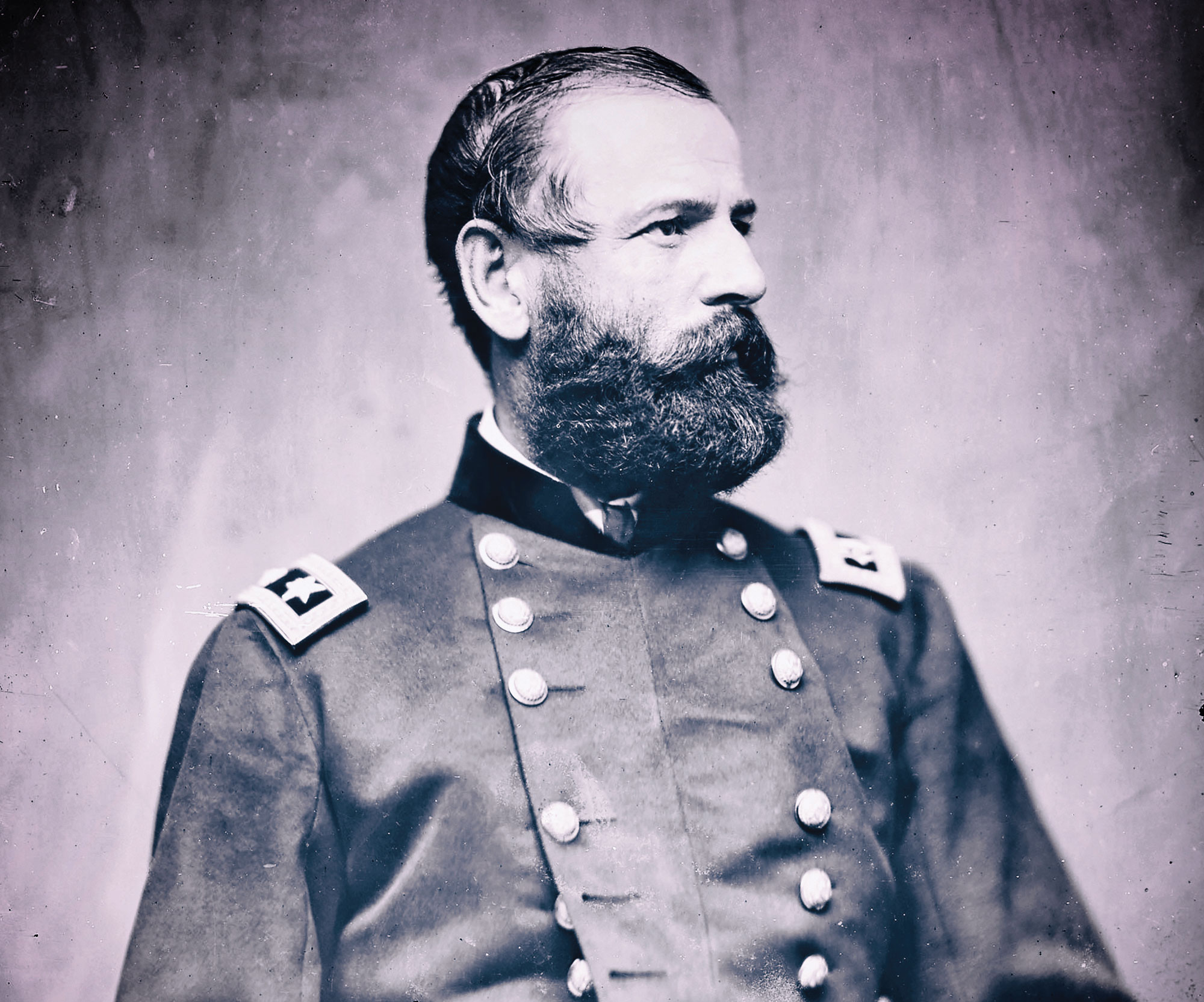
Major General Fitz John Porter
In early September 1862, as John Pope led his battered Army of Virginia back to the outskirts of Washington, he began looking for someone to blame for his disastrous defeat at Second Bull Run.
He already suspected that George McClellan had deliberately delayed coming to his aid, jealous that President Lincoln had ordered him to abandon his Peninsula Campaign and start sending his troops to Pope’s “rival” army, one corps at a time. With a hint from the president, Pope took special umbrage at McClellan’s closest confidant, Fitz John Porter, who had not followed Pope’s order to mount a particular attack during the fighting of August 29. The president showed Pope dispatches Porter had written to Ambrose Burnside in the days before—messages that dripped with sarcasm about Pope’s capacity as a general.
Burnside, who was commanding Union forces at Fredericksburg during the campaign, relayed Porter’s dispatches to Washington after Confederates cut Pope’s telegraph lines to the capital. Porter, who assumed he was only writing to his and McClellan’s old friend Burnside, described the confused movements of Pope’s army with bitterly ironic reference to some of Pope’s more arrogant public remarks about the Army of the Potomac. Pope had, for instance, dismissed concerns over “lines of retreat” and “bases of supplies,” in indirect criticism of McClellan’s well-known caution. “Let us study the probable lines of retreat of our opponents,” Pope had said, in addressing his new army, “and leave our own to take care of themselves.” After the Rebels seized Pope’s supply base and interrupted his communications with Washington, Porter remarked that “Our line of communication has taken care of itself, in compliance with orders.” As justified as the critical nature of those dispatches might be, their tone suggested to Pope (and perhaps to Lincoln) that Porter had secretly wished to see Pope defeated.1
 National Archives
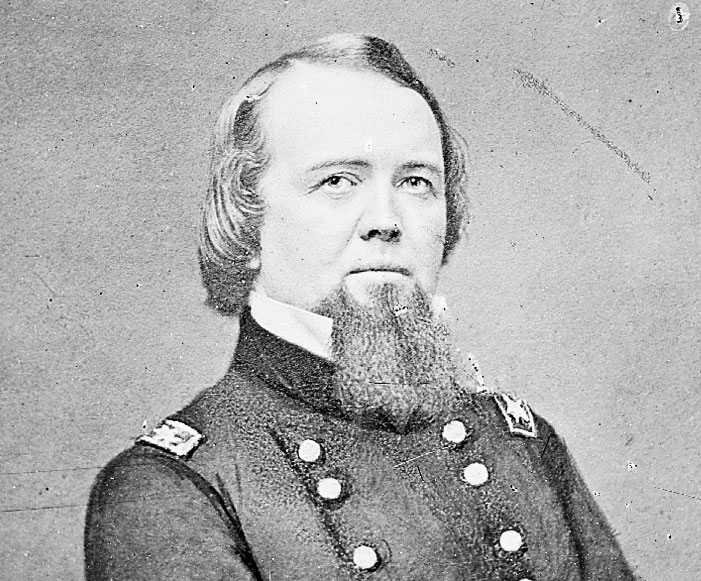
 John Pope
While Pope eventually presented several examples of Porter allegedly subverting him through active disobedience or dilatory movements, his principal accusation involved Porter’s behavior on the afternoon of August 29. Pope and most of the Army of Virginia contended with Thomas J. “Stonewall” Jackson on the Union right that morning as Porter marched toward the Union left, leading his corps of the Army of the Potomac and Rufus King’s division of Irvin McDowell’s corps. He encountered the harbingers of James Longstreet’s Confederate corps, and was deploying his troops to advance against them when McDowell arrived and remonstrated that they were too far from supporting troops. McDowell then rode away, leaving Porter waiting for him to plug the gap with King’s division—which he never did. Porter skirmished with Longstreet the rest of the afternoon, trying to coordinate his actions with McDowell, who never responded to any of his messages. Finally Porter received an order from Pope himself, headed at 4:30 p.m., instructing him to attack, but by the time it reached Porter’s leading division it was so near dark that he called it off.
The president ordered an investigation into Porter’s conduct. By then, Robert E. Lee’s Confederate army was crossing into Maryland, and Lincoln needed McClellan to lead the Army of the Potomac against it, while McClellan insisted that he needed Porter. The investigation sputtered out while McClellan followed the enemy over South Mountain and brought Lee to bay along the banks of Antietam Creek.2
Meanwhile, Pope’s accusations were already molding public opinion through the press. The Chicago Tribune, a Republican paper hostile to McClellan and those around him, harped particularly on Pope’s claim that Porter had sat stubbornly idle at the moment he was most needed. George Smalley, a New-York Tribune correspondent whose Radical Republican bona fides included a close association with abolitionist Wendell Phillips, evidently followed the Army of the Potomac into Maryland with Pope’s version of Bull Run in mind.3
Smalley’s melodramatic account of Antietam attracted wide readership, including his imaginings of what passed between McClellan and Porter in an exchange Smalley implied he had witnessed. According to Smalley, a courier from Burnside galloped up asking for reinforcements, and McClellan glanced at Porter’s “15,000 troops … fresh and only impatient to share in this fight,” then gave Porter a “half-questioning look.” Smalley depicted Porter shaking his head, at which McClellan purportedly turned to Burnside’s messenger and said he had no infantry.
 Library of Congress
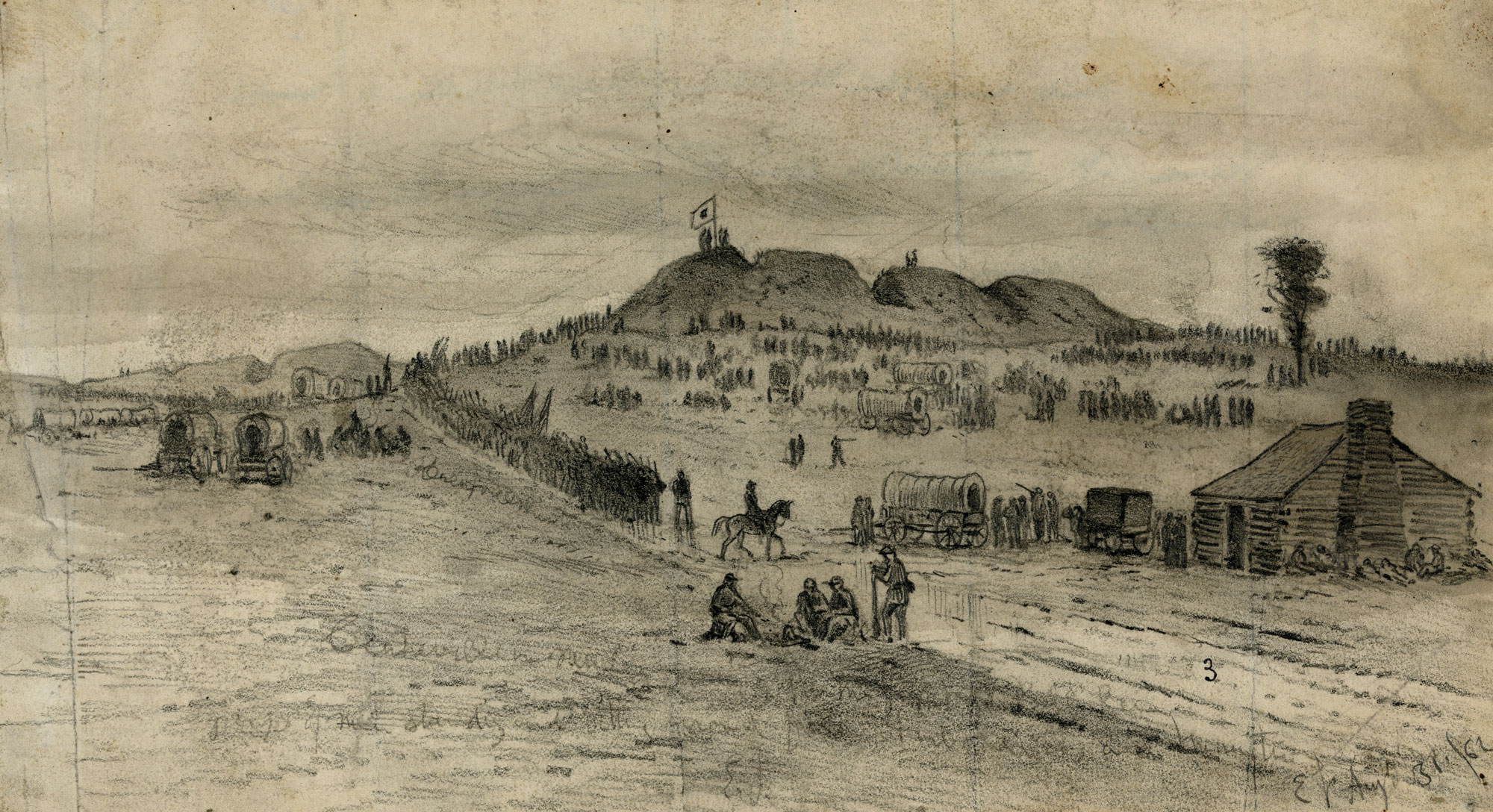
In the wake of Confederate victory at Second Bull Run, Army of Virginia commander John Pope made corps commander Fitz John Porter a scapegoat for his defeat. Above: In a sketch by Edwin Forbes, Pope’s soldiers retreat after the battle.
If Smalley even saw such an encounter involving Porter and McClellan, rather than patching together an extemporized “observation” from interviews with staff officers, he added some invention and speculation before filing his story. At the time Burnside’s appeal reached McClellan, Porter had fewer than 4,000 uncommitted troops left in his corps, instead of the 15,000 Smalley insinuated. Meanwhile, Smalley put quotation marks around his interpretation of Porter’s shake of the head: “They are the only reserves of the army; they cannot be spared.” Employing gross exaggeration and biased guesswork, Smalley created a legendary vignette of dubious authenticity that has clung to Porter’s story for 160 years, and may have influenced decisions about him in Washington.4
Early in November, as McClellan turned the army back into Virginia and struck for Richmond, President Lincoln removed him from command. Porter was relieved as head of the V Corps in the same order and called to Washington, where he was soon hauled before a court-martial and charged, ultimately, with disobedience of orders and misbehavior before the enemy. General in Chief Henry Halleck signed the order for the court, but a War Department insider deduced that Secretary of War Edwin Stanton had selected its officers—with the obvious aim of ensuring conviction.5
Most members of the court harbored at least one motive for finding Porter guilty. Major General David Hunter, a devoted Radical Republican who scorned the conservative ethic Porter represented, would preside. Brigadier General James A. Garfield, a political protégé of Treasury Secretary Salmon P. Chase (and at the time a long-term guest at Chase’s house), imbibed Chase’s deep mistrust of McClellan and his adherents. Chase also invited McDowell to his home, where McDowell convinced Garfield of Porter’s guilt; Garfield never publicly admitted his preconceived opinion, nor did he recuse himself.6
Brigadier Generals Silas Casey and Benjamin Prentiss also sat on the court. Casey had been removed from command of a division in Porter’s corps at Porter’s request, and both the president and Stanton were aware of Casey’s bitterness over it.7 Prentiss, like Hunter, was conspicuously hostile to conservatives.8
Brigadier Generals James Ricketts and King had performed poorly at Second Bull Run themselves (two of King’s officers accused him of drinking heavily during the battle), and convicting Porter might cover their own mistakes.9 Brigadier General John P. Slough was, according to a schoolmate, “a warm personal friend of Secretary Stanton,” and Stanton wanted Porter ruined as a judgment on McClellan and his influence.10
 USAHEC (Stanton); Library of Congress
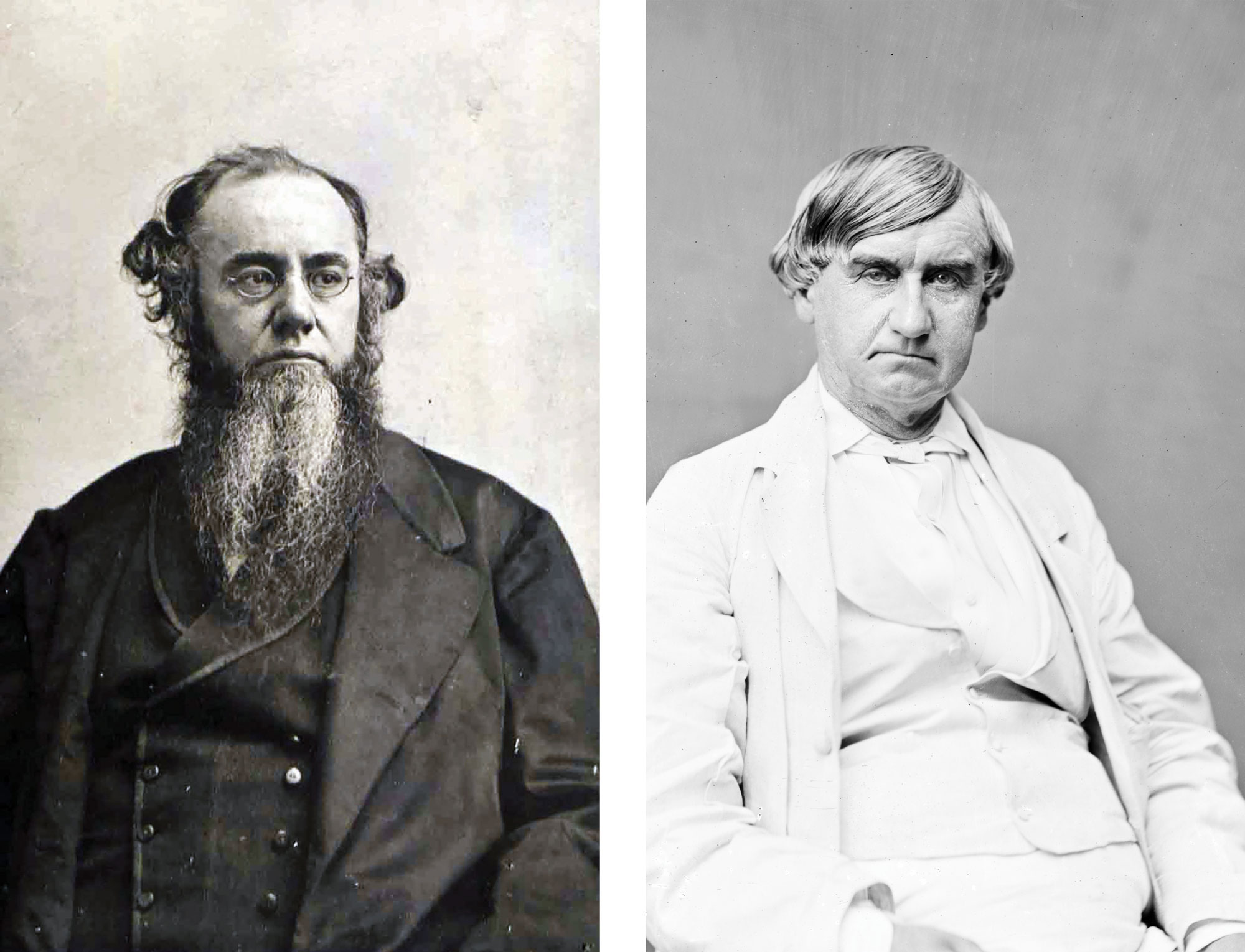
Most members of the court at Porter’s trial harbored at least one motive for finding him guilty, while the government prosecutor, Joseph Holt (pictured at right), was a crony of Secretary of War Edwin Stanton (left), who was determined to see Porter convicted.
Stanton and his collaborators sought to sway the only two presumably unprejudiced court members. Halleck showed Major General Ethan Allen Hitchcock correspondence that seemed to incriminate the McClellan faction generally—probably in the imagined conspiracy to avoid winning complete victory on the battlefield, in hopes that a negotiated peace might salvage slavery. Chase, meanwhile, buttonholed Brigadier General Napoleon Buford. Stanton also worked on Hitchcock and Buford, inviting both to his home for Thanksgiving dinner just as the court convened.11
Joseph Holt, a crony of Stanton’s from the Buchanan administration, would serve as government prosecutor. The post of judge advocate general had been created in July for another man, but Stanton had summoned Holt to his office the day Congress authorized it, and he had since delayed naming anyone for the appointment. On the same day that Pope’s accusations raised a prospect of bringing charges against Porter, if not McClellan as well, the president installed Holt—almost certainly on Stanton’s recommendation.12
The trial began on December 3, 1862. Porter and his defense team, Reverdy Johnson and Charles Eames, were surprised to find the court-martial charges signed by Brigadier General Benjamin S. Roberts, of Pope’s staff. Until then, Pope had been recognized as the complainant, and the Articles of War required the president to appoint the members of any court-martial convened to consider charges filed by the commander of an army. To avoid having the makeup of the court challenged, and run the risk of Lincoln appointing any truly objective members, the prosecution had slyly chosen Roberts as Pope’s surrogate.13
Roberts had resigned from the army in 1839, thereby avoiding court-martial for misappropriating federal funds. During the Mexican War he was reappointed, and another court-martial dismissed him for fraud and conduct unbecoming an officer for repeatedly lying to his superiors. He nevertheless won prompt reinstatement through political influence.14 Roberts and Lieutenant Colonel Thomas C.H. Smith, another Pope staff officer, were abetting their chief in the case against Porter, and Pope played along with the fiction that Roberts was the accuser. Pope had sworn privately that he would press charges, and before a congressional committee he later took credit for bringing Porter “to justice,” but under oath he told the court-martial that he had nothing to do with the prosecution.15
Holt needed a court as biased as Hunter’s to be sure of convicting Porter. Johnson and Eames pointed out that the signature of a staff officer carried the authority of his chief, but Holt disputed that objection, and the court took his side—as it would on every question thereafter. Johnson eventually characterized the court’s decisions on evidence as “so superlatively absurd as to almost destroy every hope of justice.”16
In hopes of finding guilt somewhere, Holt cited numerous transgressions, sometimes crafting several charges for one alleged offense. He accused Porter of violating two different Articles of War and listed nine individual specifications, any of which might have warranted the death penalty.
First, he accused Porter of violating the 9th Article of War for disobedience in the face of the enemy. One specification held that Porter had not begun his march to join Pope at the appointed hour. Two others accused him of disobeying a “joint order” to him and McDowell that directed them to march to Gainesville on August 29 and intercept what Pope misinterpreted as Jackson’s retreat. McDowell had not obeyed that order, either, and had departed further from it than Porter did, but he was not charged. Two more specifications alleged that Porter had disobeyed an order to join Pope with his command on August 30, simply because two brigades of that command took a wrong turn and lost their way; each brigade’s mistake was listed as a separate act of “disobedience.”
The second charge, the 52nd Article of War, alleged misbehavior before the enemy. Once again Holt contrived multiple specifications from the single charge that Porter failed to undertake an assault that Pope had called for in the 4:30 p.m. order of August 29. The first specification merely noted that the attack had been ordered and that Porter had not made it; the second declared, inaccurately, that when ordered to attack, Porter had instead retreated. A third specification exaggerated the falsity of the second, charging that Porter had “shamefully” retreated all the way to Manassas Junction.
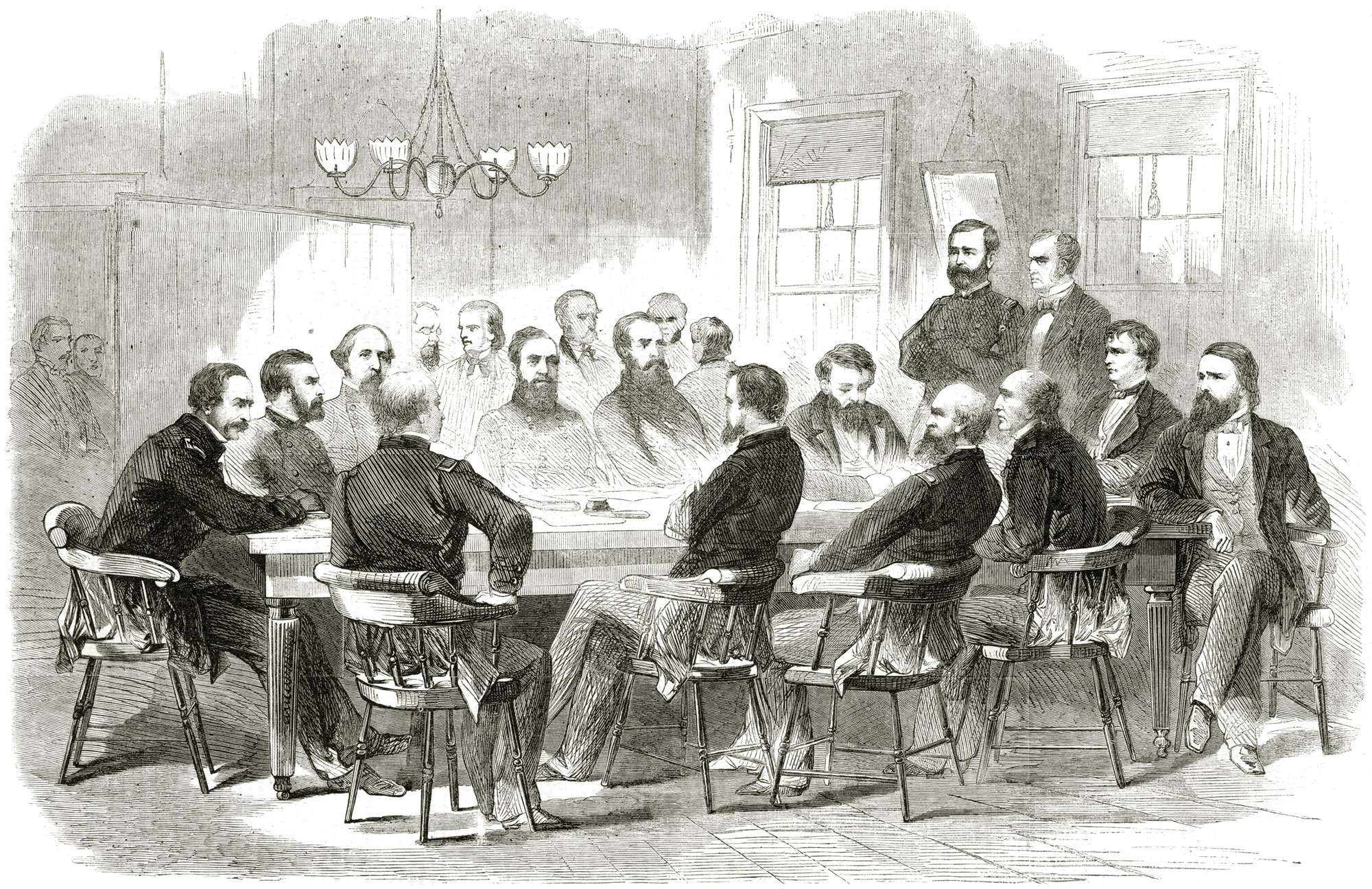 Harper’s Weekly
This sketch of Porter’s court-martial from Harper’s Weekly shows the members of the court seated at a table, with presiding member David Hunter at far left and John Pope at far right. Porter and his lawyer Reverdy Johnson stand in the background at right.
Holt’s most preposterous specification claimed that Porter waited too long and deployed too little force on August 30, when he attacked Jackson’s line at the Deep Cut. The implication, in spite of Porter’s heavy casualties in that fight, as well as his prominent part in resisting Longstreet’s flank attack, was that he meant to give Jackson the advantage. Holt had evidently concocted that canard only as propaganda for the newspapers, because he said he would offer no proof for it—a trick that allowed the press to publish the accusation, but robbed the defense of any opportunity to rebut it.17
Pope took the stand the next day, complaining of Porter’s failure to respond to the 4:30 attack order. Holt asked what the probable results would have been had Porter obeyed it, and although it was clear Pope knew little or nothing about affairs on Porter’s front, he declared “we should have destroyed the army of Jackson.”18 Once Holt handed him over for cross-examination, though, Pope ran into trouble. Johnson asked why, if Pope was so sure Porter’s disobedience had squandered a victory, he had not filed charges promptly, as the Articles of War required. Forced to choose between conceding that he was negligent in his own duty, or admitting that the accusations were really his after all, Pope saw he was cornered and refused to answer.19
Hunter came to his rescue, ordering everyone out of the room but Holt and the court. After secret deliberations the proceedings resumed, and Holt announced that the court had found the question irrelevant, ruling that it would not be answered. Porter’s lawyers submitted a written objection, insisting that Pope’s credibility depended on the answer: If he really believed Porter had lost the battle through disobedience, he was criminally negligent in not filing charges at the time. Hunter emptied the room again to consider the objection, but he recessed court for the day before reaching a decision.20
Overnight, Holt and Pope came up with an explanation. When he took the stand the next day, Pope asked to answer the supposedly irrelevant question, and Hunter called another closed-door conference. Holt may have offered the generals the substance of Pope’s intended response, which might blunt Johnson’s point and still weigh against Porter. The court agreed to hear it.21
Claiming a refreshed memory, Pope testified that immediately after the battle he had accepted Porter’s explanations for his digressions from Pope’s orders. Once back in Washington, however, Pope had reported to President Lincoln, who showed him Porter’s contemptuous dispatches to Burnside. They “opened my eyes,” Pope maintained, and convinced him that Porter had squandered the victory on purpose. He had not overlooked Porter’s disobedience, he asserted, because the official report he submitted at the time had given the government everything it needed for prosecution.
“I have not preferred charges against him,” Pope said. “I have merely set forth the facts in my official reports.”22 With the help of Holt and Hunter, Pope escaped more easily than an unbiased judge might have allowed.
To discredit Pope’s insistence that Porter could have crushed Jackson with a prompt attack, Johnson next exposed Pope’s ignorance of conditions on Porter’s part of the battlefield. He could not even locate Porter’s troops on a map, although he insisted that Porter had faced no serious enemy force. If enemy dispositions had made an attack injudicious, Johnson asked, would Pope have considered Porter disobedient for failing to comply with the attack order? A member of the court raised an objection, and the court disallowed the question because Johnson was requesting an opinion.23
That decision flew directly in the face of the court’s willingness to hear Pope’s opinion the day before, and it denied the defense the right to challenge one opinion with another. The contradiction comported with the tone of the entire trial, in which opinions damaging to Porter’s case were welcomed without exception, while those detrimental to the prosecution were invariably disallowed. Relatively cursory newspaper coverage of each day’s events failed to convey that glaring inconsistency to the public.24
“Benny” Roberts, as his more disdainful fellow officers called him, took the stand after Pope. He, too, knew nothing of the terrain or enemy presence in Porter’s sector on August 29, but Holt still asked him what would have happened had Porter obeyed Pope’s 4:30 order to attack. On a prompt objection from Porter’s attorneys Hunter again took the court into secret session, but with unblushing hypocrisy the court ruled this opinion relevant, and Roberts performed as expected.
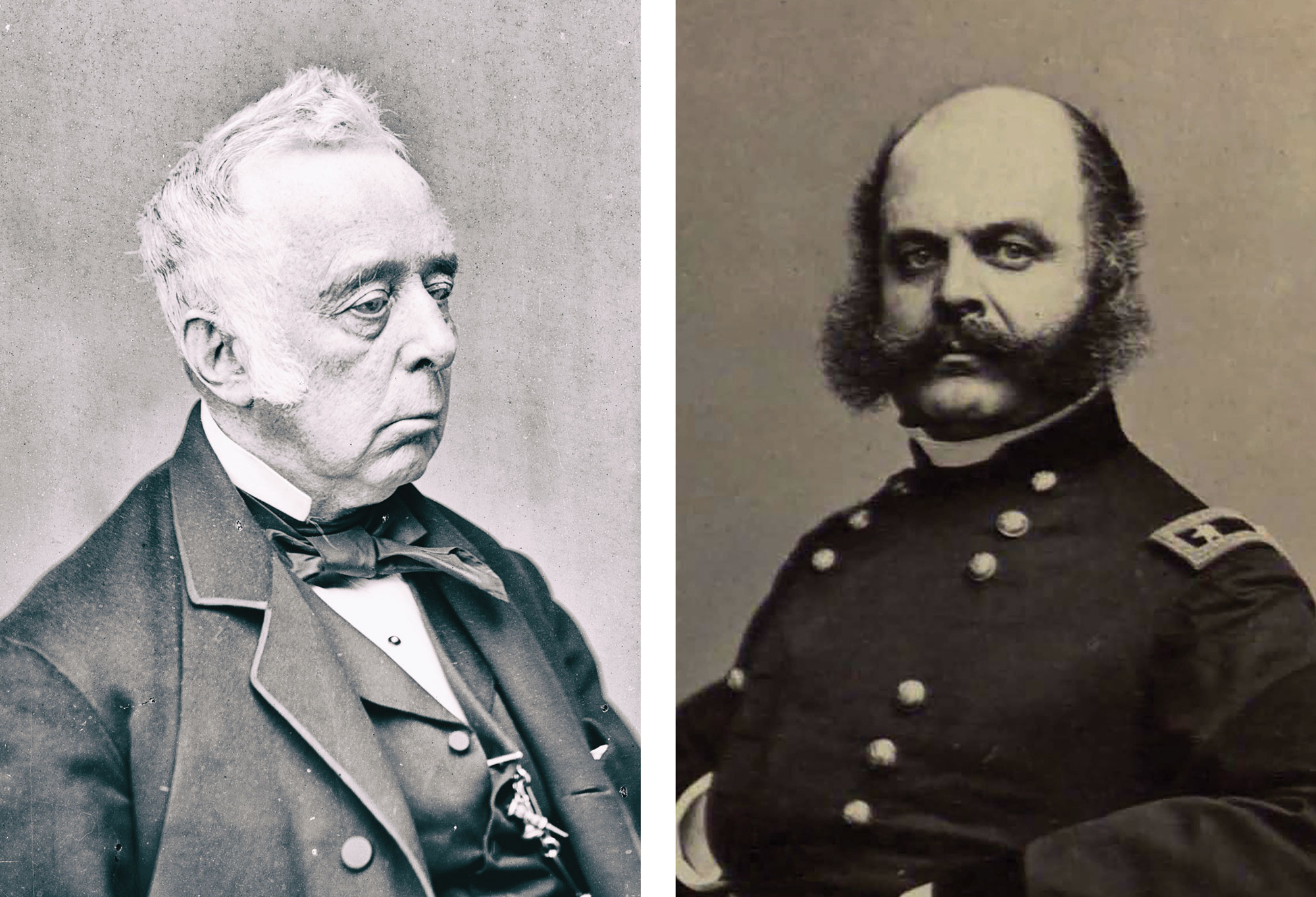 Library of Congress (Johnson), USAHEC (Burnside)
Reverdy Johnson (left) and Ambrose Burnside
“I do not doubt at all,” he replied, “that it would have resulted in the defeat, if not in the capture, of the main army of the Confederates that were on the field at the time.” Later he added that Porter should have attacked well before 4:30, even without orders. Yet, until the 4:30 order reached him, Porter was operating under Pope’s joint order, which directed Porter and McDowell to try to intercept Jackson but also cautioned them to be ready to withdraw across Bull Run that evening. Eames asked if that did not explain Porter’s failure to attack earlier in the day. The question undermined Roberts’ last accusative assertion, but a member of the court objected that Eames was asking for an opinion, so the question was not allowed.25
Interjecting court members were not named in the trial transcript, but Garfield was probably the source of most such objections. Porter told a former staff officer at the end of the proceedings that Garfield “played the part of Judge Advocate.”26
Captain Douglass Pope, the general’s nephew and aide, tried to establish that Porter had received the 4:30 attack order when there was still enough daylight to make the assault. He testified that he delivered the order to Porter “by 5 o’clock,” although a division commander and two staff officers in Porter’s corps swore that it arrived about an hour and a half later. Holt tried to corroborate Captain Pope’s testimony with that of a courier who said he had accompanied the captain, but that courier was recruited by Pope’s other agent in the prosecution, Smith—who, later investigation revealed, had solicited several men to provide similarly false testimony on that point.27
Smith himself gave the most outrageous evidence in the entire court-martial. Recounting his first and only meeting with Porter, he told the court that within a few minutes’ conversation he was convinced that Porter was a traitor. Alluding to Porter’s remark that he had not received a supply of ammunition he had requested, Smith portrayed his manner as “sneering,” and concluded from it that Porter meant to “fail” Pope.
“I had one of those clear convictions,” Smith said, “that a man has a few times, perhaps, in his life, as to the character and purposes of a person whom he sees for the first time.” He added immediately that he warned Pope “I was so certain that Fitz John Porter was a traitor, that I would shoot him that night, so far as any crime before God was concerned, if the law would allow me to do it.”28
Holt then inquired of Smith, a political appointee with no previous military education or experience, what the result would have been if Porter had launched an attack late in the afternoon on August 29. Porter’s defense team reflexively objected to this request for yet another opinion, but the court decided that the question should be answered, even after Smith admitted that he knew nothing of the situation Porter faced. Despite that admission, he declared that an attack would have sent the Confederates into headlong flight.29
Porter’s lawyers paid particular attention to Smith’s boasted clairvoyance about Porter’s manner. He had said Porter remained courteous throughout their interview, and the defense wondered how he could reconcile that with his recollection of Porter’s “sneering.” Smith ignored the question, merely reiterating that Porter betrayed “a sneering, indifferent manner and tone.” Ultimately he conceded that Porter’s sneering “was somewhat suppressed,” yet said it still convinced him that “General Porter was determined so far not to cooperate as to force us back to Washington.” Even Porter’s facial expression betokened treason, Smith contended, saying the general looked like “a man with a crime on his mind.”30
Along with the alleged prediction that Porter would “fail” Pope (offered by the convicted liar Roberts), Smith’s bizarre depiction of a vaguely incriminating manner added ammunition to Holt’s smoking gun—which consisted of Porter’s wry dispatches to Burnside. Like many others, Porter did despise Pope’s arrogance and doubted his competence, and Holt would forge that into an argument that he deliberately worked to assure Pope’s defeat.
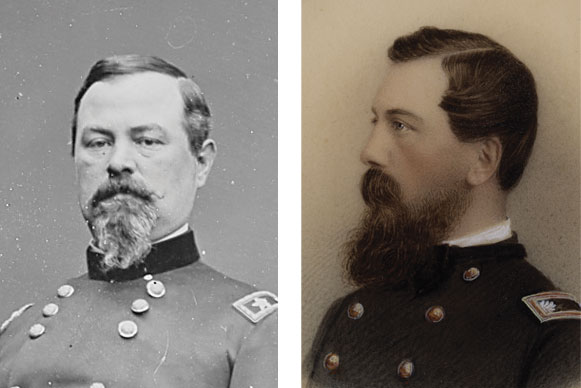 National Archives (McDowell), Library of Congress (Locke)
Irvin McDowell (left) and Frederick Locke
McDowell took the stand to recount his meeting with Porter on the Union left, around the middle of the day on August 29. Porter was then deploying for an advance against part of Longstreet’s corps. As the senior officer, McDowell held command on that part of the field because Pope was not present and his whereabouts were unknown; McDowell persuaded Porter to hold off his attack, but would not admit as much on the stand. Witnesses for Porter later testified that McDowell discouraged Porter’s assault, but McDowell made it appear that Porter was the one who hesitated to fight. His extraordinarily selective memory of the incident led an officer from Porter’s staff to charge that what McDowell told the court was “directly opposite to what he said to General Porter at the time.” McDowell could not “recollect” telling Porter he was “too far out” from supporting troops for an attack, as some officers testified he had; nor could he “recollect” advising Porter to stay where he was and wait for McDowell to fill the gap with King’s division. On the contrary, McDowell implied that he expected Porter to advance in any case. No other witness supported McDowell’s narrative, even from his own staff, while Porter supplied witnesses who contradicted McDowell altogether.31
As was now routine, Holt asked what would have happened had Porter attacked. The defense had given up objecting to the court’s studiously inconsistent rulings, so McDowell promptly obliged by saying “I think it would have been decisive in our favor.” Even he recognized that his reply was “a mere opinion,” but it was the type of opinion coveted by the court, which by now was clearly in league with Holt.32
Porter’s chief of staff, Lieutenant Colonel Frederick Locke, testified that McDowell advised Porter to hold fast while McDowell led King’s division to the open ground on Porter’s right. McDowell had abruptly ridden away from his meeting with Porter, leaving no instructions, and at Porter’s behest Locke rode back to King’s division, to have it await further orders. Going back, Locke found McDowell standing with an officer he did not know, and he asked the stranger if he were King. On receiving an affirmative nod, he delivered the message, whereupon that officer gestured to McDowell as the man who should have it. Locke repeated it to McDowell, who told him he was taking King’s division with him, and Porter should “remain where he is,” although if pressed heavily he could “fall back … upon my left.” With that, McDowell started King’s division away toward Porter’s right, although he never deployed in the void there.33
McDowell did not categorically deny Locke’s story, but as usual he could not “recollect” it. He did not remember seeing King at all that day, although King himself let it slip that they had met that morning. King, who of course sat right in front of Locke as a member of the court, eventually claimed not to recall the incident, either, although he doubted it could have slipped his mind. He had been relieved of duty August 29 for what was later speculated to have been epileptic seizures, although one of his brigade commanders and one of his own staff officers independently reported that he had been drinking hard for days. Having just been relieved of command might account for King deferring to McDowell, and epilepsy or drunkenness could have explained an inability to remember the encounter.34
There was, however, something suspicious in how long King waited to dispute Locke’s testimony. For dramatic effect, and perhaps with adequate coaching as well, Holt waited until the defense rested, 10 days later, to call King to testify that he did not remember meeting Locke or receiving any such order. Locke came back to the courtroom to reaffirm his testimony, positively identifying King as the man he had found with McDowell and reasserting that McDowell had given him what Locke considered an order for Porter to stay put.35
Locke had obviously not expected either McDowell or King to deny his meeting with them, let alone for both to do so. It would have made no sense for him to tell such a tale to save his chief, if outright denials had been anticipated, and especially from a member of the court itself. That logic had no evident effect on the other court members’ evaluation of the competing testimony, nor did they appear to accord even equal credibility to Locke’s unequivocal certainty against the prosecution witnesses’ professed inability to recall.
 Harper’s Weekly
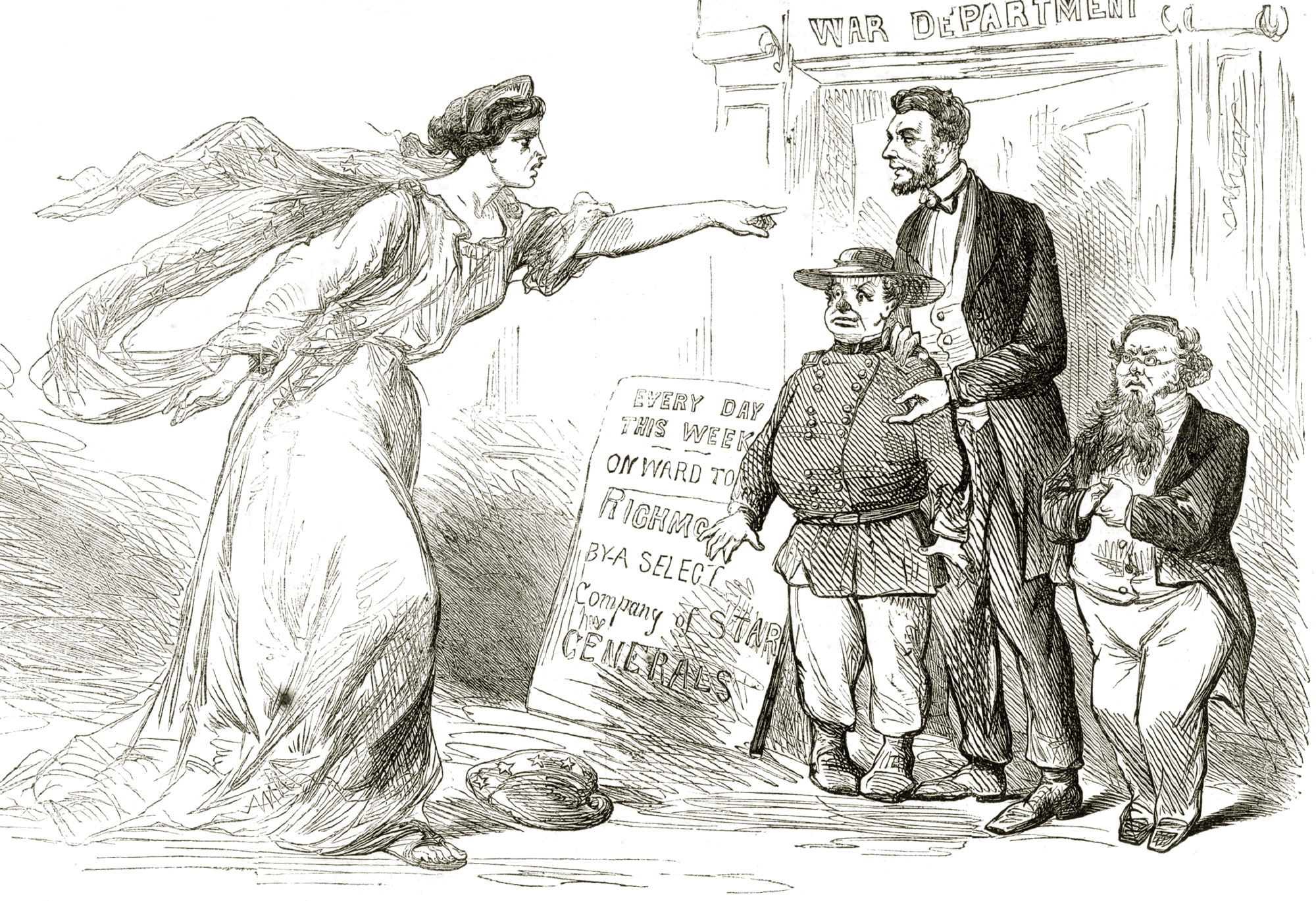
In early January 1863, Harper’s Weekly published this cartoon of an angry Columbia pointing at Henry Halleck, Abraham Lincoln, and Edwin Stanton and demanding, “Where are my 15,000 Sons—murdered at Fredericksburg?”
Burnside’s army had suffered a bloody defeat at Fredericksburg while McDowell testified, arousing a louder chorus of criticism against the Lincoln administration than after Bull Run. Whenever the White House interfered in military operations, disaster had seemed to follow. Pulling McClellan’s army from the outskirts of Richmond to reinforce Pope had preceded ignominious defeat, and removing McClellan from command had enabled Burnside’s costly calamity on the Rappahannock. Early in January public outrage reached a crescendo, and a searing cartoon in Harper’s Weekly showed Columbia pointing accusatively at the quavering Lincoln, Stanton, and Halleck, demanding of them “Where are my 15,000 Sons—murdered at Fredericksburg?”36
Two days after that cartoon appeared, Stanton sent Hunter a note directing him to bring the trial to an end, “without any unnecessary delay,” on the grounds that “the state of the service” demanded it. That unusual directive reflected Stanton’s impatience for the conviction he probably expected, so at least the previous summer’s battlefield failures could be credited to Porter’s treachery instead of administration incompetence.37
The defense presented a lengthy summation five days later. Garfield wrote a letter to his mother during the reading of it, and other members of the court may also have paid as little attention. The overt bias in the rulings on objections and evidence offered all the proof Holt needed to be certain of the verdict, and with consummate confidence he declared he would avoid delay by offering no summary for the prosecution. With that remark, the government’s presentation ended.
The court then retired for deliberation, quickly finding Porter guilty of all charges and specifications except those about the two wayward brigades. The record contains no hint that the death penalty was ever discussed; conviction alone sufficed to relieve the administration and John Pope from any responsibility in Pope’s disastrous campaign. Such heinous crimes did demand dismissal, however, and at the suggestion of one court member Porter was also barred from ever “holding any office of trust or profit under the Government of the United States.”38
The Articles of War provided no means of appealing the decision of a court-martial. The judge advocate general and the president each had to review the record for fairness and errors, and either could reject the punishment, verdict, or both, but with their approval the defendant’s fate was fixed. A handwritten 900-page transcript of the trial was therefore delivered to the White House, along with the court’s decision. Lincoln instructed Holt to “revise” the record, meaning that he should first “review” it, and summarize his opinion of the case.39
Ordinarily, in the new position as judge advocate general, Holt’s review would have scrutinized the prosecutorial conduct of a judge advocate serving under him. In Porter’s trial he had assumed that role himself, so any errors or misconduct would be his own, and Holt was the sort of man who did not concede a mistake unless it was the only alternative to admitting outright malfeasance. His participation in the trial should have disqualified him from reviewing the case, even if his determination to reach a conviction could be ignored, but Lincoln gave him the task anyway. Rather than a balanced outline of the facts as they were developed, and the points made by either side, he gave the president the jaundiced closing argument that he—as prosecutor—should have presented to the court. Lincoln would see no portion of the summation for the defense that Holt did not ridicule or contradict, often by misrepresenting the evidence or “improving” on the testimony of prosecution witnesses.40
From the beginning, Holt had known how angry Lincoln was about Porter’s disparaging tone toward Pope in the messages to Burnside, and he opened with the “animus” reflected in those dispatches. He emphasized that Roberts and Smith had foreseen that Porter would “fail” Pope, focusing especially on Smith’s telepathic recognition of Porter as a traitor. In all seriousness, Holt offered Smith’s portrait of Porter looking like “a man having a crime on his mind” as a piece of compelling evidence, dignifying Smith’s ridiculous assertions as an “intercommunication of spirits.” He exaggerated McDowell’s testimony to enhance the appearance of guilt, and listed all the hostile, solicited opinions of the triumph Porter would have won had he attacked the enemy as Pope wished.41
Holt was also aware, through Lincoln’s close friend Joshua Speed, how gullible the president could be. Speed had assured him that Lincoln was “so honest himself that he is slow to believe that others are not equally so.” That was a piece of information someone like Holt would be inclined to remember, and use.42
Gullibility may have helped Lincoln accept Holt’s relentless diatribe as a fair summary of the case, too, but the president also labored under abundant bias. In September he had found Porter’s dispatches to Burnside so aggravating that he had shown them to Pope, as though to provoke a complaint. He had been the first to order an investigation into Porter’s conduct at Bull Run. Then, just as the case was coming to trial, Lincoln had confided to a visiting senator that he considered Porter guilty.43
The court’s obvious antagonism toward Porter, as manifested in the utterly hypocritical resolution of objections, should have rung alarms for Lincoln had he examined the actual transcript. The defense summary, buried in that bushel box of manuscript pages, might have shone a new light on the case, but it would have been difficult to find and tedious to digest; Roberts and Smith had had all the prosecution testimony printed in a fat, handy pamphlet, and Holt may have provided the president with a copy, but there was nothing similar for the defense. Given the demands on his time, Lincoln probably confined himself to Holt’s antagonistic synopsis, but that alone should have aroused the suspicion of any fair-minded reader with Lincoln’s legal experience—especially with the weight Holt and the court had accorded Smith’s claims of precognition and mindreading.
Unfortunately, the president lacked any incentive for finding fault with the verdict, which offered enticing political benefits. Attributing the defeat of the Army of Virginia to Porter’s willful disobedience cleared Pope of blame, which also acquitted Lincoln of any mistake in selecting Pope to lead that new army. Depicting Porter as disloyal tainted the whole McClellan coterie with sedition, which might exonerate the president for having removed that popular general from command. Such broad administrative absolution must have seemed irresistibly inviting in the wake of Burnside’s stunning loss.
As Lincoln thumbed through Holt’s damning review of the trial, the Army of the Potomac embarked on its ill-fated Mud March. Only four days later the president would have to concede the failure of yet another general. He probably already anticipated that eventuality, which would further undermine confidence in his own leadership. The final obligation to assess the justice of the court-martial fell to Lincoln, yet he had more to lose than anyone if he overruled the verdict, as he surely understood when he signed the document that ruined Porter’s career.44
John Pope retired from the army on a pension in 1886. He spent many years trying to block and undermine Fitz John Porter’s appeals for a rehearing, often in league with Joseph Holt and James Garfield, for whom a close reexamination of the case might prove unflattering. The effort involved falsified maps, deliberately misleading out-of-context excerpts from official documents, and a healthy application of party politics—for Porter was, after all, a Democrat in an era of Republican dominance. In 1879 Porter was completely exonerated by an army review board that recommended his reinstatement, but Pope and his political allies forestalled congressional action on that recommendation for another seven years. Not until three months after Pope retired was Porter finally reinstated in his old Regular Army rank of colonel, without back pay, pension, or compensation for the thousands of dollars he had spent in pursuit of justice. At his death in 1901 he no longer even owned a home.
William Marvel is the author of many books about the Civil War, including a four-volume series on the war from the northern perspective and, most recently, Radical Sacrifice: The Rise and Ruin of Fitz John Porter (UNC Press, 2021).
Notes
1. War of the Rebellion: Official Records of the Union and Confederate Armies (Washington, D.C, 1880-1901), ser. 1, vol. 12 (2, supplement), 840, and (3):474, 699. Hereinafter cited as OR, with all citations from Series 1 unless otherwise indicated.
2. Special Order 222, September 5, 1862, and Henry Halleck’s order for the court to adjourn indefinitely, September 15, 1862, Court Martial Case File MM-51, Records of the Judge Advocate General, Record Group 153, National Archives.
3. Chicago Tribune, September 11, 12, 15, 16, 1862.
4. New-York Tribune, September 20, 1862.
5. Stephen M. Weld, War Diary and Letters of Stephen Minot Weld, 1861–1865 (Cambridge, 1927), 150; Evening Star (Washington, D.C.), November 12, 1862; Daily National Republican (Washington, D.C.), November 13, 1862; OR, 12 (2, supplement), 821. In a memoir of trial incidents, Porter identified Assistant Secretary John Tucker as the War Department official who remarked that the court was “made to convict” (Reel 25, Fitz John Porter Papers, Library of Congress, hereafter cited as FJPP). James B. Fry, who spent most of his career on staff duty at army headquarters, confirmed that Stanton regularly selected reliable or pliable officers for commissions when he wanted a particular outcome. See Fry’s Operations of the Army Under Buell from June 10th to October 30th, 1862, and the “Buell Commission” (New York, 1884), 110.
6. OR, 14:341, Series 3, 2:42–43; Niven, Chase Papers, 1:420–421; Frederick D. Williams, ed., The Wild Life of the Army: Civil War Letters of James A. Garfield (East Lansing, 1964), 141, 148.
7. OR, 51(1):714–715; Porter to “My dear Mac,” undated, Reel 29, FJPP; Roy P. Basler, ed., The Collected Works of Abraham Lincoln, 10 vols. (New Brunswick, 1953-1955, 1974), 5:361, 446.
8. Years later, Prentiss said he never had any doubt of Porter’s guilt (Prentiss to John A. Logan, March 19, 1880, Bound Volume 753, Logan Papers, Abraham Lincoln Presidential Library, Springfield, IL).
9. Beale, Diary of Gideon Welles, 1:110; transcript of William H. Paine Journal, August 29, 1862, Reel 2, FJPP; John P. Hatch to Porter, September 6, 1866, Reel 3, FJPP; OR, 12 (2, supplement): 1035–1037.
10. OR, 12 (2, supplement): 822; U.S. Congress, Committee on the Judiciary, Impeachment Investigation: Testimony Taken Before the Judiciary Committee of the House of Representatives in the Investigation of the Charges Against Andrew Johnson (Washington, 1867), 665.
11. Ethan Allen Hitchcock Diary, November 26–28, 1862, Gilcrease Museum, Tulsa, OK; Porter’s notes on John Buford’s warning about Chase’s prejudicial comments to Napoleon Buford, handwritten chronology (Reel 2) and typescript memoir of trial incidents (Reel 25), FJPP.
12. C.P. Wolcott to Holt, July 9, 18, 1862, Box 34, Joseph Holt Papers, Library of Congress; OR, Series 3, 2:957. Major John F. Lee, a scrupulously evenhanded officer, had been judge advocate of the army since 1849, and the new post had been intended as a promotion for him; Lee quit the army at the affront, and Stanton accepted the resignation with unseemly haste and satisfaction.
13. Revised Regulations for the Army of the United States, 1861 (Washington, 1861), 509; OR, 12 (2, supplement): 827, 828.
14. James W. Schaumburg to Porter, September 23, 1867, and printed proceedings of Roberts’ 1849 court-martial, both Reel 3, FJPP.
15. Pope to Richard Yates, September 21, 1862, and to William Butler, September 26, 1862, Pope Papers, Chicago History Center; Supplemental Report of the Joint Committee on the Conduct of the War, 2 vols. (Washington, D.C. , 1866), 2:190; OR, 12 (2, supplement): 840.
16. OR, 12 (2, supplement): 828; Johnson to Henry Halleck, December 14, 1863, Reel 3, FJPP.
17. OR, 12 (2, supplement): 824–827.
18. Ibid., 829–836.
19. Ibid., 836–838.
20. Ibid., 837–839.
21. Ibid., 839–840.
22. Ibid., 840–841.
23. Ibid., 848–860.
24. Ibid., 834, 841–860.
25. Ibid., 866–869.
26. Porter to Stephen M. Weld Jr., January 16, 1863, Fitz John Porter Papers, Massachusetts Historical Society, Boston.
27. OR, 12 (2, supplement): 875, 947, 957, 972, 1031; Fitz John Porter to Peter Getz, July 7, 1880, Reel 23, FJPP.
28. OR, 12 (2, supplement): 889–890.
29. Ibid., 891.
30. Ibid., 894–895, 899.
31. OR, 12 (2, supplement): 906–911, 955–956; Weld, War Diary and Letters of Stephen Minot Weld, 153.
32. OR, 12 (2, supplement): 906.
33. Ibid., 955–956.
34. OR, 12 (2, supplement):1041–1042; Transcript of William H. Paine Journal, August 29, 1862, Reel 2, FJPP; John P. Hatch to Porter, September 6, 1866, Reel 3, FJPP.
35. OR, 12 (2, supplement):1035–1036, 1046–1048.
36. Harper’s Weekly, January 3, 1863.
37. OR, 12 (2, supplement), 1053.
38. OR, 12 (2, supplement),1049–1051, 1075–1112; Benjamin Prentiss to John A. Logan, March 19, 1880, Bound Volume 753, Logan Papers, Abraham Lincoln Presidential Library, Springfield, IL.
39. OR, 12 (2, supplement), 1052, 1134.
40. Ibid.,1112–1133.
41. Ibid., 1112–1133.
42. Speed to Holt, December 31, 1861, Box 31, Joseph Holt Papers, LC.
43. Theodore Calvin Pease and James G. Randall, eds., The Diary of Orville Hickman Browning 2 vols. (Springfield, 1925, 1933), 1:589.
44. OR, 12 (2, supplement),1052.