 Library of Congress
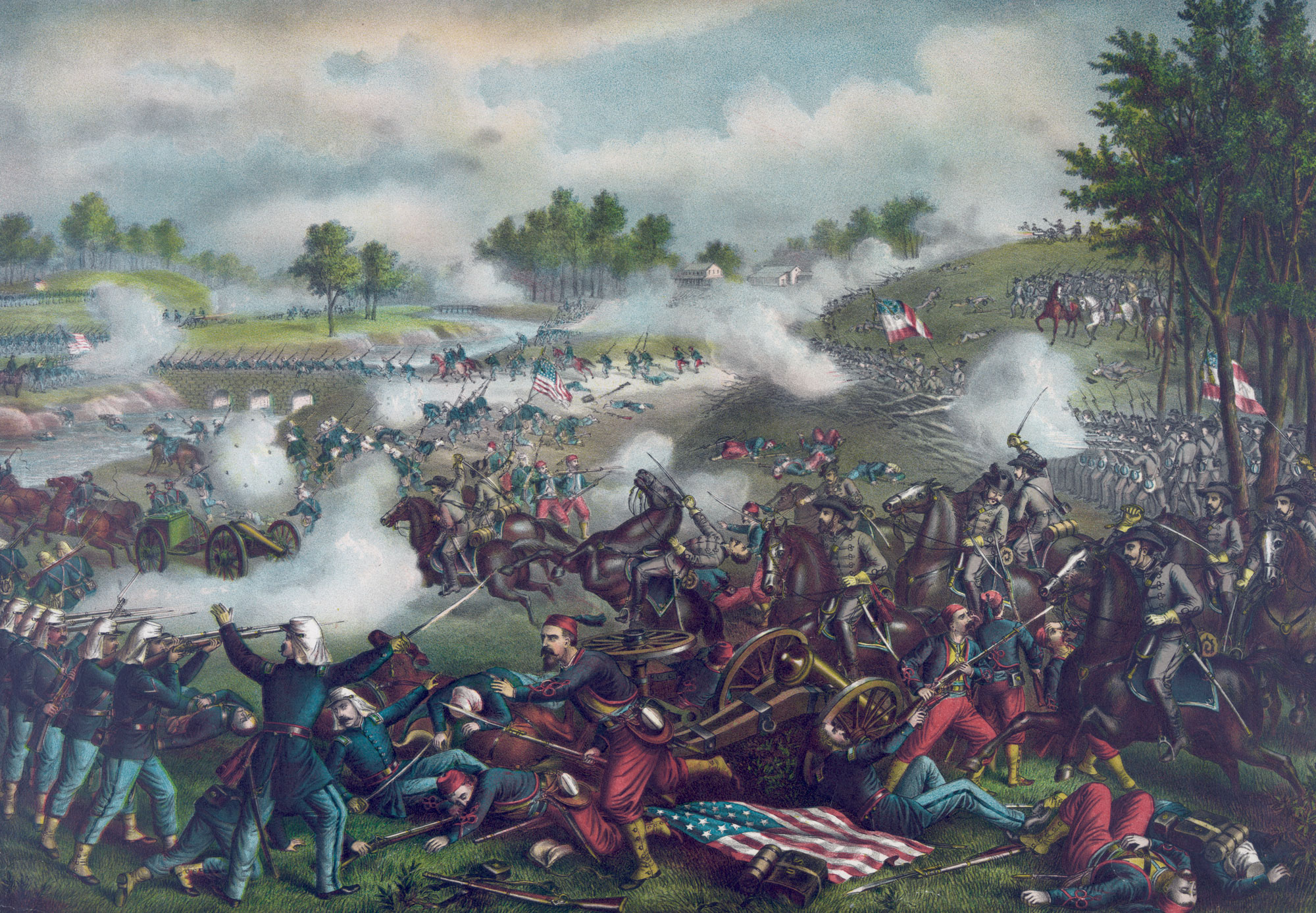
The Battle of Bull Run, fought near Manassas, Virginia, on the morning of July 21, 1861, served as a rude awakening to those in the North and South who were expecting a brief and relatively bloodless conflict.
When the Civil War began in April 1861, very few believed that it would last longer than a year. Many in the North and South thought that a single, climactic battle would provide a decisive victory for their side. Triumph in the recent Mexican-American War, remembered as a relatively short and uncomplicated affair, remained in the forefront of the public and military mind. This new conflict, with the belligerents’ opposing capitals separated by only 83 miles, appeared to lend itself to an even more rapid conclusion.
Ironically, the hero of the war with Mexico, General Winfield Scott, was one of the few influential U.S. figures who anticipated a prolonged, arduous conflict. He warned against a war of conquest and proposed a strategic plan (dubbed the Anaconda Plan by the northern press) that called for a methodical blockade of the South and gaining control of the Mississippi River. The majority of the northern public and U.S. military, however, were not supportive of such a conservative approach. Indeed, military leaders on both sides envisioned a conflict dominated by the strategic offensive. Napoleonic-style clashes on the field of battle—marked by turning movements, bayonet charges, and decisive pursuits—were seen as the preferred methods for victory.
This confidence—or, more accurately, over-confidence—in the prospects for a short conflict was echoed in the northern and southern press. The Chicago Tribune claimed the Confederacy could be defeated in three months at the most, while the Memphis Appeal predicted that the very first clash between the two armies would result in the “final success of our great and glorious cause and of the eventual defeat” of the Union.1 While such opinions were not universal, they were indeed the most common and most vociferous during the war’s first months.
In the weeks preceding the battle at Bull Run, a handful of engagements took place, amounting to little more than skirmishes. Both sides were busy building, organizing, and training their armies. Time, however, worked against the Union. Reacting to mounting political pressure for action and the impending expiration of enlistment terms for 90-day volunteers, President Abraham Lincoln authorized an offensive against the Confederate army positioned in northern Virginia, which posed the most glaring threat to the U.S. capital.
The two armies that met near Manassas, Virginia, on the morning of July 21, 1861, were evenly matched. Each boasted nearly 30,000 troops and were commanded by graduates of West Point with similar military experience—Brigadier General Irvin McDowell for the U.S. and Brigadier General Pierre G.T. Beauregard for the Confederacy. Hundreds of citizens from Washington and the surrounding areas took to the nearby hills overlooking the battlefield to watch what they believed would be the war’s entertaining single act. The atmosphere was one of eager, almost jovial, anticipation. That mood would soon change, however, as the battle raged into the afternoon, when a Confederate counterattack against the Union right flank sparked a frantic U.S. retreat. The retreat quickly turned into a disorganized, confused rout as McDowell’s panicked army streamed back toward Washington. Victorious, but suffering from disorganization itself, the Confederate army did not pursue.
The outcome of Bull Run came as a shock, especially for those in the North. The casualty numbers alone were significant—more than 800 killed and 2,600 wounded from both sides. Never before had as many Americans died in a single day’s battle. And yet, it was the manner in which McDowell’s army lost—disintegrating in panic—that carried the day’s most salient message. This war would not be easy, nor would it be won quickly. It was to be a war of attrition, not annihilation. The strategic and tactical advantage would most often reside with the defender. It would be a bloody war. Although the participants did not know it at the time, the immense destruction and loss of life that awaited them over the next four years would make the optimistic prewar predictions seem tragically naïve.
While the southern press trumpeted the Confederate victory, the newspaper headlines in the North were filled with alarm and doubt. The Philadelphia Press, which before the battle had predicted that the Confederate “ragamuffins” would scatter like “chaff before the wind” when faced by superior U.S. troops, now proclaimed Bull Run a “disaster” that presented “a terrible political problem” for the North.2 Whether the defeat at Bull Run served to galvanize the Union war effort or start the trend of battlefield futility in Virginia that would haunt the Army of the Potomac for another two years, the outlook for the war immediately changed. Those who had been so certain of a short contest now knew they had been wrong. The grueling next four years would prove just how wrong they had been.
Within the story of Bull Run we find a cautious reminder for today. Recent years have seen the emergence of a sort of false confidence expressed by various U.S. military and political leaders in our ability to identify the nature or character of our future wars. Our ongoing campaigns in Iraq and Afghanistan, coupled with the current geo-political climate, have led many to declare with conviction that our military’s foreseeable future will be dominated by similar unconventional, “small war” campaigns. As a result, a great amount of effort has been placed on shaping military organization, doctrine, and academic curriculum to deal specifically with stability and counterinsurgency (coin) missions. In other words, we are banking on the assumption that tomorrow’s wars will look very much like those of today.
This assumption is understandable, but also questionable. To best prepare our military for future wars, we have little alternative but to engage in some strategic forecasting—to identify potential threats and hypothesize how social and military landscapes will develop in the coming years. In doing so, however, we should always keep a wary eye on our history and realize that no level of certainty should be placed on our predictions. Twenty-five years ago, the landmark study America’s First Battles carried the central message that “[t]he record of Americans’ ability to predict the next war…has been uniformly dismal.”3 Despite all the advancements in technology and military organization over the last quarter of a century, there is no evidence to suggest that that ability has improved. Military analysts, strategists, authors of doctrine—and historians—can read the tea leaves of the past and present all they want. In the end, however, our best guess about the next war is still just a guess. As the Battle of Bull Run and its surprising outcome aptly demonstrated, there is no way to know the scope, length, or character of future wars for certain until they arrive.
Clay Mountcastle, a lieutenant colonel in the U.S. Army, currently serves as the Professor of Military Science at the University of Washington in Seattle. He holds a Ph.D. in history from Duke University and is the author of Punitive War: Confederate Guerrillas and Union Reprisals (University Press of Kansas, 2009).
Notes
1. Quoted in Brayton Harris, Blue and Gray in Black and White: Newspapers in the Civil War (Washington, D.C., 2000), 54; The (Memphis) Appeal, June 19, 1861.
2. The Philadelphia Press, July 23, 1861.
3. Charles Heller and William Stofft, America’s First Battles, 1776-1965 (Lawrence, KS, 1986), xii.