 Harper's Weekly
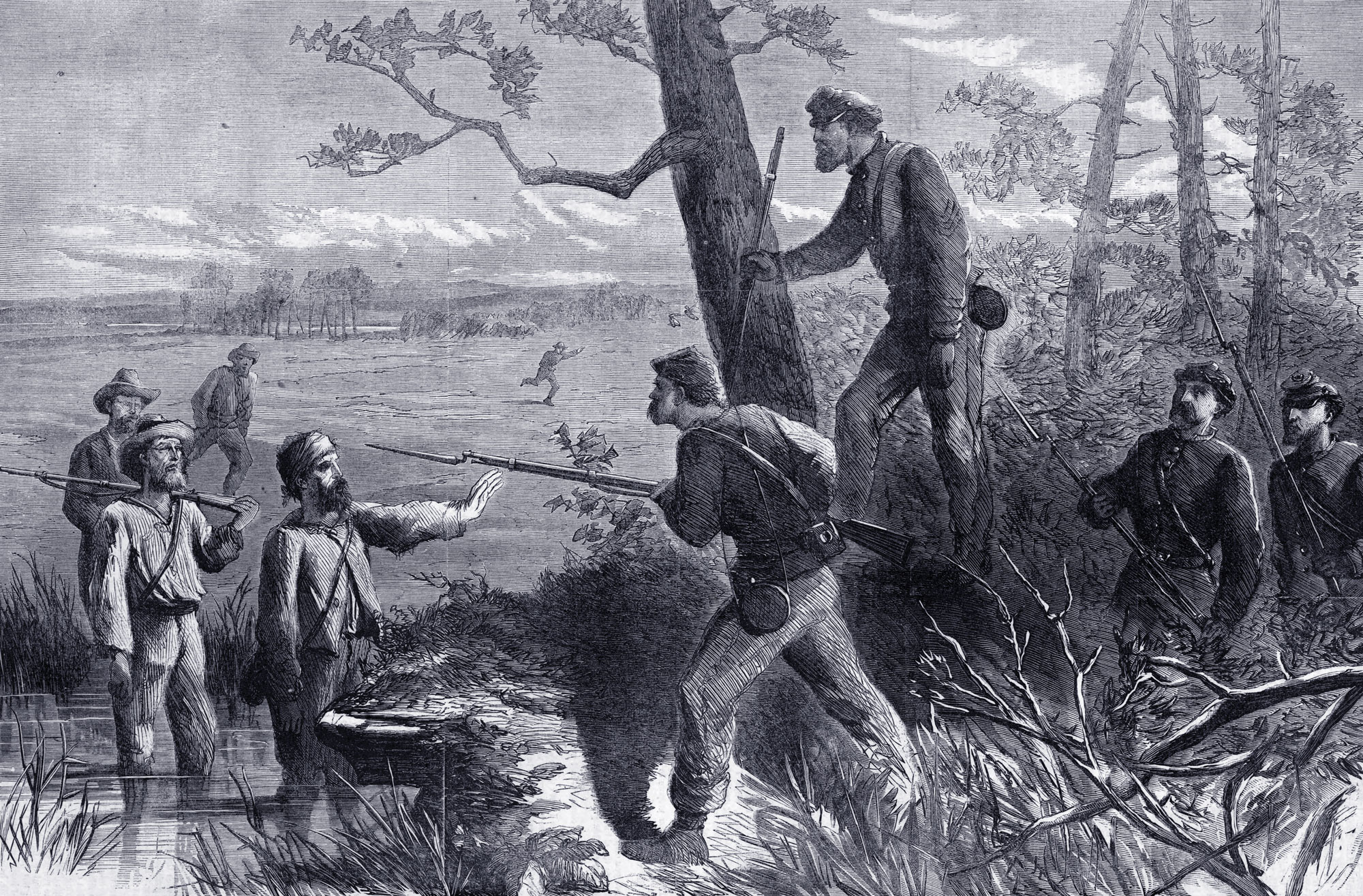
During the Civil War, soldiers who left either army on an unauthorized absence, brief or total, were said to have taken “French leave.” Shown here: Confederate deserters reach Union lines in an 1864 illustration from Harper’s Weekly.
French•leave | fren(t)SH • lēv | noun | An informal departure, or, by extension, absence without permission, escape, flight.1
Among 18th-century European social customs, taking “French leave” was considered a minor faux pas. Rather than offering a customary farewell to hosts, uncouth guests simply departed a gathering without fanfare or goodbye. The phrase appeared in Great Britain in the mid-1700s, and was probably inspired by anti-French sentiment during the Seven Years War. The British—in a dig at the French—declared the practice to be popular among ill-mannered Frenchmen on the continent. According to a short refrain in the Polite Politician, published in 1751, “French Leave is a phrase we had often in use, When one slily elop’d; nor left coin or excuse.” According to the anonymous British author, such leave was “now taken in Brabant and Flanders, By the polish’d French troops, and politer command.” In 1775, the custom appeared in a British etiquette manual. According to Lord Chesterfield’s advice “for the improvement of youth,” “if you want to know the time, withdraw, besides, as the taking what is called French leave was introduced, that on the person’s leaving the company the rest might not be disturbed, looking at your watch does what that piece of politeness was designed to prevent; it is a kind of dictating to all present, and telling them it is time, or almost time, to break up.” The French, not to be outdone, soon adapted the phrase: filer à l’anglaise (to flee the English way).2
Among Britons and Americans, the phrase became common parlance and appeared regularly in 19th-century dictionaries and popular publications. As a social custom, exiting “informal receptions” in such a way was a practice “happily in vogue in Paris.” But in other instances, taking French leave could have serious repercussions. The “saying [was] frequently applied to persons who have ran away from their creditors,” according to the Classical Dictionary of the Vulgar Tongue. John Russell Bartlett’s Dictionary of Americanisms, meanwhile, used a different but no more admirable example: a groomsman “who on their bridal eve / Had promised long to stay, / Forgot his promise—took French leave— / And bore his lamp away.”3
By 1861, French leave had become a euphemism for desertion or unauthorized absences by soldiers North and South. Desertion rates rose and fell over the course of the Civil War. And while precise statistics are impossible to calculate, at least between 10 percent and 12 percent of Confederate soldiers and 14 percent of Union soldiers deserted. These numbers are probably low; some soldiers left for only brief episodes and many officers failed to report short leaves or pardoned absenteeism. Civil War armies, likewise, never developed a uniform system for classifying deserters or distinguishing between unintentional straggling, temporary unauthorized absences, and intentional abandonment of the army. In most instances, French leave described a short unauthorized absence, often to visit family or friends. Unlike deserters, these men intended to return to the ranks. And, when they did, most received lenient sentences. Although it was formally condemned, many officers tacitly tolerated French leave and returning soldiers simply lost a few days’ pay or received extra work duty. But French leave was not without risk. Captured deserters could be severely punished or executed, and leniency became rarer as the war wore on.4
Soldiers had various motivations for leaving. According to historian Peter S. Carmichael, “the act of desertion possessed its own situational logic, rooted in time and place and shaped in decisive ways by the politics and personality of the soldier.” Some conscripts and bounty hunters enlisted with the express intention of neglecting their military duty and, though it was rare, “un-enlisted” at the first opportunity. Most soldiers prudently weighed their options, carefully considering the often-conflicting demands of family responsibilities and military duty. The family of Private John J. Hileman of the 27th Virginia Infantry, for example, urged him to come home. He wrote, “I was a free man once but it is not so now we are all slaves and are oblige to get our passes or take a French that is we will have to run off.” Hileman remained in the ranks until he was wounded at the Battle of Gettysburg on July 3, 1863. For many Civil War volunteers, French leave served a critical role by allowing citizen-soldiers an opportunity to visit home, resolve family emergencies, or tend to crops before returning to their units. And as the war dragged on into 1863 and 1864, more and more soldiers took French leave or deserted. Virginians and North Carolinians, in particular, took off when they were close to home, and little could be done to prevent them. After a short rest and a few home-cooked meals, these men returned to their regiments and reported for duty.5 Public perception of the practice varied, but for volunteer soldiers and their families, French leave (in the absence of an authorized furlough) offered an opportunity to return home, even at the risk of military censure or public condemnation.
While most commonly associated with derelict white Americans of military age, the phrase occasionally appeared in abolitionist circles during and after the war. A Pennsylvania newspaper, for example, remembered the life of Charles Robb, “formerly a slave, owned by a family in Maryland, from whom he took French leave.”6 Here the phrase assumed a radically different connotation: an escape from slavery’s yoke.
American partygoers generally stopped taking French leave in the decades following the Civil War, which is not to say everyone was politely thanking their hosts prior to departing. Instead, a new but no less ethnically stereotyped phrase, the “Irish goodbye,” came into usage. Its origins are murky, sometimes linked to the British and their anti-Irish sentiment. More often it is attributed to the wave of Irish immigrants who settled in America’s northeastern cities during and after the Irish Potato Famine. According to one hypothesis, these immigrants had left their homeland without saying farewell, never again to see loved ones. Another less-flattering hypothesis portrays Irish guests as too inebriated to make a proper exit. Regardless of the phrase’s origin, Americans of every ethnic background discreetly departed social gatherings with an Irish goodbye in lieu of taking French leave.7
The act of taking unauthorized leave in the military persisted with soldiers in both World Wars. But the phrase French leave became dated and fell from common usage. American military authorities came to report derelict soldiers as AWOL (Absent Without Leave).
Many of us still prefer taking French leave or giving an Irish goodbye in certain social settings—but now we have a new term: “ghosting.” In the age of modern technology, canceling plans by text or email at the last minute is easier—if no more polite. But there will always be those who prefer to play dead and say nothing at all. We leave a party discreetly through the back door (hoping not to awaken the dog or trip over the hedges). We cut off contact with a prospective suitor after the first or second or third date. Employees stop showing up while prospective employers fail to send rejections. According to The Washington Post, “Ghosting is normal now.” Like our Civil War ancestors who took French leave, we have now adopted ghosting.8
Tracy L. Barnett is visiting assistant professor of History at Old Dominion University in Norfolk, Virginia. She earned her doctorate in American History from the University of Georgia. Firearms—their meaning to men and their availability in 19th-century America are at the center of her scholarship.
Notes
1. William S. Walsh, Handy-book of Literary Curiosities (Philadelphia, 1892), 399.
2. Emphasis in original. T. Tompson, ed., The Polite Politician: Or, Entertaining Correspondent. Being, a Collection of Original Essays, on the Most Beautiful and Entertaining Subjects, in Prose and Verse, Etc., Vol. 2 (London, 1751), 54–55; “French Leave,” Oxford English Dictionary (New York, 2021): oed.com/view/Entry/74491?redirectedFrom=%22French+Leave& (accessed January 07, 2022); Spelling has been modernized for readability. Lord Chesterfield, Principles of Politeness: and of Knowing the World (London, 1775), 72.
3. Fraser’s Magazine (May 1864), 580, as cited in Notes and Queries: A Medium of Inter-communication for Literary Men, Artists, Antiquaries, Genealogists, Etc., Series 3, Volume 5, No. 129 (London, June 18, 1864), 494; Pierce Egan, Classical Dictionary of the Vulgar Tongue (London, 1823); John Russell Bartlett, Dictionary of Americanisms: A Glossary of Words and Phrases, Usually Regarded as Peculiar to the United States (New York, 1848), 149.
4. Peter S. Carmichael, The War for the Common Soldier: How Men Thought, Fought, and Survived in Civil War Armies (Chapel Hill, 2018), 176–181; Joseph T. Glatthaar, General Lee’s Army: From Victory to Collapse (New York, 2008), 409. For more on Civil War desertion, see Mark A. Weitz, More Damning Than Slaughter: Desertion in the Confederate Army (Lincoln, 2005).
5. Carmichael, The War for the Common Soldier, 176; John J. Hileman to Brother and Sister, October 2, 1861, Private Voices (altchive.org/node/15232); Glatthaar, General Lee’s Army, 287, 409.
6. Lewistown Gazette (Lewistown, Pennsylvania), June 22, 1864.
7. Thu-Huong Ha, “Is it the Irish goodbye, the French exit, or to leave ‘the English way’? Depends where you live,” Quartz, December 23, 2017.
8. Lisa Bonos, “Ghosting is normal now. That’s completely bonkers,” The Washington Post, February 13, 2020.