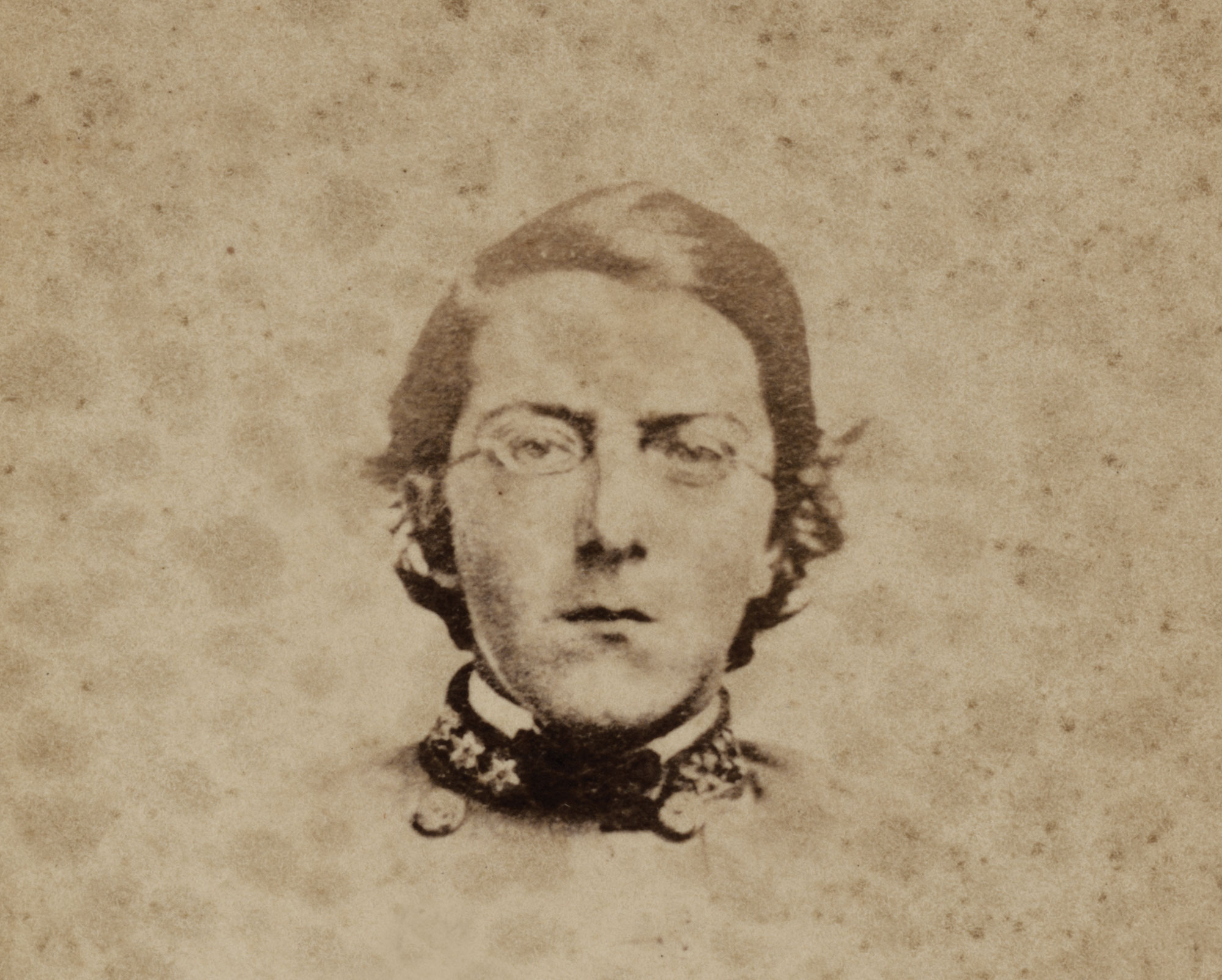
 Library of Congress
William R.J. Pegram
As the recent and unfolding conflict in Ukraine has shown us, war can force ordinary people to act with unbelievable courage and resilience to defend themselves and their homes. Many Ukrainians, embodying the truest definition of citizen-soldier, have taken up arms and bravely faced their fears of death or injury. Giving birth in bomb shelters, leading children, or elderly neighbors, or total strangers to refuge, facing down tanks in their streets—“ordinary” citizens have exemplified both moral and physical courage against overwhelming odds.
There are many ways to define courage in war; one historian described it as “a supreme imperturbability in the face of death,” which is “the ultimate gift in war.”1 Participants in the American Civil War faced those same fears when, as in any crisis or conflict, courage required a conscious choice—a decision to disregard fears and anxieties in order to attempt what must be accomplished, regardless of outcome. Civil War fiction, from Stephen Crane’s The Red Badge of Courage to Michael Shaara’s The Killer Angels, often explores the theme and drama of courage under fire, but perhaps the best such war stories are the examples of real-life participants.
Few Civil War figures better epitomized the notion of deliberate courage, even with its dark side, than Confederate artillery officer William R.J. Pegram. A bespectacled prodigy who, by age 23, had risen from lieutenant to colonel in the Army of Northern Virginia, Pegram was widely admired as one of the Confederacy’s most gifted and daring officers. The bellicose young gunner had a flair for the dramatic, informing his men on one occasion, “A soldier should always seek the most desperate post that is to be filled,” and on another, inspired them by wrapping himself in his battery’s battle flag and walking calmly back and forth amid enemy fire.2
Pegram reassured his family that such dangerous behavior was necessary by officers; all he could do was to perform his duty and rely upon divine providence to shield him from death. “I again got in a very hot place, and was unfortunate enough to lose Lieut. [Mercer] Featherstone and two men killed, and twelve wounded,” he told his sister after the Battle of Cedar Mountain in August 1862, “but an ever merciful God again took me under His protection and brought me safely through the fight.” The unfortunate Lieutenant Featherstone was decapitated by a Union artillery shell aimed at Pegram’s battery. The round passed through both the lieutenant and his horse, lodging in the body of another horse nearby, where it “then exploded, tearing him to atoms,” leaving Pegram and his men to recover the officer’s body from the bloody mess.3
During the engagement, Union marksmen singled out Pegram as the battery’s commander and deliberately focused their fire on him; all of their shots miraculously missed, though only just. “I received four bullet holes through the skirt of my coat,” he told his sister. “One sharp shooter took deliberate aim at me eight or ten times, and missed me. How is it possible to shew gratitude adequate to such divine mercy?” As a devout Christian, Pegram saw these experiences as a sign of divine favor. “What have I to fear from Yankee bullets and shells, as long as I am under His protection?” he proposed. “Ask Mother to cheer up, and remember that we are all under His protection.”4 But Pegram’s good fortune eventually ran out. After innumerable daring exploits during the war, he was mortally wounded in April 1865 at the Battle of Five Forks, just days before the Army of Northern Virginia’s final surrender at Appomattox Court House.5
Pegram’s bravery was widely admired by his superiors, his fellow officers, and many of his own volunteers. Major General Henry Heth wrote, for example, that Pegram “was one of the few men, who, I believe was supremely happy in battle.”6
One well-worn anecdote told of Confederate volunteers once declaring of Pegram, “There’s going to be a fight, for here comes that damned little man with the spec.’s!”7 At a meeting of veterans after the war, Captain William Gordon McCabe, Pegram’s friend and adjutant, fondly conjured a vision of the “boy-colonel riding along some crimson field, the sweet austerity of his grave face lit up with the joy of battle, as he was greeted by the hoarse cheering of his batteries.”8 Another veteran remembered: “There was a certain magnetism about Willie Pegram that impressed all who came into his presence with his truly noble character. Never excited, possessing at all times that perfect equipoise so much to be prized in a commander, he embodied all the qualities of a soldier.”9
These grand images of reckless heroism and coolness under fire conceal a grimmer aspect of this brand of daring courage. In 1863 one volunteer complained that Pegram was “a perfect gentleman and is moreover a fine officer, though rather too fond of fighting. In fact, he has been known to beg to be allowed to take his batt’n into a fight.” His men somehow always seemed to find themselves at the perilous forefront of the army, even when they were assigned reserve positions far from the chance of enemy contact. Consequently, Pegram’s batteries often suffered high casualties. “[S]uch chances as a batt’n happening to be in front after marching some two or three hundred miles in extreme rear is rather extraordinary are they not.”10
Pegram’s eagerness for battle may have won him glory, but it also fostered discontent in some of his volunteers, who believed their commander was profligate with their lives in pursuit of glory. At Cedar Mountain, when Pegram volunteered his battery to move into an extremely exposed position, his volunteers muttered with disapproval. This led him to take the extraordinary step of demanding that his men explicitly declare whether or not they intended to follow him into combat. If a minority expressed their disapproval, he said, they would be permitted to transfer to a new unit; if a majority disapproved, Pegram offered to resign his commission on the spot and return to the ranks as a private soldier. The volunteers, either shamed or inspired by this demonstration, unanimously chose to remain under his command.11
For Willie Pegram and thousands of other fighters in the Civil War, courageous action seemed a deliberate choice. Whether motivated by pride, patriotism, ambition, or self-preservation, to behave courageously was a difficult, often life-altering decision made in the crucible of war.
Andrew S. Bledsoe is professor of history at Lee University in Cleveland, Tennessee. He is the author of Citizen-Officers: The Union and Confederate Volunteer Junior Officer Corps in the American Civil War (Louisiana State University Press, 2015); co-editor, with Andrew F. Lang, of Upon the Field of Battle: Essays on the Military History of America’s Civil War (LSU Press, 2019); and author most recently of Decisions at Franklin: The Nineteen Critical Decisions That Defined the Battle (University of Tennessee Press, 2023).
Notes
1. Lord Moran, The Anatomy of Courage, 1945 (Reprint, Garden City Park, NY, 1987), 188.
2. Peter S. Carmichael, Lee’s Young Artillerist: William R.J. Pegram (Charlottesville, 1995), 63, 78.
3. Ibid., 56.
4. William R.J. Pegram to My Dearest Jennie, August 14, 1862, Pegram-Johnson-McIntosh Papers, Virginia Historical Society.
5. Carmichael, Lee’s Young Artillerist, 166.
6. Henry Heth, The Memoirs of Henry Heth, ed. by James L. Morrison Jr. (Westport, CT, 1974), 195.
7. Jennings C. Wise, “The Boy Gunners of Lee.” Southern Historical Society Papers 42 (1917): 152–173, 156.
8. W. Gordon McCabe, “Address to the Annual Reunion of Pegram’s Battalion, … 1886,” Southern Historical Society Papers 14 (1886): 5–34, 6.
9. J.C. Goolsby, “Col. William Johnston Pegram,” Confederate Veteran 6 (June 1898): 271.
10. Benjamin Robert Fleet, Green Mount, a Virginia Plantation Family during the Civil War: Being the Journal of Benjamin Robert Fleet and Letters of His Family, ed. by Betsy Fleet and John D.P. Fuller (Lexington, 1962), 262.
11. Carmichael, Lee’s Young Artillerist, 63.