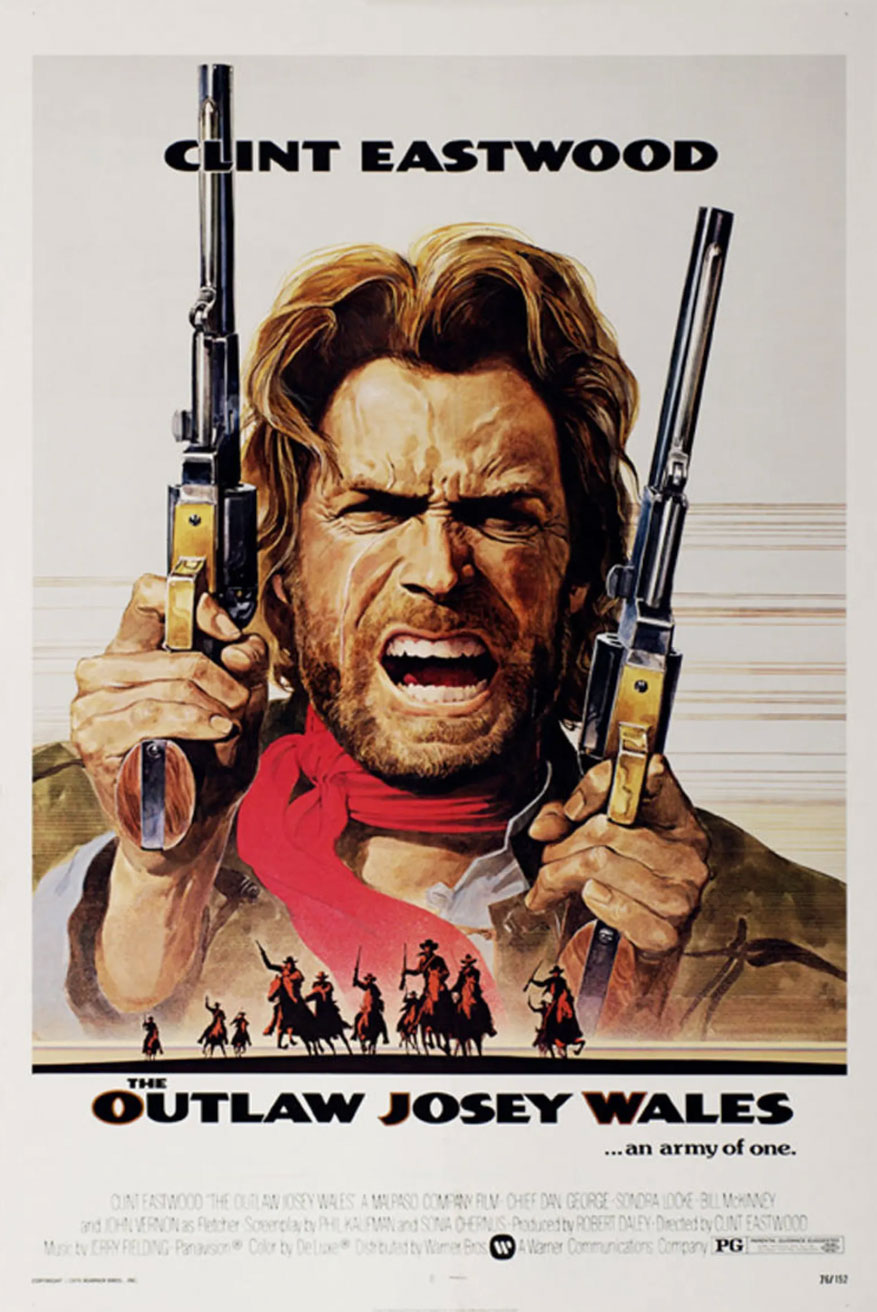
In 1976, the “New Wave” of American cinema was in full swing. Heavy-hitting films such as All the President’s Men, Rocky, Network, Taxi Driver, and A Star Is Born dominated theater marquees and Hollywood award ceremonies. For Civil War buffs the highlight of their moviegoing year wasn’t an underdog boxer or a paranoid president. No, it was a squinting, tobacco-chewing, pistol-slinging, pro-Confederate bushwhacker named Josey Wales.
Based on segregationist Asa Carter’s 1972 novel, The Rebel Outlaw, which was itself plagiarized from a 1938 account of bushwhacker William “Wild Bill” Wilson, The Outlaw Josey Wales starred Clint Eastwood as a farmer-turned-guerrilla in wartime Missouri. It was a risky decision to present an irregular combatant, let alone one with a penchant for gunning down Union troops, as a sympathetic antihero in the 1970s. The United States had just finished a humiliating withdrawal from Vietnam after years of struggling against guerrilla tactics. Political wounds notwithstanding, the film did well upon release (grossing more than $31 million on a $3.7 million budget) and then developed a cult following among Civil War and western movie fans. For better or worse, The Outlaw Josey Wales became the historical foundation for how generations of Americans imagined guerrilla violence during the Civil War.
I vividly recall a case in point, in 2010, when I was doing research at the University of Georgia, finding the name “Josey Wales” penciled into a roster of bushwhackers included in Carl Breihan’s 1959 book Quantrill and His Civil War Guerrillas. And Wales’ inclusion wasn’t in jest. Now, on the film’s fiftieth birthday, let’s see what The Outlaw Josey Wales gets right, what it gets wrong, and what falls somewhere in between. Without fact-checking the entire movie, we’ll focus on three major themes and judge how they stack up against the prevailing scholarly wisdom of 2026.
In the film’s opening sequence, a tranquil morning on the Wales farm in western Missouri is interrupted by the rumbling of hooves. A horde of Red Legs (Unionist paramilitaries from Kansas) thunders onto the screen. They rape and murder Wales’ wife, burn his house down with his young son inside, and leave Wales for dead after the band’s leader whacks him over the head with his saber. Back on his feet, Wales soon joins up with a vengeance-seeking company of Confederate bushwhackers led by “Bloody Bill” Anderson and he hunts the men responsible for killing his family. Over the next two-and-a-half hours, viewers see all manner of violent encounters played out in settings, and on a scale, not usually associated with Civil War combat. The killing is hyper-local and hyper-personal. This blurring of the traditional line between battlefront and homefront in the western borderlands is something the movie gets right. For untold Missourians and Kansans, irregular violence constituted their regular Civil War experience—with the war literally waged from within and upon their households.
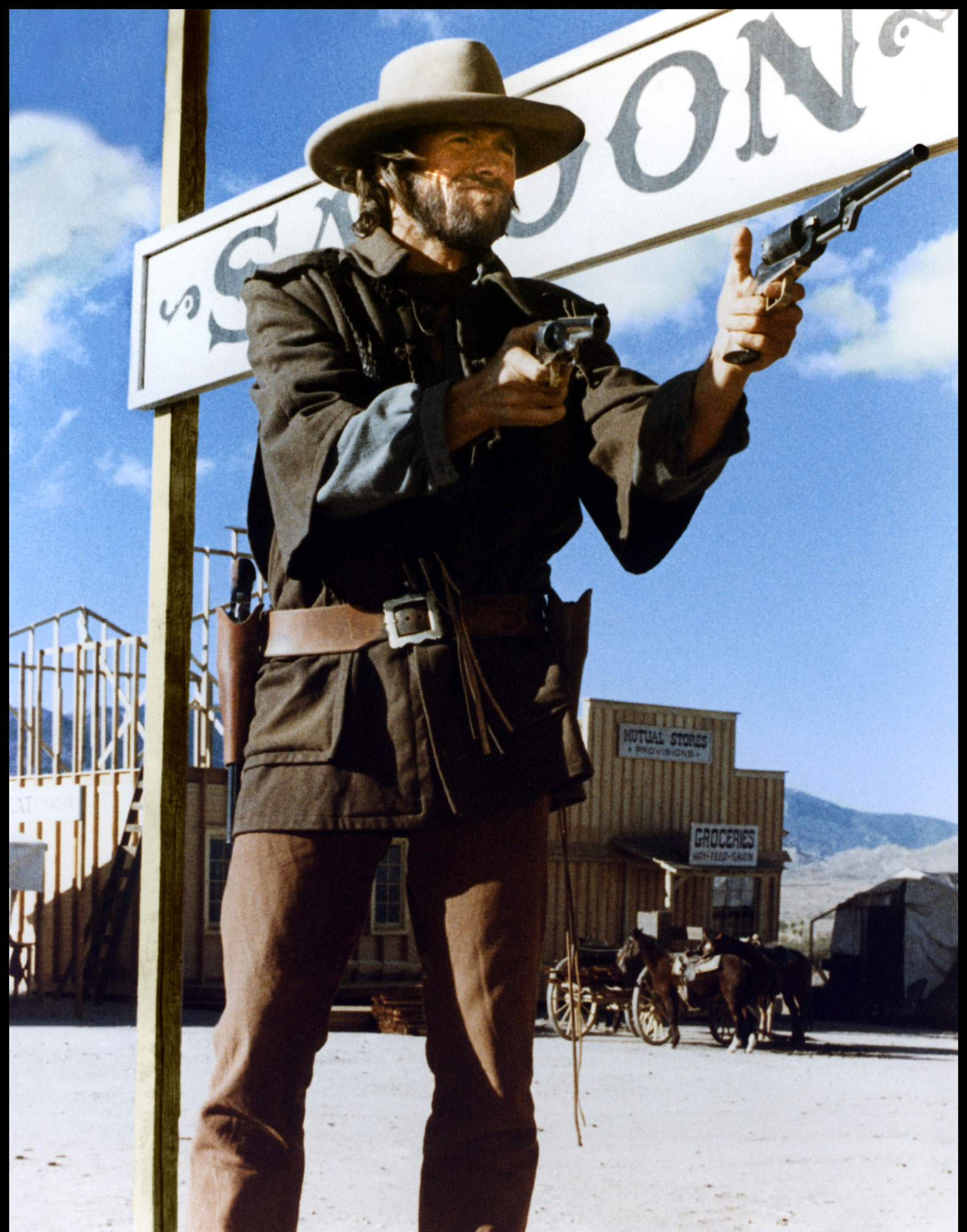 TCD/Prod.DB / Alamy
Clint Eastwood was the title character in the 1976 movie The Outlaw Josey Wales, a film that, for better or worse, informed many Americans’ views of Civil War guerrilla warfare.
Aside from bloodshed, one constant of The Outlaw Josey Wales is the apparent inability of Union troops to track down and/or capture the renegade bushwhacker. At every turn, the widely hunted Wales outsmarts or outguns the pursuing “blue bellies” with aplomb. In one memorable scene, Wales tricks the Red Legs onto a river ferry before snapping its cable and setting his would-be captors adrift. He then turns to tell a Unionist onlooker, “Well, Mr. Carpetbagger, we got somethin’ in this territory called the Missouri boat ride.” And in one of the movie’s iconic moments, Wales asks a startled group of Federal soldiers with whom he has a standoff in a small frontier town, “Are you going to pull those pistols or whistle Dixie?” before dispatching them with a lightning-fast draw. Catchy as Wales’ one-liners might be, the notion that Union forces were incompetent, even bumbling, guerrilla hunters is something the film gets wrong. Later in the war, the federal government unleashed squads of regular soldiers specifically trained to track down and eliminate notorious bushwhackers. Near Albany, Missouri, one such unit laid low the real “Bloody Bill” Anderson in October 1864. In Kentucky, Union authorities hired former soldier Edwin “Bad Ed” Terrell to lead a band of “special detectives” against high-profile guerrilla leaders. After assassinating Bill Marion and Hercules Walker, Terrell’s men scattered the last of William Quantrill’s followers in June 1865 and delivered the architect of the Lawrence Massacre a fatal wound.
An underlying premise of The Outlaw Josey Wales is the title character’s inability to hang up his guns even after the war is over. He is hounded all the way from Missouri to Indian Territory by the same fanatical Red Legs who murdered his family and now want to rid the entire nation of Rebels. Wales eventually kills the Red Leg captain—a character based very loosely on the aforementioned Edwin Terrell—but stays in the Far West, unable to return to Missouri. In reality, the vast majority of men who fought as guerrillas during the Civil War did exactly the same thing as their regularly enlisted counterparts when the conflict ended: They went home and resumed farming. With this in mind, the movie’s depictions of bushwhackers murdered wholesale while trying to surrender and of Wales forced into outlawry is a push. As illustrated by Pulitzer-winning historian and biographer T.J. Stiles, a select few Confederate bushwhackers, most notably Frank and Jesse James, believed crime was their only postwar option; they couldn’t imagine a world in which Unionist Republicans in Missouri would allow them to swap their weapons for plows. To an extent, they had a point. However, the reason we remember the James-Younger Gang is precisely because they were extraordinary.
In the film’s closing scene, Wales—now using the alias “Wilson”—is recognized in a border town saloon by an ex-bushwhacker-turned-pursuer named Fletcher. Fletcher refuses to expose Wales’ identity to a pair of officers whom he has joined to investigate the wanted man’s whereabouts. When the officers leave, satisfied Wales is dead, Fletcher attempts to convince his former friend that the war is over. Wales replies, “I reckon so. I guess we all died a little in that damn war.” At that, the outlaw, bleeding from a wound received during his last stand against the Red Legs, mounts his horse and rides off. Whatever came next is a mystery. Did Wales die from his wound? Was the ruse of his death exposed, putting bounty hunters back on his trail? Was he killed by Indians? Or did he live happily ever after with the new, ragtag family he acquired over the course the movie? Audiences were ultimately left to imagine their own future for Josey Wales because a planned sequel, again directed by and starring Eastwood, never materialized.
Regardless of what you think happened to “Mr. Chain Blue Lightning” after concluding his feud with the Red Legs, one thing is certain: The Outlaw Josey Wales will continue, still for better or worse, to inform how Americans imagine Civil War guerrilla warfare one squint, one spit, and one .36-caliber lead ball at a time.
Matthew Christopher Hulbert is Elliott Associate Professor of History at Hampden-Sydney College. He is currently writing a narrative history of the Lawrence Massacre and its place in Civil War history and memory. Find him on Instagram @the_outdoor_professor or at matthewchristopherhulbert.com.

This article by Matthew Hulbert is superb and his observations concerning what “the film got wrong” are right on the mark. Indeed, as Paul A. Thomas and I continue work on our book “Hell and Its Fury: The History of the Kansas Red Legs,” we have found a few examples of successful guerrilla hunting by none other than Kansas Red Legs. This of course really puts a damper on the film’s “Irregular Lost Cause” subterfuge. Indeed, it was a Kansas Red Leg that helped capture the bushwhacker, Jim Vaughn. In the last week of May 1863, William “Bill” Jones, a man described by one newspaper as “one of the much-berated Red Legs,” visited Wyandotte, almost certainly to call on his friend, the noted Red Leg, Albert Saviers. While there, Jones spotted two suspicious characters. Calling for backup from a Union Army officer named J. A. Soward and another citizen, the three arrested and disarmed the two strangers. Both suspects wore Union uniforms and were armed with two revolvers each and a knife. The captured men turned out to be the notorious bushwhackers, Jim Vaughn and William Van Clief. Soward took them to Kansas City, where Vaughn was immediately tried before a military commission and sentenced to death. He was hanged on May 26.