 Library of Congress
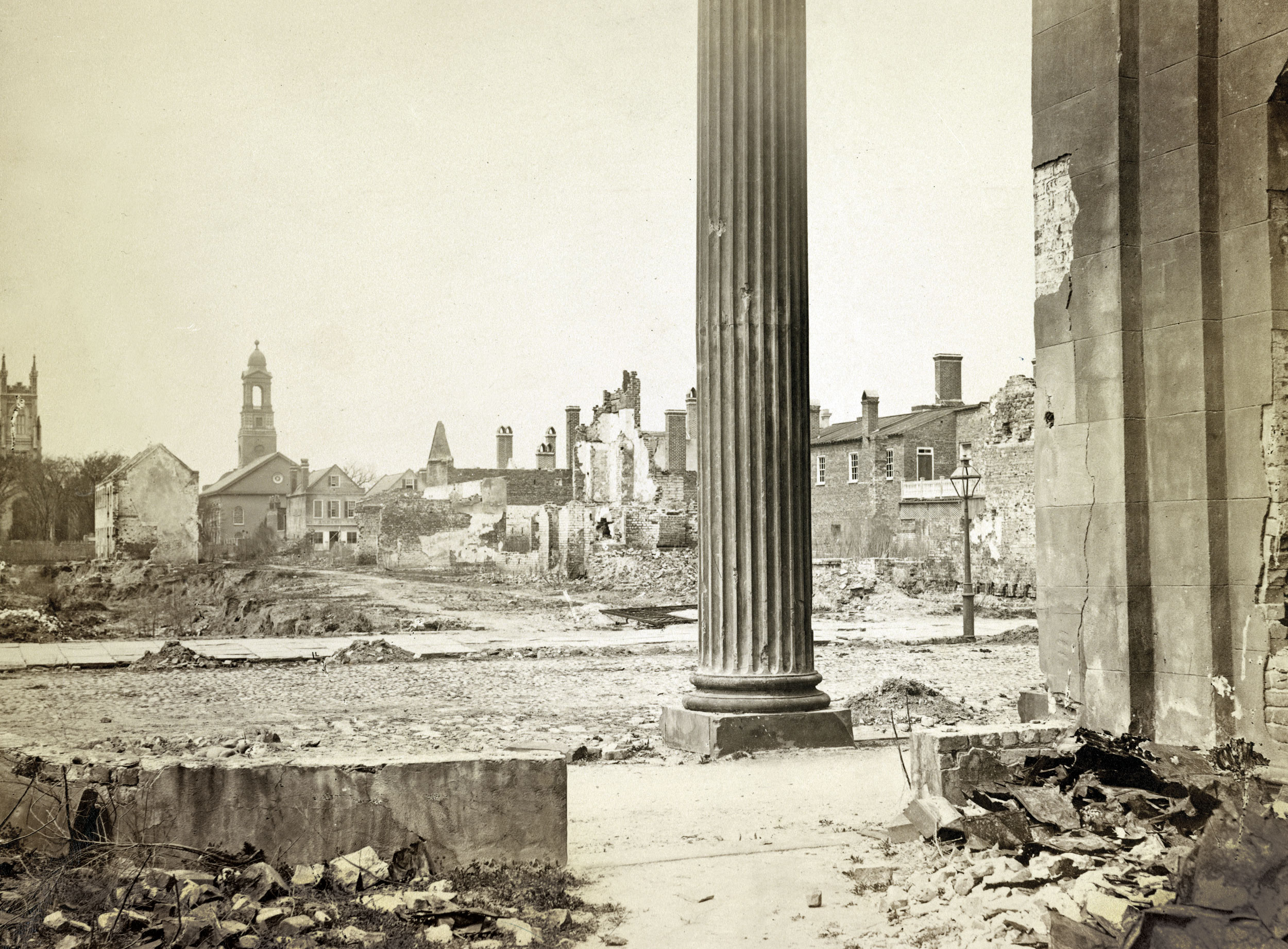
The ruins of Charleston, South Carolina, as viewed from the Circular Church on Meeting Street. The northern abolitionists who visited the city in April 1865 got an up-close look at the widespread destruction.
On the evening of April 13, 1865, the steamship Oceanus neared its destination of Charleston, South Carolina, after a three-day trip from New York City. Passing by Fort Sumter, the island fort where the Civil War had begun four years earlier, the ship’s nearly 200 passengers, most of whom were members of antislavery minister Henry Ward Beecher’s Brooklyn congregation, broke out into song. “Praise God, from whom all blessings flow! / Praise Him, all creatures here below!” they bellowed. Darkness was settling in, and without a single light reaching beyond the wharves, Charleston looked dead to the passengers aboard Oceanus. After suffering an enormous fire in late 1861, and then a lengthy Union siege that left gaping holes in the buildings across the lower peninsula, the city resembled the ruins at Pompeii.1
But Charleston, occupied by Union forces since February, quickly came alive as the New York ship brought welcome news: General Robert E. Lee and his Army of Northern Virginia had surrendered to Lieutenant General Ulysses S. Grant at Appomattox Court House on April 9. “Oh! the shouts from the blue-jackets,” when they heard that the Civil War was finally coming to a close, wrote Theodore Cuyler, a Brooklyn pastor who was aboard Oceanus. “How the dark, sullen city beyond gave back the echoes! How they rang through the ruined mansions of the man-stealers!”2
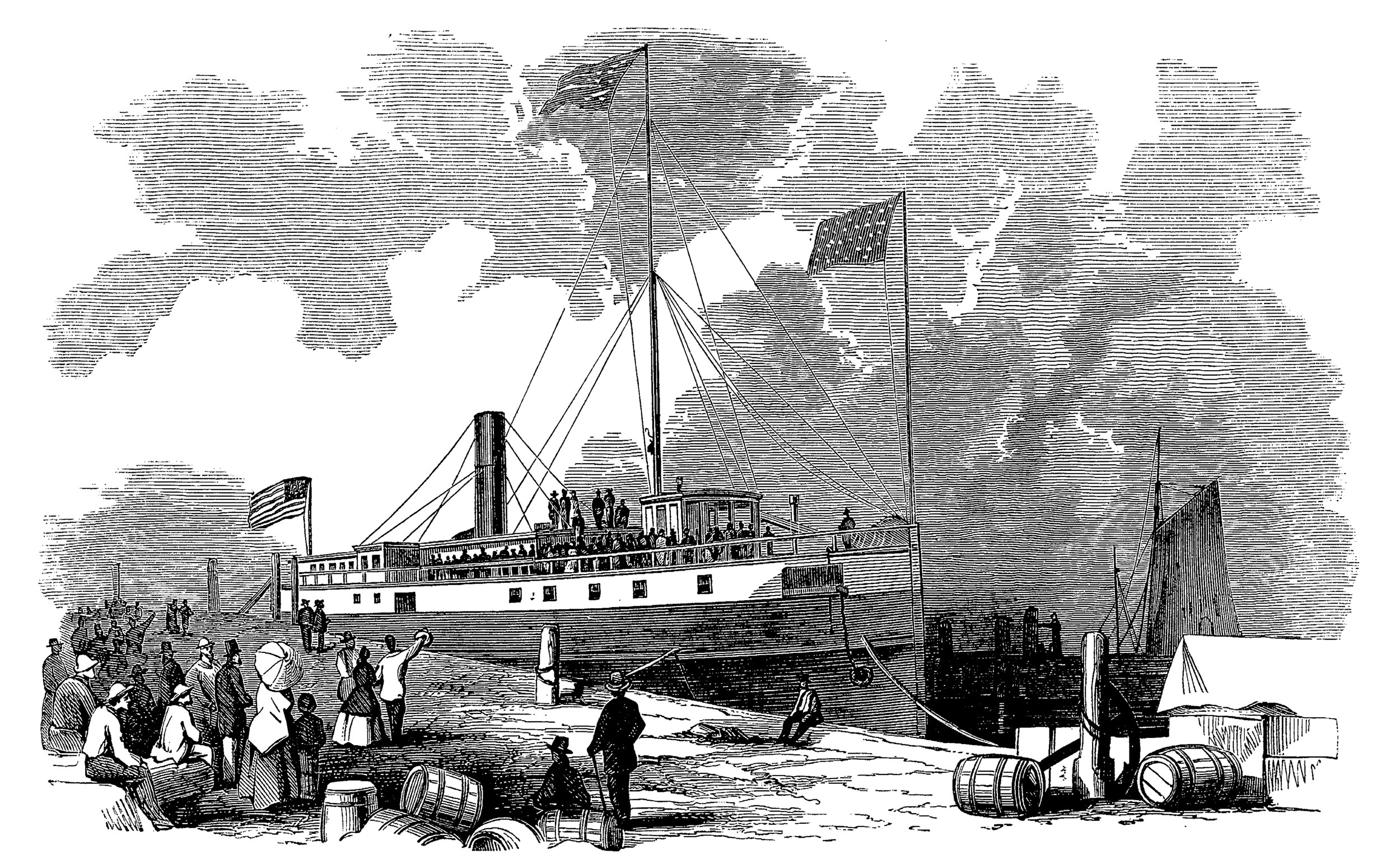 The Trip of the Steamer Oceanus to Fort Sumter and Charleston (1865)
The steamer Oceanus at dock in Charleston, South Carolina. The ship, which arrived on April 13, 1865, carried nearly 200 passengers, most of them members of antislavery minister Henry Ward Beecher’s Brooklyn congregation who were eager to bear witness to the end of the city’s slave regime
The celebration lasted late into the evening and began again the following morning, which happened to be Good Friday. American flags flapped in the breeze, making “a novel scene” in the Deep South city. New arrivals—including northerners and abolitionists who arrived on Oceanus and similar ships, Union soldiers, missionaries stationed in the South Carolina Sea Islands, and no doubt some freedpeople—wandered the city triumphant, some claiming spoils from the vacant homes and offices. Locals were up early, too. “Negroes of every shade thronged the streets; gray haired ‘uncles’ and turbaned ‘aunties,’ grinning and giggling children, and ‘picaninnies,’ all manifesting joy to see us,” reads an account written later by several Oceanus passengers. Even some white Charlestonians found the scene irresistible, though they were drawn out by “curiosity” rather than “patriotism.”3
Like many other opponents of slavery that spring, the Oceanus passengers had traveled to Charleston to bear witness to the demise of the peculiar institution in its American capital. No city in the United States rivaled Charleston in terms of the role that slavery had played in its formation and success, nor in the political, economic, and ideological support that the city had provided for the expansion of slavery in the young republic. Although Charleston was in shambles in early 1865, abolitionists could not pass up an opportunity to see remnants of, and perhaps secure relics from, the city’s slave regime before they disappeared for good.
Friday, April 14, 1865, was an especially auspicious time for such a venture. That was the day the United States planned to officially return the American flag to Fort Sumter in an elaborate ceremony. Four years earlier, on April 14, 1861, Major Robert Anderson had lowered the national banner, surrendering the federal installation at Fort Sumter to Confederate general P.G.T. Beauregard and inaugurating four bloody years of civil war. Now, Anderson, accompanied by a host of dignitaries, was returning there to raise the very same flag. Many Americans viewed Charleston as the birthplace of secession. Hereafter, predicted Cuyler, the city would be known as “at once its cradle and its grave.” The passengers of Oceanus would be there when slavery, and the Confederate nation created to perpetuate it, were symbolically laid to rest.4
 Boston Public Library
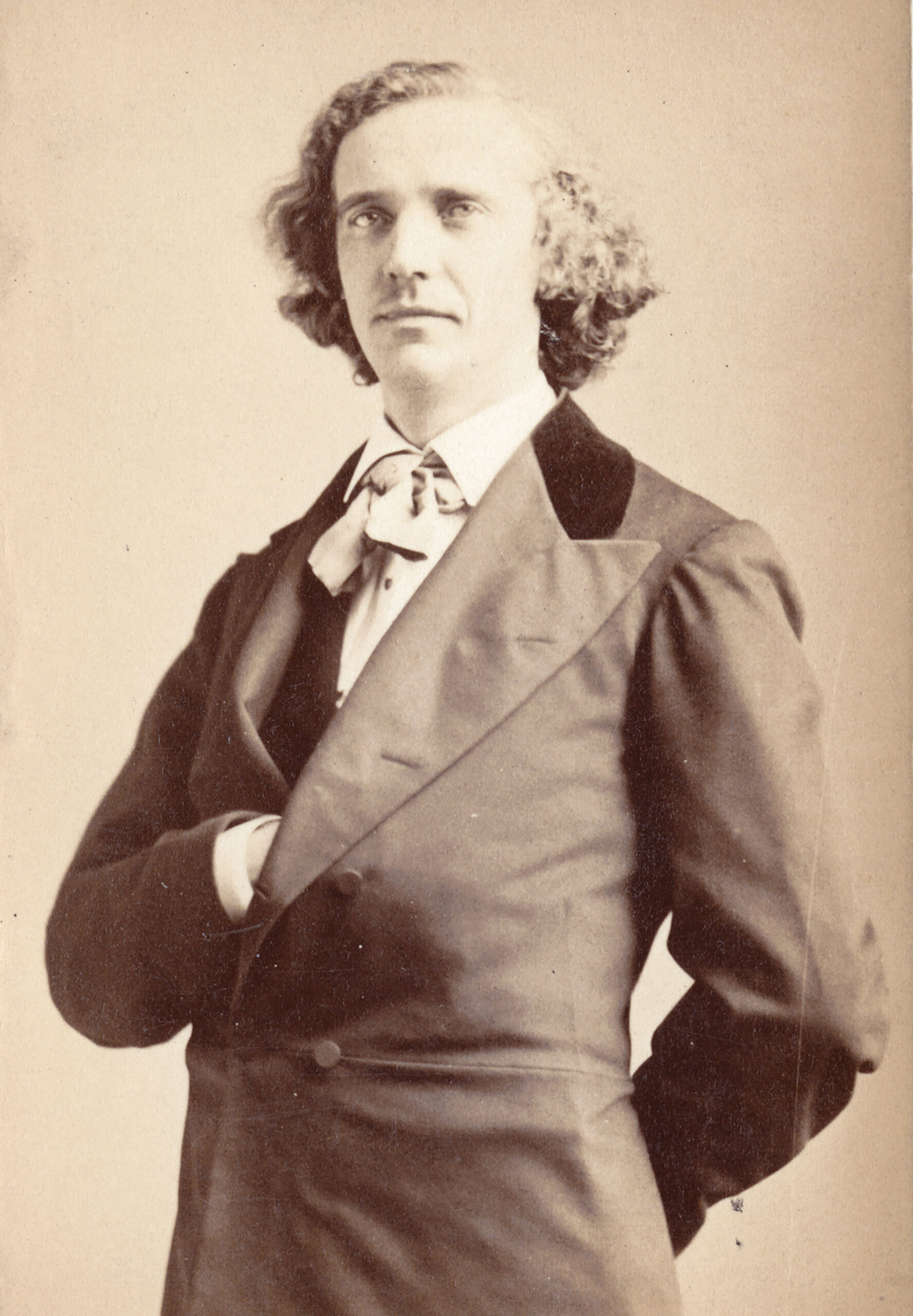
Theodore Tilton
Northerners and abolitionists had been flocking to Charleston since the Confederate army retreated from the city in mid-February 1865. The first to arrive were war correspondents who accompanied the Union troops who occupied the city beginning on February 18. In the weeks that followed, reporters from newspapers including the New-York Tribune, the Boston Daily Journal, and the Philadelphia Press published moving columns documenting Charleston’s emancipation as well as accounts of their search for the remains of the city’s slaveholding culture. Inspired by such stories, scores of antislavery northerners began making similar pilgrimages to the capital of American slavery. They toured its holy sites—the slave-trading district, the Work House (where disobedient slaves were confined and tortured), the Citadel (a military academy founded to police the enslaved population), and the offices of the Charleston Mercury (the city’s leading secessionist newspaper)—often picking up a keepsake or two to take back home.
These excursions reflected the popularity of memento collecting in the 19th century. It was common for middle-class Americans to travel to historical sites to gather relics that they believed would help them forge a deeper connection with the nation’s past. This phenomenon reached its apex during the Civil War, during which soldiers and civilians in the North and South saved objects that reminded them of the conflict, from fragments of battle-scarred trees to bullets that had pierced loved ones.5
Even before the conflict was over, northern prisoners of war in Charleston had secretly gathered mementos of slavery. While imprisoned at the Work House, Union engineer Warren Lee Goss tucked away “a bundle of documents” about the punishment meted out there. “July 10, ’58. Master of the Workhouse,” read one. “Receive the girl, Mary, give her (15) fifteen paddles and return to me. SAM’L WATSON.” Goss held on to these documents throughout his confinement and carried them north when he was paroled.6
The memento gathering accelerated after the Union army took control of Charleston. The passengers on Oceanus spent the better part of their brief excursion combing the city for souvenirs of slavery and the Civil War. They headed home to New York on Sunday, April 15, with fragments from a Blakely gun, a pair of slave manacles, and bushels of Confederate currency, among many other items. Other northern visitors set their sights on artifacts associated with John C. Calhoun, South Carolina’s great defender of slavery. During his April visit, New York editor Theodore Tilton stopped by Calhoun’s tomb in St. Philip’s Church Cemetery, which, though spared by Union shells, had “been hacked by relic-seekers.” No fan of Calhoun, Tilton was nonetheless disturbed by the destruction. “I have no sympathy with hammerers at tombstones. The dead have a right to undisquieted ashes.” Tilton had no way of knowing that Calhoun’s ashes, in fact, remained as secure as ever. Several years earlier, a group of Charleston gentlemen had secretly moved the statesman’s remains for fear that local blacks—or, worse yet, northern fanatics—might dig them up. Regardless, Tilton chose a less destructive method to acquire his memento of Charleston, plucking some clover growing near the ruins of Institute Hall, where the South Carolina ordinance of secession had been adopted in 1860.7
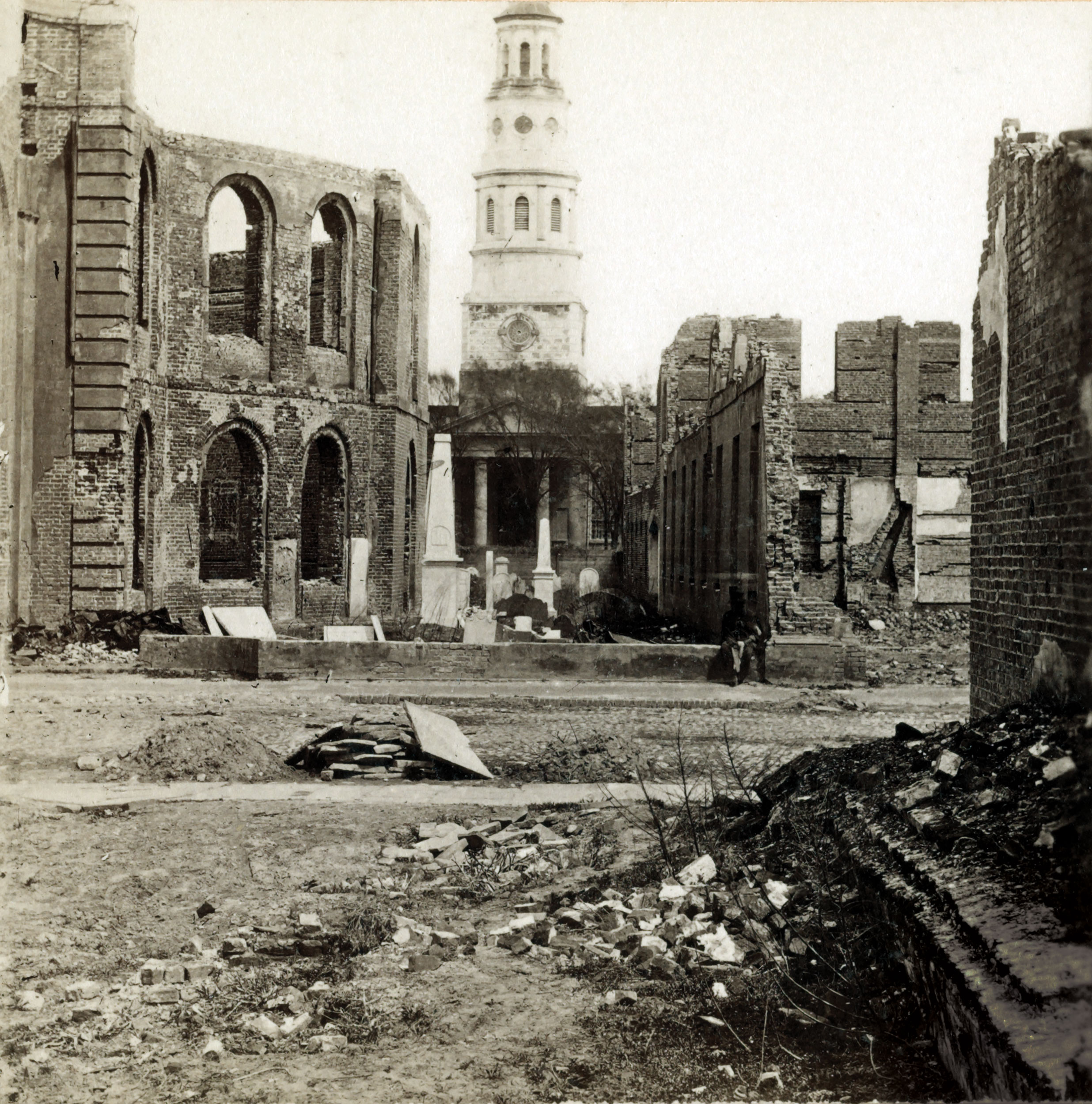 Library of Congress
Many of the northern visitors to Charleston in April 1865 combed the destroyed city for remnants of slavery and the war. Among them was New York editor Theodore Tilton, who plucked some clover growing near the ruins of Institute Hall (seen here), where the South Carolina ordinance of secession had been adopted in 1860.
New-York Tribune reporter James Redpath, for his part, had grabbed a keepsake from the offices of the Charleston Mercury. When Redpath toured the battered Mercury headquarters in late February, he found some printer’s type that editor Robert B. Rhett Jr. had set up for the secessionist paper’s final issue. Redpath absconded with it “for posterity.” The Scottish-born abolitionist concluded his first story on liberated Charleston by noting that “the irrepressible spirit of radicalism” still seemed “to inhabit” the Mercury’s editorial room, though it is “on the right side now.” Above the room’s mantelpiece, someone had scribbled in pencil a message that would have made Rhett’s blood boil: “For President in 1868, WENDELL PHILLIPS, of Massachusetts; For Vice-President, FREDERICK DOUGLASS, of New-York.”
Redpath also joined with a number of other northern visitors who pillaged Charleston’s slave-trading district for what he called “relics of barbarism.”8 After Charleston outlawed the sale of slaves on public streets in 1856, most auctions had been conducted in the buildings and offices clustered on Chalmers and State streets. Boston Daily Journal correspondent Charles Coffin recorded a detailed account of his visit to Ryan’s Mart, the most prominent of such venues. Coffin entered the Chalmers Street complex through an iron gate, above which sat the word “Mart” in gilt letters. Behind the gate, he found a sizable hall, with an auction table running the length of the structure and ending at a locked door. With the help of a freedman, Coffin broke through the wooden door, gaining entry to the rest of the property. At one end of the yard, which was walled in on all sides, was the four-story brick prison known as Ryan’s Jail. Next to the hall was a small room—“the place where women were subjected to the lascivious gaze of brutal men.”
Coffin focused his gaze on “the steps, up which thousands of men, women and children have walked to their places on the table, to be knocked off to the highest bidder.” The journalist decided to take the steps back with him to New England. “Perhaps,” he reasoned, “Gov. Andrew, or Wendell Phillips, or Wm. Lloyd Garrison … would like to make a speech from those steps.” Coffin also secured two locks and the gilt letters from the front of Ryan’s Mart. Other accounts suggested that Coffin and his colleagues acquired a slave market bell, manacles, and slave trade records. Abolitionist raiders like Coffin did not sweep Charleston’s slave markets clean, however. Among the items they left behind, reported James Redpath, was a slave trader’s desk on which someone had inscribed antislavery “texts for the day” from William Lloyd Garrison and John Brown.9
 Library of Congress
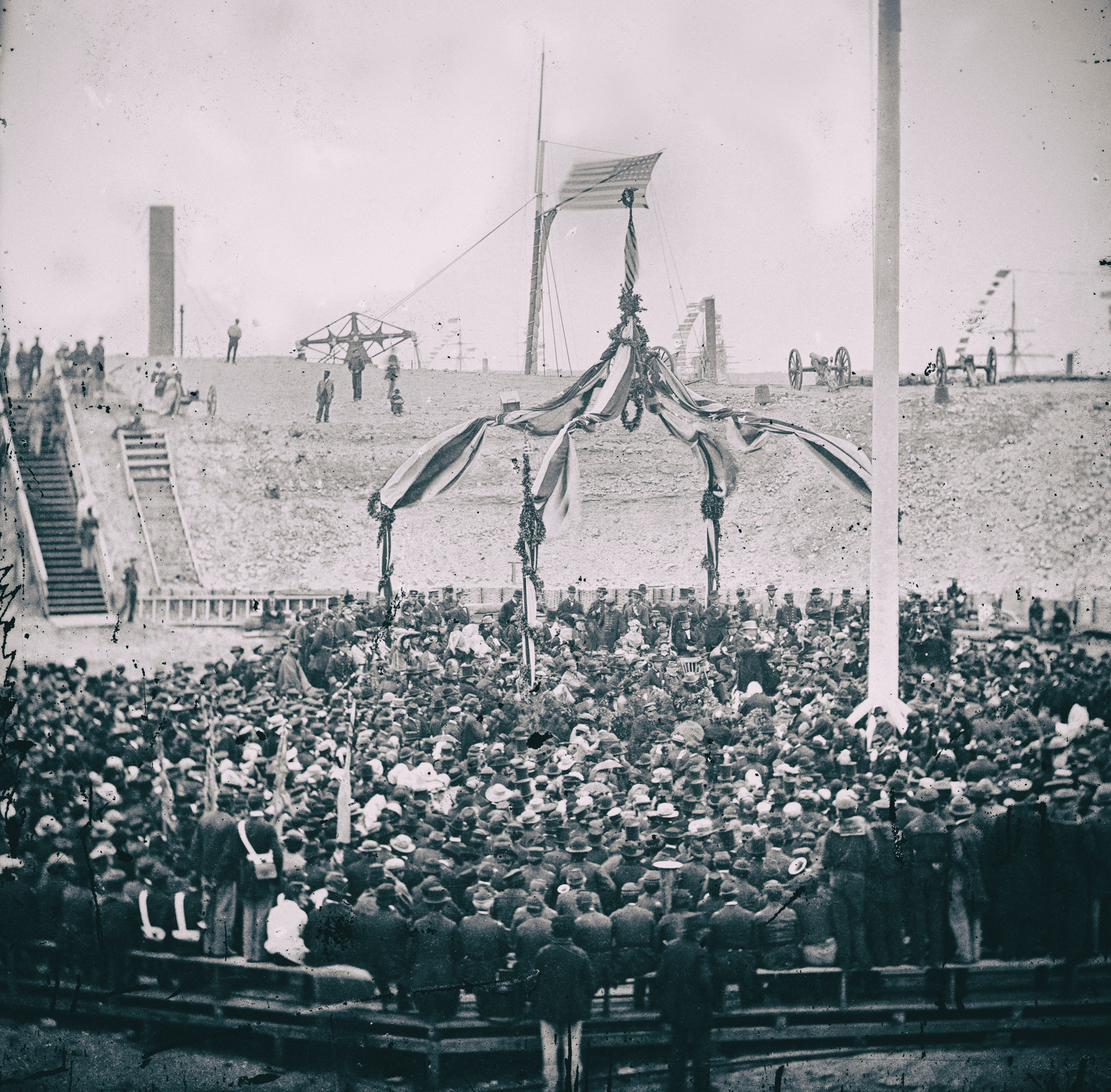
Pictured here is the April 14, 1865, ceremony—attended by more than 3,000 people, including the Oceanus passengers—at Fort Sumter during which the American flag that had been taken down four years earlier when the fort’s U.S. garrison surrendered to Confederate forces was raised again. As part of his hourlong keynote address, Henry Ward Beecher exclaimed, “No more war! No more accursed secession! No more slavery, that spawned them both!”
Many slavery relics eventually found their way into the hands of northern reformers. Wendell Phillips was reported to have received a slave market bell as a gift from a Massachusetts man, most likely James Redpath, while a secession banner was to be sent to “a Massachusetts society.” Philadelphia Press correspondent Kane O’Donnell gathered papers from several slave marts. His newspaper subsequently published excerpts from these documents, which included correspondence between Charleston slave dealers and prominent public figures, including former South Carolina governor James Henry Hammond and the Confederacy’s first two secretaries of the treasury, Christopher Memminger and George Trenholm.10
A few weeks after he toured the slave-trading district, on March 9, 1865, Charles Coffin officially presented his relics to the Eleventh Ward Freedman’s Aid Society at the Boston Music Hall before a large audience. In a striking display, the auction block steps from Ryan’s Mart were placed on the very stage from which antislavery minister Theodore Parker once rained invective down upon the Slave Power in his Sunday sermons. The lock to the slave pen was placed on the music hall’s desk and the gilt “Mart” letters were suspended from the organ. Coffin regaled the crowd with stories about the Charleston slave trade, reading from a broker’s papers.
Later, fulfilling the wish Coffin had expressed when he salvaged the auction block steps, William Lloyd Garrison mounted them in order to put “the accursed thing under his feet.” Standing atop the steps—portals into the enslaved past—the abolitionist editor sought to enhance his connection to the people for whom he had fought so long. The crowd erupted in thunderous applause, waving white handkerchiefs in celebration, before Garrison offered a lengthy lecture. Over the next few weeks, Garrison, British abolitionist George Thompson, and other antislavery colleagues re-created this scene at Freedmen’s Aid Society meetings in Lowell and Leicester. One month after Garrison mounted the auction block steps in Boston, he and Thompson set sail for Charleston.11
 Boston Public Library
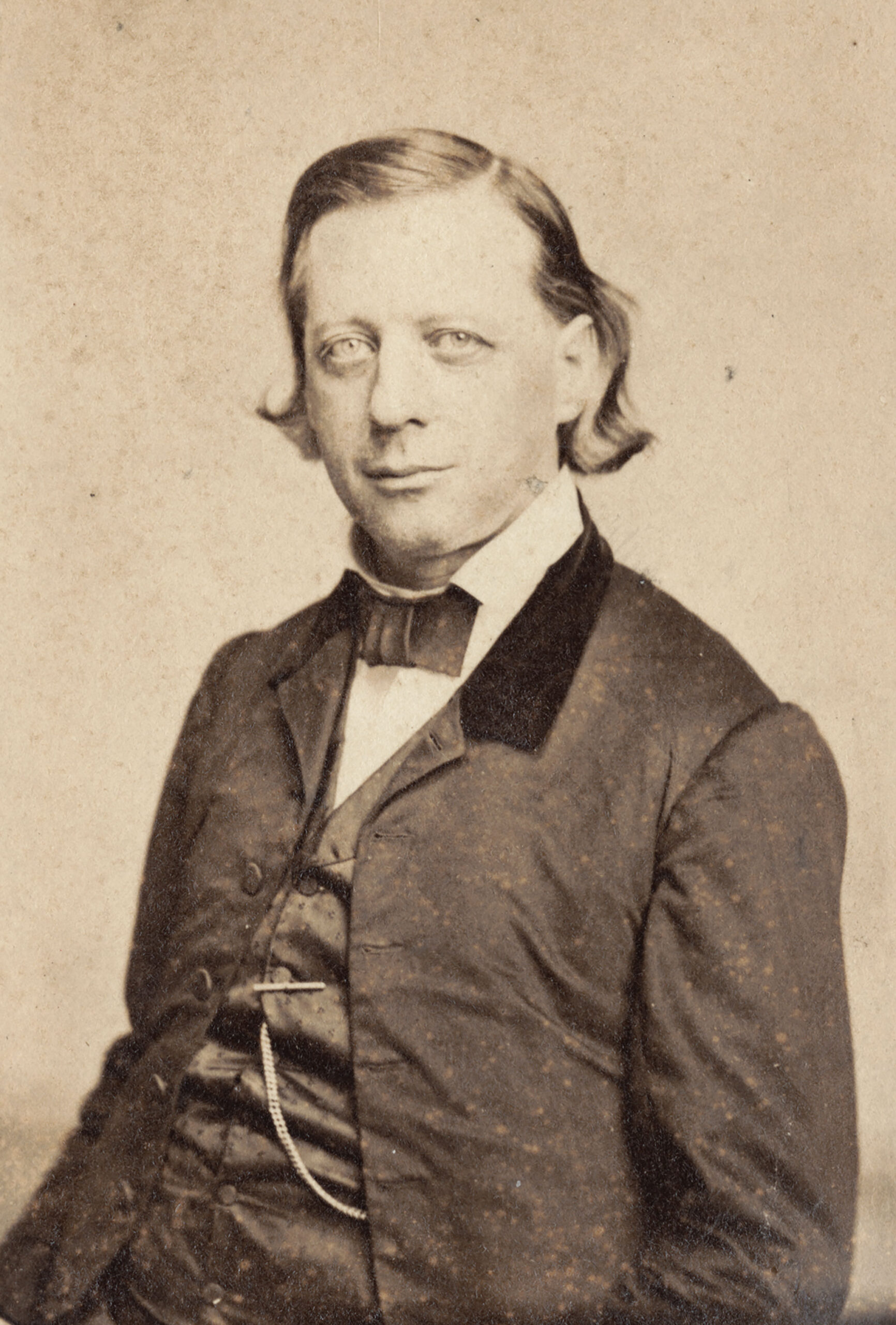
Henry Ward Beecher
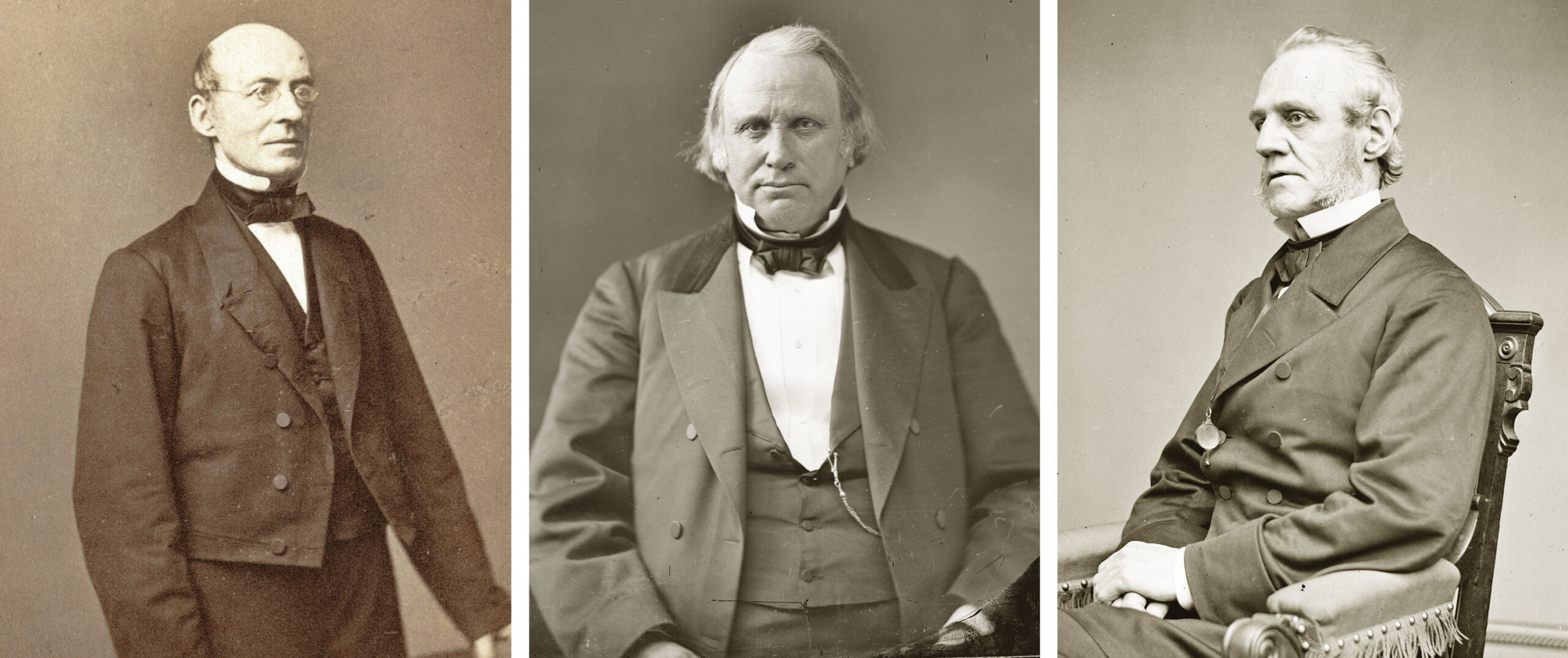
William Lloyd Garrison and George Thompson traveled from New York City to Charleston aboard the steamship Arago along with several other leading antislavery figures, including minister Henry Ward Beecher, newspaperman Theodore Tilton, and Senator Henry Wilson of Massachusetts. They went south not just to see the capital of American slavery for themselves but also, at the behest of the White House, to participate in the flag-raising festivities at Fort Sumter.
President Abraham Lincoln and his cabinet understood the symbolic significance of the occasion. While the flag-raising ceremony itself signaled political and military victory, they made sure to include individuals who would underscore the revolutionary social changes wrought by the conflict. Secretary of War Edwin M. Stanton asked Beecher, a renowned orator and vocal critic of slavery, to give the ceremony’s keynote address. Stanton also invited Garrison—the most famous abolitionist in America, a man who had once publicly burned the Constitution—and Thompson to attend the ceremony as official guests of the government. Among the homegrown abolitionists who took part in the ceremony were Robert Smalls, the former slave who had dramatically seized his freedom by commandeering the Confederate ship Planter in Charleston three years earlier, and Robert Vesey, son of Denmark Vesey, who was executed for plotting an 1822 slave insurrection in the city.
At 10 a.m. on April 14, boats began ferrying people—northern and southern, soldier and civilian, white and black, all now free—out to Fort Sumter. Some made the short journey in steamships, while a number of the freedpeople ventured into the water in flats and dugouts, hoping that they might be picked up by a larger vessel, perhaps the legendary Planter. Still captained by Smalls, the ship ferried ex-slaves to Fort Sumter under an overcast sky.
Like Charleston, the tiny man-made island at the mouth of the harbor was a bombed-out shell of its former self. “Fort Sumter is a Coliseum of ruins,” Theodore Tilton wrote. “Battered, shapeless, overthrown, it stands in its brokenness a fit monument of the broken rebellion.” More than 3,000 people, including the Oceanus passengers and members of a black army regiment commanded by Beecher’s brother James, filled the fort, some spilling out onto its crumbling walls.12
 Library of Congress (2); Boston Public Library (Garrison)
(From left) William Lloyd Garrison, Henry Wilson, and George Thompson
The ceremony opened with a song, a short prayer, and recitations of several psalms as well as Major Anderson’s 1861 dispatch of surrender. Next, the former commander of Fort Sumter came forward. As Anderson and his old staff sergeant removed from a leather mailbag the enormous flag that had been taken down four years earlier, the crowd roared. Three sailors attached the flag to the halyards, and then Anderson began to speak. “After four long, long years of war, I restore to its proper place this flag which floated here during peace, before the first act of this cruel Rebellion,” he said, before thanking God that he had lived to see this day. Next, with the aid of a dozen men, including George Thompson, Anderson lifted the banner high into the air.
As “the old smoke-stained, shot-pierced flag,” rose, so too did everyone in the fort.13 Waving hats and handkerchiefs, the spectators erupted with shouts, laughter, and tears when the flag reached its peak. Their noisy cries were drowned out by the sound of six cannon fired from Sumter and many more that answered from the forts and batteries surrounding the harbor. “It was the most exciting moment in my life when the flag went up,” wrote Brooklyn pastor Theodore Cuyler.14
Beecher’s keynote address, which followed soon after, failed to match the emotion of the flag-raising exercise. With an eye toward the future, the minister had decided to read formal remarks rather than talk extemporaneously. His hour-long address “lacked the peculiar magnetism of his less studied efforts,” according to one eyewitness. Beecher “seemed deeply impressed with the consciousness that he was speaking, at least, semi-officially, and that his utterances would be regarded, not only as the voice of the authorities at the Capital, and of all the nation, but would pass from that hour into history.” The minister was also determined to strike a magnanimous note, which disappointed some of the partisans in his audience. Laura Towne, a Pennsylvania abolitionist who had come up from the Sea Islands of South Carolina, where she taught ex-slaves, wondered why he had bothered to reach out to white Charlestonians when “there were not a dozen there.”15
Although Beecher approached his address in a spirit of Christian forgiveness, he pulled no punches in assigning blame for the war—to “the ambitious, educated, plotting, political leaders of the South”—or in praising its radical results. “The soil has drunk blood, and is glutted,” he admitted, but the time has come “to rejoice and give thanks.” In unfolding the flag at Fort Sumter, the assembled were restoring the peace and sovereignty of the nation. “No more war! No more accursed secession! No more slavery, that spawned them both!” he intoned to great applause.16
That evening Major General Quincy A. Gillmore, commander of the army’s Department of the South, hosted a banquet at the Charleston Hotel. Attendees marveled not just at the “sumptuous dinner” but also at the presence of Garrison and Thompson. A New York Times correspondent observed that the life of either reformer “would not have been worth, the price of the rope which would have served to hang him, if he had simply ‘put in an appearance’” in Charleston a few months earlier.
After dinner, the guests offered up a series of toasts. President Lincoln was on the mind of many that night. Perhaps most moving were the words of Garrison, who had been a longtime critic of the president. “Of one thing I feel sure,” announced the editor, “either he has become a Garrisonian Abolitionist or I have become a Lincoln Emancipationist.” Whatever the case, Garrison concluded that Lincoln’s “brave heart beats for human freedom everywhere.” Little did he or anyone else in Charleston know that the president’s brave heart would not beat much longer. For that same night, as abolitionists and federal officers cheered the maintenance of the Union and the end of slavery, Lincoln’s assassin John Wilkes Booth made it clear that for some Confederates the war was not over.17
Charleston still had its fair share of unreconstructed Rebels, too. Writing from her residence on South Bay Street on April 14, Maria Middleton Doar fumed over the “crowds of Negro women accompanied by men in uniform parading on the battery” while they waited for the flag to be raised at Fort Sumter. “There is to be a ball tonight at Cousin W[illiam Middleton]’s house,” she told a cousin. “Would you believe that some Charleston ladies are going[?]” Doar was happy to report that “most of those who have been insulted by invitations have indignantly refused.”18
Outside the city, Confederate sympathizers also stewed. In May, Emma Holmes, an elite young Charlestonian who midway through the war had moved to Camden, more than 100 miles inland, wrote in her diary that the word from home was that a “grand Union glorification” had taken place on Good Friday. Among the fooleries of the day, she complained, were the flag-raising ceremony, a parade of the city’s black residents, and a “promiscuous ball” held at the Middleton residence— the same ball that troubled Maria Doar. Holmes found a measure of satisfaction in reports out of Charleston that “the really respectable class of free negroes, whom we used to employ as tailors, boot makers … etc., won’t associate at all with the ‘parvenue free.’”19
 Library of Congress
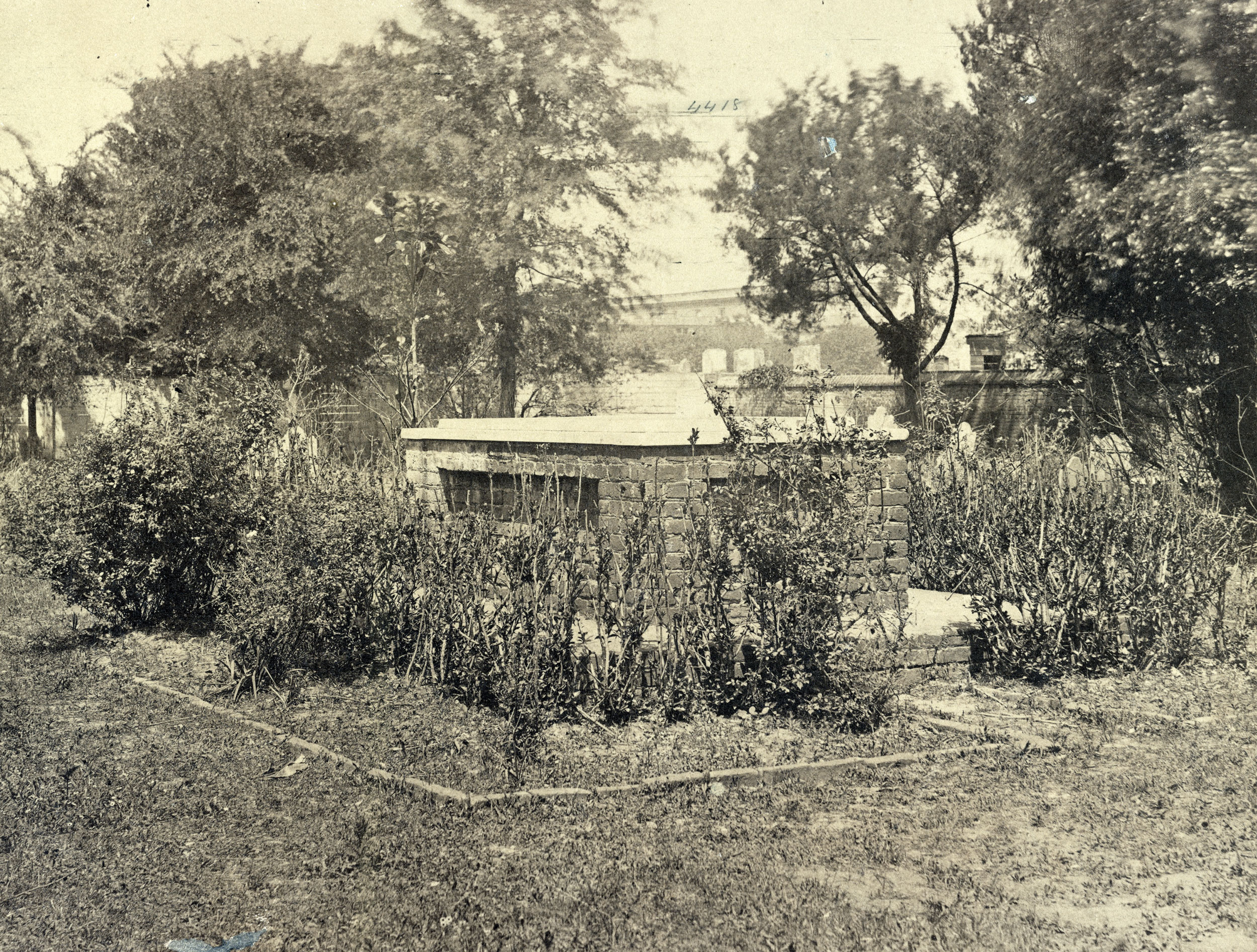
On April 15, the day after the flag-raising ceremony at Fort Sumter, Henry Ward Beecher joined a group of fellow northerners (including William Lloyd Garrison, Henry Wilson, and George Thompson) on a visit to the gravesite of John C. Calhoun. “All this great crop of war,” noted Beecher, “is from the dragon-toothed doctrines that were sowed by the hands of that dangerous man.”
Early Saturday, April 15, the morning after the flag-raising ceremony, Henry Ward Beecher strolled through Charleston, seeing reminders of slavery—and its demise—all over town. At one point, he called on former governor William Aiken Jr., who lived in an imposing home in the city’s northern section and had owned close to 1,000 slaves before the war. Beecher hoped to talk about the future with Aiken, a prominent Unionist, but the governor seemed drawn incessantly back to one point: “The President ought not to have issued his Proclamation.” Aiken spoke of his relationship with his slaves in “couleur de rose,” added Beecher. The governor’s tales were familiar. “There is a liturgy on the subject,” he wrote. “You take a thousand Southerners at Saratoga and Newport, and they will all repeat the same story of their care and nurture of the slaves, and of the addiction of the slaves to them.” The next day, Beecher spoke directly to Aiken’s former slaves, who gave him an altogether different impression. “We shall never know what slavery is,” he concluded, “until the slaves tell us.”
Later that morning, Beecher joined Thompson, Wilson, Tilton, and Garrison on a visit to John C. Calhoun’s gravesite. “All this great crop of war,” maintained Beecher, while standing over the (unbeknownst to him) empty tomb, “is from the dragon-toothed doctrines that were sowed by the hands of that dangerous man.” In what one eyewitness described as among the most striking scenes of the extraordinary weekend, Garrison put his hand on the simple marble slab, inscribed with just a single name: Calhoun. “Down into a deeper grave than this slavery has gone,” he said, “for it there is no resurrection.”20
The abolitionists stood in silence as Garrison’s pithy obituary hung in the air before walking the short distance over to the Citadel Green. Thirty years earlier, thousands of white Charlestonians had gathered on that parade ground to burn antislavery tracts and an effigy of Garrison in a large bonfire. But on April 15, 1865, the Citadel Green played host to thousands of black Charlestonians who were listening to the words of black reformer and Union officer Martin Delany.
That afternoon, a vast crowd packed into Zion Presbyterian Church, adjacent to the green on the corner of Calhoun and Meeting streets, to listen to speeches by Garrison, Thompson, and Henry Wilson, among others. At the start of the program, an ex-slave named Samuel Dickerson came forward with his two small daughters, each of whom carried a bouquet of flowers. Dickerson, who would become a lawyer and Republican activist in the decade that followed, welcomed Garrison with moving words. The Massachusetts abolitionist replied that he was incapable of expressing the overwhelming emotions he felt as he listened to Dickerson and looked into the faces of the enormous audience. Reminding them that he had been fighting slavery for nearly four decades, Garrison confessed that he thought that this day would never come. “Thank God this day you are free!” he proclaimed to great cheers. “And be resolved that, once free, you are free forever.” Garrison also read from a sales records book that someone had recovered from a slave-trading firm, as well as a recent newspaper advertisement for “an active boy about fourteen years old.” Looking out at the black masses before him, the abolitionist editor asked, “Have any of you got such a boy to sell?” The crowd began to sway back and forth, scream, cry, and shout, “No!”21
Later in the program, the entire crowd sprung to its feet when someone invoked the name of the “great Emancipator” and “hats and ‘kerchiefs, swung to the wildest cheers!” (Word of Lincoln’s assassination—he died not long before the exercises had begun—would not arrive in Charleston until the following week.) The meeting closed after the assembled determined to follow up on the weekend’s events by inviting Wendell Phillips, Frederick Douglass, and other northern reformers to join them in celebrating the Fourth of July in Charleston. Afterward, the black citizenry escorted the abolitionists back to the Charleston Hotel, forming a procession that seemed a mile long.22
On Monday, April 17, as Beecher, Garrison, Thompson, and company prepared to leave Charleston, the crowds were even larger. “The streets were full of colored people,” wrote Beecher, who noted that Union soldiers, including Garrison’s own son George Thompson Garrison, had been busy liberating thousands of slaves from nearby plantations. Though desperately poor, the freedpeople who joined Garrison and his colleagues at the wharf offered whatever tokens of gratitude they could spare. Some carried roses, others honeysuckles. Samuel Dickerson offered another eloquent speech, and black children belted out songs. At 10 a.m., the abolitionists sailed out of Charleston, watching as Dickerson knelt at the wharf’s edge, one arm draped around his daughters and the other holding the American flag.23
Blain Roberts and Ethan J. Kytle, professors of history at California State University, Fresno, are authors of Denmark Vesey’s Garden: Slavery and Memory in the Cradle of the Confederacy (The New Press, 2018).
Notes
1. [Justus Clement French], The Trip of the Steamer Oceanus to Fort Sumter and Charleston, S.C. (Brooklyn, 1865), 25.
2. Theodore Cuyler, “Etchings at Fort Sumter,” Independent, April 27, 1865.
3. New-York Tribune, April 18, 1865; Trip of the Steamer Oceanus, 39.
4. Theodore Cuyler, “A Trip to Fort Sumter and the Doomed City,” Liberator, May 5, 1865.
5. See Teresa Barnett, Sacred Relics: Pieces of the Past in Nineteenth-Century America (Chicago, 2013), 21–23, 50–105; Joan E. Cashin, “Trophies of War: Material Culture in the Civil War Era,” The Journal of the Civil War Era 1 (September 2011): 339–367; and Megan Kate Nelson, Ruin Nation: Destruction and the American Civil War (Athens, 2012), 154–157, 229–232.
6. Warren Lee Goss, The Soldier’s Story of His Captivity at Andersonville, Belle Isle, and Other Rebel Prisons (Boston, 1867), 207.
7. Theodore Tilton, “The Excursion to Fort Sumter,” Independent, April 27, 1865.
8. New-York Tribune, March 2, 1865.
9. The New York Times, March 6, 1865; New-York Tribune, March 2, 1865.
10. Philadelphia Press, March 30, 1865.
11. “An Immense Meeting in Music Hall,” Liberator, March 17, 1865.
12. Tilton, “Excursion to Fort Sumter.”
13. Trip of the Steamer Oceanus, 51–52.
14. Cuyler, “Trip to Fort Sumter.”
15. Trip of the Steamer Oceanus, 55; Laura M. Towne, The Letters and Diaries of Laura M. Towne, ed. Rupert Sargent Holland (1912; reprint, New York, 1969), 161.
16. Trip of the Steamer Oceanus, 67, 58.
17. The New York Times, April 20, 1865; “Banquet in Charleston,” Liberator, May 12, 1865.
18. Maria Middleton Doar to Maria H. Middleton, April 14, 1865, Folder 8, Box 161, Doar-Middleton Families Papers, South Carolina Historical Society, Charleston, SC.
19. Emma Holmes, diary, May 1, 1865, in The Diary of Miss Emma Holmes, 1861-1866, ed. John F. Marszalek (Baton Rouge, 1979), 441–442.
20. Henry Ward Beecher, “Narrative of His Trip to South Carolina,” Independent, May 11, 1865; A.P. Putnam, “Abolitionists in Charleston,” Independent, April 27, 1865.
21. Trip of the Steamer Oceanus, 99; Elizabeth G. Rice, “A Yankee Teacher in the South,” Century Magazine 62 (May 1901): 154.
22. Esther Hill Hawks, diary, April 15, 1865, in A Woman Doctor’s Civil War: Esther Hill Hawks’ Diary, ed. Gerald Schwartz (Columbia, 1984), 132.
23. Beecher, “Narrative of His Trip.”
This article is adapted from Denmark Vesey’s Garden: Slavery and Memory in the Cradle of the Confederacy by Ethan J. Kytle and Blain Roberts. Copyright © 2018 by Ethan J. Kytle and Blain Roberts. Used with permission of the publisher, The New Press. All rights reserved.