 Library of Congress
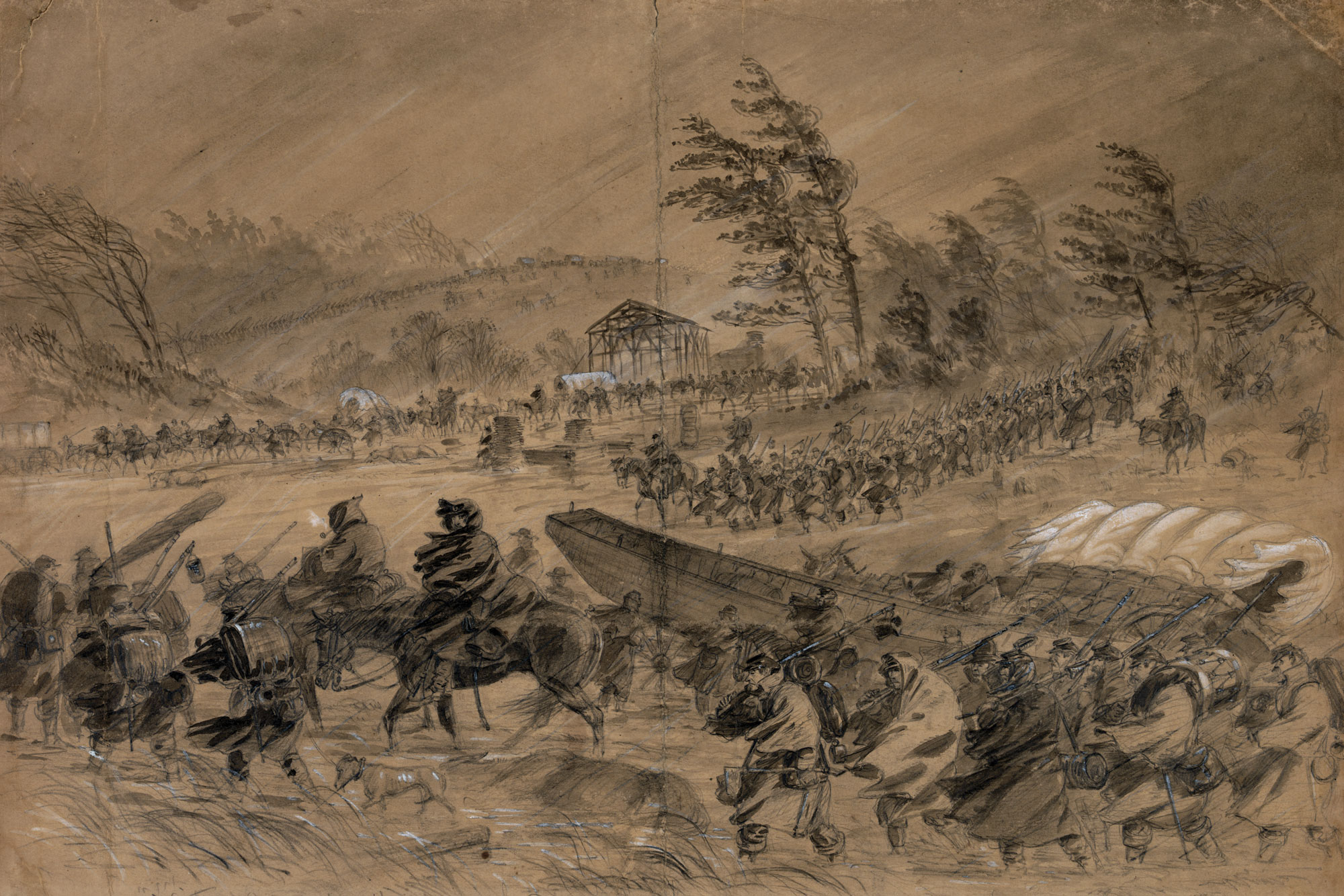
Union soldiers brave the elements during a winter march in this Alfred R. Waud sketch. The soldiers who campaigned in East Tennessee during the winter of 1863-1864 suffered similarly frigid conditions.
Bloody footprints trailed both Union and Confederate soldiers maneuvering for advantage in East Tennessee during the winter of 1863-1864. Only in those isolated mountains had the opposing armies not halted active operations for the winter. In November, Confederate general Braxton Bragg had dispatched James Longstreet’s corps, reinforced by two cavalry divisions, to East Tennessee to recover Knoxville from U.S. forces, while he besieged the enemy Army of the Cumberland in Chattanooga. The results were not what Bragg had expected. Near month’s end, his army suffered decisive defeats outside Chattanooga at Lookout Mountain and Missionary Ridge, while Longstreet’s campaign against Knoxville, “widely held to be the Confederates’ poorest,” ended in defeat in mid-December, prompting southern diarist Mary Chesnut to observe, “what a horrible failure, what a slow old humbug is Longstreet.” Yet even after Longstreet ended his Knoxville operation, the presence of his ragged infantry and poorly shod cavalry forced the Union to retain significant forces in the area.1
“Frozen edges of earth cut into naked feet,” the Charleston Courier reported about the South Carolina troops stationed that winter in East Tennessee, “until the path of the army may be almost said to have been tracked in blood.” “The whole corps is barefoot & in rags,” wrote Lieutenant William R. Montgomery of the 3rd Georgia Sharpshooters, “some of them wear mockersons made of rawhide.” Horseshoes were in such short supply that cavalrymen extracted shoes and nails from the hooves of dead horses, and pulled bloated equine corpses out of frigid rivers for salvage. Robert Coles of the 4th Alabama reflected that “this was the coldest winter the regiment experienced, and in which we suffered more hardships than during any other.”2
Union troops posted in the area suffered almost as intensely. Colonel Samuel W. Price of the 21st Kentucky reported men with “feet lacerated for the want of shoes,” and Lieutenant Colonel Oliver van Tassell of the 34th Illinois Infantry complained that “a number of them were quite barefoot.” Major General John G. Foster, commanding the Army of the Ohio, the chief Union force in the region, admitted that “one-half the men were unfit for a march for want of shoes or clothing. The issue of bread or meal rarely came up to one-quarter of the ration.” One Yankee corporal philosophically informed his kin, “Last year I think I told you I had a mess of beans and pork for a Christmas dinner. This year I am not so fortunate.”3
Food, rather than grand strategy, kept drawing Longstreet and Foster into battle. Following Bragg’s defeat at Chattanooga, Longstreet found himself operating at the far end of an extremely tenuous supply line. His only rail connection to Virginia delivered bare essentials: ammunition, medicine, and occasionally shoes or clothing. For food, he had to forage in the foothills of the Clinch Mountains. Foster drew his supplies through Chattanooga, but the U.S. troops stationed there had nearly starved that fall and had needs of their own, and the railroads leading back to Nashville had not been repaired. Thus minimal supplies reached Chattanooga, just the leavings of which were available for Knoxville. Union supply officers also concentrated on forwarding ammunition, medicine, shoes, and clothing, leaving Foster to glean rations by whatever means available.
East Tennessee’s most bountiful foraging area lay between Foster’s base at Knoxville and Longstreet’s Morristown headquarters, 40 miles up the Holston River. South of the Holston, in a quadrilateral roughly bounded by the run of the French Broad River to Bull’s Gap, were Strawberry Plains, New Market, Mossy Creek, and Dandridge, coveted so fervently by both armies that barefoot men marched through blizzards to fight for them. Longstreet waxed eloquent regarding the area’s largess: “Pumpkins were on the ground in places like apples under a tree. Cattle, sheep, and swine, poultry, vegetables, maple-sugar, honey, were all abundant.” As Brigadier General Samuel Sturgis, Foster’s cavalry chief, observed: “Breaking the enemy’s backbone is well enough, but I think it will do him equal injury to break his belly.”4
 Library of Congress
The Battle of Dandridge had its origins in recent Union victories at Knoxville (pictured here) and Chattanooga.
Bone-Piercing Cold
Temperatures plummeted on New Year’s Day 1864. “The whole idea of the ‘Sunny South’ is exploded,” groused one Pennsylvanian, and a trooper wearing the Union blue of the 9th Kentucky Infantry experienced “a coldness that seemed to pierce the very bones.” Colonel Asbury Coward of the 5th South Carolina found his thermometer reading 8 degrees when Major General Ulysses Grant arrived in Knoxville on January 2. Currently commanding the Military Division of the Mississippi (virtually all Union troops between Virginia and the Mississippi River), and well aware that he was soon to be named general-in-chief of the U.S. Army, Grant came, determined that “if Longstreet is not driven from Tennessee soil, it shall not be my fault.” The Illinoisan reluctantly authorized a 10-day postponement of operations to accumulate supplies, a period of inactivity broken only by small cavalry actions. Brigadier General William E. “Grumble” Jones’ rebel brigade braved freezing temperatures on January 3 to surprise a Union garrison at Jonesville, just across the Virginia border, seizing nearly 400 prisoners, three cannon, and 27 wagons. Colonel William J. Palmer’s 15th Pennsylvania Cavalry returned the compliment on January 14, breaking up a raiding party out of North Carolina and capturing Brigadier General Robert B. Vance, brother of the Tarheel State’s governor.5
Grant’s insistence on a mid-winter offensive produced the war’s biggest fight of that dreary January. Setting a deadline of January 15, he ordered Foster to “drive Longstreet at least beyond Bull’s Gap.” Impatient at a continual lack of initiative in the Army of the Ohio, Grant specified the plan: The IX and XXIII Corps would advance to Mossy Creek, the IV Corps to Strawberry Plains, and Sturgis’ cavalry to Dandridge to “threaten Longstreet’s flank.” From those positions they would launch the attack, the IV Corps pushing two divisions to Dandridge as a preliminary gambit. Though his supplies remained inadequate, Foster moved on schedule—more than likely because he knew that Grant was on the verge of relieving him.6
By mid-January the Army of the Ohio’s three infantry corps and three cavalry divisions fielded just 23,000 poorly clad soldiers, controlled by a patchwork command structure. Foster had been incapacitated after a fall from his horse reopened an old wound, forcing him to turn over command to the IX Corps’ John Parke. Parke—a better staff officer than commander—remained at Strawberry Plains, directing operations by courier. Gordon Granger found himself too indisposed to accompany his IV Corps, leaving the advance—about 13,000 men—under the de facto control of the senior division commander, Phil Sheridan.7
Longstreet could have waited the Yankees out. With the forage around Strawberry Plains exhausted, that remaining near Mossy Creek sufficed for little more than the Union cavalry. Parke complained that “when over the river I am at a loss to know how to provision it [the advance], and when it reaches Dandridge the difficulty is as great, if not greater.” As William T. Sherman observed, Foster’s army was “bound to go ahead or fall back,” bringing on a battle before lack of food forced a retreat. Longstreet, on the other hand, could either sit in his defenses or fall back, drawing the Federals farther from their meager sources of supply.8
Nonetheless, Longstreet reacted aggressively when his cavalry relayed word of the U.S. advance. He ordered two divisions to march for Dandridge, and had three more brigades brought up by train from Bull’s Gap. Longstreet claimed that he simply did not want “to leave our shoe factory and winter huts and take up the tedious rearward move,” but contemporary evidence suggests otherwise. General Joseph Johnston, Bragg’s successor in command of the Army of Tennessee, had just complained to President Jefferson Davis from Georgia, “Longstreet has gone into winter quarters. If he has suspended active operations, I should like to have the cavalry belonging to this army.” Longstreet countered, “I am obliged to forage here or leave the country; without the cavalry cannot forage,” neglecting to mention that he had already suggested that East Tennessee should be abandoned. “I do not think we can do anything here or at Chattanooga,” he had recently written Robert E. Lee, arguing that his infantry should be transferred back to Virginia to “throw our forces behind General Meade and catch him in the mud.” This could be accomplished “if we could leave our cavalry here to destroy the railroad,” which meant retaining Johnston’s horsemen. Sitting quietly while the enemy penetrated his main foraging area would hardly convince anyone that he had not “gone into winter quarters.”9
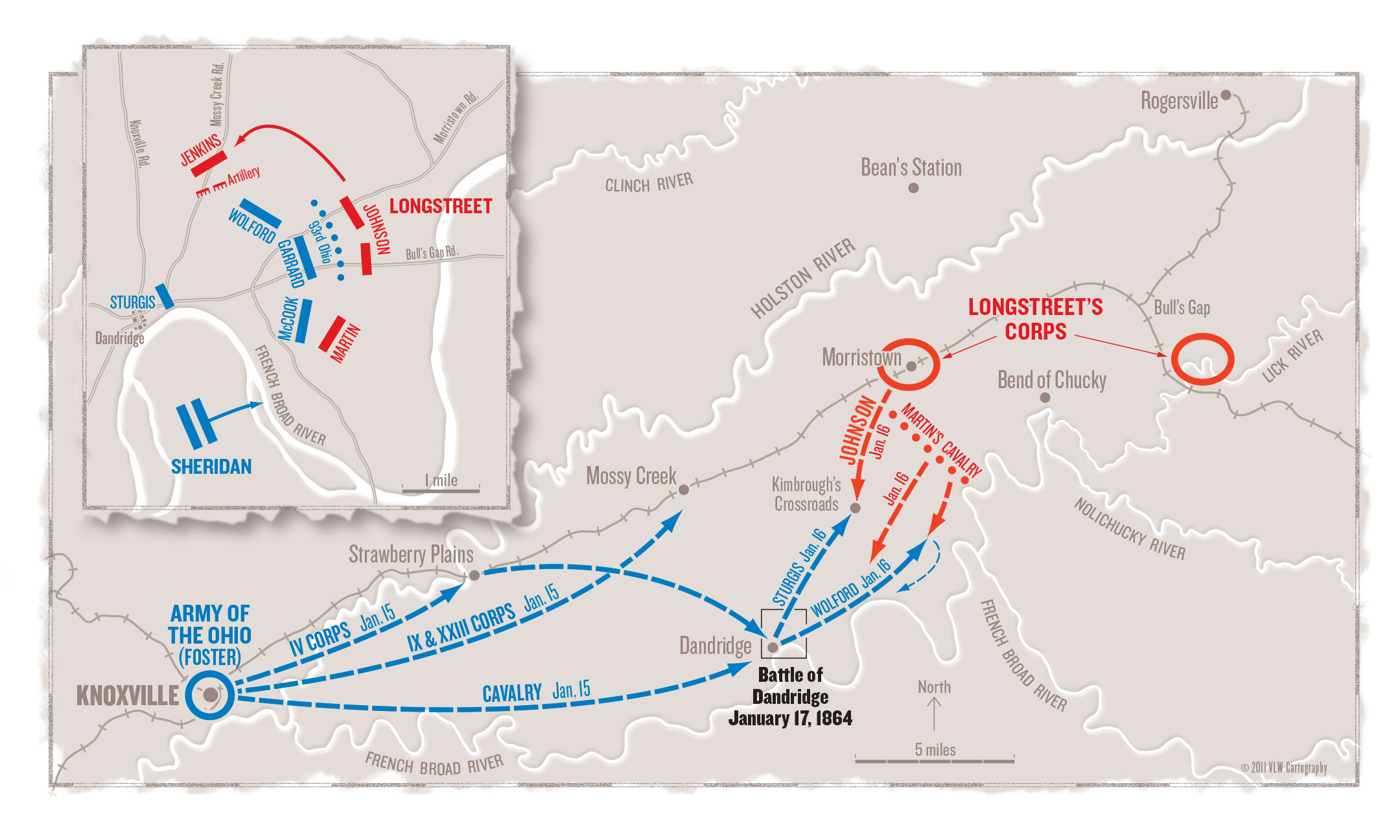
The Battle of Dandridge | East Tennessee | January 1864: In the wake of Union victories at Knoxville and Chattanooga, Grant launched a mid-winter offensive, ordering elements of John Foster’s Army of the Ohio to drive James Longstreet’s Confederates at least beyond Bull’s Gap, and preferably out of East Tennessee altogether. On January 15, U.S. forces began a three-pronged advance from Knoxville; on January 17, a day after Longstreet successfully beat back the lead Union element—cavalry commanded by Samuel Sturgis—at Kimbrough’s Crossroads, the opposing forces, buttressed by reinforcements, clashed again, just outside of Dandridge.
Unpleasant Surprises
Equally critical to Longstreet’s decision was his state of mind. The Knoxville misadventure had badly shaken the Georgian’s self-confidence; the troops, rumor held, had nicknamed him “Peter the Slow,” and even his headquarters staff became disillusioned. Frustrated, Longstreet lashed out at his subordinates, relieving longtime friend Lafayette McLaws and Texan Jerome Robertson, while creating an atmosphere of disaffection between Micah Jenkins and Evander Law, the senior brigadiers fighting each other for command of John B. Hood’s old division. Dimly perceiving how badly his reputation had tarnished, Longstreet had recently offered his resignation. When Richmond refused it, the Georgian decided to start his rehabilitation on the battlefield. He needed a good fight.10
Though cavalry would play a critical role in the fighting during the next two days, neither side’s mounted leadership was particularly inspired. The 41-year-old Sturgis had earned his spurs as an Indian fighter: profane, bombastic, hard drinking, and ruthless. Pursuing Mescalero raiders in 1855, the then-lieutenant of the 1st U.S. Cavalry was faced with renegades attempting to surrender. “Well, men, I do not understand a word they are saying,” he shouted, “haul off and let them have it.” Commanding an infantry division through Fredericksburg, the Pennsylvanian became more famous for wit (“I don’t care for John Pope one pinch of owl dung!” he had remarked about one of his former commanders) than for fighting ability. Major General William T. Martin, a 40-year-old Mississippi lawyer, led a cavalry regiment in Virginia before being promoted to division command in Tennessee. Longstreet’s opinion was unequivocal: “Martin has not had experience enough to give him confidence in himself or his men. Without confidence a cavalry leader can have no dash, and without either he cannot be the leader we need.”11
Sturgis set out on January 16 to seize Kimbrough’s Crossroads, a key road junction nine miles east of Dandridge, which would block Longstreet’s access to Bull’s Gap if the Confederates retreated, or threaten the Georgian’s rear if he engaged Foster’s infantry. Dangerously overconfident, Sturgis split his command on diverging roads, leading 2,000 horsemen on the Bull’s Gap road, while sending Colonel Frank Wolford and 1,000 cavalry several miles farther south on the Bend of Chucky road. Sturgis invited Sheridan, who had just arrived in Dandridge, to ride along and see him “whip the enemy’s cavalry.” “Little Phil” declined, preferring to supervise the construction of the pontoon bridge necessary for his divisions to cross the French Broad.12
 Library of Congress (6)
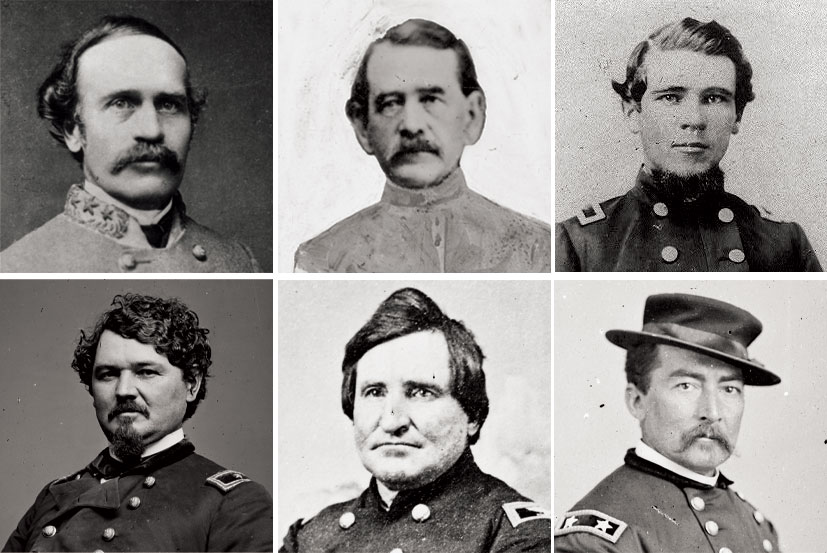
Battle of Dandridge key commanders: (clockwise from left) Bushrod Johnson, William T. Martin, Micah Jenkins, Philip Sheridan, Frank Wolford, and Samuel Sturgis.
Frank Wolford, a Mexican War veteran and criminal lawyer, had raised the 1st Kentucky Cavalry, sparred with Rebel cavalryman John H. Morgan through 1862-1863, and participated in the chase that finally bagged the famed raider in Ohio. Confederate George Mosgrove paid him the ultimate compliment: “If there ever existed a body of Federal troops that the Kentucky boys dreaded to meet, it was gallant General Frank Wolford’s famous Kentucky command.” Sturgis believed that Wolford could easily handle any detachments of Rebel cavalry picketing the lower road. Neither officer expected the Kentuckian to run into all four Confederate cavalry brigades.13
Longstreet met Martin about mid-morning, five miles east of Dandridge, “having come forward to be assured that our cavalry had not mistaken a strong cavalry move for one by the enemy [infantry].” The Mississippian was “engaged with the enemy, both sides on strong defensive grounds and using their horse batteries, but no infantry was in sight.” Martin did not know how much Union cavalry opposed him, or how far back Yankee infantry might be found; he did know that Sturgis was flanking him on the Bull’s Gap road. Longstreet, aware that Sturgis would collide with an infantry division at Kimbrough’s Crossroads, directed Martin to determine how many Federals held the hill in his front by throwing them off. Wolford’s skirmishers relinquished the hill, but bought their commander time to deploy on the next ridge, which he prepared to defend more tenaciously. Longstreet’s practiced eye gauged the Union force to be much smaller than his own, and detected no evidence of infantry support. He ordered Martin to take the hill. The Mississippian demurred, saying “he thought it could not be done without infantry.” Irritated, Longstreet instructed the cavalryman to detach a brigade for his own use, and to keep the enemy’s attention focused on the main Confederate line.14
Noticing a patch of woods that would conceal his movement, Longstreet led 600 horsemen of the 3rd Arkansas, 6th North Carolina, and 8th and 11th Texas Cavalry around the Union left flank. In a clearing they dismounted, leaving behind one-quarter of their number as horse-holders, and one of the Confederacy’s senior generals formed 450 troopers into a single line and headed up the hill. Wolford’s pickets fired a few shots at the attackers, alerting the Union commander that he was being turned; again, he ordered his division to retreat.15
Sturgis discovered his own unpleasant surprise at Kimbrough’s Crossroads: two Rebel infantry brigades under Brigadier General Bushrod Johnson. Initially convinced that only a regiment on picket confronted him, Sturgis ordered Colonel Archibald Campbell’s lead division to dismount and seize the crossroads. Johnson’s division, having left hundreds of barefoot soldiers at Morristown, counted only about 1,000 muskets and four cannon, but the 46-year-old Ohio native who had followed his adopted Tennessee in 1861 was a West Pointer, a Mexican War veteran, and an excellent tactician. Not about to be hustled out of position by Yankee cavalry, Johnson calmly deployed behind his skirmishers, brought up his artillery, and prepared to move forward. Sturgis later convinced himself that he had never intended to capture the crossroads, just reconnoiter, and that “the object of the reconnaissance being accomplished,” it was time to withdraw. Johnson barely acknowledged the action, noting that Sturgis had “dashed on our pickets, then formed a line and skirmished for an hour.”16
Had Longstreet remained with the cavalry he might have destroyed Wolford’s division, seized Dandridge, and isolated Sturgis’ entire command. The Georgian, however, left to bring forward his infantry, and Martin reverted to his normal caution, following Wolford but not pushing him. Even so, leading his jaded division back from Kimbrough’s Crossroads, Colonel Campbell reported that “the enemy had driven Wolford’s division back in disorder”; Colonel Thomas Jordan of the 9th Pennsylvania Cavalry less charitably described “Wolford’s division in full retreat, galloping away from the enemy.” Campbell brought his troopers in on Martin’s right flank, brushing an unsuspecting brigade off a ridge about a mile outside Dandridge, which the Federals held until dusk ended the day’s fighting.17
Sturgis sent a panicky dispatch to Sheridan, insisting that he needed infantry support to hold the town. Sheridan reinforced the cavalry with some XXIII Corps infantry under Colonel Daniel Cameron. His own division and that of Brigadier General Thomas J. Wood he kept west of Dandridge, planning the next morning to erect his bridge over the French Broad, cross it, and place himself on the Confederates’ left flank. He also “deemed it advisable that the responsible commanders of the army should be present, and so informed them.” Parke and Granger, receiving Sheridan’s message, finally left Strawberry Plains, but would not reach Dandridge until the next night. Sheridan, fixated on his pontoons, left the defense of Dandridge in Sturgis’ shaky hands.18
 Library of Congress (2)
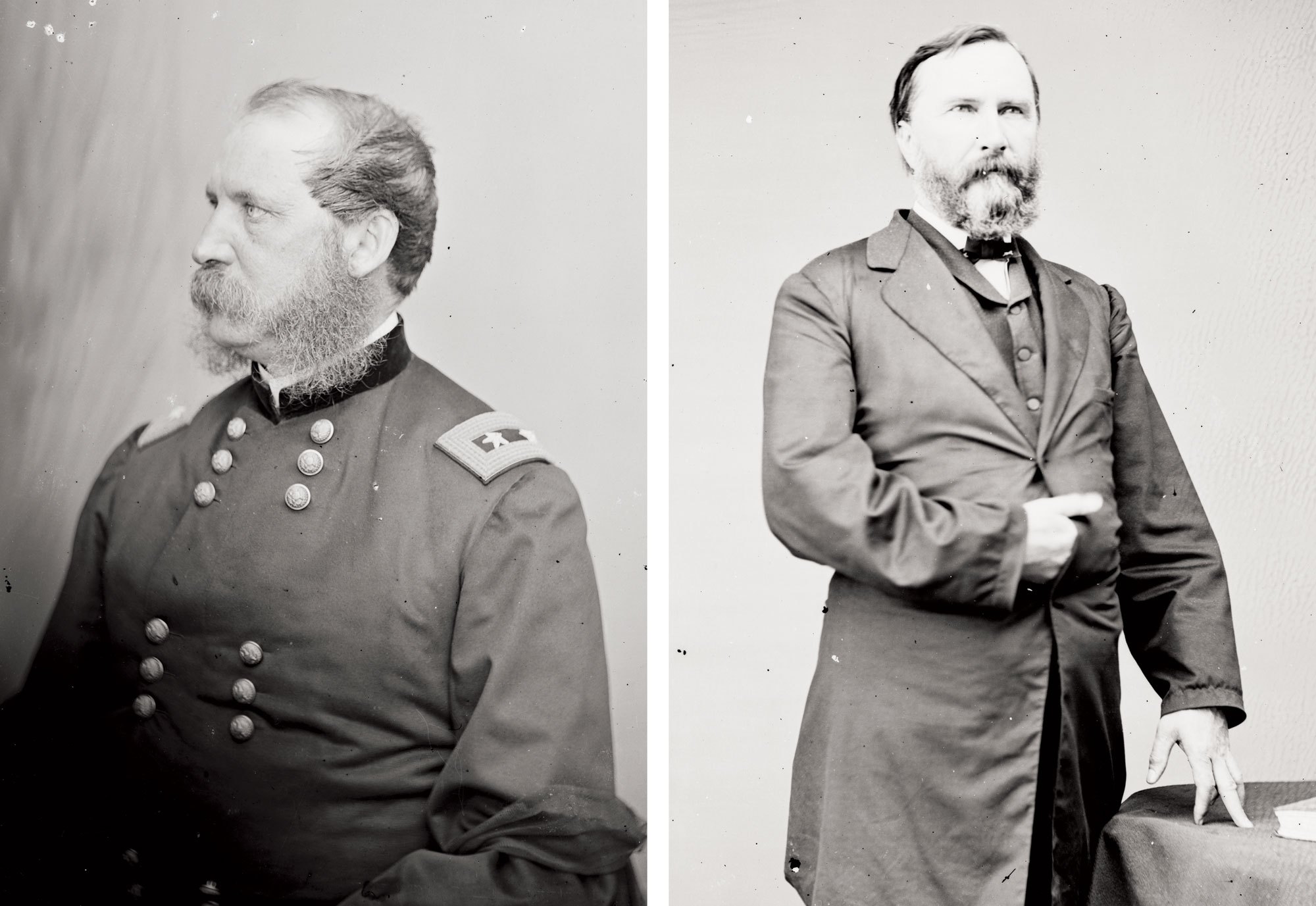
Confederate forces under Lieutenant General James Longstreet (right) engaged elements of the Union army commanded by Major General John G. Foster (left) at Dandridge.
Longstreet’s infantry spent most of January 17 struggling over 10 miles of frozen roads, upon which “bleeding feet left marks at every step.” Nonetheless, by 4 p.m. the Georgian had concentrated 3,000 infantry, 1,500 horsemen, and eight guns outside Dandridge; seven miles to the rear were Major General Robert Ransom’s two thin brigades, whose men had packed their ruined shoes “with straw and leaves … so that they could not be tracked through the snow by bleeding feet.” Sturgis deployed along the last ridge east of Dandridge, with Wolford on the left, Colonel Israel Garrard in the center, and Colonel Edward McCook (quitting a sickbed to supersede Campbell) on the right. Realizing that Wolford’s men were still demoralized, Sturgis picketed their front with an infantry regiment, the 93rd Ohio. The Pennsylvanian therefore fielded 2,500 cavalry, a few hundred infantry, and four cannon. Another infantry brigade, consisting of some 1,000 to 2,000 men, remained nearby in Dandridge, though Sheridan inexplicably stationed it there without either subordinating its commander to Sturgis or providing him with any clear orders.19
Longstreet planned to repeat the previous day’s turning movement. Jenkins’ brigades threaded their way through some woods on the Union left, the artillery following far enough behind that “the ringing of the iron axles of the guns might [not] give notice of our purpose.” With the infantry established on Sturgis’ flank, the batteries deployed to support the attack. Johnson spread his regiments across the front of the Union line, while Martin demonstrated on the far left. Delays in getting the infantry in place kept Longstreet from attacking until nearly dusk, but when he did, everything came off with clockwork precision.20
Martin’s cavalry “drove back our pickets so rapidly that he was enabled to open a flank fire,” reported Colonel Oscar La Grange, whose brigade had to be shifted to counter the threat. Minutes later, Longstreet’s main attack tore into the 93rd Ohio; “they were driven in and pursued with great fury,” Wolford admitted. He reinforced the 93rd with 12th Kentucky Cavalry, and—as the fighting grew heavier—the rest of his division. Although Wolford later claimed to have “repulsed him, driving him back into the woods,” the truth was otherwise. La Grange, engaged with Martin’s diversionary attack, looked over his shoulder to see the Confederates driving Wolford’s command again: “The enemy’s infantry advanced on our line across an open field, disregarding our fire … [and] passing heedlessly over the bodies of their fallen comrades.” La Grange made no apologies for pulling back: “without waiting [for] so hopeless a contest as must have taken place between dismounted cavalrymen and a superior force of trained infantry, our line was withdrawn.” McCook, sensing imminent disaster, summoned the infantry in Dandridge forward, only to be informed by the first regimental commander encountered that “he was placed there on picket and had no orders.”21
Darkness and a shift in the weather saved Sturgis from a complete debacle. By the time Jenkins’ men redeployed to face west and the artillery had been brought up, it was nearly 8 p.m., and a light drizzle had begun to winter. Rebel infantrymen soon found ground softened into mud less to their liking than a hard freeze. McCook located Cameron, who authorized his regiments to support the cavalry, while Sturgis’ men fell into another ragged line just outside Dandridge. As the Pennsylvanian waited to see if Longstreet planned a night attack, Parke and Granger rode up.22
The Federals’ situation was not—or should not have been—that serious. Longstreet had attacked with 4,500 men, and could call forth another 800 to 1,200 during the night. Around Dandridge, Parke had 2,000 demoralized cavalry and 2,500 infantry. Southwest of the town, Granger’s two divisions, totaling 10,000 soldiers, had the potential to deliver a crushing attack on the Confederate left once Sheridan crossed the French Broad. “Little Phil” had worked his men all day to construct a bridge by driving wagons into the river and planking over their beds. Consuming 25 condemned wagons brought for that purpose and still short of the far shore, he cannibalized his supply train to span the final distance. By late afternoon the first infantry tramped across, only to discover that Sheridan had built a bridge to a large wooded island, on whose far side remained several hundred yards of icy water. Foster spoke of Sheridan’s “great mortification”; Sheridan never filed a report, and baldly lied about the incident in his memoirs. Parke took this miscue as a decisive omen, retreating during the night. “The troops fell into column sullen and silent,” remarked one Indiana officer. “After all our marching & fighting all winter, everything was lost in one big blunder.”23
“The retreat seems to have been made somewhat hastily and not in very good order,” Longstreet reported, riding into Dandridge at dawn. “[T]he enemy is much demoralized.” He ordered Martin to harass the retreating Federals, though his horses lacked shoes and the rain had turned back into snow. Longstreet’s infantry was in no condition to pursue anyone; wrote one Georgian, “we had a hard time but that is very common now with Longstreets corps.” Nonetheless, Longstreet’s spirits had been revitalized by two days of tactical success.24 When Martin reported Parke withdrawing past Strawberry Plains, he demanded relentless pursuit: “If you press him vigorously it will become a panic.” Convinced that he might stampede the Federals out of the region, Longstreet requested a pontoon bridge from Virginia—”by rail; I need it quick”—because the unexpected receipt of 2,000 shoes allowed him to consider advancing infantry in support of his horsemen.25
 Library of Congress
Major General John G. Parke, whose retreat from Dandridge created a furor bordering on panic among Union forces.
Parke’s retreat created a furor bordering on panic. Foster credited rumors that 15,000 Rebels had reinforced Longstreet from Virginia—errant nonsense, but Foster was too sick and Parke too timid to realize it. Foster ordered Parke to send his trains and wounded back to Knoxville, and “to winter back on that place with his whole force should the enemy advance.” He wired Grant that he was preparing for another siege: “I … can stand him out here for ten days quite comfortably and for ten days more on horse-flesh if necessary.” The Illinoisan, about to depart for St. Louis to visit his desperately ill son, canceled his leave to coordinate a relief effort. Foster, Grant confided to Major General George Thomas, would have to go: “as I want Longstreet routed and pursued beyond the limits of the State of Tennessee, it is necessary to have a commander physically able for the task.”26
The panic quickly blew over. As far as most of the troops were concerned there had never been anything to be panicked about. The infantry, aside from the 93rd Ohio, had seen no action before being countermarched at the inexplicable whims of its officers. Had they been privy to the fears of their generals, the soldiers would have been as bemused as Brigadier General Jacob Cox, who received “verbal inquires” on January 22 “in regard to the condition of my command.” Cox gently reassured Foster that the XXIII Corps “will most cheerfully undergo every hardship, and endure patiently every privation which a real military necessity may impose.” Foster recovered his aplomb in a few days (Parke and Granger had none to recover), wiring Grant on January 20 that he now discounted reports of Longstreet being reinforced, and was “doubtful of his intention to attack us here.” Grant left for St. Louis.27
Longstreet maintained the facade of an attack on Knoxville for two weeks, though the only real fighting consisted of inconsequential cavalry actions. Sturgis thrashed Martin in embarrassing fashion south of the French Broad on January 27. “General Martin had a severe cavalry fight,” Longstreet dryly informed Richmond. “He was driven back 4 miles, with a loss of 200 killed, wounded, and missing, and 2 pieces of artillery…. Do send me a chief of cavalry.” The following day Sturgis blundered headlong into Martin’s other division, more capably commanded by Frank Armstrong and supported by Johnson’s infantry. Armstrong ambushed the Federals south of Dandridge, shooting them up from the front as Johnson marched toward their rear. According to George Dibrell, one of Armstrong’s brigade commanders, Sturgis “retreated thirty-five miles before stopping … and reported at Sevierville he had fought all of Longstreet’s Infantry.” Such claims usually represented hyperbole, but in this case Dibrell might have been reading over Sturgis’ shoulder.28
Grant’s demands and Longstreet’s aspirations notwithstanding, neither side had the strength or the supplies to seize all of East Tennessee. They could only spar impotently, causing needless casualties and siphoning off resources better committed elsewhere. Foster summed up the situation on January 29, insisting, “We should avoid fighting a great battle in this section of the State. Large armies cannot be supported here for any length of time.”29 Unfortunately, Major General John M. Schofield was already travelling to Knoxville to relieve him, and Grant was no longer listening.
Soon, both Grant and Longstreet headed toward Virginia, to participate in the climactic showdown that would begin in the Wilderness a few months later. Most of Schofield’s troops would be sent to reinforce Major General William T. Sherman’s advance into Georgia. The sacrifices of barefoot soldiers on both sides around Dandridge and Knoxville that winter would become a nearly forgotten footnote of the war. Their bloody footprints literally marked a road leading nowhere.
Steven H. Newton is Professor of History and Political Science at Delaware State University. He is the author of nine books, including Joseph E. Johnston and the Defense of Richmond (University Press of Kansas, 1998) and Lost for the Cause: The Confederate Army in 1864 (Savas Publishing, 2000).
Notes
1. John E. Stanchak, “Knoxville Campaign,” in Patricia L. Faust, ed. Historical Times Illustrated Encyclopedia of the Civil War (New York, 1986), 420-421 [hereafter cited as HTIECW]; Judith Lee Hallock, General James Longstreet in the West, A Monumental Failure (Fort Worth, TX, 1995), 79-94; Jeffrey D. Wert, General James Longstreet, The Confederacy’s Most Controversial Soldier, A Biography (New York, 1993), 356-360; C. Vann Woodward, ed., Mary Chesnut’s Civil War (New York, 1981), 509; Lowell Harrison, “A Battle Beyond Knoxville,” Civil War Times Illustrated, vol. XXVI, no. 3 (May 1987): 16-21, 46-47; Bruce S. Allardice, “Longstreet’s Nightmare in Tennessee,” Civil War, vol. XVIII (June 1989): 32-43.
2. James J. Baldwin III, The Struck Eagle, A Biography of Brigadier General Micah Jenkins and a History of the Fifth South Carolina Volunteers and the Palmetto Sharpshooters (Shippensburg, PA, 1996), 255; James Longstreet, From Manassas to Appomattox (Secaucus, NJ, 1984; reprint of 1896 edition), 521, 526; George Montgomery Jr., ed., Georgia Sharpshooter, The Civil War Diary and Letters of William Rhadamanthus Montgomery (Macon, GA, 1997), 100; Edward Porter Alexander, Military Memoirs of a Confederate, A Critical Narrative (New York, 1993; reprint of 1907 edition), 491; United States War Department, The War of the Rebellion: A Compilation of the Official Records 129 vols. (Washington, 1880-1901), Series I, Vol. XXXII (part 1), 63, 94: 480; (part 2), 59 [herafter cited as OR; all references are to Series I unless otherwise noted]; J. Gary Laine and Morris M. Penny, Law’s Alabama Brigade in the War Between the Union and the Confederacy (Shippensburg, PA, 1996), 214; James K. Swisher, Prince of Edisto, Brigadier Micah Jenkins C. S. A. (Berryville, VA, 1996), 127.
3. OR, XXXI (part 1), 286-287; (part 2), 499, 501; (part 3), 358, 392; XXXII (part 2), 45, 59; William Gilfillin Gavin, ed., Infantryman Petit, The Civil War Letters of Corporal Frederick Petit (Shippensburg, PA, 1990), 132.
4. Longstreet, Manassas to Appomattox, 520; OR, XXXI (part 1), 630; LII (part 2), 581, 584.
5. Baldwin, Struck Eagle, 257; Edward Carr Franks, “The Detachment of Longstreet Considered: Braxton Bragg, James Longstreet, and the Chattanooga Campaign,” in Steven E. Woodworth, ed., Leadership and Command in the American Civil War (Campbell, CA, 1995), 56; Ulysses S. Grant, Personal Memoirs of U. S. Grant (New York, 1982; reprint of 1952 edition), 351; Gavin, Infantryman Petit, 182; Kenneth W. Noe, ed., A Southern Boy in Blue, the Memoir of Marcus Woodcock, 9th Kentucky Infantry (U. S. A.) (Knoxville, 1996), 250-251; Blair, Politician Goes to War, 150; OR, XXXI (part 3), 479, 879, 881; XXXII (part 1), 60, 66-69, 71, 75; (part 2), 9, 19, 43, 52-53, 507, 510, 511, 516, 528, 537, 550; LII (part 2), 582; Ezra J. Warner, Generals in Gray, Lives of the Confederate Commanders (Baton Rouge, 1959), 313-314; Gary C. Walker, The War in Southwest Virginia, 1861-1865 (Roanoke, 1985), 71-72; John C. Inscoe and Gordon B. McKinney, The Heart of Confederate Appalachia, Western North Carolina in the Civil War (Chapel Hill, 2000), 131-132.
6. OR, XXXI (part 3), 529, 571; XXXII (part 1), 33-34, 80; (part 2), 43, 63, 71-72, 82-83.
7. OR, XXXI (part 3), 548, 559, 889; Philip H. Sheridan, Personal Memoirs of P. H. Sheridan, General United States Army, one-volume edition (New York, 1992;
reprint of 1888 edition), 179-180.
8. OR, XXXII (part 1), 41, 45; (part 2), 3, 146-147.
9. Longstreet, Manassas to Appomattox, 526; OR, XXXII (part 2), 536, 541-542, 550; Michael West, 30th Battalion Virginia Sharpshooters (Lynchburg, 1995), 69.
10. Wert, Longstreet, 356-366; G. Moxley Sorrel, Recollections of a Confederate Staff Officer (New York, 1905), 174-187.
11. OR, XXXI (part 3), 559, 889; XXXII (part 1), 59; (part 2), 632; (part 3), 30; Stephen Z. Starr, The Union Cavalry in the Civil War, 3 vols. (Baton Rouge, 1985), III: 254, 344-345; Jeffrey D. Wert, “Samuel Davis Sturgis,” in HTIECW, 729-730; Robert M. Utley, Frontiersmen in Blue, The United States Army and the Indian, 1848-1865 (Lincoln, NE, 1967), 150-151; William Marvel, Burnside (Chapel Hill, 1991), 214; Bruce Catton, Mr. Lincoln’s Army (Garden City, NY, 1951), 6-7; Edward G. Longacre, “William Thompson Martin,” in HTIECW, 477-478; Edward G. Longacre, Mounted Raids of the Civil War (Lincoln, NE, 1975), 210.
12. Sheridan confuses dates and details in this portion of his memoirs to greater extent than elsewhere, placing the meeting with Sturgis on January 17 rather than January 16. When Sheridan does something like this, it is invariably to obscure some potentially embarrassing episode, in this case the farce with the pontoon bridge, detailed below. OR, XXXII (part 1), 79-80; Sheridan, Memoirs, 179-181.
13. James A. Ramage, Rebel Raider, The Life of General John Hunt Morgan (Lexington, KY, 1986), 167-168, 176; Bell Irwin Wiley, ed., Kentucky Cavaliers in Dixie (Wilmington, 1987; reprint of 1957 edition), 96.
14. Longstreet, Manassas to Appomattox, pp. 526-527; OR, XXXII (part 1), 93.
15. Longstreet, Manassas to Appomattox, pp. 526-527; OR, XXXII (part 1), 86, 88, 93.
16. OR, XXXI (part 3), 889; XXXII (part 1), 79-80; Robert D. Hoffsomer, “Bushrod Rust Johnson,” in HTIECW, p. 397; Charles M. Cummings, Yankee Quaker, Confederate General, The Curious Career of Bushrod Rust Johnson (Rutherford, NJ, 1971), 16; Longstreet, Manassas to Appomattox, 528; Janet B. Hewett, Noah Andre Trudeau, and Bryce A. Suderow, eds., Supplement to the Official Records of the Union and Confederate Armies, 100 vols. (Wilmington, NC, 1994-2000), VI: 215 [hereafter cited as SOR].
17. OR, XXXII (part 1), 86-87.
18. Sheridan, Memoirs, 180; OR, XXXII (part 1), 79, 81.
19. Sorrel, Recollections, 183; OR, XXXI (part 3), 889; XXXII (part 1), 80, 81, 85, 91, 93; Sheridan, Memoirs, 180; Longstreet, Manassas to Appomattox, 528; West, 30th Virginia Battalion Sharpshooters, 69.
20. OR, XXXII (part 1), 93; Longstreet, Manassas to Appomattox, 528.
21. OR, XXXII (part 1), 85, 90, 91, 93; Longstreet, Manassas to Appomattox, 528; Baldwin, Struck Eagle, 257.
22. Ibid.
23. OR, XXXII (part 1), 41, 45, 79; Longstreet, Manassas to Appomattox, 528; Sheridan, Memoirs, 181; John W. Rowell, Yankee Artillerymen: Through the Civil War with Eli Lilly’s Indiana Battery (Knoxville, 1975), 171.
24. OR, XXXII (part 1), 93; Montgomery, Georgia Sharpshooter, 100.
25. OR, XXXII (part 2), 580, 594, 596, 597-598, 609, 633.
26. OR, XXXII (part 2), 127, 138, 140, 149-150, 151, 194-195; Marvel, Burnside, 338; Merlin E. Sumner, ed., The Diary of Cyrus B. Comstock (Dayton, OH, 1987), 253-254.
27. OR, XXXII (part 2), 151, 153, 177.
28. OR, XXXII (part 1), 134-135, 149; SOR, VI: 218-220; Longstreet, Manassas to Appomattox, 532.
29. OR, XXXII (part 1), 43-44.