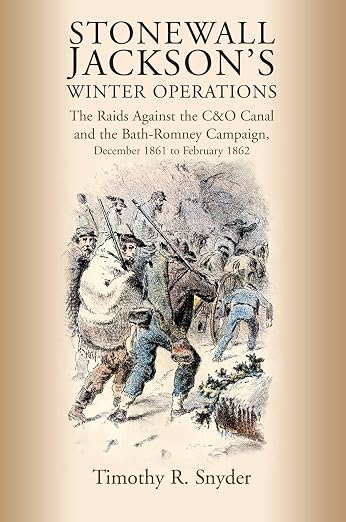
The Civil War exploits of Thoams Jonathan “Stonewall” Jackson have too often been recorded in myth and hyperbole. In Stonewall Jackson’s Winter Operations: The Raids Against the C&O Canal and the Bath-Romney Campaign, December 1861 to February 1862, historian Timothy R. Snyder argues that idolizing historical figures comes at the cost of their humanity. “We often place those whom we admire upon a pedestal, to study, emulate, and admire,” Snyder writes. “Often their faults, failures, and poor decisions are minimized or overlooked in the glare of their successes.” (xiv). Most historical works about Jackson focus on his rapid maneuvers and stunning victories in the 1862 Shenandoah Valley Campaign. Snyder recovers the overlooked C&O Canal Raids and the Bath-Romney Campaign that preceded the general’s rise to prominence.
At the First Battle of Manassas, Brigadier General Thomas Jackson steadied his nervous, inexperienced soldiers atop Henry Hill. This composure was rewarded by the Confederate War Department, which promoted Jackson to major general and placed him in command of Virginia’s Valley District in October 1861. Jackson was tasked with defending Virginia’s northern border under General Joseph Johnston. Union forces had already occupied the nearby town of Romney, pressuring Jackson to act quickly. Jackson requested that Richmond place General William Wing Loring’s brigades under his command. President Jefferson Davis and Secretary of War Judah P. Benjamin, initially cautious about diverting troops, approved the request after confirming Union forces were preparing to advance on Jackson in Winchester.
While waiting impatiently for Loring’s arrival, Jackson turned his attention to the Chesapeake & Ohio Canal. He ordered raids on Dam No. 4 and Dam No. 5 to cut off the flow of water feeding the canal—and to disrupt coal shipments being sent to Washington. The first raid on Dam No. 5 was a total failure. Union sharpshooters dispatched by Colonel Samuel Leonard drove back the raiding rebels with long-range fire. Privately, Jackson attributed the failure to the fact that the raid had extended into the Sabbath, which Snyder notes the general tried his best to keep free of secular activity. Despite the setback, Jackson remained determined, if not outright stubborn, and continued the raids. “I am still sanguine of accomplishing my purpose at another point,” Jackson wrote to the Confederate Secretary of War before turning his sights to Dam No. 4. (71). But this expedition failed, too. Lieutenant Colonel Turner Ashby’s cavalry captured a small Union scouting party, and the resulting skirmish along the Potomac riverbank left the dam unscathed.
The crescendo of these raids culminated in the final raids on Dam No. 5, which Jackson decided to personally lead. Determined to leave nothing to chance, Jackson avoided fighting on the Sabbath and reinforced his ranks with the Stonewall Brigade. Failure found him regardless. Union artillery bombarded a Confederate work party sent to cut the dam’s timber. Once again, the dam was left intact.
General Loring’s units finally arrived in December of 1861 to support an already frustrated Jackson. The first of Loring’s brigades (led by Colonel William B. Taliaferro) reached Winchester in early December, but the rest trickled in slowly throughout the month. When Jackson requested that the War Department forward General Edward Johnson’s brigade, still stationed in the Alleghenies, to support his incoming raid on Romney, Loring ordered Johnson’s brigade to stay put due to a recent Union attack. Secretary of War Benjamin backed this decision, which represented a threat to Jackson’s authority as a commander. Loring demonstrated that he could bypass Jackson and appeal directly to the War Department. So began the tension between the two generals.
That tension escalated when the army set out toward Bath in early January 1862. Jackson directed Brigadier General Richard B. Garnett’s Stonewall Brigade to remain in advance, forcing Loring’s men to halt and shiver in the winter cold while they waited. The relationship between the two generals deteriorated rapidly. One of Loring’s men later wrote that after their first encounter with Jackson, they were “not very favorably impressed” (116). The next morning, Jackson grew impatient with the soldiers who paused to cook their rations and ordered them back to march. Garnett objected, stating his men could go no farther without eating. Jackson became furious with this opposition, as he believed any delay would push action into the Sabbath and deprive him of the element of surprise.
As Jackson’s exhausted army closed in on Bath, Loring countermanded Jackson’s order to march and halted his men after being angered that he had been kept in the dark about the purpose of the campaign. The army pressed on regardless, and the Union garrison at Bath, badly outnumbered, withdrew across the Potomac to Hancock, Maryland, before Jackson’s men made contact. From the Virginia side of the river, Jackson laid a barrage of artillery on Hancock as he demanded its surrender. Union General Frederick Lander refused and endured the attack, leading Jackson to give up and return his attention to Romney. Jackson’s men occupied Romney without a fight as the Union garrison had retreated before their arrival. Despite this rare success, Jackson did not stay to enjoy it. He returned to his headquarters in Winchester, Virginia, leaving Loring’s frail brigades to hold the town through the worst of winter. Snyder documented that after Loring and his command heard of this move by Jackson, “the howls of protest reverberated throughout the halls of government in Richmond” (184).
The campaign collapsed almost as soon as Jackson left. Romney proved to have little strategic value. Loring’s officers grew mutinous as Union forces occupied nearby Cumberland, Maryland, forcing the Confederates to be placed on picket duty when they desperately needed rest. In late January, Colonels William B. Taliaferro and Samuel V. Fulkerson, along with nine other junior officers, wrote directly to Loring, describing men starving and freezing, tallying two-thirds of the regiment unfit for duty. Rather than wait for their complaint to wend its way through the courier channels, these officers traveled to Richmond. They urged President Davis and Vice President Alexander Stephens to reevaluate Jackson’s aptitude for command. President Davis informed his cabinet that Jackson was “utterly incompetent” during the campaign (194). Secretary of War Benjamin then bypassed Jackson entirely, ordering Loring’s command back to Winchester without the general’s approval.
Jackson, feeling cheated of a mission he considered a success, demanded reassignment back to his professorship at the Virginia Military Institute, or else the acceptance of his resignation. Davis refused to accept Jackson’s abdication and dispatched allies, such as Representative Alexander Boteler, to convince Jackson to reconsider.
Here, Snyder notes a remarkable irony. As a young officer in Florida, Jackson had once quietly sought information that undermined his commander, William French, after becoming disillusioned with his leadership. Jackson, once critical of a superior he lost faith in, now found himself on the receiving end of the very same conduct.
Snyder concludes that Jackson “caused most of the other problems he encountered during this period” (242). He professes that Jackson’s objections to the Confederate executive authority were entirely “unjustified” (251). This verdict downplays the rebel government’s own complicity. Davis and Benjamin had approved Jackson’s plan, only reversing course once conditions worsened. Loring’s personal rivalry with Jackson only complicated matters that were never Jackson’s alone to control. No commander could have outmarched the brutal winter that caused hospitals in Winchester to fill with over three thousand sick and frostbitten men. That said, the blame for the canal raids, born entirely out of Jackson’s own initiative, may fairly be placed on his shoulders. The Bath-Romney campaign was a collaborative failure.
The research informing Snyder’s book is meticulous, drawing on both Confederate and Union soldiers’ diaries, letters, and even weather logs to reconstruct the campaign with empirical precision. The book is further enhanced by its maps and archival images, which together ground the reader in both the terrain and the faces of the men who fought over it. In sum, Stonewall Jackson’ s Winter Operations is an essential read for anyone seeking to understand Jackson beyond the legend—and a valuable corrective to a historiography that has too often left the general on his pedestal.
Adrian Lopez is a graduate student in the Department of History at Sam Houston State University.