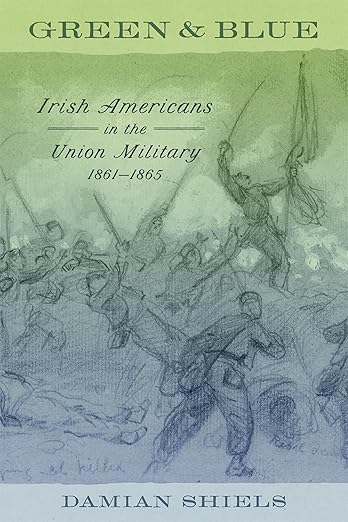
Irish American participation in the Civil War has long been a well-known facet of the conflict, aided in no small part by the existence of famous units such as the Irish Brigade. In Green and Blue: Irish Americans in the Union Military, 1861-1865, however, Damian Shiels contends that the prominence of these Irish units has served to obscure aspects of the Civil War experience for Irish Americans at large.
Due to these units’ reputations and a dearth of sources from enlisted Irish Americans, most studies have relied on the writings of middle- and upper-class individuals in Irish regiments, which may not represent the views or experiences of the majority of Irish Americans. Shiels, the founding editor of the Irish in the American Civil War blog, has sought to address this issue by examining pension applications to assemble a collection of wartime correspondence from nearly 400 Irish American soldiers and sailors. The letters of these primarily enlisted and working-class men form the foundation of his examination of Irish Americans in Green and Blue.
One of Shiels’s primary contributions is to challenge the prevailing estimate of how many Irish Americans fought for the Union. This number has traditionally been given as 150,000, which would indicate that the Irish were “proportionately underrepresented in the U.S. military” (41). Shiels demonstrates that this figure was based on data from the U.S. Sanitary Commission that excluded the Regular Army and the navy, both of which contained disproportionate quantities of Irish Americans. Shiels further argues that those born to Irish immigrants “undoubtedly regarded themselves as distinctly Irish American” and should be included when discussing Irish American military service (26). These additions and similar adjustments produce a new figure of roughly 250,000, which would indicate that Irish Americans were not underrepresented in volunteering.
Green and Blue also serves to challenge stereotypes that have been associated with Irish Americans during the war. Historians have portrayed the Irish as having participated in the Civil War because of their desire for Irish independence, with groups like the Fenians seeing the war as an opportunity to gain experience for a later struggle against Britain. While many Irish emigrants expressed a desire for Irish independence, Shiels asserts that the majority saw the United States as the best future home for them and their relatives. These men frequently expressed patriotic motivations when discussing their enlistment and sent money to Ireland to enable further migration, which both serve as indications that they were more concerned with the fate of the Union than Ireland.
Despite lacking some qualities that have previously been attributed to Irish Americans, working-class Irishmen still possessed traits that made them a distinctive group and influenced their military service. Shiels notes that because many Republicans were perceived as nativists, Irish soldiers broke with most of their comrades and supported Democratic politicians during the war. Furthermore, although significant numbers of Irish Americans were Presbyterians or Anglicans, the vast majority were Catholic. Given that “only fifty-three Catholic chaplains are known to have served” in the Union ranks, these men did not enjoy the same access to clergy as their Protestant counterparts (75). The individuals discussed in Green and Blue also sought out other Irishmen in their units when socializing, which indicates that Irish Americans attempted to form their own ethnic communities even within non-Irish units.
As Shiels’s focus in Green and Blue is largely on working-class Irish Americans, it is unsurprising that a few of their characteristics were shaped by their economic position. Military service was of course more enticing to those who earned paltry wages or were unemployed, especially once significant enlistment bonuses were introduced as the war progressed. While their relative poverty could push Irish Americans into military service, it also contributed to their higher-than-average desertion rate. Shiels demonstrates that men who felt that their absence was risking their families’ wellbeing were understandably tempted to desert, especially when their relatives sent letters complaining about poor living conditions.
Green and Blue represents a significant accomplishment in advancing the study of the common Irish American soldier. By assembling the corpus of correspondence on which his research is based, Shiels is able to provide insights into individuals who constituted the majority of Irish Americans and the backbone of the Union forces. Green and Blue will be of interest to any reader who wishes to learn more about how Irish and working-class Americans’ lives were shaped by the Civil War.
Jeremy Knoll is a doctoral student studying the U.S. Civil War in the Department of History at The Ohio State University.