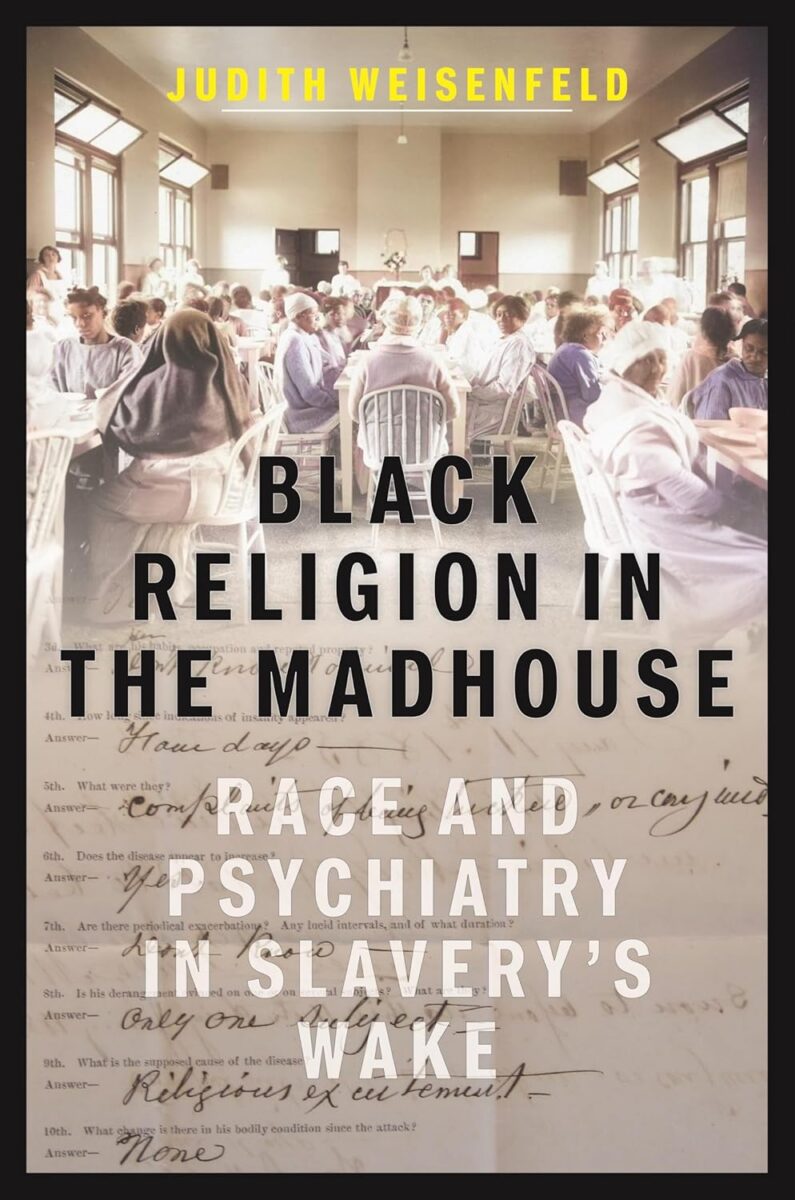
In the nineteenth and twentieth centuries, ideas about religion played a critical role in shaping the theories white psychiatrists developed about African Americans and mental illness. “Medical understandings of mental normalcy,” Judith Weisenfeld contends, “pathologized a range of Black religious beliefs, spiritual sensibilities, practices, and social organizations and framed them as manifestations of innate racial traits” (4). Psychiatrists reduced African American religious life to spurious claims about racial traits and mental illness. Black Religion in the Madhouse probes how the “racism embedded in these theories of religion’s place in African Americans’ purported mental instability in freedom was an important factor in the rise of psychiatry as an authoritative and powerful profession in the post slavery era” (12).
Weisenfeld, who is currently the Agate Brown and George L. Collord Professor of Religion in the Department of Religion at Princeton University, has published widely on Black religion. Her previous books include New World A-Coming: Black Religion and Racial Identity during the Great Migration (2016), Hollywood Be Thy Name: African American Religion in American Film, 1929-1949 (2007), and African American Women and Christian Activism: New York’s Black YWCA, 1905-1945 (1997). In this volume, Weisenfeld focuses on the United States, specifically the “social worlds of formerly enslaved Black people and their descendants” (13). She draws on an impressive array of primary sources—including judicial records, hospital records, newspapers, published studies, and autobiographies—and contributes to several different historiographical conversations.
Weisenfeld begins in 1889 in Liberty County, Georgia. During the summer, hundreds of African Americans “congregated in daily worship on rough-hewn benches arranged in a circle beneath the branches of two moss-covered live oak trees” (19). The Children of the Wilderness garnered significant attention in the press. Many white people saw the Children of the Wilderness as a worrisome demonstration of the possible dangers of Black religious enthusiasm. Weisenfeld skillfully illustrates the importance of religious independence for many Black people and pervasive white cultural fears about what they considered to be “Black religious fanaticism unbound” (33).
The panic about the Children of the Wilderness helps Weisenfeld frame a broader story of how physicians racialized ideas about religious excitement. Unsurprisingly, white medical authorities who used their “claimed expertise to define mental normalcy and deviance,” she explains, increasingly saw “religious excitement” in racialized ways (44). Racialized constructions about religion and mental illness reinforced many people’s beliefs that racial traits, not individual circumstances, shaped Black mental states. In a cascading effect, “the racialization as Black of religious excitement as a precipitating cause of insanity lent medical authority to the pathologizing of African American religious life” (47).
Racialized religious excitement, Weisenfeld contends, had three distinct characteristics (each the subject of one chapter in the book): superstition, emotionalism, and credulity. White physicians often argued for a racial propensity for superstition. As they cast the beliefs of some African Americans as superstition, they reduced spiritual practices rooted in Central and West African religious traditions to “irrational and false belief” (80). Mental hospitals became sites for disciplining what physicians saw as emotionalism in Black patients. Critically, Weisenfeld notes, not all religious excitement signified mental illness. Some forms of religious expression, often those displayed by white people, were portrayed as sane and reasonable. The “framing of others as abnormal and excessive aided the marginalization of varieties of Black Christianity, such as Holiness and Pentecostal beliefs and practices” (147). White doctors often contended that Black people were susceptible to Black “cults” like Father Divine’s Peace Mission. However, beginning in the 1930s, ideas about innate racial characteristics began to lose ground to ideas about the impact of the social environment on mental disorders. For an increasing number of commentators, “the new challenges of the urban environment combined with the failures of traditional churches to meet community needs accounted for the appeal of these groups, rather than racial propensities” (182).
Weisenfeld concludes with cooperative efforts between Black religious and political leaders and Black and white psychiatrists and social workers to help individuals with mental distress. She focuses on the Lafargue Clinic in Harlem, which “focused on extending access to psychotherapy to Black patients who were limited in finding therapists because white practitioners did not take them as clients and because of the small number of Black therapists” (203). Although the Lafargue Clinic closed in 1958, it “offered services that derived, in part from religious commitments but refused the long-standing white view of African American religion as contributing to mental disorders” (209).
In sum, Black Religion in the Madhouse offers a well-researched discussion of race, religion, medicine, healthcare, and the development of psychiatry in the late nineteenth and twentieth century U.S.
Evan C. Rothera is Assistant Professor of History at Sam Houston State University and the Co-Director of the SHSU Civil War Consortium.
Related topics: African Americans