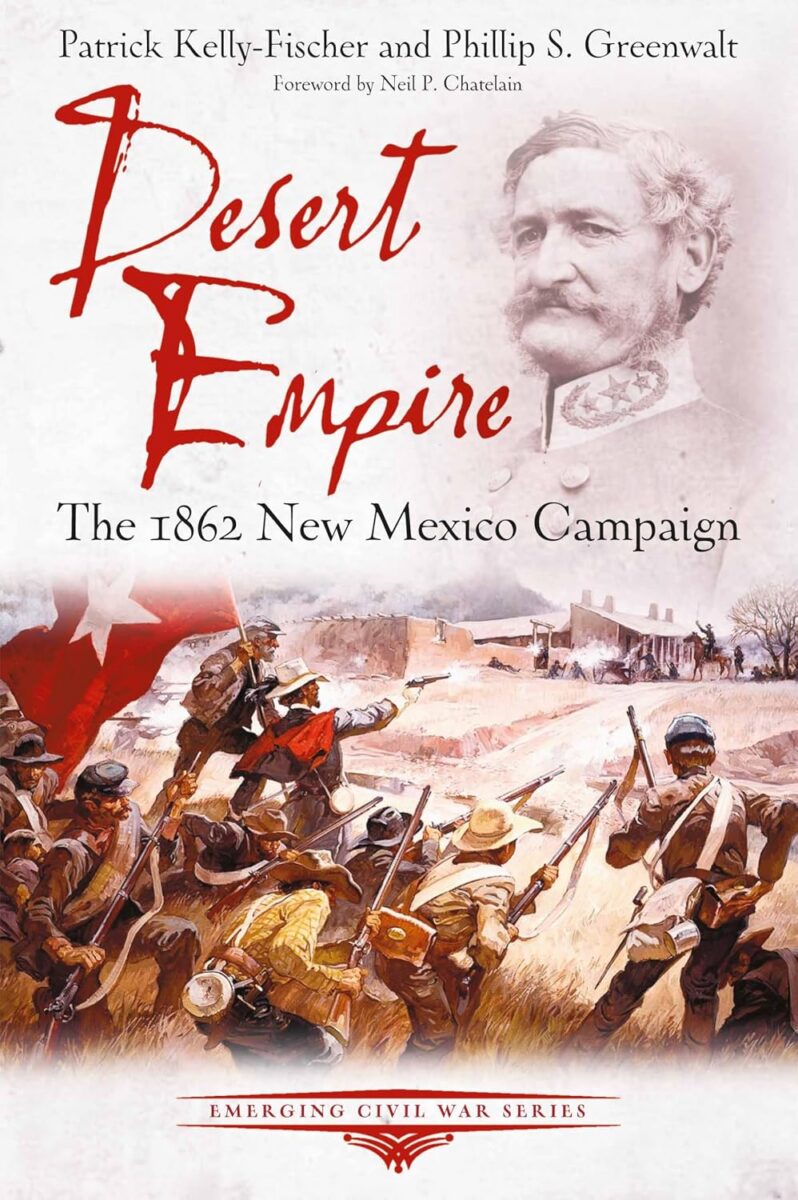
In Desert Empire: The 1862 New Mexico Campaign, authors Patrick Kelly-Fischer and Phillip S. Greenwalt provide a detailed military history of the Confederacy’s attempt to create a “desert empire.”
White southern enslavers had eyed the lands that became New Mexico and Arizona long before the Civil War. Desiring to stretch a transcontinental railroad across the slaveholding South, Jefferson Davis coveted the desert southwest during his tenure as Secretary of War under President Franklin Pierce (xxii).
Davis let up none of his ambitions. Once the war began, he saw control of the southwest as critical to the Confederate war effort. Union forces had blockaded the coastlines of the Southern states. Davis viewed expansion as a way to alleviate the blockade’s deleterious effects, giving the Confederacy an outlet to the Pacific Ocean (xxv). Southerners also desired the mineral wealth that existed in the southwestern territories of the United States (xxii).
The book effectively lays out the Confederates’ goals for the campaign, but Desert Empire truly excels in its characterizations of the key players involved in the New Mexico Campaign. Confederate general Henry Hopkins Sibley personally traveled to Richmond to request permission to lead a campaign into New Mexico. Sibley eagerly wanted to lay claim to the territory and drive into northern New Mexico and Colorado.
Sibley’s Union counterpart in the New Mexico territory was Col. Edward R.S. Canby. The Union commander faced problems dealing with who he could trust within his own forces. Confederate sympathizers within the army and distrust of Mexican Americans and Native Americans led Canby to request volunteers “of American origin” to serve under his command.
Two of Canby’s subordinates made their names in different ways and are highlighted by Kelly-Fischer and Greenwalt. The first is Christopher “Kit” Carson, the famed frontiersman who led the 1st New Mexico Volunteer Infantry (17). With Carson’s knowledge of the American West and relationships with Native and Mexican Americans, he took command of the 1st New Mexico, which mostly consisted of locals that Canby did not wish to command. John Chivington, who commanded American forces several years later at the infamous Sand Creek Massacre, commanded the 1st Colorado Infantry Regiment at the Battle of Glorieta Pass. It was during the New Mexico campaign when he first distinguished himself in battle, destroying the Confederate supply train during the battle, effectively ending the Confederacy’s ability to fight and maintain control of the New Mexico Territory (101).
The downfall of the Confederacy’s adventures in New Mexico boiled down to two factors. For one, Sibley’s effort ran headlong into a brutally harsh desert environment that provided little sustenance for soldiers on active campaign (xxvi). For another, once the Union forces received reinforcements and supplies, they proved able to overwhelm the Confederates.
As with other volumes in the Emerging Civil War series, Desert Empire doubles as a narrative history and tour guide. Three chapters conclude with suggestions on how to visit the sites most important to the New Mexico campaign. Chapter Four highlights the Valverde battle site, while Chapter Six details how to visit Fort Union. Chapter Eight describes the Pecos National Historical Park, which contains the Glorieta Pass site. Many of these sites are remote. The site of the Battle of Valverde is now mostly privately owned, and Fort Craig is accessible only via dirt and gravel roads in an area with poor cell phone reception, so visitors will find this volume especially handy (47-48).
Desert Empire provides readers with a compact and accessible history of the 1862 New Mexico campaign. The authors complement their narrative with historical images and modern photographs that highlight the difficulties both armies faced during the campaign. They also append a complete order of battle and list of suggested readings.
Probing a lesser studied corner of the war, Desert Empire is a most worthy addition to Savas Beatie’s popular Emerging Civil War series.
Matthew P. Harrington is a graduate student in the Department of History at Sam Houston State University.