 Library of Congress
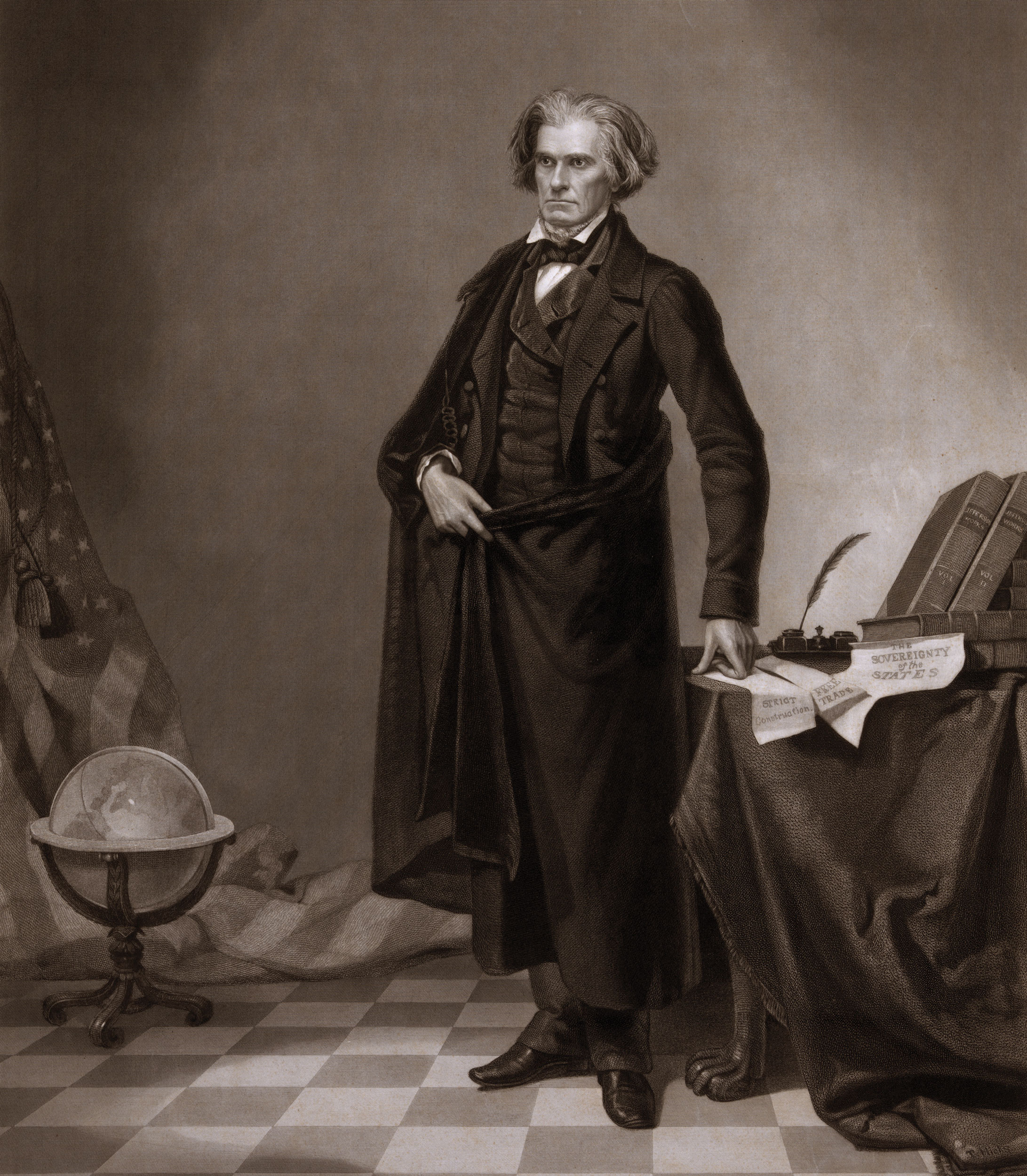
John C. Calhoun
On the afternoon of June 24, 2020, hundreds of people gathered in Charleston, South Carolina’s Marion Square erupted in cheers as, after 17 hours, workers removed a statue of John C. Calhoun. For more than a century, the 12-foot bronze of the state’s most famous son and slavery’s greatest champion had stood on a lofty perch in the square. Just a block away sits Emanuel AME Church, where on June 17, 2015, a Confederate flag-waving white supremacist murdered nine black members at a Bible study group. The killings sparked America’s ongoing reckoning with Confederate and other white supremacist symbols, a reckoning that so far has toppled more than 100 statues. As the Calhoun statue fell to the ground just days after the anniversary of the Emanuel massacre, things in Charleston seemed to be coming full circle.
Yet the city’s first Calhoun memorial, his tomb, remains mostly overlooked. Located a few blocks south of Emanuel Church, in the cemetery of St. Philip’s Church, Calhoun’s grave has in recent years attracted far less attention—and little controversy—compared with his monument. In the 19th century, though, it was not only a big tourist destination but also the site of one of the nation’s earliest struggles over Civil War memory—a bizarre tale that involved the covert disinterment of Calhoun’s remains midway through the war. The cradle of secession, the spot where the first shots of the Civil War were fired, Charleston also helped give birth to America’s long battle over how the conflict would be remembered.
 New York Public Library
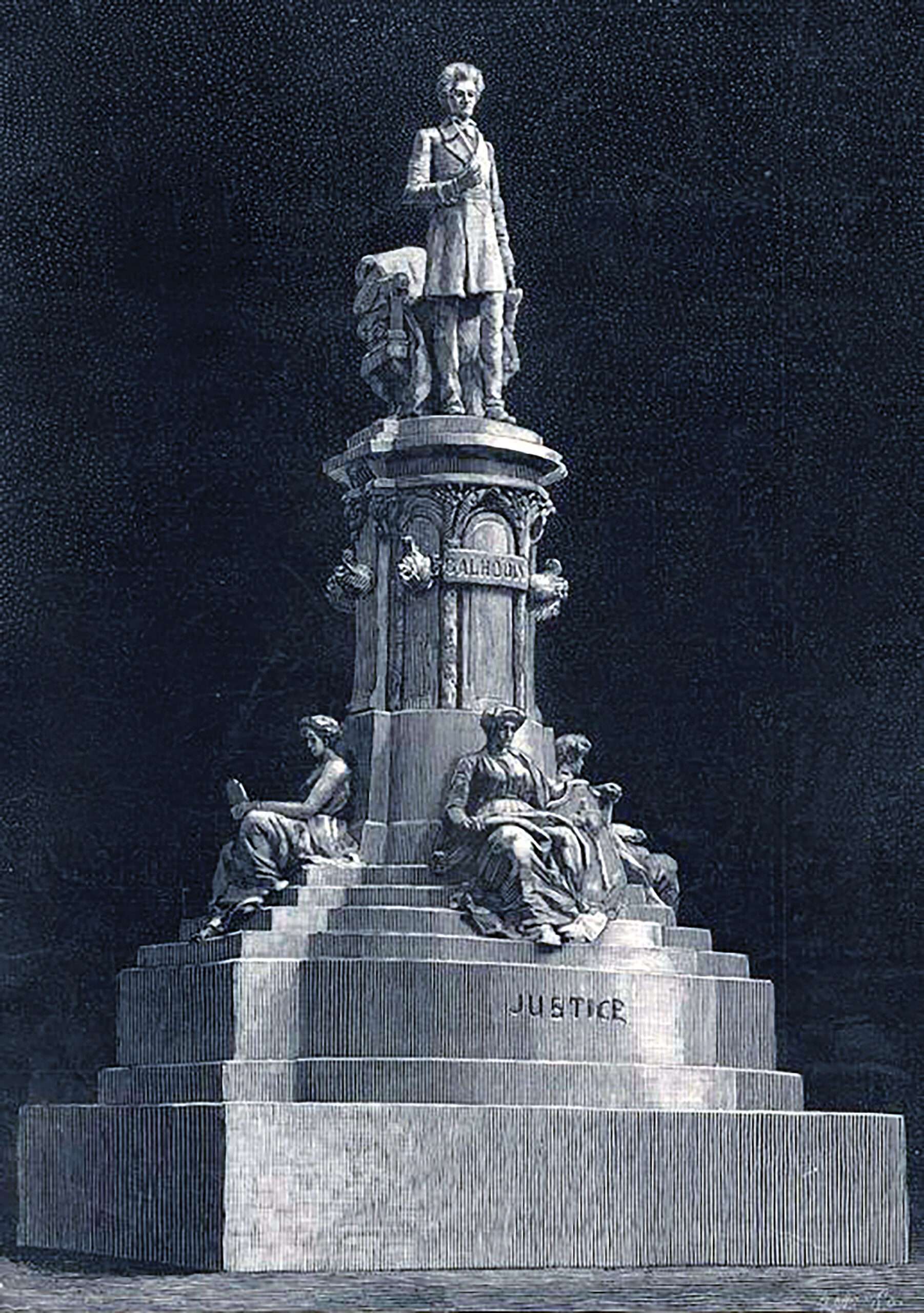
In the wake of John Calhoun’s death, residents of Charleston moved to memorialize him in a variety of ways, including making plans for a Calhoun monument in Citadel Green (now Marion Square), construction of which was interrupted by the war but completed in 1887. Above: A rendering of the Calhoun monument based on a photograph of the sculptor’s model.
It is somewhat surprising that John C. Calhoun would end up buried in Charleston. Hailing from the Upcountry, where he was born near Abbe-ville in 1782, Calhoun had little love for South Carolina’s first city. Charlestonians, however, felt otherwise. Their affection for the dour and humorless figure once described as “the cast iron man” certainly had something to do with Calhoun’s prominent stature.1 He served as a U.S. congressman and senator, secretary of war, secretary of state, and vice president of the United States (under John Quincy Adams and Andrew Jackson) over four decades of public service.
But Charlestonians were especially devoted to Calhoun because he was a dogged defender of their culture. The owner of two plantations and more than 100 enslaved people, Calhoun took for granted that slavery was the foundation of southern society. Presidents George Washington and Thomas Jefferson, among other enslavers, had viewed slavery as at best a necessary evil. Calhoun rejected this notion, arguing that it was “a positive good” that benefited both masters and slaves.2 He maintained that the South had to guard this benevolent institution at all costs. In the late 1820s, Vice President Calhoun had outlined a theory of nullification that came close to igniting armed conflict with the federal government in an effort to stymie future challenges to slavery. Just weeks before he died in Washington in 1850, Senator Calhoun warned that northern agitation on the slavery question might soon force the South “to choose between abolition and secession.”3
Little wonder that Charlestonians—75% of whom lived in families that owned enslaved people—showered Calhoun with affection after he succumbed to tuberculosis. The City Council resolved that “in token of respect to the eminent abilities and elevated virtues” of such “a cherished and devoted son,” it would not only formally receive Calhoun’s body but also erect “a suitable monument … to his memory” in what is today Washington Square Park on Broad Street.4 By the mid-1850s, the Ladies’ Calhoun Monument Association (LCMA), which took the lead in this campaign, had picked a new site for the memorial: the Citadel Green (now called Marion Square). The LCMA laid a cornerstone for the monument in 1858 before the Civil War brought the project to a standstill. The monument was finally installed in 1887. A decade later, it was removed and replaced by the much larger one that towered over Marion Square until June 2020.
Charleston’s tributes to Calhoun did not stop with these monuments. In the wake of his death, the city commissioned portrait artist G.P.A. Healy to paint a full-length picture of Calhoun for display at City Hall. And Charlestonians celebrated his birthday with parades and renamed Boundary Street—which bisected the peninsula and formed the southern boundary of the Citadel Green, where the monuments would be installed—Calhoun Street.
The city’s elaborate funeral for Calhoun in 1850 was the centerpiece of these early memorial activities. When the iron sarcophagus containing his remains arrived on April 25, it was greeted by the most impressive funeral procession Charleston had ever seen. People from across the state, the region, even the nation attended the ceremony, while few residents missed the opportunity to celebrate their hero. The two-mile procession included Calhoun’s family, a delegation from Washington, the governor of South Carolina, and many local politicians, militia companies, and fraternal organizations. After the parade, Calhoun’s body lay in state in City Hall, where big crowds paid their respects. The Charleston Courier took special note of the reception that African-American and enslaved residents accorded the funeral. Reflecting their deep faith in the paternalistic ideology championed by Calhoun, city officials permitted everyone—black and white, slave and free—to visit his coffin. Black Charlestonians reportedly embraced this opportunity in “considerable numbers.”5
 Harper's Weekly
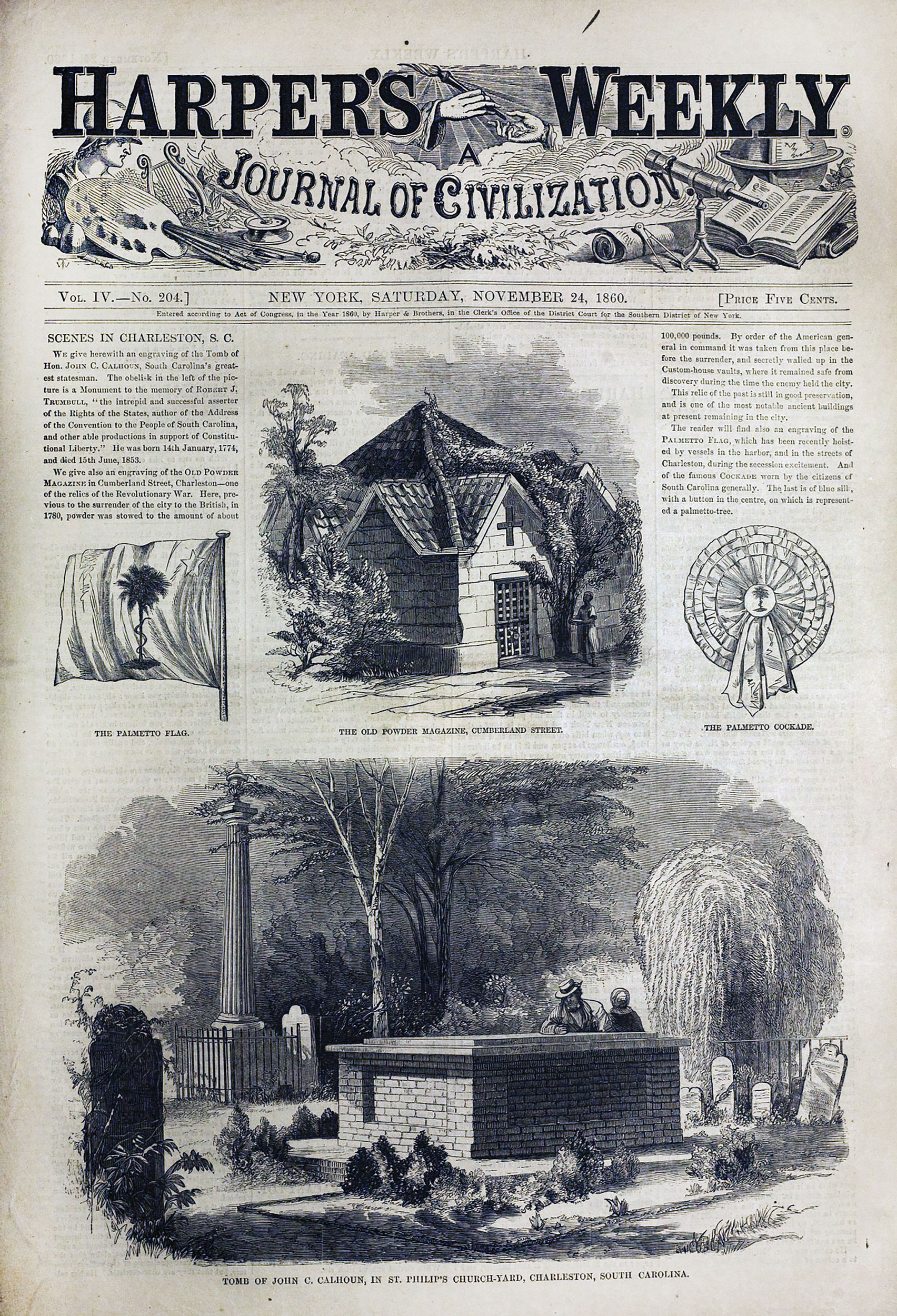
Calhoun assumed renewed significance during the secession crisis, when Charlestonians regularly invoked his words in support of slavery and the South—and made pilgrimages to his grave at St. Philip’s Church. Above: the cover of the November 24, 1860, edition of Harper’s Weekly, which includes an engraving of Calhoun’s tomb as part of its coverage of the secession fervor gripping South Carolina.
Whites viewed the funeral as a somber moment for mourning and reflection, but many African Americans were enthused. Fredrika Bremer, a Swedish writer who happened to be in town to witness Calhoun’s funeral, noted that “during the procession a whole crowd of negroes leaped about the streets, looking quite entertained, as they are by any pomp.” Their excitement had political significance. According to Bremer, blacks at the procession declared, “Calhoun was indeed a wicked man, for he wished that we might remain slaves.”6 Years later, Elijah Green recalled that as a young slave boy he had dug Calhoun’s grave, and said, “I never did like Calhoun ’cause he hated the Negro; no man was ever hated as much as him by a group of people.”7
Although Calhoun’s family had not planned to bury him in Charleston, city residents convinced them and Governor Whitemarsh Seabrook to allow Calhoun’s body to be provisionally interred in the city, with the Legislature to pick the ultimate resting place later. After the funeral service at St. Philip’s Church, Calhoun’s coffin was moved across the street to the church’s western cemetery and a temporary vault. It was never to leave Charleston.
The hasty construction of Calhoun’s tomb resulted in a modest brick sepulcher with a marble slab marked with the name “Calhoun.” Despite its unassuming nature, the tomb quickly became a visitor attraction.
Calhoun’s grave assumed more significance after almost a decade, when Abraham Lincoln’s 1860 election prompted South Carolina to lead a Deep South secession parade. Calhoun, after all, was widely considered the father of secession by northerners and southerners alike. “What nobler monument to Calhoun could anyone wish,” asked the Charleston Courier just days after the election, “than a Southern league or confederacy of independent, equal States, embodying … the great cardinal truths of government and political science which Calhoun living taught … and Calhoun dying bequeathed[?]”8 On November 24, Harper’s Weekly published an engraving of Calhoun’s tomb as part of a front-page feature on the secessionist fervor in South Carolina.
The South Carolina secession convention gathered in Charleston the next month, spurring calls across the city to stage a grand procession to Calhoun’s grave once the deed was done. After the convention adopted the Ordinance of Secession, urged one Carolinian, every white man who is capable should march through town to Calhoun’s tomb. There, he suggested, the ordinance could be read at “the consecrated spot which marks the last resting place of Carolina’s distinguished son.”9
It is not clear this procession ever took place. But other pilgrimages to Calhoun’s grave happened during the convention. “Some fair daughter of Carolina,” reported the Charleston Mercury on December 22, “has laid a modest offering of evergreens at the tomb of Carolina’s great statesman.”10 Two days later, on Christmas Eve, members of the Sons of the South, a militia unit from Savannah, Georgia, visited Calhoun’s tomb to pay their respects. According to an 1866 account, either this group of men or a similar one celebrated secession by encircling Calhoun’s grave and vowing to devote their “lives, their fortunes, and their sacred honor” to the “cause of South Carolina independence.”11
Calhoun’s tomb also figured in Confederate minds four months later when fighting broke out in Charleston Harbor. Just hours before U.S. Army major Robert Anderson signaled the surrender of Fort Sumter to Confederate forces on April 13, a local man witnessed what he believed to be “an omen of victory” at Calhoun’s grave.12 That morning, he told the Charleston Mercury, he saw a gamecock—a bird associated with South Carolina revolutionary Thomas Sumter, for whom the island fort was named—land on the tomb, flap its wings, and crow.
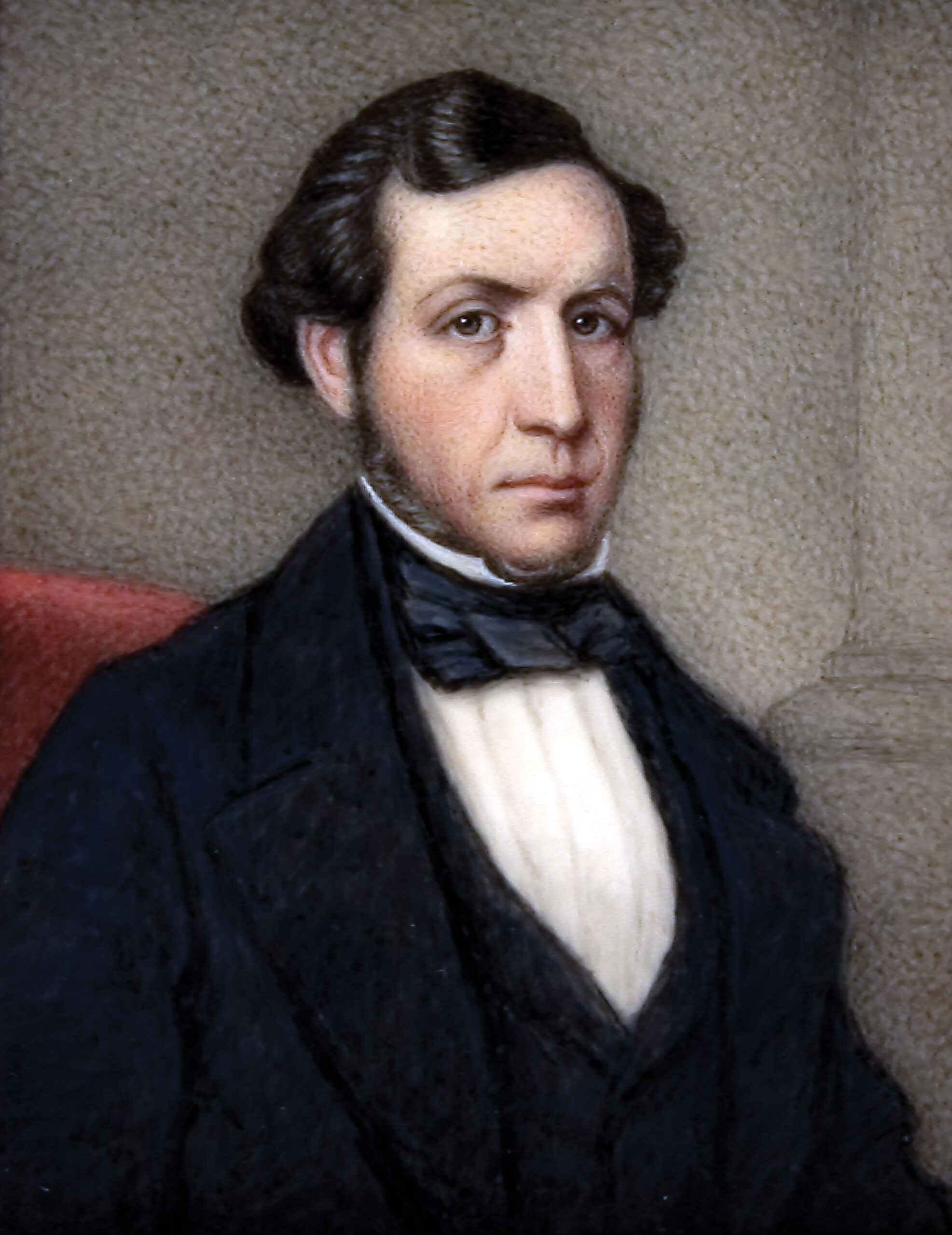
That victory omen only lasted so long. By 1862, the United States Navy had tightened its grip on the South Carolina coast, and some Charleston Confederates feared for the safety of Calhoun’s tomb, among the city’s other tributes to him. Leading the defense of Calhoun memorials were cotton factor Henry Gourdin and his younger brother Robert. Staunch supporters of Calhoun and the secessionist movement he had inspired, the Gourdin brothers had assisted in bringing Calhoun’s body to Charleston in 1850 and had signed South Carolina’s Ordinance of Secession a decade later. Robert had also been a founding member of the 1860 Association, which in the runup to the Civil War had spread the gospel of secession by publishing and disseminating pamphlets that predicted doom for slavery in the Union and safety outside of it.
When the United States military threatened Charleston in the early stages of the conflict, the brothers arranged to have a statue of Calhoun removed from its City Hall home to the state capital, Columbia, for safekeeping. As it happened, the statue, crafted by renowned sculptor Hiram Powers, would not survive Columbia’s fall to William T. Sherman’s army in 1865.
 Smithsonian American Art Museum
Henry Gourdin (pictured above) and his younger brother Robert, long supporters of secession, in 1850 helped bring Senator Calhoun’s body from Washington, D.C., to Charleston, and in 1860 signed South Carolina’s Ordinance of Secession. When Union forces threatened Charleston early in the war, the Gourdins orchestrated the removal and reburial of Calhoun’s remains so that enemy troops might not “disturb” them.
The Gourdins along with Calhoun’s family also feared that the occupation of Charleston by Union forces might lead someone to dig up Calhoun’s bones. In June 1862, Calhoun’s eldest son, Andrew, suggested to Robert Gourdin that he make plans to save his father’s remains “from the vandals should they occupy the city.”13 The Gourdins arranged for the Confederate general P.G.T. Beauregard “to notify them whenever there appeared to be any serious danger of Charleston’s falling into the hands of the enemy, in order that they might take the necessary steps to protect the remains of Mr. Calhoun from desecration.”14
Danger seemed to be upon them the following spring, when a large Union fleet, including several ironclads, appeared off the coast. The Gourdin brothers put their plan into action. First, they sought out John N. Gregg, St. Philip’s black sexton. As Gregg recalled decades later, Robert Gourdin told him, “We want to remove Mr. Calhoun’s remains for fear they may be disturbed by the ‘Yankees’ when they take possession of the City.”15 Gregg agreed to help. Late that evening, he joined a small group of Charleston masons and gentlemen who, under the cover of darkness, removed Calhoun’s metal casket from the tomb in St. Philip’s western cemetery, placed it in pine case, and moved it across the street to the church. They stowed the casket under the stairs, hidden by a piece of carpet. The following evening, the Gourdin brothers and a few friends joined Gregg and Robert L. Deas, the black sexton from the nearby Huguenot Church, and two laborers to bury the casket in a plot in St. Philip’s eastern cemetery, behind the church.
In a letter Robert Gourdin wrote just hours afterward, he assured Andrew Calhoun that the location of the casket would remain secret. The two laborers who had reinterred it had no idea what they were burying, and the stone masons who had opened the tomb “supposed that the remains were to be sent into the Country.” The rest of the party, including the two sextons—freeborn African Americans who were “entirely reliable and trustworthy,” according to Gourdin—agreed not to tell a soul where they had hidden Calhoun’s remains.16 From all accounts, they kept the secret.
When, two years later, Union troops marched into Charleston, many people assumed that Calhoun’s body was still inside the tomb marked with his name. And just as the Gourdins and the Calhoun family had feared, the grave attracted the attention of the occupying forces as well as of a host of northerners who flocked to the cradle of secession in the spring of 1865.17 Several prominent antislavery voices, including William Lloyd Garrison, George Thompson, Theodore Tilton, and Henry Ward Beecher, visited Calhoun’s gravesite while they were in Charleston for an April ceremony in which the American flag was raised again at Fort Sumter. “There lies a man whose name is decayed worse than his mouldering form,” said Garrison, the Boston abolitionist, as he stood over the (unbeknownst to him empty) tomb. “The one may have a resurrection, the other never!”18
Like much of the lower peninsula of Charleston, the St. Philip’s Church cemetery had been battered by Union artillery, one shell having landed just feet from Calhoun’s gravesite. But it was visitors who exacted the worse toll. Several hundred Brooklyn residents who had joined Garrison, Beecher, and the others for the Fort Sumter ceremony, spent much of their trip grabbing Charleston mementos, especially those related to the slave regime. Some gathered magnolia leaves they found near Calhoun’s grave, while others chipped away at the marble on his tomb. Though they were not the first to deface Calhoun’s gravesite, by the time they left, all four corners of his tombstone had been damaged. “Among those who bore off a piece,” observed one eyewitness, “was the minister of one of our Brooklyn Churches.”19
Fellow Brooklyn minister Henry Ward Beecher could not countenance such vandalism. Although he blamed Calhoun for the war, he saw no point in violating his grave. “What on earth should a man want a memorial of Calhoun for?” Beecher wondered. “And if one wanted it, what must be the measure of that want that would lead him to desecrate a grave, and break down gravestones, that he might have something to put on his mantel-piece or on his cabinet-shelf, and say, ‘I stole that from the grave of Calhoun?’”20 A New York Times correspondent likewise condemned the defacement, urging any vandals to pay attention to two messages scribbled on the tomb: “A Massachusetts man and an Abolitionist abhor the violation of this tomb” and “Respect ourselves if we do not him who lies beneath this stone.”21
Of course, nothing worthy of respect, disdain, or anything else lay beneath that stone in 1865—a fact that eventually became common knowledge. Indeed, in the months and years that followed, newspapers often reported that Calhoun’s remains were no longer in the western cemetery. (Their new location remained a closely guarded secret.) A Cleveland Daily Herald reporter who visited Charleston in 1874 asked a policeman if the tomb in St. Philip’s cemetery was Calhoun’s final resting spot. “It was once his grave,” replied the officer, “but his body was removed during the siege of Charleston back into the country and has never been returned.” Later that year, another reporter conducted a man-on-the-street poll, standing close to the original gravesite and asking passersby where Calhoun was buried. “Nobody knew,” he observed. “One man thought he was buried up the country; another was sure he laid under the Capitol at Washington; a third intimated Columbia.”22
 Library of Congress
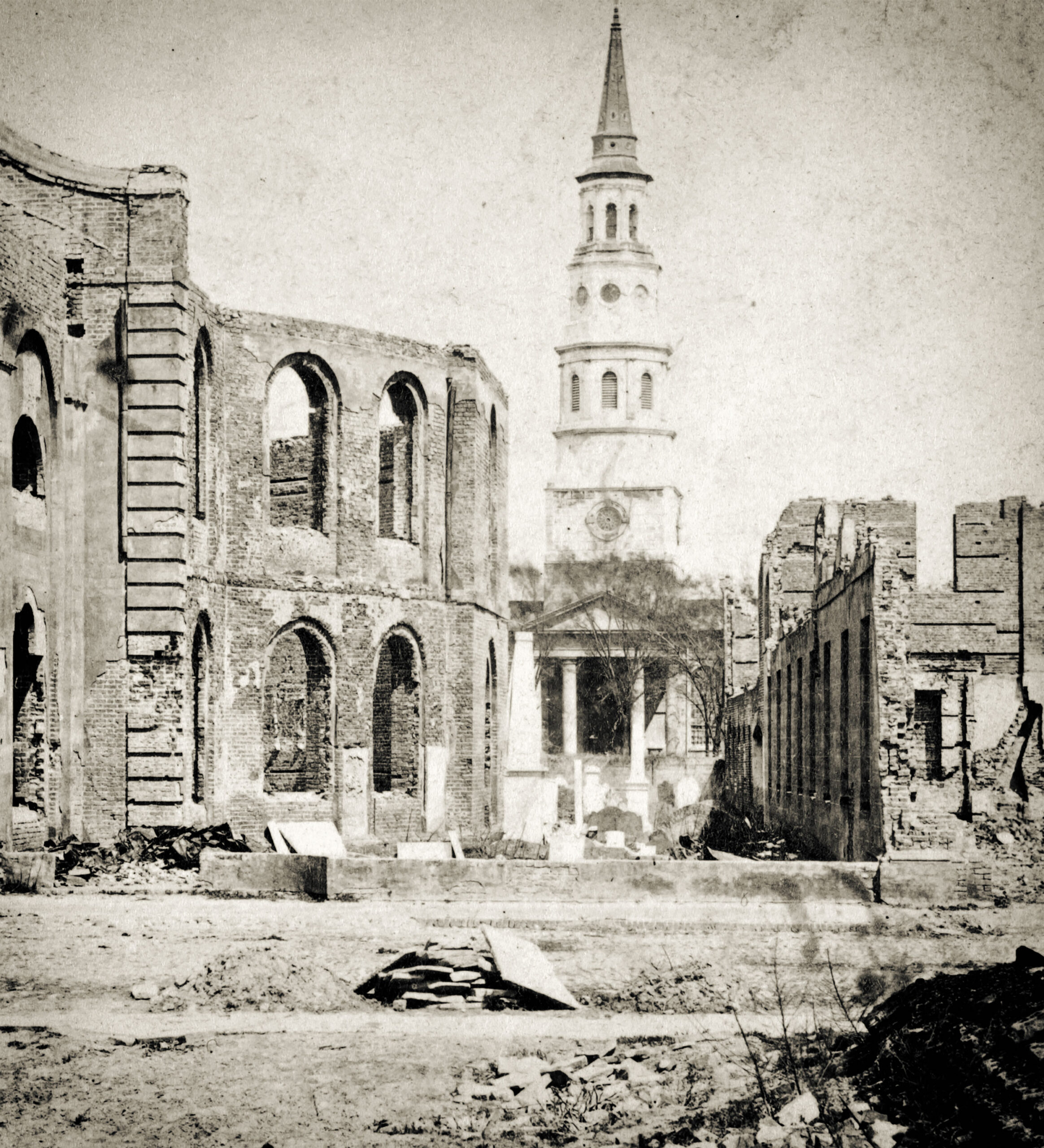
By the spring of 1865, Union artillery had taken a toll on much of Charleston, including the grounds of St. Philip’s Church. While Calhoun’s gravesite would escape damage from Union shells, it did suffer defacement at the hands of northern visitors who descended on the city at war’s end. Shown here: St. Philip’s Church (center) sits among ruined buildings in 1865.
All three of these Charlestonians would have been surprised to learn that by this point Calhoun’s remains had, in fact, been returned to the original tomb. Several years earlier, Henry Gourdin had determined that it was safe, and one spring morning in 1871 with the help of John Gregg, the sexton, and a few others, the remains were reburied. They had planned the event to occur without any fanfare, but several hundred St. Philip’s congregants got wind of it and gathered to watch. Several women decorated Calhoun’s coffin with evergreen wreaths and flowers and at least two South Carolina newspapers documented the proceedings.
Despite this publicity, questions about Calhoun’s tomb lingered into the 20th century. When a Syracuse, New York, visitor went looking for the tomb in 1916, he happened upon two elderly men who told him that the clandestine nature of the first disinterment had led to some confusion when the remains were returned in 1871. “The tree that marked the spot where the great statesman was buried had rotted away,” they explained, and so “people only guessed where the original remains were.” All that could be found were “a few bones.” One of them conceded, “Really, there is a good deal of guess work about the remains of Calhoun.”23
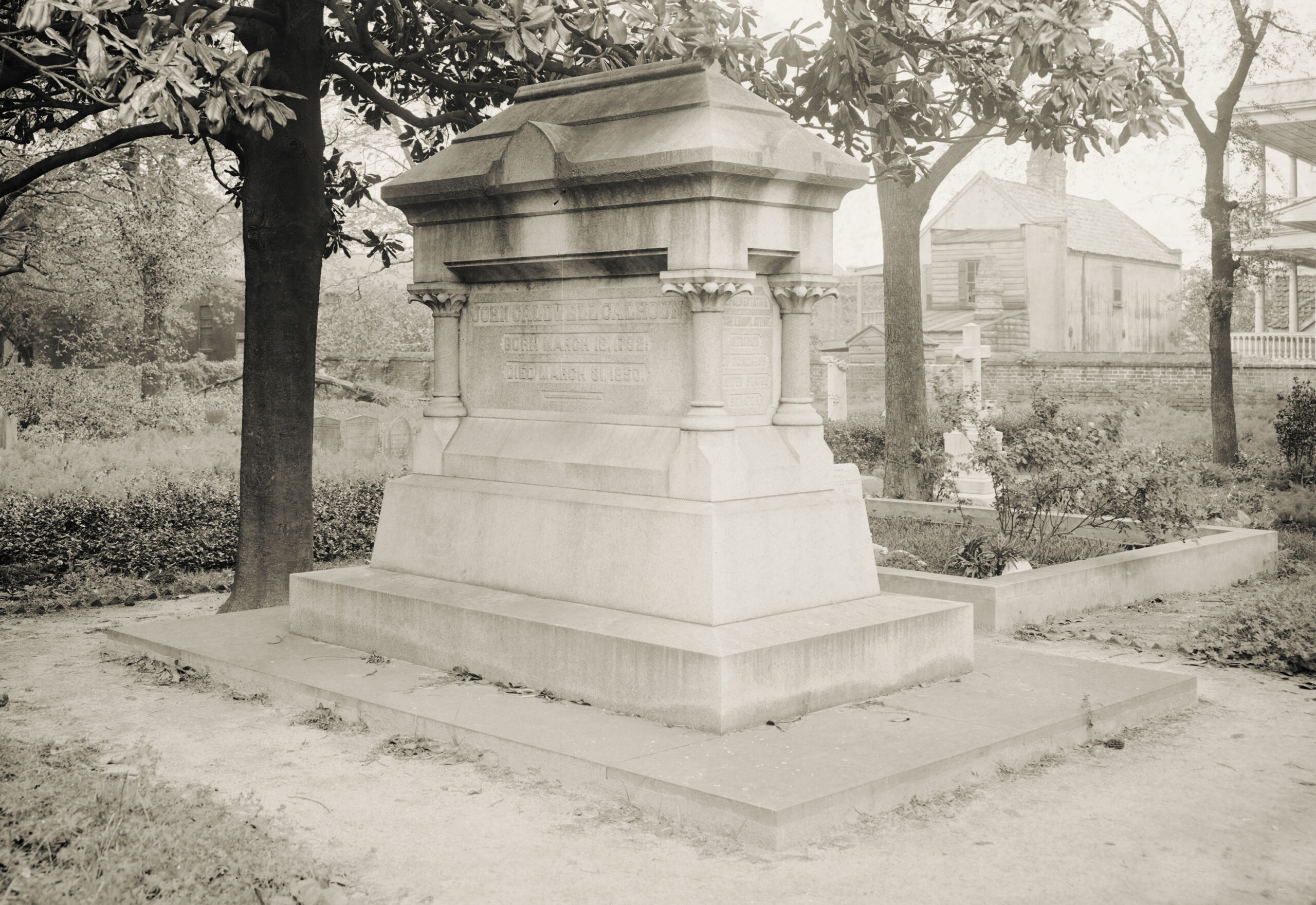
That uncertainty surely had something to do with the tomb’s disrepair. Visitors in the late 19th century often noted the poor condition of the site, even after the state appropriated $3,000 in 1883 to erect a more fitting tomb than the plain brick sepulcher that had stood since the 1850s. The next year, a 10-foot stone sarcophagus was installed.
With Calhoun’s remains now in a substantial new home, local fears about their safety seemed to subside. Still, the News and Courier urged vigilant protection of the tomb: “It will not fail to occur to the mind of any one who may visit the monument that immediate provision should be made for its proper protection, by surrounding it with an enclosure strong enough and high enough to preclude the possibility of injury to the work by thoughtless or evil disposed persons.” The paper went on to remind readers that “the simple slab” that had just been removed “bears silent witness to the necessity of such precaution, as it was so badly chipped and broken by relic-hunters that it was found necessary to round the corners to prevent further damage.”24
Yet there is no evidence that any such precautions were ever taken. Indeed, 15 years later, a reporter from Utica, New York, said that he struggled to even locate Calhoun’s tomb, notwithstanding its size. “The last resting place of John C. Calhoun,” he wrote, was “a sunken place covered with weeds and brambles—nothing to distinguish it from the grave of a pauper.”25
 Library of Congress
When, in 1884, Calhoun’s remains were moved to a new tomb (shown here as it appeared in the early 1900s), a Charleston newspaper wrote that “the bones of the great Calhoun have for the first time found a resting place and memorial stone worthy of his imperishable fame.”
Not long before Calhoun got his new tomb in 1884, Gregg’s successor as St. Philip’s sexton offered an explanation for the tomb’s disorderly appearance. Noting the “unkempt condition of the graves” in the cemetery, including Calhoun’s, he told a New York Evening Post reporter, “I would have come in here myself, … plant flowers and tidy up a bit, but I am afraid the white folks might take offence at a black man’s doing it.” He then explained that he had known Calhoun well, having “acted as his valet on occasions.” The sexton had no fondness for him, however. Calhoun “struck me once,” he said, “which is more than my own master ever did.” He called Calhoun “a very impatient man,” whose generosity hardly matched the other men to whom he was assigned when they visited his enslaver, former South Carolina governor Francis Pickens, one of Calhoun’s cousins. “Gentlemen I was in the habit of waitin’ on often gave me a quarter, fifty cents, sometimes a dollar, but Mar. Calhoun all the time I knew him never gave me a copper,” the sexton said.26
It is not likely white Charlestonians would have objected to St. Philip’s black sexton taking care of Calhoun’s grave. The local elite were accustomed to African Americans playing a role in their most intimate affairs. In any case, the sexton’s comments to the contrary attest to the fact that, three decades after his death, Calhoun remained a potent—and divisive—figure. A News and Courier article that appeared in 1884, just as the politician’s remains were deposited in their new sarcophagus, underscores this point. Coming on the heels of Grover Cleveland’s election—the first Democrat elected president since the Civil War—the paper judged the new Calhoun tomb “a singular coincidence”: “At the very moment when the American people have signified their determination that the Federal Government must and shall be cleansed from the corruption with which twenty-four years of continuous Republican rule has encrusted, the bones of the great Calhoun have for the first time found a resting place and memorial stone worthy of his imperishable fame.”27 Viewed in this way, the new tomb was a symbolic representation of the end of a Republican regime that—from the perspective of the newspaper and southern conservatives more generally—had upended their world by abolishing slavery and introducing biracial democracy during Reconstruction.
Three years later, in 1887, Charleston installed a sizable Calhoun monument in Marion Square. It and the second, much larger tribute that replaced the first Calhoun monument in 1896, and stood until June 2020, soon supplanted the tomb as the chief Calhoun attractions in the city. Some visitors to Charleston still made pilgrimages to St. Philip’s cemetery, but most communed with the spirit of Calhoun through the two statues that rose in the park at the center of the peninsula.
 Library of Congress
John C. Calhoun
The Calhoun monuments were also frequent targets of those who hated the man and all he represented. Detractors subjected both memorials to a steady stream of derision and vandalism—from the 1880s to the present. They threw rocks and defaced them with paint. In the wake of the church massacre in 2015, protesters spray-painted “racist” at the base of the second Calhoun monument, and to its engraved testament, “Truth Justice and the Constitution,” added “and Slavery.”28
With his statue no longer casting its shadow over Marion Square, Calhoun’s tomb is once again Charleston’s sole monument to the great defender of slavery and the ideological godfather of secession. It remains to be seen whether the St. Philip’s Church cemetery gravesite will once again be a battleground over Civil War memory.
Ethan J. Kytle and Blain Roberts, professors of history at California State University, Fresno, are authors of Denmark Vesey’s Garden: Slavery and Memory in the Cradle of the Confederacy, now available in paperback. They are currently writing a book on the 1960 battle to desegregate public schools in New Orleans.
Notes
1. John Niven, John C. Calhoun and the Price of the Union: A Biography (Baton Rouge, 1988), 344.
2. John C. Calhoun, “Remarks on Receiving Abolition Petitions (Revised Report),” in The Papers of John C. Calhoun, ed. Clyde N. Wilson (Columbia, 1980), 13: 395.
3. Calhoun, “Speech on the Slavery Question,” in The Papers of John C. Calhoun, ed. Clyde N. Wilson (Columbia, 2003), 27: 198.
4. “Narrative of the Funeral Honors Paid to the Hon. J.C. Calhoun, at Charleston, S.C.,” in The Carolina Tribute to Calhoun, ed. John Peyre Thomas (Columbia, 1857), 65.
5. Charleston Courier, April 27, 1850.
6. Fredrika Bremer, The Homes of the New World: Impressions of America, translated by Mary Howitt (New York, 1853): 1: 305.
7. Elijah Greene, in The American Slave: A Composite Autobiography, ed. George P. Rawick (Westport, 1972), 2(2): 196.
8. Charleston Courier, November 12, 1860.
9. Charleston Mercury, December 20, 1860.
10. Ibid., December 22, 1860.
11. Benson J. Lossing, Pictorial History of the Civil War in the United States of America (Philadelphia, 1866), 1: 104.
12. Charleston Mercury, April 16, 1861.
13. Andrew P. Calhoun to Robert N. Gourdin, June 26, 1862, in Gentlemen Merchants: A Charleston Family’s Odyssey, 1828-1870, ed. Philip N. Racine (Knoxville, 2008), 487.
14. The New York Times, November 22, 1884.
15. John N. Gregg, “Exhumation of the Body of John C. Calhoun 1863,” South Carolina Historical Magazine 57 (January 1956): 57.
16. Robert N. Gourdin to Andrew P. Calhoun, April 6, 1863, in Gentlemen Merchants, 580.
17. For more on this, see Ethan J. Kytle and Blain Roberts, “When the Abolitionists Went to Charleston,” The Civil War Monitor, Vol. 8, No. 4 (Winter 2018).
18. Theodore Cuyler, “A Trip to Fort Sumter, and the Doomed City,” Liberator, May 5, 1865.
19. Brooklyn Daily Eagle, April 26, 1865.
20. Henry Ward Beecher, “Narrative of His Trip to South Carolina,” Independent, May 11, 1865.
21. The New York Times, May 7, 1865.
22. Cleveland Daily Herald, November 5, 1874.
23. Syracuse Herald, March 12, 1916.
24. Charleston News and Courier, November 15, 1884.
25. Utica Observer, April 22, 1899.
26. New York Evening Post, March 11, 1884.
27. Charleston News and Courier, November 15, 1884.
28. Philip Weiss, “John C. Calhoun Statue Vandalized in Downtown Charleston,” WCSC News, June 23, 2015.