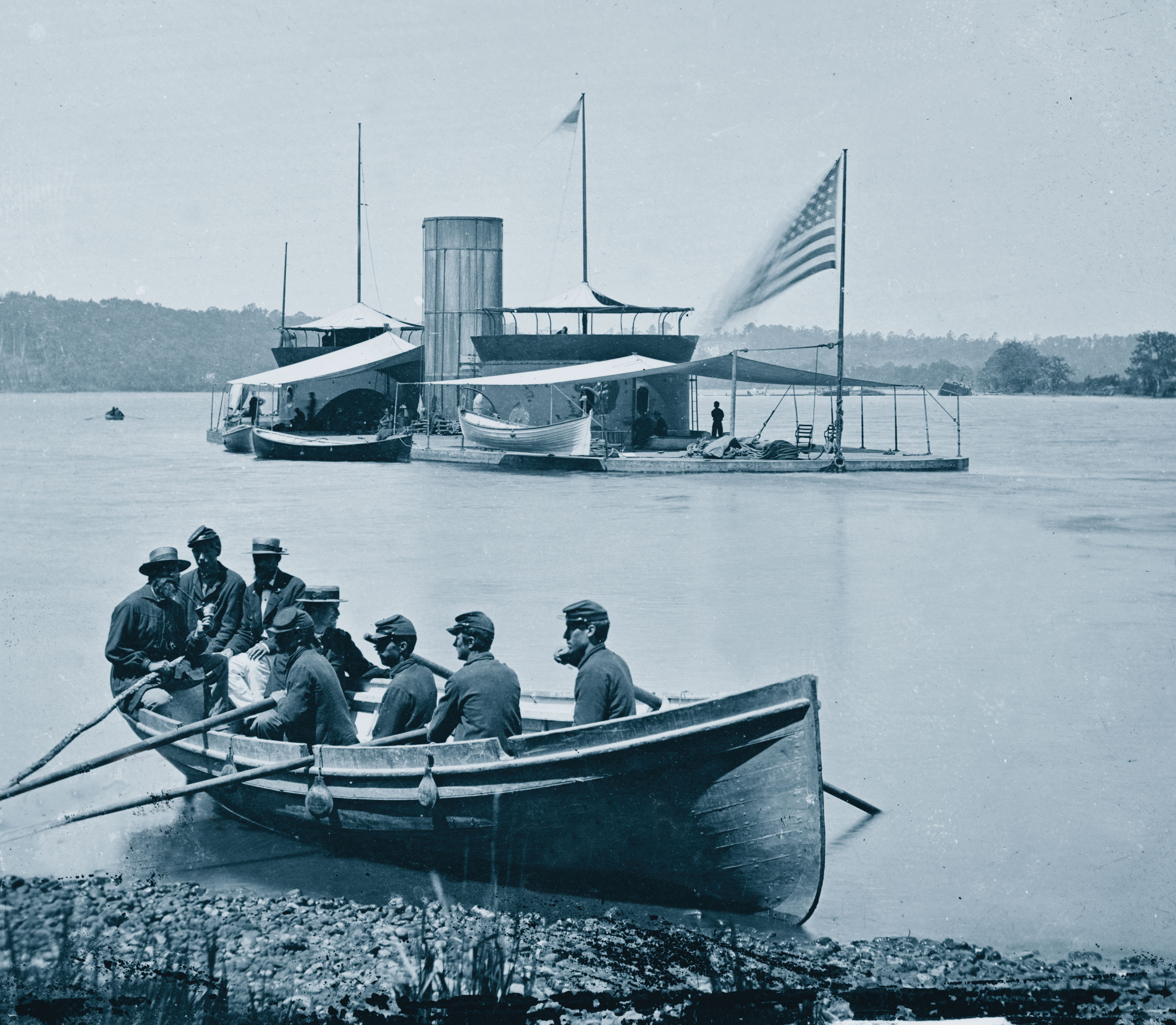
The warship USS Onondaga is shown on the James River in 1864. The following year, the ironclad would play a central role in the Battle of Trent’s Reach, one of the war’s last major naval engagements.
In mid-1862 a powerful warship began taking shape at the Continental Iron Works in Greenpoint, New York. A product of the monitor mania gripping the War Department following USS Monitor’s dramatic debut, the new vessel represented one of several variations on a theme. This monitor would be an all-iron affair and carry two turrets with four guns. Unlike the first (and many of her clones), whose iron deck extended out from the hull, this warship’s deck and hull were seamlessly joined, something her designers hoped would improve her oceangoing qualities. She tipped the scales at 2,592 tons and had a draft of 12 feet 10 inches.
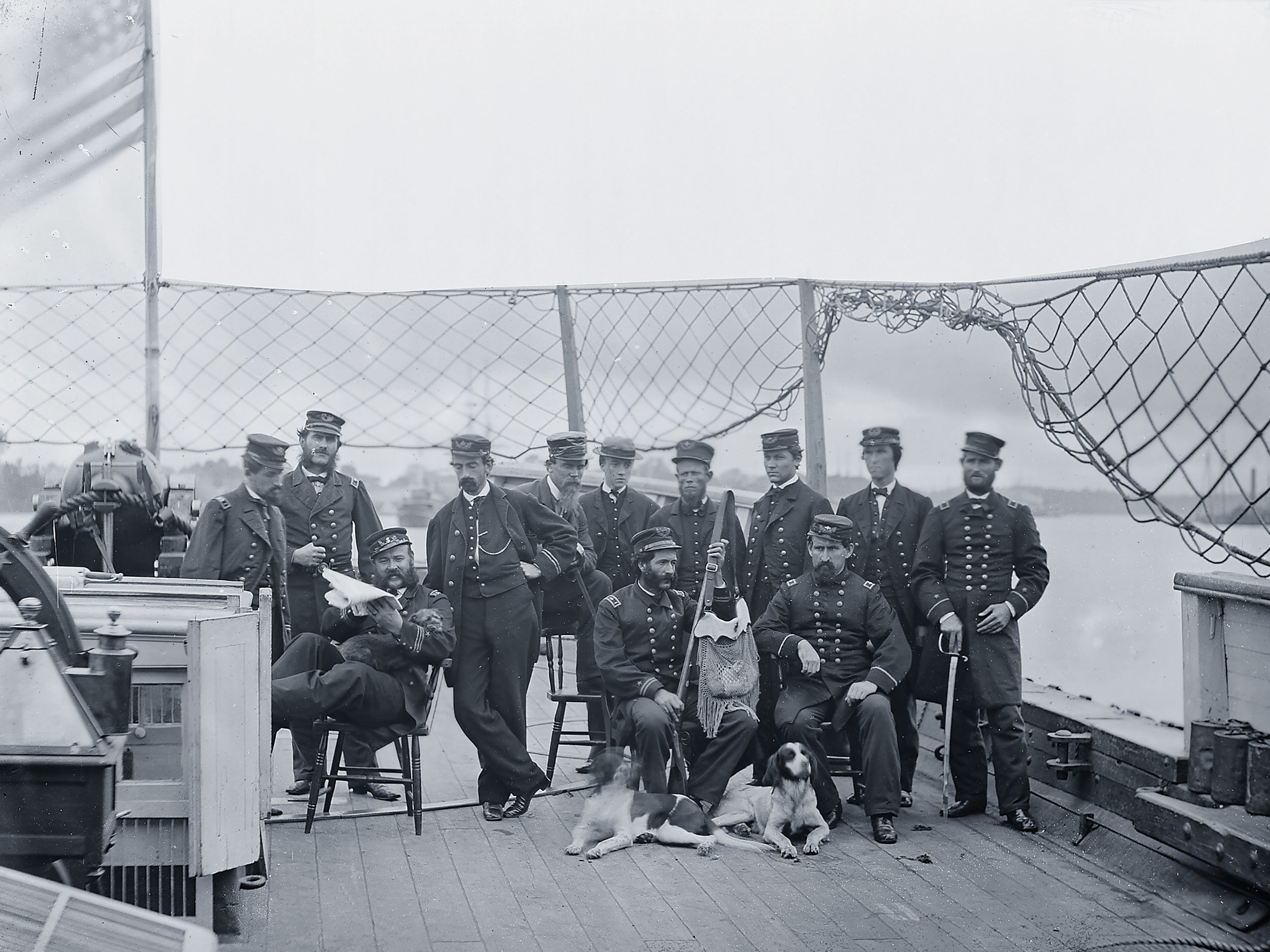
USS Onondaga was formally launched in late July 1863. In the months that followed, machinery and weapons were installed and the 150 or so men who would operate and fight aboard the craft were enlisted. The recruits reported for processing to the 40-year-old receiving vessel, USS North Carolina. Observed a reporter present when one batch arrived: “As soon as they get aboard the ship they are all placed in line and their papers handed to the 1st Lieutenant of the vessel, who notifies the Captain. The coxswain then reads the names off, and as each man’s name is called he answers to his rate, such as ‘landsman,’ etc., is looked at by the Captain and then detailed to his quarters.”1
 National Archives
Launched in 1863, USS Onondaga boasted two turrets with four guns and a crew of approximately 150 men. Shown here are the warship’s officers, who gathered on Onondaga’s deck for the camera in 1864.
Among those signing on to Onondaga was a landsman named Michael J. Callinan. The officer interviewing the Irish immigrant encountered a warmhearted, genial man, 5 feet 6¾ inches tall, red haired and with a florid complexion. He failed to catch the finer point of the newcomer’s patronym, entering him on the rolls as Callahan. In all other ways save one, Callinan was no different from the many thousands brought into the Union navy during the conflict, but that one difference was significant. Before enlisting, Callinan had been a sometimes reporter and essayist for the New York City-based newspaper The Irish-American. He had promised his editor to continue that role once aboard Onondaga and was a man of his word. From May 1864 to April 1865 he contributed 25 letters to the weekly paper. They provide invaluable insights into the experiences of a common sailor and the service performed by a Civil War monitor.2 For his pre-muster contributions to the newspaper Callinan had employed the nom de plume “A Garryowen Boy,” after his Irish heritage. He continued that practice during his military service, eventually shortening it to plain “Garryowen.”
After a shakedown cruise in the New York City area, Onondaga was ordered to report to Newport News, Virginia. She departed on April 21, 1864, arriving on station two days later. Garryowen’s first letter was dated May 3 from the “James River.” He briefly described the voyage from New York, proclaiming that Onondaga was “one of the most formidable of the Monitors,” adding her “armor … consists of four heavy guns, two in each turret, of fifteen-inch smooth bore and eight-inch rifle.” All in all, she was a warship “looked upon to accomplish great results.”3
 Naval History and Heritage Command
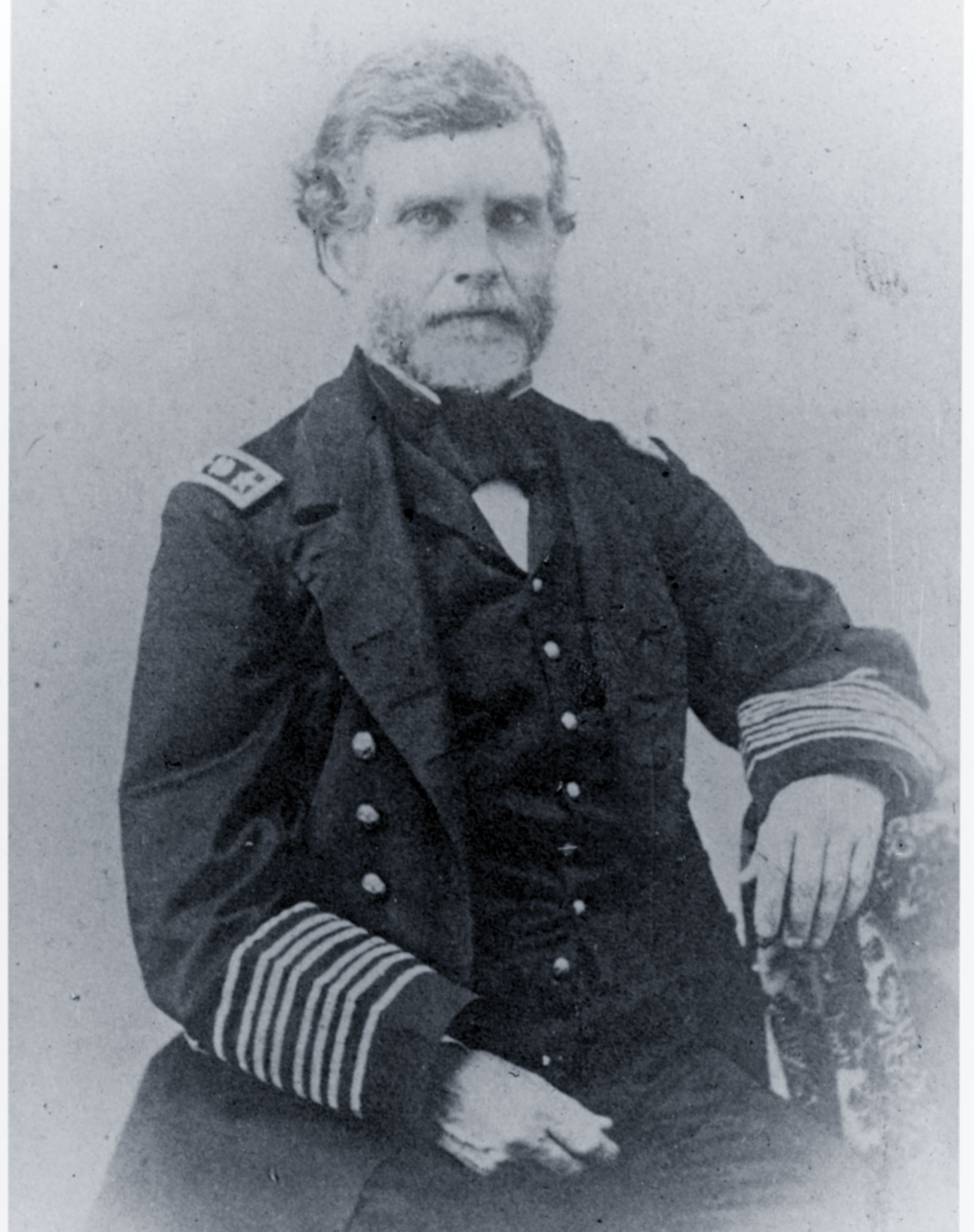
Acting Rear Admiral Samuel P. Lee
Two days later, Callinan and Onondaga joined a large Union fleet advancing up the James River as part of Lieutenant General Ulysses S. Grant’s spring offensive. While Grant and the Army of the Potomac tackled General Robert E. Lee’s army in north-central Virginia, a second force under Major General Benjamin F. Butler ascended the James to attack Richmond from the south. More than 120 vessels were involved, divided into a “First Fleet” (army-controlled ships) and a “Second Fleet” (the Union navy component, commanded by Acting Rear Admiral Samuel P. Lee). “The day was beautifully fine,” observed Garryowen, “and the mustering and starting of so many vessels was indeed magnificent.”4 Sandwiched between the two fleets were eight armed steamships whose job was to clear the river of Rebel mines (then called torpedoes) so that the powerful navy monitors could advance.
This precaution was tragically validated on May 6, when the torpedo screeners reached the Deep Bottom area. By this time a portion of Butler’s land forces had seized City Point, while the larger body was moving westward across a fat finger of land known as Bermuda Hundred, with the Appomattox River defining its southern side and the James marking its northern and eastern boundaries. Everything along the north bank of the James River was considered enemy territory, with good reason: Posted here were nine Rebel firing stations wired to powerful torpedoes set in the river channel.
It appears that one of the Union warships, a converted ferry boat named Commodore Jones, violated standing orders by getting too close to the small craft grappling for the mines and steamed over one. An alert Confederate firing team promptly completed the electrical circuit. A New York Tribune reporter nearby witnessed “a column of smoke astern, and fragments of wood shoot up, heard a smothered explosion, felt a slight shock, saw the Com. Jones raised up from the center then settle away, and then nothing was visible but the bow and the stern, with both colors flying.” One of the lucky survivors recalled: “They say that the noise of the explosion was terrific, but I don’t know anything about it. All I do know is that I found myself in the water with a confused idea that I had been hit with a club.” Sixty-nine men died in that explosive instant. Onondaga was out of sight downstream, but Callinan learned of the incident and Garryowen declared, “So much for rebel ingenuity.”5
This loss laid bare one of the sore spots in army-navy partnership. As long as the Rebels had free rein along the north bank of the James, swept areas could be quickly reseeded with torpedoes and horse batteries could execute hit-and-run ambushes. Admiral Lee needed the army’s manpower to sanitize the north bank and keep it that way. Butler was sympathetic to the navy’s needs, but he was fully engaged in fighting through to Richmond with a force reckoned to be half of what was needed. He wanted the naval guns supporting his right flank, but Admiral Lee would not rush the sanitizing process, so the navy element lagged behind. Butler’s manpower shortage also meant that Lee had to worry about maintaining supply and communication lines back to Hampton Roads, as well as respond to requests from General Grant for support as the Army of the Potomac maneuvered southward, all of which stretched the James River force to its limit.
 VLW Cartography
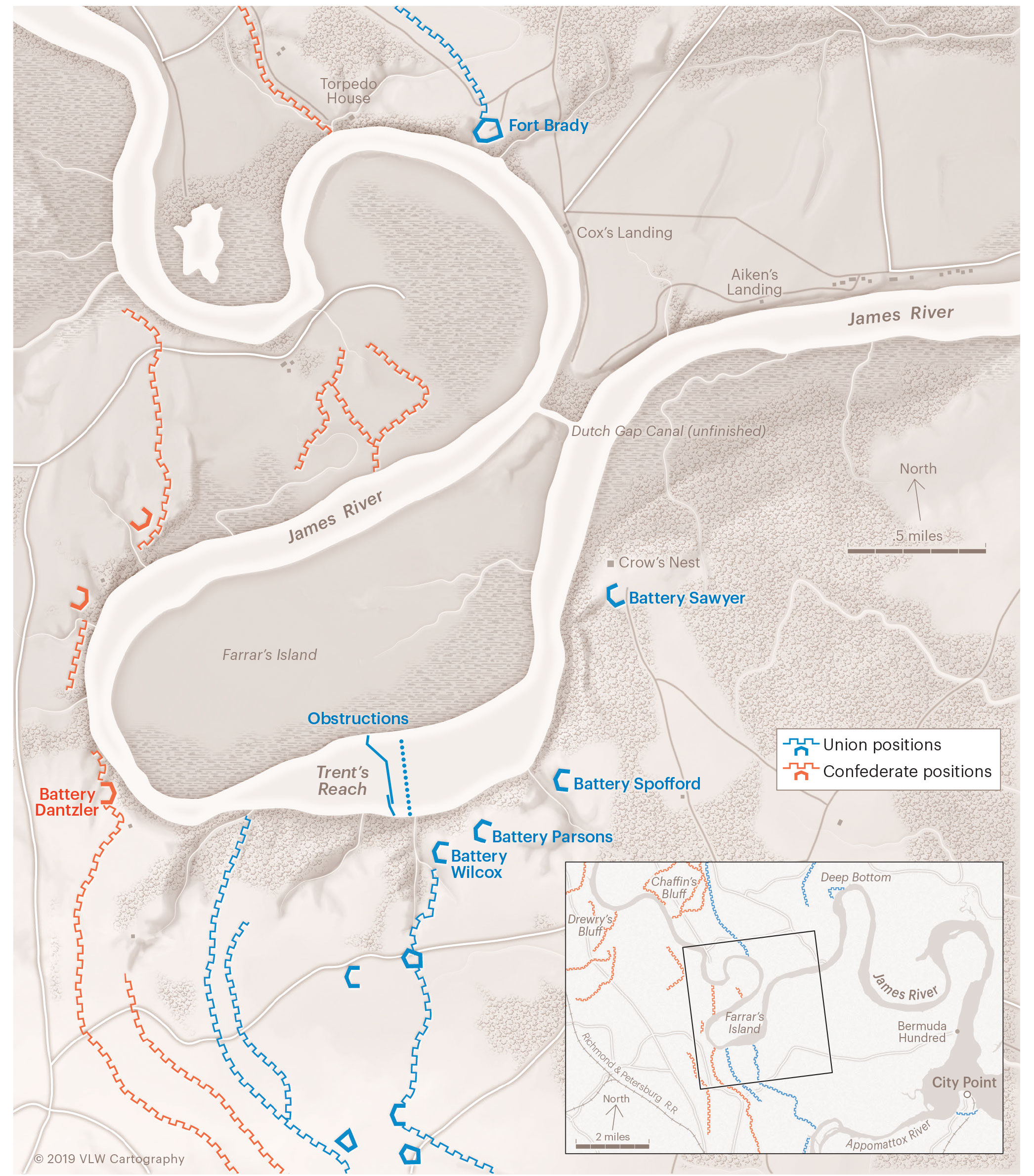
The Struggle for Trent’s Reach | James River, Virginia | May 1864 – January 1865
During Lieutenant General Ulysses S. Grant’s spring 1864 offensive against General Robert E. Lee in north-central Virginia, a second Union force under Major General Benjamin F. Butler ascended the James River with plans to attack Richmond from the south. Butler’s force included more than 120 vessels, which were divided into two fleets (army-controlled ships and navy-controlled ships). The naval advance stalled in May at Trent’s Reach, a point where the James narrowed and beyond which Confederate troops maintained control. The stalemate broke the following January, when a Confederate fleet attempted to breach the Union barricade at Trent’s Reach and continue on to threaten City Point, Grant’s major supply and command center. The Rebel ships eventually withdrew after heavy fighting, leaving the vital stretch of river under Union control. Less than three months later, Lee would surrender to Grant at Appomattox Court House.
The navy arrived at Trent’s Reach on May 17—the last east-west river stretch touching Bermuda Hundred before the James looped northward. Here the channel narrowed, the depth reached only 8½ feet, and high bluffs rose in the distance. The deep-draft monitors could proceed no farther, and until the army cleared the banks ahead, Lee would not risk his wooden gunboats. Butler’s movement had meanwhile shifted into reverse gear under heavy enemy pressure, and just three days after the navy arrived on scene the Union ground force had fallen back to a defensive line stretched across Bermuda Hundred, anchored on its right by Lee’s guns. In taking his position, Butler ceded control of the high ground west of Trent’s Reach, allowing the Confederates to erect a powerful battery—Dantzler (also called Howlett)—there.
Admiral Lee’s problems may have been well above Michael J. Callinan’s pay grade, but this didn’t prevent Garryowen from observing some of the consequences, without connecting them to any larger picture. “Though not actually engaged in fighting,” he wrote his readers on May 26, “we are improving the time by making every preparation—occasionally sending one of our messengers of death [i.e., artillery shells] through the woods to keep off prowling guerillas as we now and then get reports that they are locating themselves along the river. In such cases we proceed to the scene of operations, when they seem to anticipate our movements and make themselves scarce.” Those pinpricks blossomed into a major effort on June 21, as Battery Dantzler—supplemented by Confederate warships—opened a sustained bombardment on the Union navy’s front line. “Everything was immediately put into fighting trim,” reported Garryowen, “decks cleared; hammocks ‘piped’ up; the watch below aroused from their quiet slumbers; ‘all hands to quarters;’ and every preparation on our part made to participate in the melee, should the occasion require or an opportunity offer.” When the contretemps ended after six and a half hours, the situation remained the same.6
By now Onondaga was positioned at the eastern end of Trent’s Reach, carefully out of any direct line of fire. This became one of her primary posts from then on, along with Aiken’s Landing (three miles east). This location, and some key army decisions that assisted the navy mission, would essentially define Michael J. Callinan’s personal war experience. One of those important decisions was made by General Grant, then investing Petersburg with the Army of the Potomac, who ordered a bridgehead established on the north bank of the James at Deep Bottom. This was accomplished on June 20 and greatly reduced the threat level for the Union warships patrolling the river. A big beneficiary was the Union navy’s most effective and unsung asset in this campaign: its replenishment capabilities. Onondaga’s log charts the businesslike routine of weekly shipments received: fresh vegetables and meat, clothing and munitions, machine parts, and—most importantly in this steam age—coal. By this time Callinan had been promoted to fireman, so he would have been directly involved in the weekly fueling. It was a hard and dirty job (involving tens of tons of coal for each delivery), which Garryowen tactfully refrained from describing. He did, however, brag that Onondaga’s power plant was “the most important part of the ship.”7
 Library of Congress
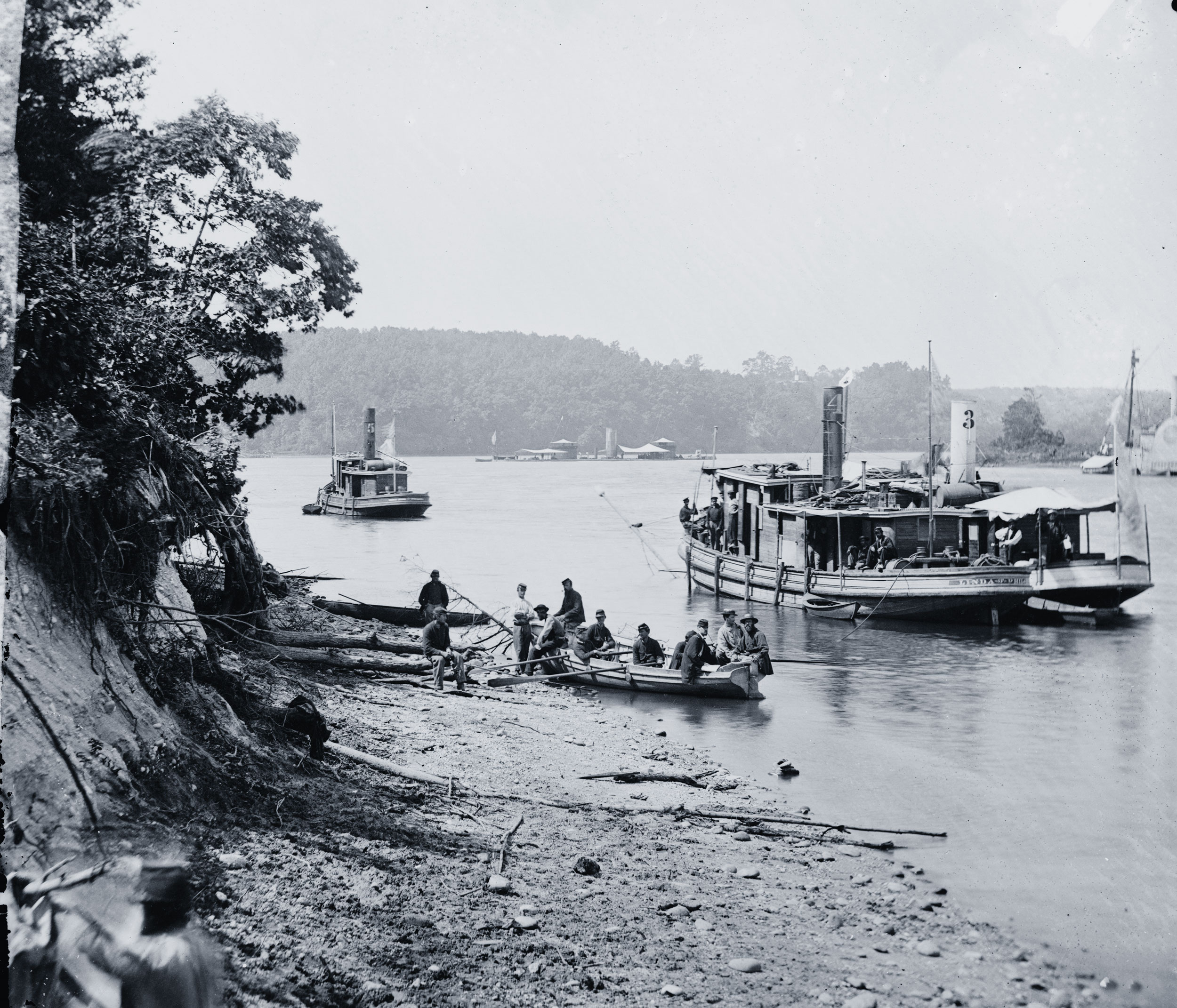
USS Onondaga (visible in the distance) stands watch in the James River near Trent’s Reach. The formidable ironclad’s presence proved a powerful deterrent to Confederate naval ambitions in the area.
The army also helped by establishing some land batteries watching over Onondaga’s anchorage area, but then stirred the pot by erecting a signal tower nearby (colloquially called the Crow’s Nest) that made a great aiming point for the Rebel guns. Benjamin Butler brought the pot to a boil with his decision to bypass the enemy batteries west of Trent’s Reach by digging a canal across the narrow neck of the loop at a point called Dutch Gap, perhaps a mile and a half north of Onondaga’s forward parking space. Stopping this activity became a Confederate obsession, and hardly a day passed throughout the summer and fall of 1864 without enemy shells falling near Onondaga, which occasionally returned the compliments. The “avowed object” of the Rebel efforts was, Garryowen acknowledged, “to annoy us or drive us away from our canal operations. But they ‘can’t do.’ Their range, so far, is decidedly wide of the mark, and, consequently, ‘the work goes bravely on.’”8
Admiral Lee had undertaken the James River campaign believing he would direct the naval contribution to a drive on Richmond. By early summer it was clear that the land forces were engaged in a lengthier operation aimed at Petersburg, with the navy’s role scaled back to river security. So Union efforts turned to erecting a barrier blocking Trent’s Reach to prevent the Confederate ironclads from coming down. A number of disposable vessels were obtained, positioned, sunk, and bound together with spars and chains. Lee turned his attention to managing the coastal blockade, leaving the James River operations to the senior officer on station, Captain Melancton Smith, commanding USS Onondaga.
Any Confederate deserters picked up on or along the river were first brought to Onondaga for questioning before being passed along to the army for additional interrogation. They did not escape Michael Callinan’s attention. We “have more or less of them every day,” Garryowen informed his readers, “and their reports of the condition of the Southern people is humiliating, if we could indulge in any compassion for them; but that they are tired and sick of the war, there is no doubt, and only pant for the opportunity to safely declare themselves so.”9 It was partly intelligence gleaned from Confederate deserters that led to one of the more dramatic combined operations of the James River campaign.
When the Federals established their Deep Bottom bridgehead and successfully beat back a Confederate effort to retake it, the Rebels had to extend an exterior defensive line south to the river. It was a slow work in progress and had yet to reach a house and buildings belonging to Henry Cox, where the Confederates were using two mills to process food for the troops and constructing torpedoes in the barn. After Federals gathered intelligence about the activities, a conference aboard Onondaga deemed the structures a worthwhile target and a mission to destroy them was mounted under the overall command of army Lieutenant David W. Chambers.
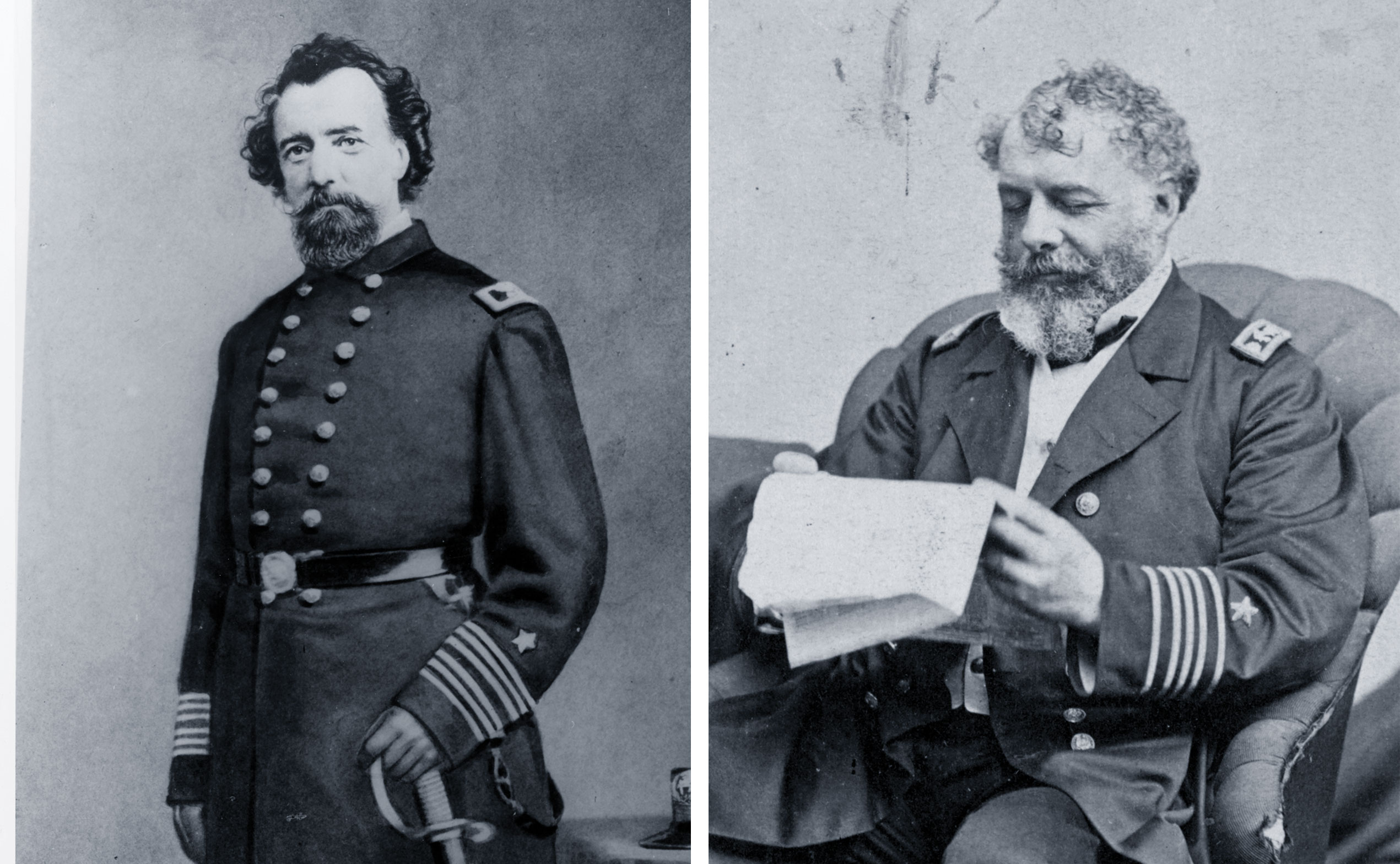 Naval History and Heritage Command
Captain Melancton Smith (left) and Commander William A. Parker (right)
On the evening of July 11, a force consisting of 70–80 men from the 3rd Pennsylvania Heavy Artillery (previously assigned to the navy for picket duty) and 50 more from the 10th Connecticut Infantry were conveyed by USS Stepping Stones to a landing near Dutch Gap. A navy ensign served as guide and the raiding party approached the Cox farm in two columns. A Rebel picket alerted the small security force from Richmond’s City Battalion assigned to the farm, who opened fire on the Yankees. Lieutenant Chambers ordered a charge that routed the two dozen defenders, capturing 14 of them.
The raiders had come equipped with turpentine fireballs, which soon had the buildings ablaze. The approach of a large Confederate reserve caused the Federals to withdraw, but not before they confiscated a torpedo and its firing equipment, some military papers, and an armor-piercing shell of British manufacture. A nearby signal station was also destroyed. Even though Garryowen had no specific comment on the affair, he did reflect that this was a time “while the hostile parties on both sides of us are measuring their strength and manuring the soil of Virginia with their hearts’ blood.”10
While Onondaga’s steely presence proved a powerful deterrent to the enemy’s naval ambitions in the area, its essentially passive assignment led to what Garryowen bemoaned as “dull monotony.” Dull it may have been in the engine room, but the monitor’s administrative wheels were constantly turning. “Our old crews’ time is expiring now every week,” noted Garryowen, “and the boys are going home—in twos and threes at a time. Of course new hands fill up their places.” Included among the new crewmembers was a pair of contraband slaves who were logged as “shipped as of this date.” For those crewmembers who became too ill for the basic treatments available aboard, there were sick tickets issued for transport to the Norfolk Marine Hospital. For those needing nourishment of the soul, there were prayer meetings and regular Sunday services, which Garryowen testified were well attended.
Above all, discipline was maintained. Callinan may have been among 150 men packed into a small space, but Garryowen viewed the confining quarters through rose-colored glasses. “We have a good set of officers, [and] a bully crew,” he proudly declared. Yet Onondaga’s log dutifully documented a steady litany of infractions onboard: swearing, fighting, malicious or insolent language to a superior officer, and theft. A log entry from late 1864 notes: “John Cameron cox’n placed in double irons … for quarrelling. J.T. English placed in double irons for attempting to shoot J. Cameron & W.T. Price also placed in double irons for being accessory to the act.”11
“Our ‘boys’ are variously employed,” Garryowen wrote in October 1864, “exercising at drill.”12 This routine included fire drills, small arms drills, as well as regular exercises for guns and turrets. A monitor was part submarine, with most of the crew living and working below the water line, so escape drills were a necessity. It says something about the crewmembers’ survival instincts that the 150 aboard Onondaga generally took less than a minute to come up on deck, and in one instance did so in 35 seconds. But even a bully crew needed a break from the war, and liberty parties were regularly dispatched, though they couldn’t go much beyond City Point. Garryowen entertained his readers with three accounts of what he termed “aquatic sports,”13 providing play-by-play coverage of races among four of the small boats carried aboard the monitor: the captain’s gig, the whale boat, the lifeboat, and the launch.
The whale boat was the favorite to win, and it didn’t disappoint in the first running. “The greatest excitement and enthusiasm was manifested on the occasion,” Garryowen commented, “and as the crew of the winning boat, flushed with victory, tossed their oars, the captain ordered three cheers for the coxswain and crew of the ‘1st whale boat,’ which were responded to with a will, and such cheers only as a jolly set of man-of-war men can give. They were taken up and re-echoed by a large crowd of enthusiastic soldiers from ‘Crow’s Nest,’ who were strewed along the bank, anxious and excited spectators of the sport, and who made the valley of the James River ring with their war-like yells of victory.” A repeat engagement 21 days later produced the same result, though it was almost a tie. Finally, in a November heat, the launch took the honors.14
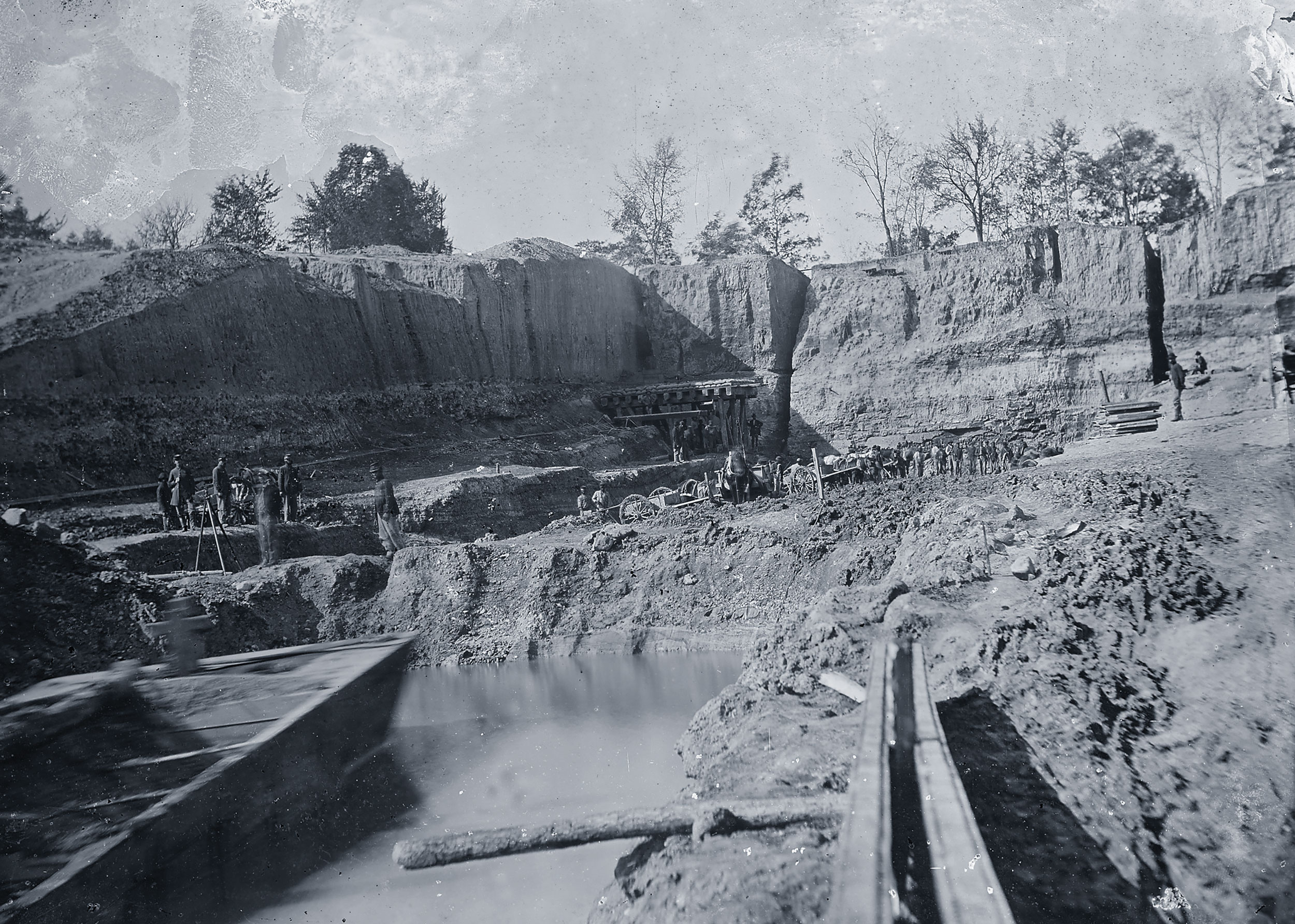 National Archives
In the fall of 1864, while the sailors of Onondaga fought what crewmember Michael J. Callinan termed “dull monotony,” the vessel did witness activity, including a change in the ship’s command from Captain Melancton Smith to Commander William A. Parker and the ongoing construction of the Dutch Gap Canal (above).
In late October 1864, there were changes at the top for Onondaga. Captain Melancton Smith was promoted to command of USS Wabash, which would soon join the North Atlantic Blockading Squadron. Garryowen was sorry to see Smith go, proclaiming him “one of the most skillful and experienced officers in the service.” Lieutenant Commander Charles H. Cushman took over on an interim basis (prompting Garryowen to assure his readers that “the right man is in the right place”). A permanent replacement eventually arrived in the person of Commander William A. Parker. Hats were also changed at the top of the command pyramid, with Rear Admiral Lee replaced by Rear Admiral David Dixon Porter. Commander Parker would have a starring role in what would be Onondaga’s one major and still controversial ship-to-ship engagement.15
Callinan and his mates had a front row seat for General Butler’s audacious plan to carve a canal through the narrow neck of Dutch Gap, the project that had attracted unrelenting Confederate shelling. Garryowen’s first reference to the scheme had come in a missive dated August 21. Mentions followed in almost every letter, often no more substantial than noting that the work continued, spiced with comments on the persistent Rebel disruption efforts. Finally, on January 1, 1865, all was deemed ready, and the dams holding back the river water on either end were dynamited. Reported Commander Parker to Admiral Porter: “The earth was thrown up into the air about 40 or 50 feet and immediately after fell back into its original place.” Garryowen pronounced it a fiasco, writing that “nothing remains of the ‘great Dutch Gap canal’ but a ditch with a stream of water running through it, not sufficient to float a skiff; and instead of the recent flood clearing it, it only helped to fill it in.”16
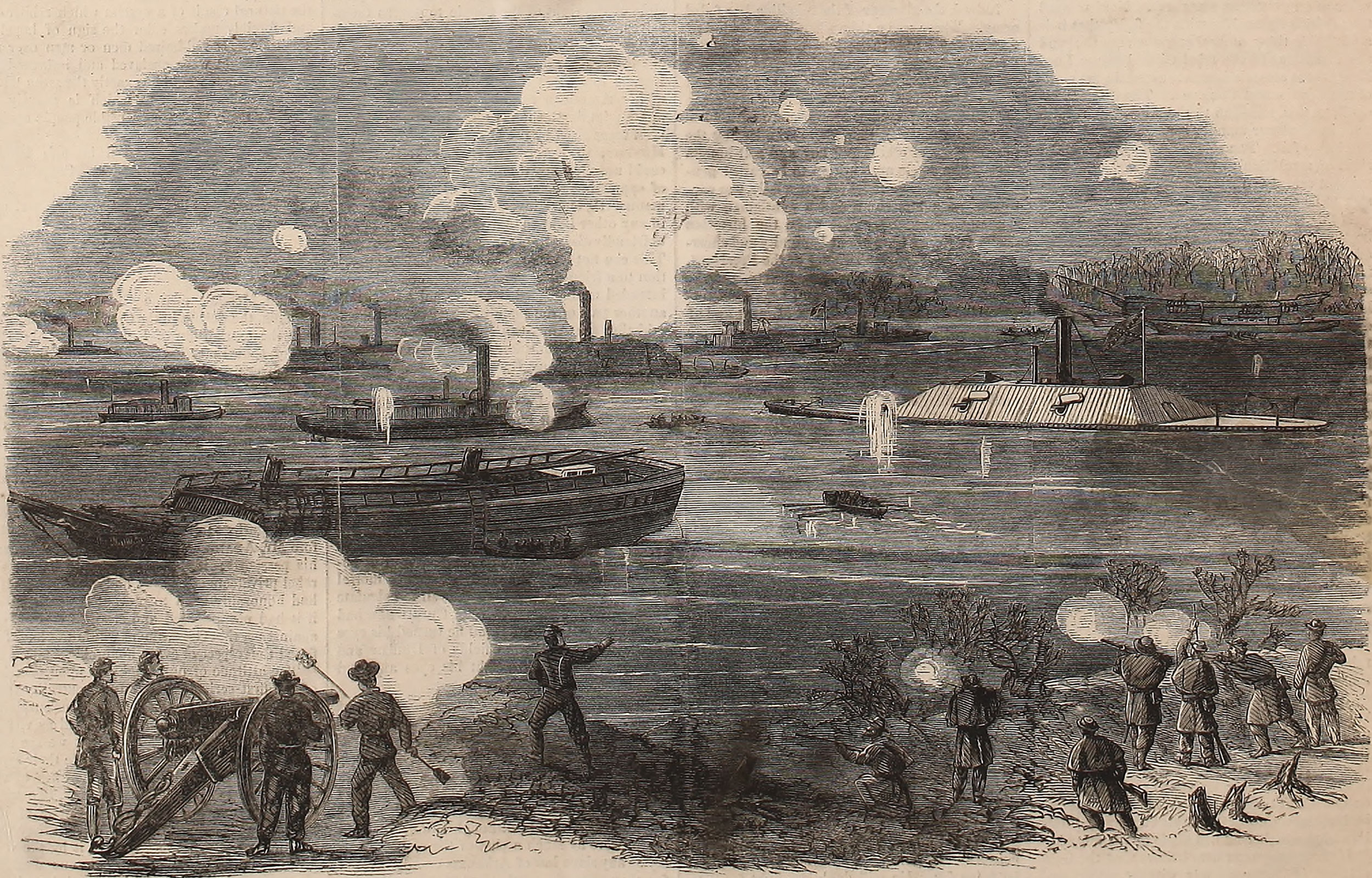 Harper’s Weekly
In this sketch by Alfred Waud, a Confederate fleet breaks through the Union obstructions at Trent’s Reach while taking heavy fire during the evening of January 23, 1865. Onondaga—then positioned several miles away near Aiken’s Landing—would engage the remaining Rebel vessels the following morning and drive them from the area.
New events soon placed Callinan and Onondaga directly in harm’s way. Admiral Porter was tasked with commanding the naval component of the Union effort to shut down the Confederate seaport of Wilmington, North Carolina. The effort would require capturing the potent Fort Fisher, which guarded the Cape Fear River’s entrance. Porter assembled a powerful fleet for the job, and in the process stripped away all the monitors assigned to the James River, save Onondaga, as well as many other gunboats and warships. (Several that he believed he was leaving behind ready for action were actually immobilized in Hampton Roads undergoing repairs.) Only a few vessels were on hand at the tip of the sword in Trent’s Reach, which should have been sufficient defense as the Confederate navy had yet to test the barricade.
However, the steady drumbeat of Union military successes in the fall and winter greatly raised the pressure on Richmond’s naval officials to make use of their three expensive ironclads, CSS Fredericksburg, CSS Richmond, and CSS Virginia II. The trio had been regularly positioned near Drewry’s Bluff and sporadically dropped downriver to lob shells at extreme range. The formidable line of obstructions that the Federals had placed across Trent’s Reach remained the single greatest impediment to any sortie, though persistent mechanical breakdowns and poor crew training had also aborted some earlier Confederate efforts.
A significant mid-January thaw changed the picture. River levels rose, and the additional freshet pressure compromised the barrier’s integrity. The timing was now or never, although it remained a high-risk operation for the Confederate navy. The mission: muscle through to City Point to wreak havoc on the Union army’s major supply and command center. Union intelligence services were effective enough that on January 21 Commander Parker was alerted by Grant’s chief of staff that plans for an enemy sortie were afoot. Steps were undertaken to re-establish the barricade and strengthen the artillery defenses, but these efforts were still being organized when the Confederate attack force steamed downriver.
Military positions had changed drastically since Onondaga had arrived in the James River the previous May. In September, Butler’s Army of the James had crossed to the north side of the river in an unabashed drive on Richmond. As so often happened with Butler’s grand plans, reality fell short of aspiration, and his soldiers got no farther than the Confederate exterior line, some half-dozen miles southeast of the capital. They soon established Fort Brady on the north bank of the James, perhaps five miles upriver from the Trent’s Reach barricades. The Confederate hold on portions of the south bank remained solid, so the Rebel battle fleet steaming from Drewry’s Bluff had to first run the gauntlet of Fort Brady before gaining the protective cover of the friendly batteries overlooking Trent’s Reach. The three Confederate ironclads were assisted in the venture by five gunboats and three torpedo boats, each mounting one spar torpedo.
Onondaga began the night of January 23 at her alternate post near Aiken’s Landing (three miles downriver from the barricade), supported by two gunboats and a torpedo boat. At 8:30 p.m. the monitor’s deck officer noted that he “heard heavy firing in the direction of Fort Brady.” Two hours later the Crow’s Nest reported enemy sappers were within the obstructions. General quarters sounded sometime between 10:30 p.m. and 11 p.m. to summon the crew, and the night was, according to Garryowen, “dark as pitch.”17 Unknown to them, the Rebel attack force was already in the throes of dysfunction. While the vessels got past Fort Brady without any significant damage, soon afterward Virginia II’s maneuverings caused one of the Confederate torpedo boats to run aground. A gunboat remained behind to salvage the grounded craft, so both were essentially lost to the operation.
As CSS Fredericksburg, which had the shallowest draft of the ironclads, steamed slowly into the compromised barricaded area, her two ironed consorts each went aground behind her. This drew the gunboats and torpedo boats to assist them, leaving Fredericksburg with just one escort. Meanwhile, every Union army battery in range was pouring shot and shell into the cluster. Although she suffered bothersome damage doing so, Fredericksburg cleared the barrier zone and had reached a point just below the eastern end of the Dutch Gap Canal when her captain received a recall order. The ironclad returned to the main body, where the captain reported that no Union navy opposition had been encountered.
In letters written on January 24 and February 6, Garryowen provided what remains the most extensive narrative of these events from a participant aboard Onondaga:
Last night about eight o’clock, heavy and continuous firing was heard in the direction of “Howlett’s” [battery] and about eleven o’clock we were signaled, “the rams are coming.” We immediately were beat to quarters, and in quick time every man was at his station. We lay in hourly expectation of them till about four o’clock this morning, when we concluded to have at them. With this intention we weighed anchor, when our vessel suddenly “sheared,” and grounded on the opposite shore, our port propeller thereby becoming deranged, to what extent as yet we can’t tell, but sufficient to render the port engine at present useless. On account of the unexpected accident we dropped down to the pontoon bridge at Jones’ Landing [near Deep Bottom, two miles from Aiken’s Landing], there to await them, and at the same time protect the bridge and base of supplies for the Army of the James. At about nine this morning, seeing they were not advancing, our undaunted Captain procured two tugs and had them to tow us up [to the barricade], which was accordingly done, we working the starboard engine only; and in this crippled condition faced the rebel foe, and poured our 15-inch solid shot into them thick and heavy, for about two hours, the result of which was that one of them was struck in the magazine and blown up, the other two “turned tail and run,” and left us alone in our glory.18
The vessel that exploded at 7:10 a.m. was not a Rebel ram, but the gunboat Drewry, which had been overwhelmed by land battery hits. Onondaga did strike Virginia II with two 15-inch shells, both of which penetrated her ironed casement, causing damage and causalities. The Rebel warships eventually withdrew, leaving Onondaga holding her position near the barrier. From the perspective of General Grant, the navy had badly mishandled the engagement and exposed City Point to a potentially catastrophic firestorm. His anger centered on Commander Parker’s “failure” to immediately engage, and such was the force of the general-in-chief’s censure that the Navy Department relieved, then court-martialed, Parker. Garryowen wrote his second letter about the engagement just after his commander’s dismissal.
The “rebels did not come down on a fool’s errand,” he explained, “they were well provided with torpedo boats and other instruments of destruction, which we, single-handed as we were, by any means of strategy or prowess could baffle. We could fight the rams, it is true; but the torpedo boats, like hornets, would swarm around us in the dark, and cause such a ‘rise’ in Yankee patriotism as would cast the gold speculators of Wall street in the shade. And for not committing such a rash act, we are cowards!” Garryowen praised Commander Parker, who throughout the chaotic events was “cool, calm and collected—to him we owe our presence here now; and to him the numerous shipping, bridges and warehouses on the James are indebted for their preservations.”19
Parker’s court-martial convened a dozen days after Garryowen’s letter. In the end, the panel found the commander guilty of avoiding a fight and recommended his dismissal. Secretary of the Navy Gideon Welles, however, overturned the verdict, allowing Parker to retire.
The few months of service remaining for Onondaga passed with Callinan continuing to write cheerful dispatches as Garryowen. Then came the collapse of the Confederacy in April, a moment symbolized for Callinan by the unannounced visit of President Abraham Lincoln to inspect the vessels (now including additional monitors) watching over the refurbished barricade at Trent’s Reach. Remembered Garryowen, “repairing on deck, I observed that illustrious gentleman on a tug proceeding towards the head of the fleet, and afterwards, slowly descending in a row-boat, viewing the iron ‘mud-turtles’ as he passed. Our crew were drawn up on the port-side, rigged and equipped with Sharp’s rifles, and on his passing presented arms, which Father Abraham acknowledged and passed on.”20
On May 29 Onondaga weighed anchor for the final time in the James River and eight days later docked in the Brooklyn Navy Yard to begin the decommissioning process. Garryowen’s discharge had preceded that by nearly two months, and in his final letter, dated April 10, he thanked the officers and crew “for their uniform kindness and indulgence to me.”21 Garryowen had teased his readers on several occasions about his identity, never revealing his real name, but it seems clear that Callinan’s connection to Garryowen was an open secret on his home patch. He returned to his old “job” of sometimes-correspondent covering events of importance to the Irish-American community. The Garryowen byline continued until 1872, when Callinan suffered a serious fall from his apartment steps. The accident resulted in his death at age 40 from the effects of concussion.
In a letter to The Irish-American written before his military service began, Garryowen said: “The first and most important duty of man is to his God; the next to his country and then to his family, friends and relatives.”22 While in the midst of his service he reflected on his ship’s role in the war and his higher motivation:
“As is generally known, there is not sufficient water to allow us to ascend the river any higher, or else the rebel navy would ere now have been numbered among the things that are past—hence our present inactivity. But, as it is, we are of incalculable value, inasmuch as the rams aforesaid (in case of our withdrawal) would have no formidable enemy to encounter in their descent, and would sweep the river from City Point to Hampton Roads, thereby cutting off the supplies which are absolutely necessary for maintaining our grand army in the field. Thus it is that we are the ‘Gibraltar of the James.’ Our glorious and time-honored banner, the ‘Stars and Stripes,’ waves defiantly and triumphantly from our flag-staff. Our noble officers and heroic crew (as fine specimens of humanity as ever decorated the decks of any navy in the world) are eager for the fray. Our sole ambition is to re-establish the principles and laws of our government as we found them, and as they have heretofore protected us and guaranteed us the right of freemen and citizenship,—and if those rights and privileges have been impeded during the prosecution of the war, the government nevertheless stands, and we mean that it shall stand.”23
Noah Andre Trudeau is the author of numerous military history articles and eight Civil War history books. His books include: The Last Citadel, Like Men of War, Gettysburg: A Testing of Courage, and Southern Storm. His latest, Lincoln’s Greatest Journey, tracks the experiences of Abraham Lincoln while at City Point, Virginia, in March-April 1865.
Notes
1. Brooklyn Daily Eagle, April 27, 1864.
2. Information on Callinan is taken from the 1864 Onondaga muster rolls (National Archives), and his obituary appearing in the July 2, 1872, edition of The Irish-American.
3. The Irish-American, May 21, 1864.
4. Ibid., May 28, 1864.
5. New York Tribune, May 10, 1864; New York Press, April 24, 1898; The Irish-American, May 28, 1864.
6. The Irish-American, June 11, August 27, 1864.
7. Ibid., May 28, 1864.
8. Ibid., September 3, 1864.
9. Ibid., September 24, 1864.
10. The description of the July 11–12 raid comes from a variety of sources beginning with the reports of Captain Smith and Lieutenant Chambers, in United States Naval War Records Office, Official Records of the Union and Confederate Navies in the War of the Rebellion 30 vols. (Washington, 1894-1922), Volume 10, 267 (hereafter cited as ORN); a more extensive account in the Philadelphia Inquirer, July 18, 1864; and two brief pieces in the Richmond Dispatch, July 14-15, 1864. Garryowen’s observations come from The Irish-American, June 11, 1864.
11. Onondaga log book (National Archives), entries for September 1 and November 29, 1864; The Irish-American, May 28, 1864, and December 17, 1864.
12. The Irish-American, October 22, 1864.
13. Ibid.
14. Ibid., November 12 and December 17, 1864.
15. Ibid., October 29 and November 5, 1864.
16. ORN, Volume 11, 400; The Irish-American, February 4, 1865.
17. ORN, Volume 11, 656; The Irish-American, February 4 and 15, 1865.
18. The Irish-American, February 4, 1865.
19. Ibid., February 18, 1865.
20. Ibid., April 8, 1865.
21. Ibid., April 22, 1865.
22. Ibid., February 24, 1866, reprinting a letter dated April 2, 1864.
23. Ibid., September 10, 1864.
Related topics: naval warfare