Full-length portrait of a bearded Union soldier in uniform, laden with knapsack, blanket roll, canteen, and other field equipment.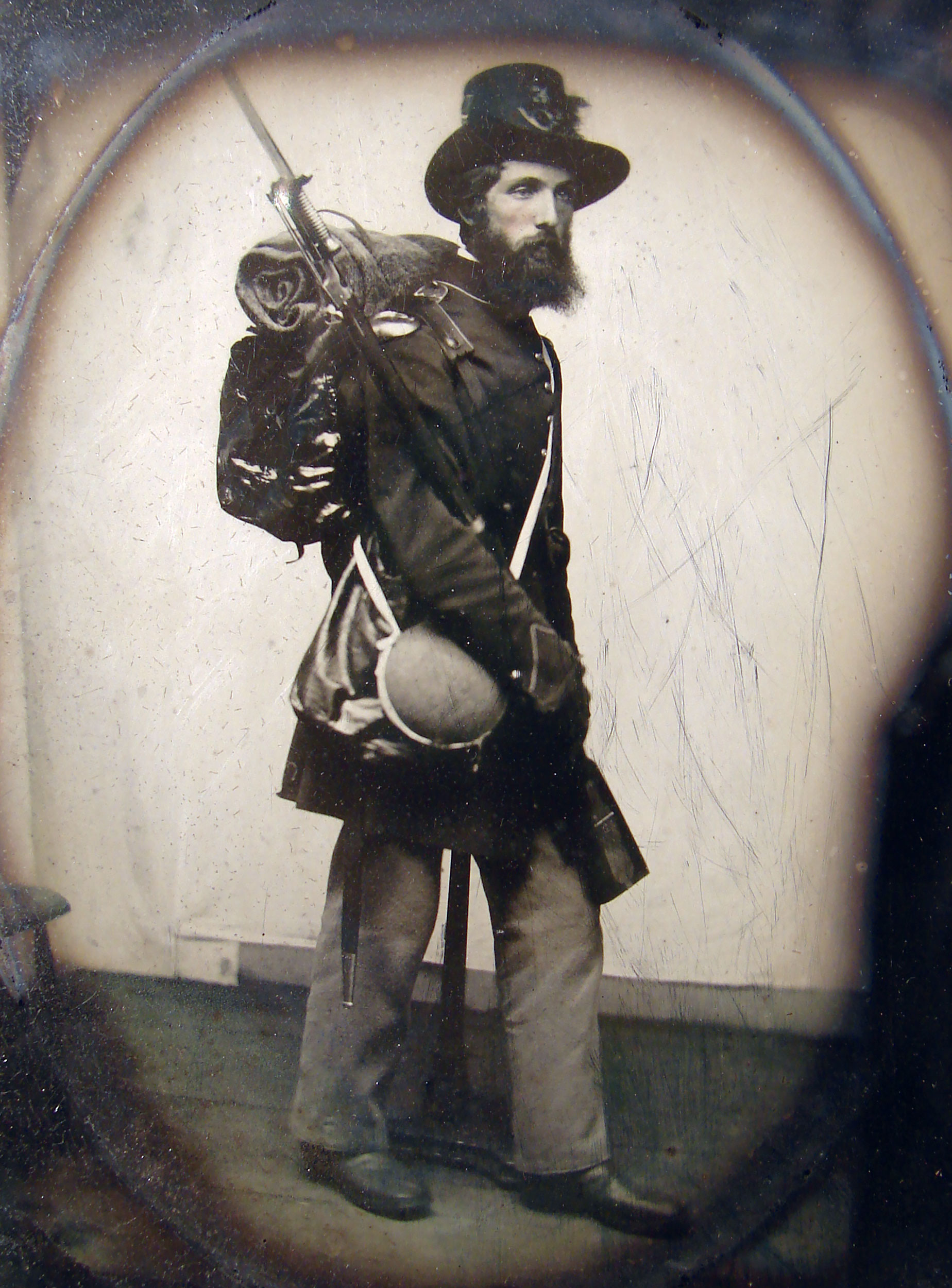 Library of Congress
During the Overland Campaign of 1864, veteran Union soldier John Billings took notice when a full-strength—and fully equipped—regiment of reinforcements marched past his camp. “These men had started from Washington with knapsacks that were immense in their proportions, and had clung to them manfully the first day or two out, but this morning in question, which was of the sultriest kind, was taking them beyond endurance.” As these new arrivals soon learned, a full knapsack compounded a soldier’s burden on the march, which could exceed 60 pounds. While veterans like Billings found ways to minimize this load—discarding all but the most necessary personal effects, and even the knapsacks themselves—the extra weight could (and sometimes did) cause serious health problems, including hernias, when not shouldered wisely. Here we highlight the average weights of key elements contributing to Billy Yank’s personal cargo.
Weight of Union Soldiers’ Equipment
5.25 pounds — Union soldier’s winter overcoat
5.75 pounds — Haversack containing three days’ cooked rations
1 pound — Daily ration (10 pieces) of hardtack
6 pounds — Empty knapsack
5 pounds — Army-issued wool blanket
1.75 pounds — Half shelter tent
2 pounds — Single change of underclothing (shirt, drawers, socks)
4.5–5.0 ounces — Uniform hat without trimmings
3.2 pounds — Trousers, woolen shirt, drawers, and socks
3.8 pounds — Full army canteen
11–14 pounds — Rifle and “accouterments”
4 pounds — 40 rounds of ammunition
143 pounds — Average weight of Union soldiers
5′ 6.4″ — Median height of Union soldiers
Sources
John D. Billings, Hardtack and Coffee (1887); Earl J. Coates and Frederick C. Gaede, eds., The 1865 Quartermaster Manual, Volume I (2013); Benjamin Gould, Investigations in the Military and Anthropological Statistics of American Soldiers (1869); Charles Smart, The Medical and Surgical History of the War of the Rebellion, Part III, Volume I, Medical History (1888); U.S. War Department, The War of the Rebellion: A Compilation of the Official Records 129 vols. (Washington, 1880–1901), Series I, Vol. 25, pt. 2. With thanks to Robert Lee Hodge for his assistance.