 Library of Congress
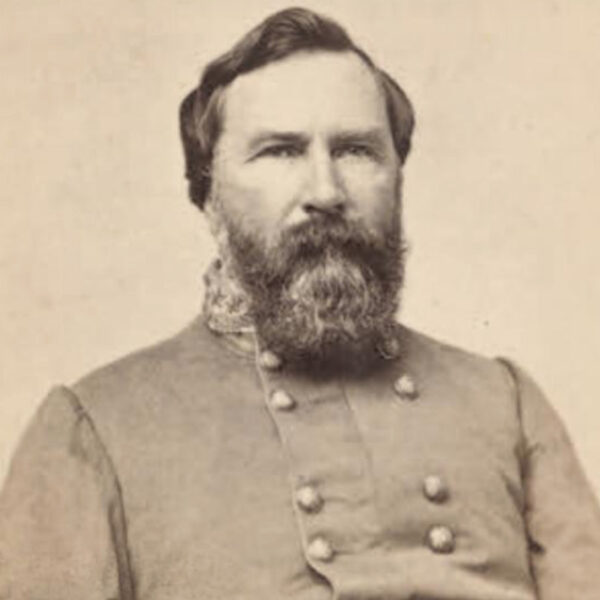
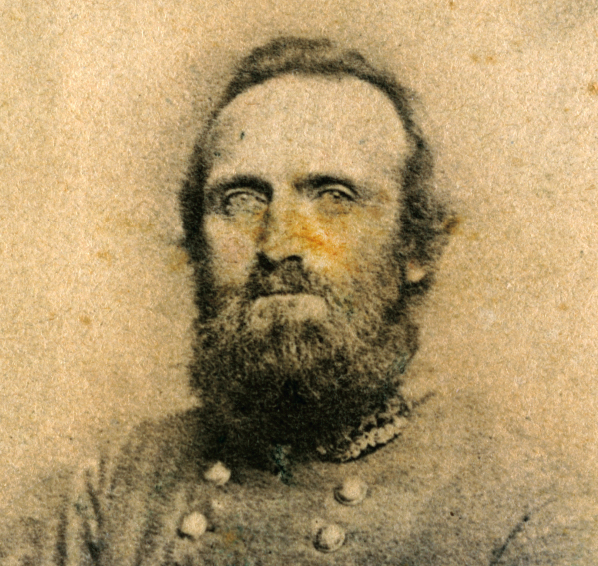
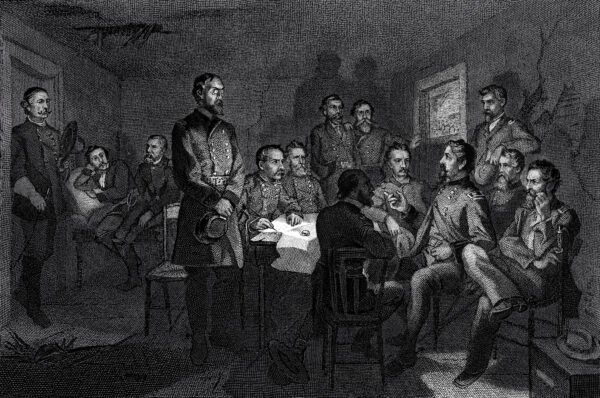
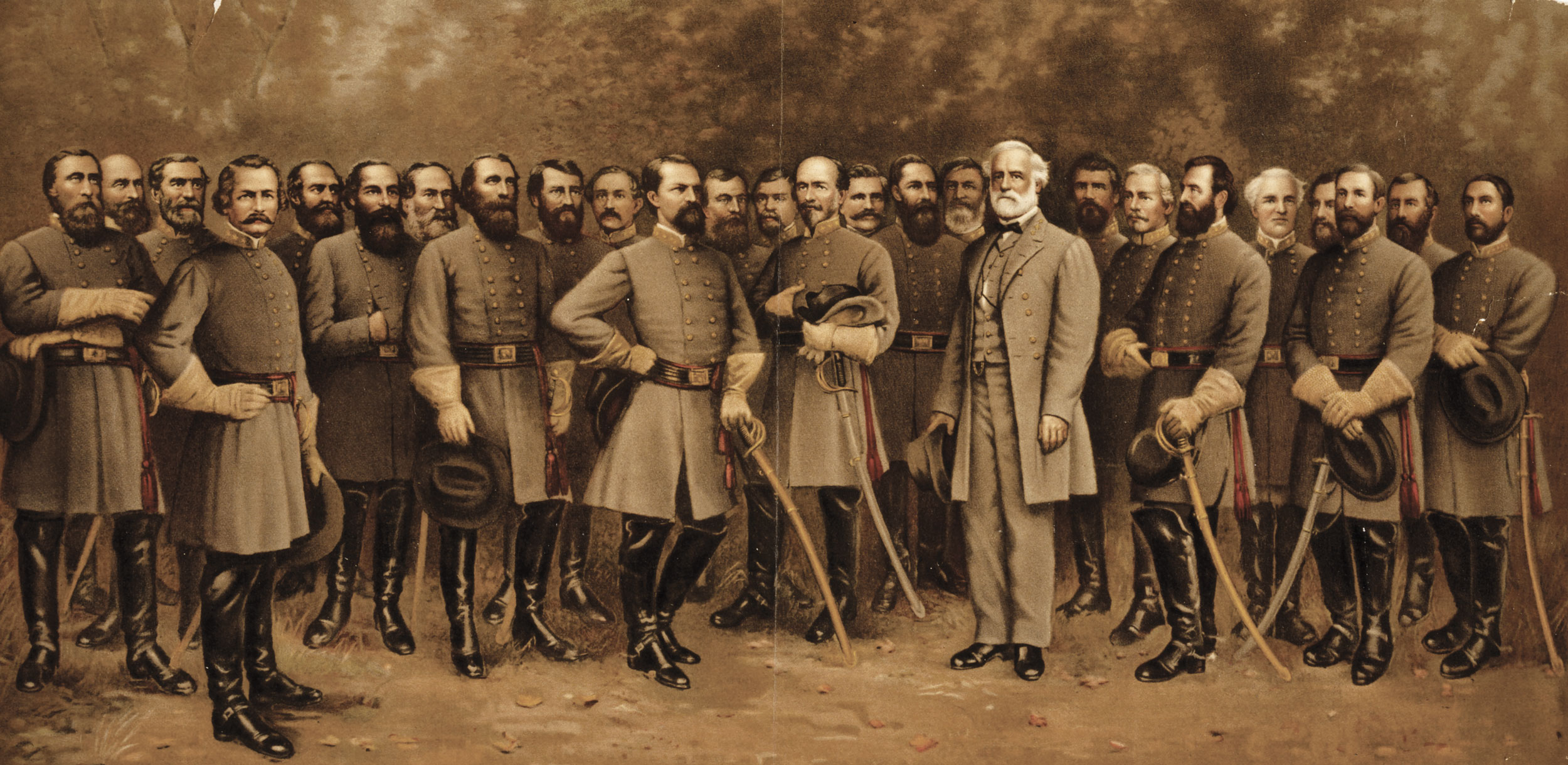
This chromolithograph by William B. Matthews shows Robert E. Lee alongside other prominent Confederate generals.
There are moments in time when historical processes compress like an accordion to single decisions. One of the most important in the American Civil War was Robert E. Lee’s choice, on April 18–19, 1861, to resign from the U.S. Army rather than “draw my sword” against “my native State” of Virginia.
But for all the prominence of Lee’s decision, its mechanics are poorly understood and haphazardly documented. It was, in fact, a decision with at least four separate segments, and descriptions of what happened within those segments only emerged over a number of years, and in an inconsistent and partial fashion, leaving later biographers of Lee to piece them together in an equally haphazard fashion. So, how, exactly, did the most momentous resignation in American history occur?
Lee’s decision actually took place in stages, in what we can call a series of “scenarios,” beginning weeks and months before with remarks in Texas and Washington, D.C., followed by discussions with Francis Preston Blair and Winfield Scott on April 18, and then a final, climactic scenario at Arlington, Lee’s Virginia home.
 Cowan’s Auctions Inc. (cowanauctions.com)
Lee’s decision to resign from the U.S. Army in 1861 took place in stages, the first of which began while he was stationed in Texas during the winter of 1860–1861, when he wrote letters about the secession crisis to his wife, Mary Custis Lee (pictured above in a wartime photo), and other family members.
The first scenario begins with Lee’s preliminary comments about secession and resignation while he was still stationed in Texas in the winter of 1860–1861 as the lieutenant colonel of the 2nd U.S. Cavalry. In a series of eight letters begun on November 24, 1860 (just after news of Abraham Lincoln’s election reached him in Texas), to his wife, Mary Custis Lee, his adult children, and two relatives, he deplored secession as revolutionary.1 But he qualified that criticism by adding that he would withdraw from the Army if secession broke up the Union, and then tacked on the further qualification that he would stay out of any ensuing conflict unless “honor” demands otherwise.2
Lee was recalled from Texas to Washington, D.C., by orders from General-in-Chief Winfield Scott. He arrived at his home at Arlington on March 1 and accepted promotion on March 16 to colonel of the 1st U.S. Cavalry.3 He had one preliminary meeting with Scott “directly after his return” from Texas in which Lee asked Scott “what was going to be done” and warned Scott that “if he (Lee) was to be placed on duty against the South he wanted to know so that he might at once resign.” Scott, however, soothed Lee’s anxieties by indicating that “a peaceful solution would be attained,” and Lee went back to Arlington “much relieved, as he had intended resigning if there were any intentions of putting him on War duty.”4
 Library of Congress
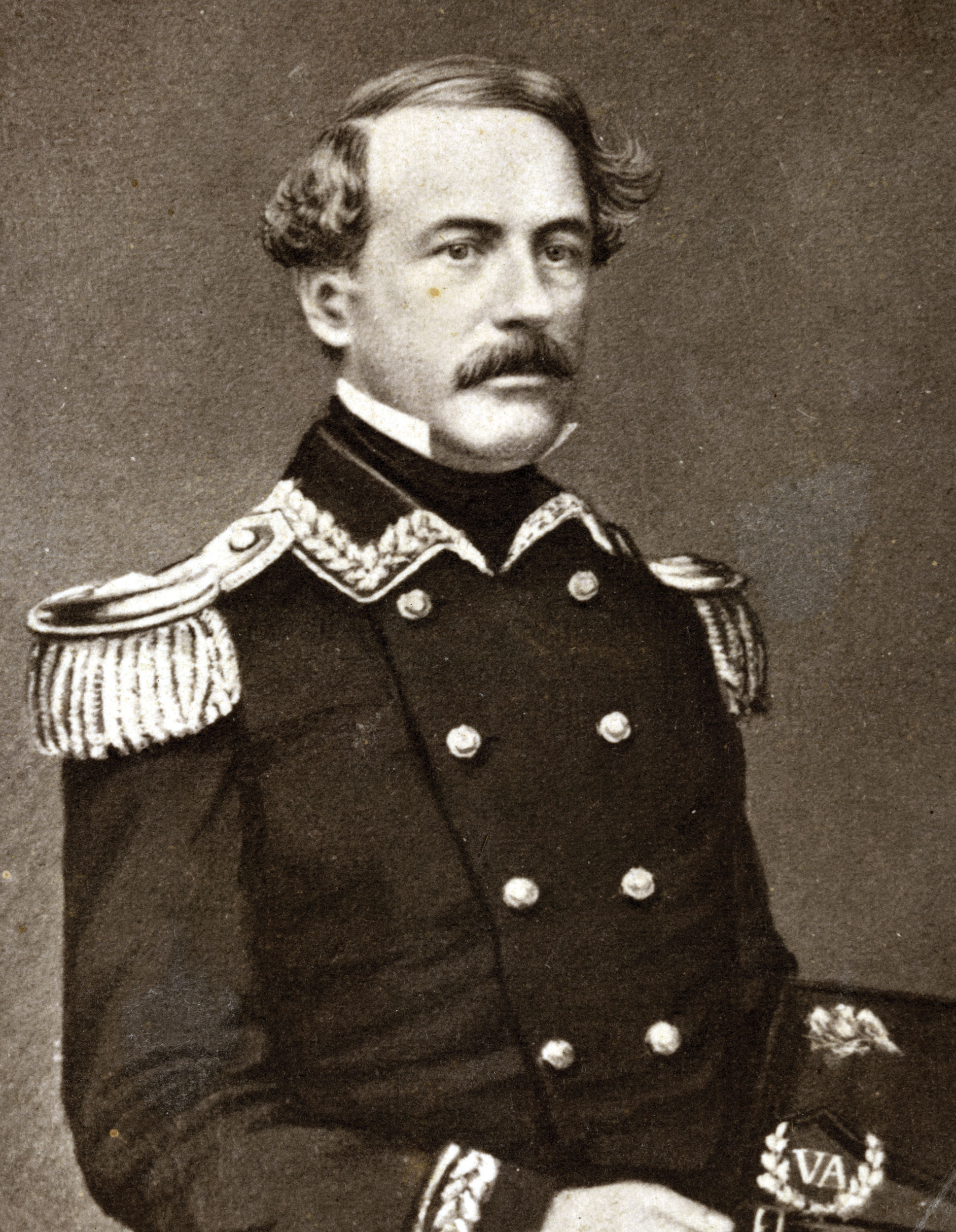
A younger Lee dons his U.S. Army uniform in an image from the 1840s.
The second scenario occurred on Thursday, April 18, 1861, after Confederate forces bombarded Fort Sumter into submission and President Lincoln issued a proclamation calling out the loyal states’ militias. In this scenario, Lee was summoned to a meeting with Francis Preston Blair, a veteran political operative, at the Washington townhouse of Blair’s son Montgomery at 1651 Pennsylvania Avenue. Blair, with the blessing of Lincoln and Secretary of War Simon Cameron, asked Lee whether he would “take command of the army,” with the implication that Scott would remain as the overall general-in-chief. Lee declined.5
The third scenario occurred “immediately after this interview” on April 18, when Lee sought out Scott.6
The fourth scenario took place after Lee returned to Arlington that evening. His eldest daughter, also named Mary Custis Lee, who composed an eyewitness description of the decision, remembered that her father did not return from Washington “till late in the evening” and “after dark” on the 18th. This pushed Lee’s deliberations into the daytime and evening of Friday, April 19, which is when he learned, while running errands in downtown Alexandria with his wife and eldest daughter, that the Virginia secession convention had cast its votes for secession rather than cooperate with Lincoln’s proclamation.7 Lee’s own recollection in 1868 was that he composed the resignation letter on Friday, but “kept it by him another night” (the letter itself is dated the 20th). In addition to the resignation letter, Lee wrote explanatory letters to four individuals: Scott; his brother Sidney Smith Lee, a U.S. Navy officer who was also in the throes of deciding about resignation; Ann Kinloch Lee Marshall, his invalid sister and the wife of Baltimore judge William Marshall, a Unionist Republican; and Roger Jones, another relative and a lieutenant in the Regular Army. He also probably wrote at least one other explanatory letter to an unidentified correspondent, which was published in The New York Times in August.8
The decision hung in the air while Lee attended Christ Church in Alexandria with his daughter Mary on Sunday morning, April 21. He afterward huddled with Lee relatives, principally Cassius Francis Lee, and “a delegation of gentlemen come from Richmond on a mission to persuade him to place his sword at the service of his State.”9 The “delegation” may have been headed by judge John Robertson, acting as a “special messenger” from Governor John Letcher. Robertson gave Lee what he later called the first news “officially” about the Virginia secession ordinance and asked Lee to meet with him in Alexandria on the morning of the 22nd and travel on to Richmond.10 This was not in itself unusual, since it was not actually the first time Lee had been solicited by Virginia state authorities for military advice. Lee responded in the affirmative to the messenger, and met Robertson the next day and departed for Richmond on the Virginia Central Railroad.11 Even while he was en route, Governor Letcher was nominating him to the secession convention to be “Commander of the Military and Naval Forces of the State of Virginia.”12
No word of these “scenarios” seems to have seeped into public awareness before Lee left for Richmond. Lee himself recorded nothing of the details of the decision apart from the allusion, in his April 20 explanation letter to Scott, to the discussions that had taken place beforehand. In fact, Lee remained mute on the subject during the war. The only comments he allowed himself to make on the decision occurred in two interviews he permitted by an Ohio army chaplain and a New York Herald reporter in April 1865, and even then he did no more than give the sketchiest view of his reasons, and without mentioning an interview with Blair or Scott.13
The first clear (and public) inkling that there was more to Lee’s departure from the U.S. Army than a simple resignation appeared in a letter by Montgomery Blair, written on August 6, 1866, and published in the New York Post. The Post’s readers should understand, Blair insisted, that the war had really been caused by “the ambition of a few political leaders” who aggravated the dissensions of North and South “under the delusion that it was a mere matter of discussion, which would be terminated by peaceful separation, or pass off like other political questions by a collapse of the inflammatory feeling incited by debate.” Southerners were “taken by surprise” when matters came to blows—and no one, Blair added, more so than Robert E. Lee.
General Lee said to my father, when he was sounded by him, at the request of President Lincoln, about taking command of our army against the rebellion, then hanging upon the decision of the Virginia [secession] convention, “Mr. Blair, I look upon secession as anarchy. If I owned the four millions of slaves in the South, I would sacrifice them all to the Union: but how can I draw my sword upon Virginia, my native State?” He could not determine then; said he would consult with his friend General Scott, and went on the same day to Richmond, probably to arbitrate difficulties; and we see the result.14
 Library of Congress
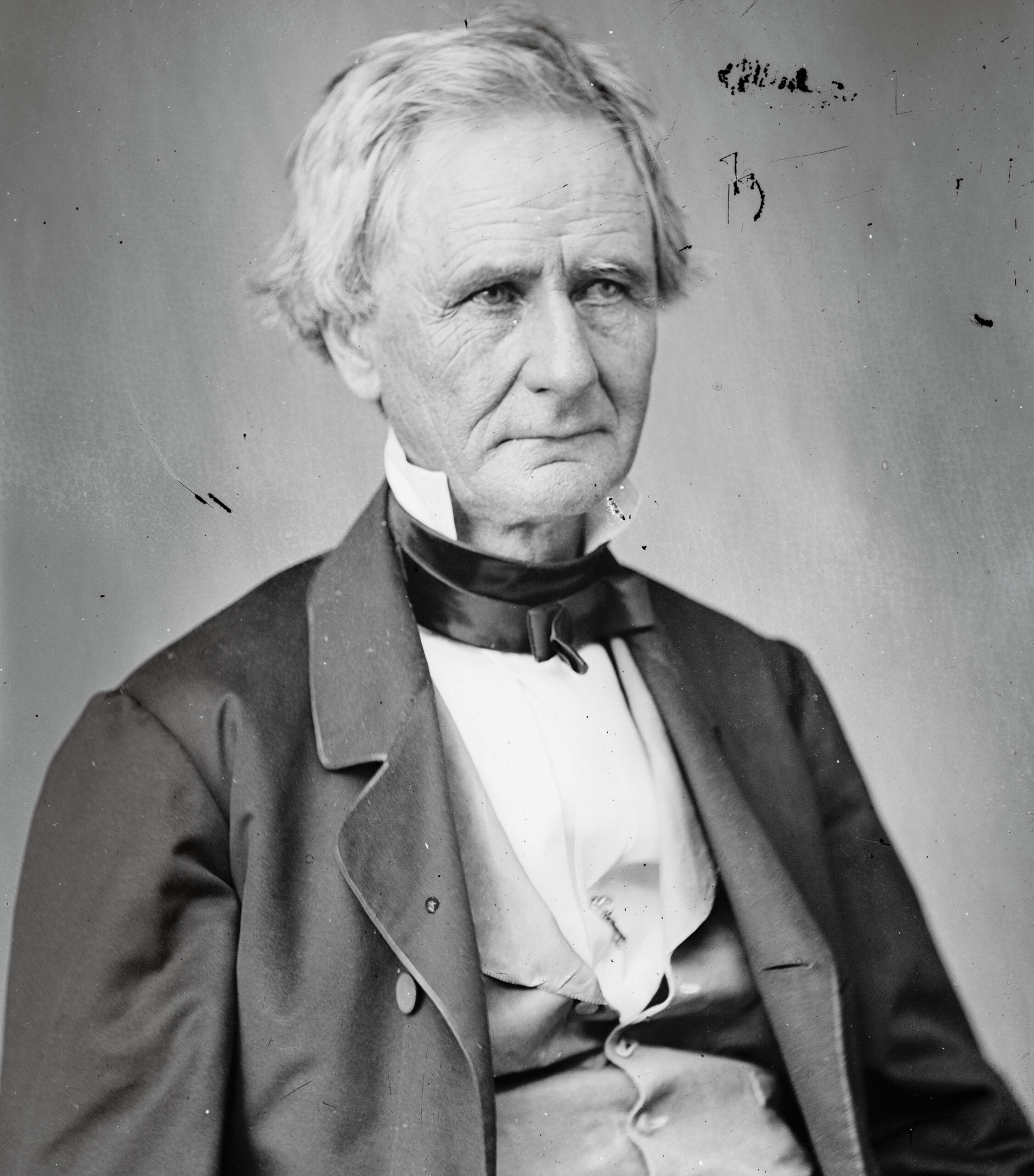
Several years after the end of the conflict, Simon Cameron (pictured above), who served as Lincoln’s first secretary of war, claimed that Lee had accepted the offer to command the U.S. Army before “desert[ing to Virginia] under false pretenses.” “I should have arrested him in a moment if I had had a chance at him,” Cameron later mused, “and I have always regretted that I never did get that chance.”
Then, on February 19, 1868, Simon Cameron (by that point a U.S. senator from Pennsylvania) set off an eruption by claiming that Lee had actually initiated the interview with Francis Preston Blair, then “intimated” that he wanted Scott’s command (who acquiesced when the demand was presented to him) and promised to set his Virginia affairs in order and assume the command, and finally “deserted under false pretences” to the Confederacy.
General Lee called on a gentleman who had my entire confidence, and intimated that he would like to have the command of the Army. He assured that gentleman, who was a man in the confidence of the Administration, of his entire loyalty, and his devotion to the interests of the Administration and of the country. I consulted with General Scott, and General Scott approved of placing him at the head of the Army. The place was offered to him unofficially, with my approbation, and with the approbation of General Scott. It was accepted by him verbally, with the promise that he would go into Virginia and settle his business and then come back to take command. He never gave us an opportunity to arrest him; he deserted under false pretenses. I should have arrested him in a moment if I had had a chance at him, and I have always regretted that I never did get that chance…. I think he behaved worse than any of the men who acted so treacherously to the Government.15
Cameron’s accusation triggered at least two direct responses in which an angered and embarrassed Lee finally laid out his own recollections of the details of his resignation. The first response was an agitated interview given on February 25, 1868 (a week after Cameron’s charges), to William Allan, a former artillery officer in Lee’s army who was then teaching mathematics at Washington College. Allan’s notes describe how Lee “stated to me all the circumstances connected with his resignation from the old army.” Winfield Scott had recalled him from Texas to have Lee on hand as the situation over secession deteriorated. Lee insisted that he “could not go on duty against the South,” but Scott assured him that “there would be no war.” It was not until April 18, when he was summoned to the meeting with Blair, that it became clear that “Mr. L. and Cabinet wanted Gen Lee to be Commander in Chief in [the] field.” Blair was “very wily and keen,” appealing to his “ambition” and his place as “a representative of the Washington family.” But Lee would not budge, even as he “deprecated War” and “Said as far as the negro was concerned he would willingly give up his own (400) for peace.” Lee then went “direct” to Scott, who “expressed his deep regret” over Lee’s decision, “but said he had rather expected it.” Returning to Arlington, Lee “wrote his resignation [the] next day, but kept it by him another night to reflect fully,” and “on Saturday morning [the 20th] enclosed the resignation with a note to Scott” for forwarding to Secretary Cameron.16
 National Archives
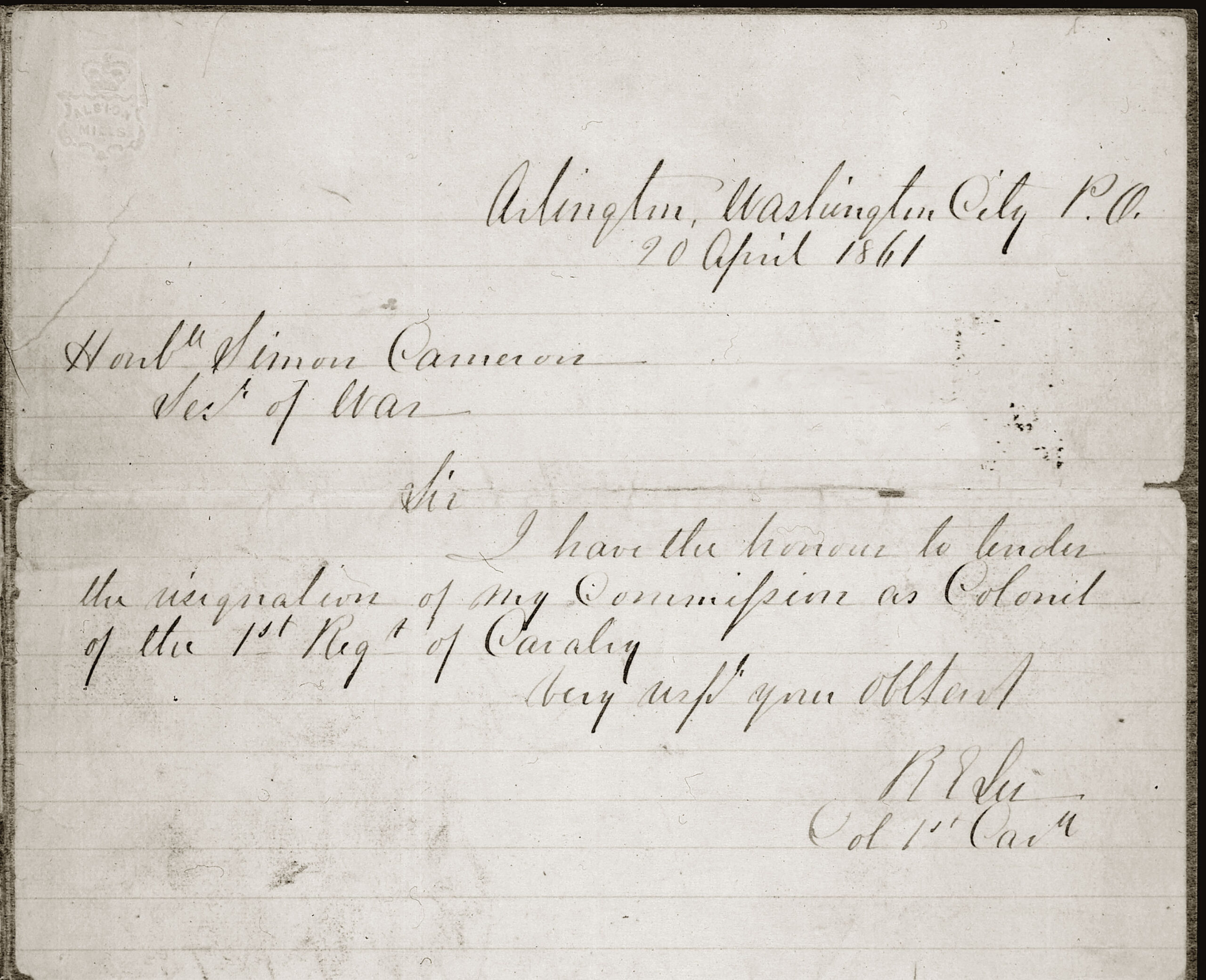
According to Lee, his meetings on April 18, 1861, with Francis Preston Blair and Winfield Scott did not persuade him to accept command of U.S. forces, and his determination to “take no part in an invasion of the Southern States” never wavered. Above: Lee’s letter of resignation, addressed to Simon Cameron.
Second was a letter, written by Lee the same day as the interview, to Reverdy Johnson, a U.S. senator from Maryland who had challenged Cameron’s veracity on the Senate floor. In the letter, Lee denied that he had ever “intimated to any one that I desired the command of the United States Army,” much less to Blair. The meeting with Blair had “been at his invitation, and as I understood at the instance of President Lincoln,” and Lee had made it clear that “though opposed to secession and deprecating war,” he “could take no part in an invasion of the Southern States.” He composed a resignation letter, and “on the second morning thereafter … forwarded my resignation to General Scott,” intending “to pass the remainder of my life as a private citizen.” It was his expectation that, even then, “some way would have been found to save the country from the calamities of war.” The Johnson letter was not published until 1875 (in John William Jones’ Personal Reminiscences, Anecdotes, and Letters of Gen. Robert E. Lee), but Lee added one more significant detail in an interview with William Preston Johnston, a former aide-de-camp to Jefferson Davis and, like William Allan, a postwar faculty member at Washington College, on March 18, 1870, two years after the letter was written and just seven months before Lee’s death, in which Lee insisted that the most important influence on his decision had been Scott’s assurances that there would be no war. “General Scott was induced to believe that pacification was intended by Mr. Lincoln and Mr. Seward,” and had tried to persuade Lee “that Mr. Lincoln would recede.”17
A year later, Blair dictated his own recollection of the interview with Lee, and it conformed almost entirely to Lee’s refutation of Simon Cameron. Blair wanted it understood that he had acted at Lincoln’s and Cameron’s bidding, not Lee’s. “The matter was talked over by President Lincoln and myself for some hours on two or three different occasions,” and both “expressed themselves as anxious to give the command of our army to Robert E. Lee.” But Blair, acting only as an intermediary, was cautious of approach, intending the discussion with Lee to be not so much an offer as an effort to “sound General Robert E. Lee, to know whether his feelings would justify him in taking command of our army.” For the first time, a go-between was mentioned: Lee’s cousin, Major John Fitzgerald Lee, the judge advocate-general of the Army, who “sent him a note at my suggestion.”
But if Blair’s original instinct was caution, in the meeting he was more direct, and he plainly told Lee that “President Lincoln … wanted him to take command of the army.” Lee’s reply at first sounded encouraging, since Lee professed to be “devoted to the Union” and “would do everything in his power to save it, and that if he owned all the negroes in the South, he would be willing to give them up and make the sacrifice of the value of every one of them to save the Union.” The sticking point was Virginia, since “he did not know how he could draw his sword upon his native State.” Blair remembered the interview as a long one, lasting “several hours on the political question.” Significantly, Blair insisted that at the end Lee remained undecided and asked for time to consult with “his friend General Scott.” Blair agreed to the delay, and Lee “left the house.” The next Blair heard, Lee had been met “by a committee from Richmond” and “went with them,” although even then, it was only “to consult the Virginia convention as to some mode of settling the difficulty.”18 Later that same year, Lee’s wife, in a letter written for use by former Confederate general Wade Hampton in a memorial address, added one further detail, that Blair urged Lee to “go to see Mr. Lincoln.” But Lee demurred: “that would be useless, but I must go and take leave of Gen. Scott.”19
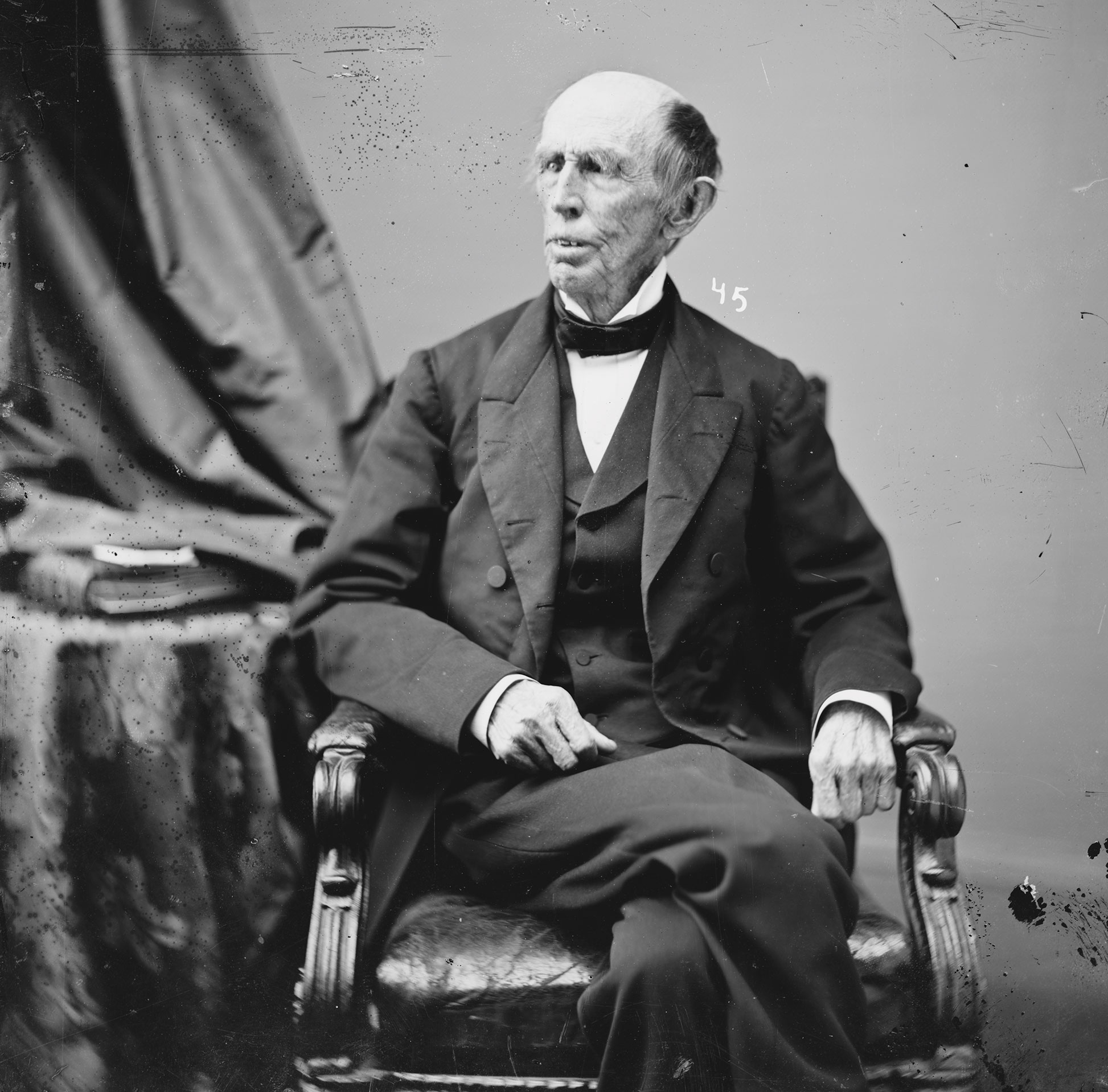 Library of Congress
Francis Preston Blair
One of the more startling omissions in Winfield Scott’s 1864 autobiography is that he makes no mention at all of his April 18 interview with Lee subsequent to Lee’s meeting with Blair. There are, nevertheless, three eyewitness accounts of the interview, including Lee’s own in his explanatory letter to Scott on April 20. It is a spare letter, thanking Scott for “more than a quarter century” of “uniform kindness and consideration” but informing the old general that “since my interview with you on the 18th inst. I have felt that I ought no longer to retain my commission.” Then, Lee added what had since Texas become a near-standard line: “Save in defense of my native State, I never desire again to draw my sword.”20
Two other witnesses were more expansive. Erasmus Keyes was Scott’s military secretary, and in his 1884 memoir relates how “the two Virginians remained alone together nearly three hours.” Keyes “surmised” that Scott had “offered to retire from the service and give Lee the command of the Federal army,” which is not quite the arrangement Blair described. What is unusual is Keyes’ understanding that Scott “desired to see him at the head of a Union force” for the purpose of averting war rather than leading it, “to keep the peace and to prevent civil war, which they equally abhorred.” But Lee somehow “considered war inevitable” and “departed to join the seceders.”21
Edward D. Townsend (who was then serving as an assistant adjutant general) is much more detailed but also prone to misdating events in his Anecdotes of the Civil War (also published in 1884). Townsend has Lee returning to Arlington from Texas, but without reporting to Scott, and provoking the general to declare that “It is time he should show his hand.” A summons is thus sent, not by Blair or a Blair representative, but by Townsend, suggesting Lee “call at the general’s headquarters.” Lee does so (although Townsend misdates Lee’s arrival to April 19), and Scott and Lee proceed to a frosty exchange in which Scott confronts Lee with the demand that he “frankly declare” his intentions. Lee responds evasively, pointing out how other southern officers are making a “fatal mistake” by resigning. But Scott presses relentlessly: “If you purpose to resign, it is proper you should do so at once.” Lee then makes a remarkable plea for understanding, based on the legal vulnerability of the Lee family’s Virginia properties. “General, the property belonging to my children, all they possess, lies in Virginia. They will be ruined if they do not go with their State. I can not raise my hand against my children.” Unmoved, “the general then signified that he had nothing further to say,” and the next day, Lee’s resignation came to hand.22
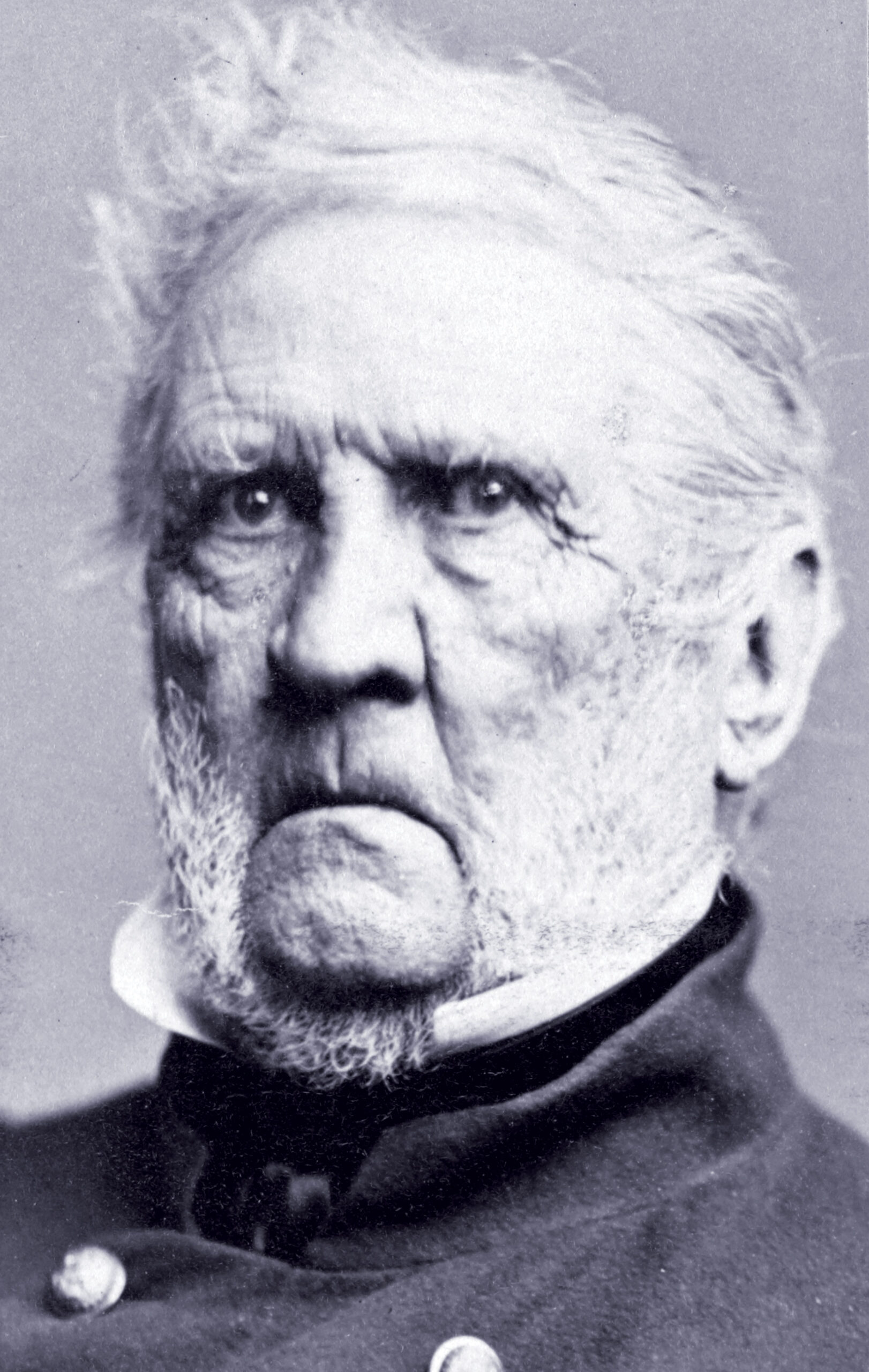 Library of Congress
While the exact contents, tone, and length of the April 18 discussion between Lee and Winfield Scott (above) remain unknown, Lee departed the meeting with his fellow Virginian certain in his decision to leave the U.S. Army.
In Townsend’s account, the encounter is formal to the point of chilliness. By contrast, Mary Custis Lee, in her 1871 letter to Wade Hampton, made it more poignant: “This parting was one of great emotion on both sides, Gen. Scott saying: ‘Lee you have made the greatest mistake of your life, but I feared it would be so.’” And an anonymous description that appeared in a brief note in Household Journal four months later has Scott begging Lee, “For God’s sake, don’t resign Lee,” only to have Lee respond, “I am compelled to; I cannot consult my feelings in this matter.” Finally, “while the tears were coursing down their cheeks,” they were “too full of feeling to find utterance for one word.”23
Curiously, the evidence about Lee’s personal turmoil over this interview is conflicting. On the basis of a “very vivid account” given by Mary Custis Lee, John William Jones’ Life and Letters of General Robert E. Lee, Soldier and Man in 1906 has Lee spend the night of April 19 in the throes of depression “after his last interview with General Scott,” and then write an agonized resignation letter. Mary Custis Lee’s 1871 letter is also alive with personal observation, describing that night in terms of a Gethsemane:
After a sleepless night, during which he said, “passed the severest struggle of his life,” he determined to resign a commission which he could no longer hold with honor. He would gladly have waited, hoping even then matters might be accommodated without recourse to arms; but this could not be, and on the morning of the 20th he sent over his resignation, which was accepted.
Although the Jones “account” and the Hampton letter are similar in content, Jones reverses the order of events: Lee writes his resignation letter first and then, asking “to be left alone for a time,” paces “his chamber above, and was heard frequently to fall on his knees and engage in earnest prayer for divine guidance.” And he emerges from the struggle, “calm collected, almost cheerful,” and presents his wife with “my letter of resignation, and a letter I have written to General Scott.”24 Lee’s daughter Mary, in a reminiscence composed in 1871 for Charles Marshall, Lee’s wartime aide-de-camp and military secretary, makes no mention of any “struggle” through that night. Lee entertains “two prominent gentlemen of Alexandria” at breakfast. Then, once the visitors had departed, Lee almost casually calls family members into “his private room, where … we found him seated at his table, with papers before him” and reads them the resignation letter. Lee adds, “I wrote it early this morning when I first came down & dispatched Perry [an Arlington slave] over to Washington with it before breakfast.” The family seems dumbfounded, and Lee has to explain, “I suppose you all think I have done very wrong, but it had come to this, & after my last interview with Gen. Scott I felt that I ought to wait no longer.”25
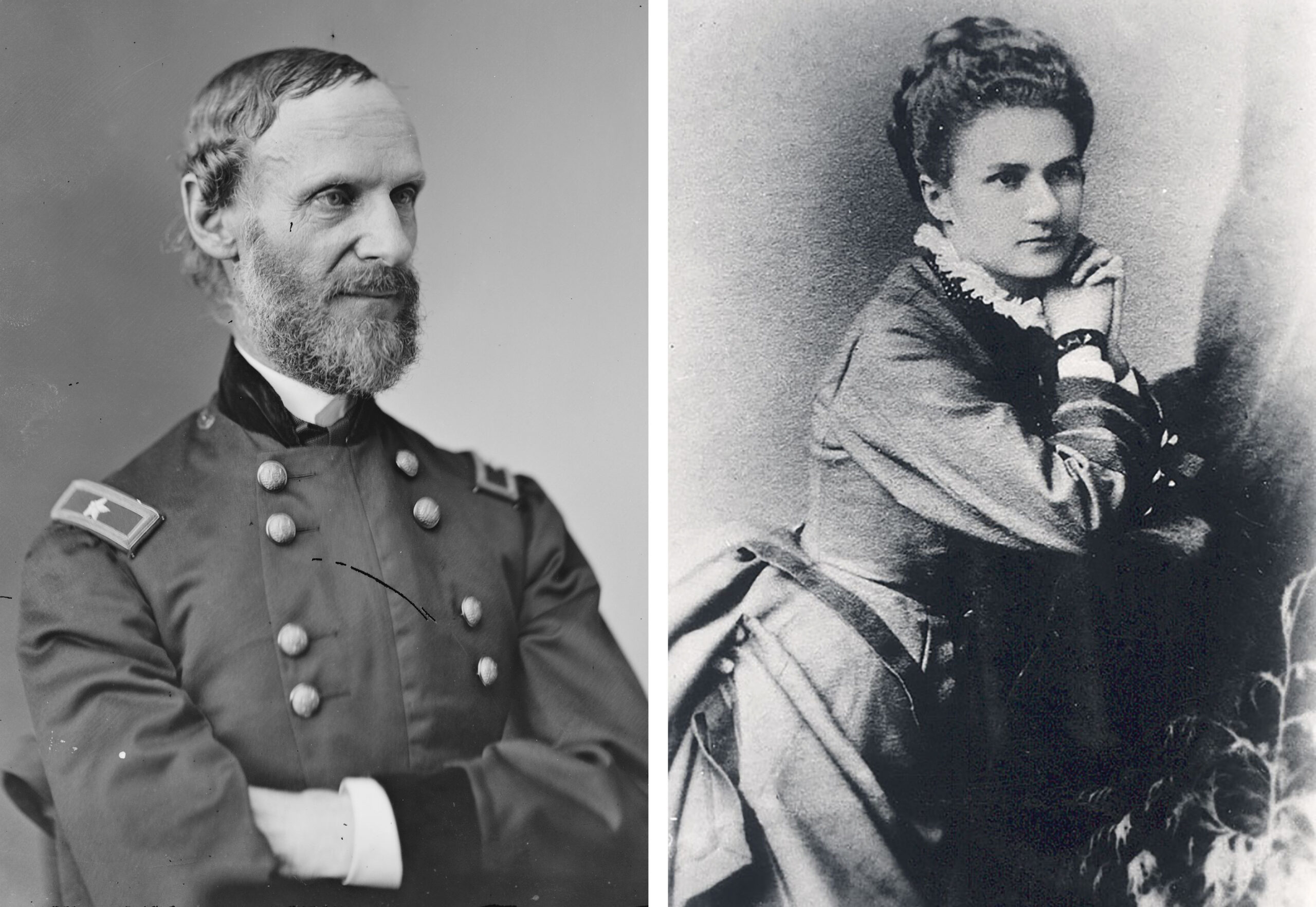 Library of Congress (Townsend); Arlington House, The Robert E. Lee Memorial
Two diametrically opposed accounts of the Lee–Scott meeting on April 18 came from Edward D. Townsend (above left), then serving as an assistant adjutant general, and Mary Custis Lee (above right), the general’s eldest daughter. Whereas Townsend characterized the encounter as unfriendly, Mary Custis Lee later wrote of it as marked by heartfelt emotion.
Once the conflicting welter of letters, accounts, and memoirs are sorted out, a reasonably coherent sequence emerges, and with some important implications for the soldier who would become the Confederacy’s greatest living icon. From the first, Lee was deeply unhappy at the prospect of a disruption of the Union over slavery, especially if that disruption in some way endangered Virginia’s position. But Lee never spoke about taking up arms on behalf of the South or the Confederacy, only in defense of Virginia. The peculiarity of that determination is that Virginia had never actually bulked that large in Lee’s life. Lee family members, going back to the 17th century, were significant players in the life of Virginia, but the Revolutionary Lees were national-minded Federalists.26 Robert E. Lee himself was born in Virginia, at Stratford Hall, on the Northern Neck, but lived most of his life someplace else: first in Alexandria, in the District of Columbia, then at West Point as a cadet from 1824–1829, and then in military postings in Georgia, Missouri, New York, and Maryland. His marriage to Mary Custis in 1831 gave him a home in Virginia (although not until Alexandria and Arlington were retroceded to Virginia in 1846), but Arlington was the Custis family home, not his own, and its facing across the Potomac river toward the Capitol was a constant reminder of where the Custis family’s loyalties resided. When Lee’s father-in-law, George Washington Parke Custis, died, he passed over his son-in-law, leaving Arlington and several other Custis properties to Robert E. Lee’s sons (G.W.C. Lee, W.H.F. Lee, and R.E. Lee Jr.), with Mary Custis Lee retaining only a life interest in Arlington. Lee was left a Virginia-less Virginian.
What Lee did have, however, were extraordinarily deep family ties to Virginia. From the various progeny of the Virginia Lees, not to mention the Carter connections inherited through his mother (and the Fitzhughs, to whom he was related through the Carters and his mother-in-law), Lee inhabited a thick network of cousinage that included at least 80 other individuals and a lifetime of peregrinations from one extended-relative estate to another.27 But this only raises a second complication, since not all of the Lee cousinage joined the Confederacy, and what was more, Lee did not need, necessarily, to oppose those who did. Lee would have needed only to resign from the Army and sit out the ensuing conflict as a neutral.28
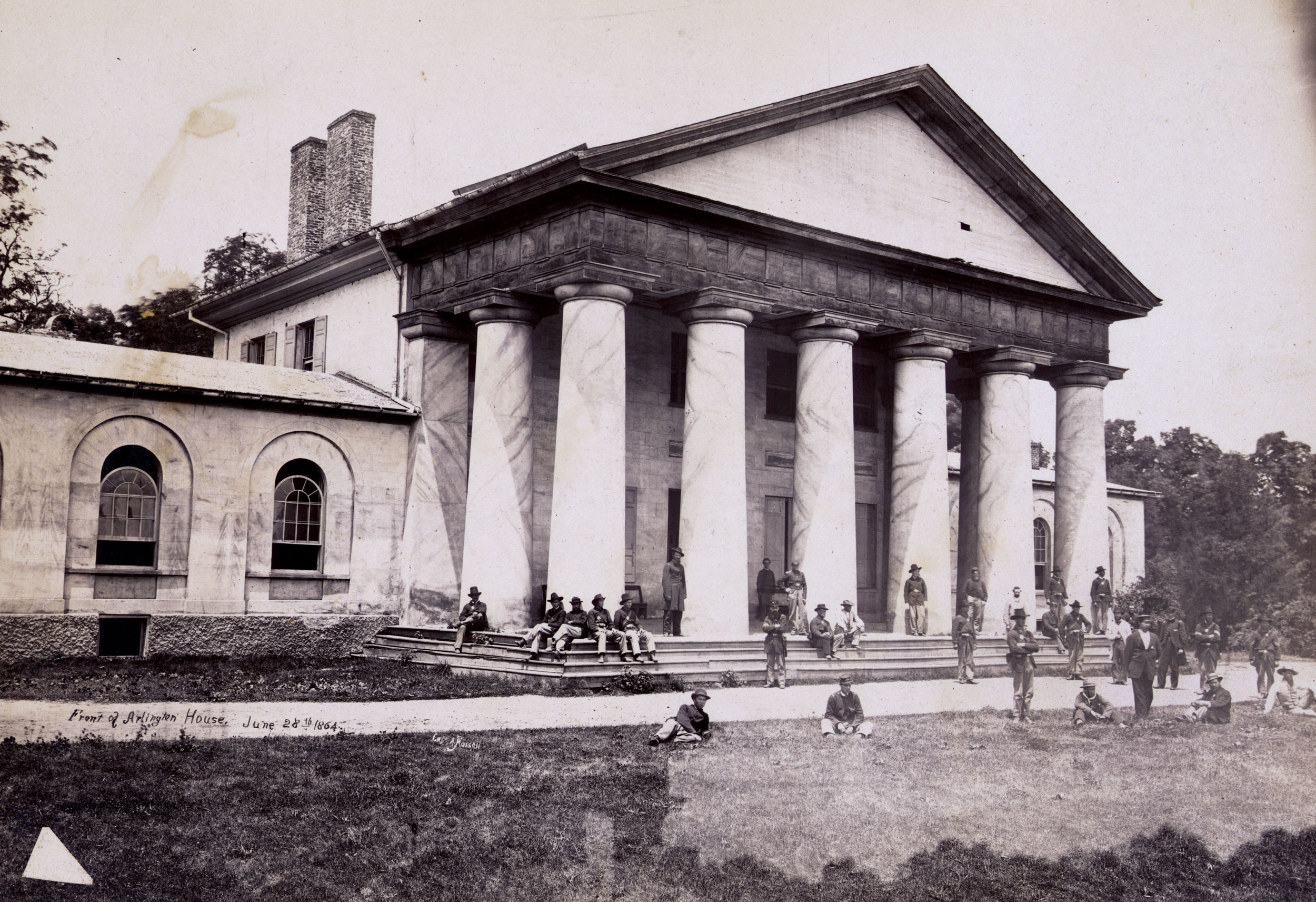 Library of Congress
While the main reason for Lee’s decision to resign from the U.S. Army was his desire to avoid being put in a position to draw his sword against Virginia, it likely was also based in part on his interest in saving Arlington (pictured here in 1864) and other family properties from confiscation.
This, however, was the moment when the considerations of family intersected with the obligations of property, for it is unlikely that anyone living at Arlington could have survived for very long as a neutral. Perched high on its bluff over the Potomac, Arlington provided a perfect platform for artillery that could make the entire federal capital untenable. A reporter for The New York Times warned that “Arlington Heights … command every building and every foot of ground in Washington.” So, even before the news of Lee’s resignation was public, voices in Richmond were calling for “the construction of earthwork batteries on the Va. heights overlooking & commanding Washington—to be defended from assault by musketry until heavy artillery can be mounted.”29
If Lee had decided to cooperate with Blair, Scott, and Lincoln, and taken charge of the federal forces being summoned to Washington by Lincoln’s April 15 proclamation, he would have had to face the prospect that Arlington would be commandeered by Virginia forces, and even, if no further resolution of the stand-off was attempted, that it would be confiscated by Virginia authorities who would, by that point, be beyond any legal restraint by U.S. courts. It is this possibility that throws into unexpected color the plea overheard by Edward D. Townsend during Lee’s interview with Scott: “General, the property belonging to my children, all they possess, lies in Virginia. They will be ruined if they do not go with their State.” Or, as would have been just as likely, if Lee did not cooperate with the Virginia secessionists.
What complicates this dilemma still further is the unanswered question of what Lee believed Virginia’s secession from the Union and his own resignation were likely to lead to. If he resigned his commission (and legal obligations) to the U.S. Army and cooperated with the Virginia secessionists, he would certainly save Arlington and the other Custis properties from Virginia confiscation for his children. That would, of course, not protect them from federal occupation and confiscation. But the assumption was, in fact, that there would be no such occupation, because there would be no war. Scott even assured Judge Robertson on April 19 that “none of the troops now called into service would be used against the seceded States, unless the Government was attacked, and this the people of Virginia might rely on.”30 Hence, Lee’s impression (in his 1870 interview with William Preston Johnston) that Scott believed “that pacification was intended by Mr. Lincoln and Mr. Seward” and “that Mr. Lincoln would recede.”
By accepting an invitation to take a role in determining Virginia’s military response, Lee might be in the perfect position to ensure that peace would be the result rather than war—and save the Custis properties from molestation by either federal or Virginia authorities. This certainly seems to have been the seed planted in the mind of Cassius F. Lee during his after-church conference with Lee in Alexandria on April 21. Putting Lee “in command of the Virginia troops,” Cassius Lee hinted in a letter he wrote to Lee two days later, “might lead to a peaceful settlement of our difficulties.” Citing other Virginians, Cassius Lee wanted his cousin to understand that he would now be in a position to “bring about, at least, an armistice, preparatory to a National Assembly for peaceful settlement of our troubles.” After all, “Virginia from her geographical position … has it in her power … to come in as mediator, rather as an umpire & settle the question.” In such a role, Robert E. Lee would “be a leader in this matter” and “have an honor never reached by Napoleon or Wellington.”31
But events were galloping far away from any likelihood that they could be steered toward reunion negotiations. Virginia officially joined the Confederate States of America on May 7; on June 8, Virginia’s forces were transferred to the jurisdiction of the Confederate States, and in August, Lee would be commissioned as a senior general of the Confederate army. Lee would soon evolve into an ardent defender of secession and the Confederate cause, so much so that, together with his war record as the Confederacy’s premier general, it is easy to conclude that this was the attitude with which he made the initial decision to take sides against the United States. But the actual record of the decision is more complicated, and the Lee who resigned from the U.S. Army on April 20 may have seen his decision and the following fateful meeting in Richmond as part of a nascent peace plan. Considering its eventual outcome, few Civil War choices could be more ironic or tragic.
Allen C. Guelzo is the Henry R. Luce Professor of the Civil War Era, and Director of Civil War Era Studies at Gettysburg College, and is currently the Wm. L. Garwood Visiting Professor in the James Madison Program in American Ideals & Institutions at Princeton University. He is the author of a number of books, including Lincoln: Redeemer President (1999) and Lincoln’s Emancipation Proclamation: The End of Slavery in America (2004).
Notes
1. Robert E. Lee to George Washington Custis Lee (November 24 & December 14, 1860, January 23 & January 30, 1861), to Annette Carter (January 16, 1861), to Martha “Markie” Williams (January 22, 1861), to Mary Custis Lee (January 23, 1861) to Eleanor Agnes Lee (January 29, 1861), and to R.W. Johnson (February 13, 1861). The Annette Carter letter is in William Franklin Chaney, Duty Most Sublime: The Life of Robert E. Lee As Told Through the “Carter Letters” (Baltimore, 1996), 61-63; the letter to “Markie” Williams is in “To Markie”: The Letters of Robert E. Lee to Martha Custis Williams, ed. Avery Craven (Cambridge, 1933), 58. The others are in Francis Ray Adams, An Annotated Edition of the Personal Letters of Robert E. Lee, April, 1855–April, 1861 (unpublished Ph.D. dissertation, University of Maryland, 1955), 2:693-697, 701-704, 721-722, 723-725, 727-731, and 735-739.
2. D.S. Freeman, R.E. Lee (New York, 1934), 1:425-426 and Jonathan Horn, The Man Who Would Not Be Washington: Robert E. Lee’s Civil War and His Decision That Changed American History (New York, 2015), 98-99.
3. “Special Orders No. 16” (February 4, 1861) in United States War Department, The War of the Rebellion: A Compilation of the Official Records 129 vols. (Washington, 1880-1901), Series I, 1:586; General Orders of the War Department, Embracing the Years 1861, 1862 & 1863, Adapted especially for the Use of the Army and Navy of the United States, eds. T.M. O’Brien and O. Diefendorf (New York, 1864), 1:23.
4. William Allan, “Memoranda of Conversations with General Robert E. Lee,” February 25 & March 10, 1868, in Lee the Soldier, ed. Gary W. Gallagher (Lincoln, 1996), 9-10, 12.
5. See “Letter from Montgomery Blair,” New York Evening Post, August 8, 1866, and “Letter from Hon. Montgomery Blair,” Daily National Intelligencer, August 9, 1866; Mary Custis Lee also provided Wade Hampton with a letter describing the Blair interview for Hampton’s for his 1871 oration, Address on the Life and Character of Robert E. Lee, in Baltimore.
6. Eleanor Agnes Lee to Mildred Childe Lee, April 19, 1861, Lee Family Papers, Virginia Historical Society; John William Jones, Life and Letters of Robert Edward Lee, Soldier and Man (New York, 1906), 127.
7. “Local Items,” Alexandria Gazette, April 19, 1861; Margaret Sanborn, Robert E. Lee: A Portrait, 1807-1861 (Philadelphia, 1966), 1:312.
8. Allan, “Memoranda,” February 25, 1868, in Lee the Soldier, 10.
9. Mary P. Coulling, The Lee Girls (Winston-Salem, NC, 1987), 82-83; Sarah L. Lee, “War Time in Alexandria, Virginia,” South Atlantic Quarterly 4 (July 1905): 235; Constance Cary Harrison, Recollections Grave and Gay (New York, 1916), 25; “Cazenove Lee Remembers Robert E. Lee,” Alexandria History 3 (1981): 21.
10. Journal of the Acts and Proceedings of a General Convention of the State of Virginia (April 20, 1861),169; Allan, “Memoranda” (February 25, 1868), in Lee the Soldier, 10.
11. Lee to T.P. August, December 20, 1859, in Adams, ed. Personal Letters of Robert E. Lee, 2:554-555; Robertson to Letcher, April 20, 1861, 98. Letcher had dispatched an earlier messenger, David Funsten, who failed to reach Alexandria due to disruptions in train schedules.
12. Letcher to ‘Gentlemen of the Convention,’ April 22, 1861, in Journal of the Acts and Proceedings of a General Convention of the State of Virginia, Assembled at Richmond (Richmond, 1861), 184.
13. Thomas M. Cook, “The Rebellion. Views of General Robert E. Lee,” New York Herald, April 29, 1865; “A Talk With General Lee,” The New York Times, August 12, 1879.
14. “Letter from Montgomery Blair,” New York Evening Post, August 8, 1866.
15. “Senator from Maryland” (February 19, 1868), in Congressional Globe, 40th Congress, 2nd session, 1270.
16. Allan, “Memoranda of Conversations with General Robert E. Lee” (February 25, 1868), in Lee the Soldier, 9-10.
17. Jones, Personal Reminiscences, Anecdotes, and Letters of Gen. Robert E. Lee (New York, 1875), 141-142; “Memoranda of Conversations Between Gen. Robert E. Lee and William Preston Johnston: May 7, 1868 and March 16, 1870,” ed. W.G. Bean, Virginia Magazine of History and Biography 73 (October 1965): 483.
18. Blair’s account of the interview, made on April 14, 1871, but not published until 1895 as a long footnote in the third volume of James Ford Rhodes’ History of the United States. See Rhodes, History of the United States from the Compromise of 1850 (New York, 1895), 3:365.
19. MCL, in Wade Hampton, Address on the Life and Character of Gen. Robert E. Lee, Delivered on the 12th of October, 1871, before the Society of Confederate Soldiers and Sailors, in Maryland (Baltimore, 1871), 16.
20. Robert E. Lee to Winfield Scott, April 20, 1861, Archives of the Robert E. Lee Memorial Foundation, Papers of the Lee Family, Box 3, M2009.250, Jessie Ball duPont Library, Stratford Hall, VA. See also Jones, Life and Letters, 132-133, Freeman, R.E. Lee, 1:441-2, and Wartime Papers of Robert E. Lee, eds. Clifford Dowdey & L.H. Manarin (Boston, 1961), 8-9. In his 1868 letter to Reverdy Johnson, Lee alludes briefly to going “from the interview with Mr. Blair to the office of General Scott,” where he “told him of the proposition that had been made to me, and my decision.”
21. Erasmus Keyes, Fifty Years’ Observation of Men and Events, Civil and Military (New York, 1884), 207. Freeman, to the contrary, believes the meeting Keyes describes to have occurred in March (R.E. Lee, 1:433-4).
22. Townsend, Anecdotes of the Civil War in the United States (New York, 1884), 30-31.
23. “Virginia News,” Alexandria Gazette, April 30, 1861; MCL, in Wade Hampton, Address on the Life and Character of Gen. Robert E. Lee, 16; “General Lee and General Scott,” Household Journal of Popular Information, Amusement and Domestic Economy, August 10, 1861, 295. One other witness to Lee’s interview with Scott, William Woods Averell, left a record of his impressions of the encounter, but they were limited only to Averell’s observations of Lee’s agitation in Scott’s anteroom before the meeting. “After handing in my report I went to the office of General Scott to inform him of the action I had taken, fearing the information, being of an unimportant character, might not reach him through the Adjutant-General’s office…. While waiting alone a few minutes in the General’s anteroom, Colonel Robert E. Lee arrived. It was the last time I ever saw him. He was wearing an officer’s overcoat as the morning was quite chilly. We shook hands and exchanged some inquiries and remarks about health and the weather. I saw that he was greatly troubled. He did not stand still but kept slightly lifting one foot and then the other as if they were cold. His impassible face did not conceal an expression of keen distress…. When I came out from my brief audience with the General in chief, I stopped and said, ‘Good bye, Colonel Lee.’ He stared, extended his hand and his voice dropped almost to a whisper as he said, ‘Good bye, Mr. Averell.’” Ten Years in the Saddle: The Memoir of William Woods Averell, eds. E.K. Eckert and N.J. Amato (San Rafael, 1978), 247-248.
24. Jones, Life and Letters, 132; MCL, in Wade Hampton, Address on the Life and Character of Gen. Robert E. Lee, 16.
25. Elizabeth Brown Pryor, “‘Thou Knowest Not the Time of Thy Visitation’: A Newly Discovered Letter Reveals Robert E. Lee’s Lonely Struggle with Disunion,” Virginia Magazine of History and Biography 119 (September 2011): 290 and “The General In His Study,” The New York Times, April 19, 2011.
26. Burton J. Hendrick, The Lees of Virginia: Biography of a Family (Boston, 1935), 373-374; Stanley Elkins & Eric McKitrick, The Age of Federalism (New York, 1993), 632; The Debates, Resolutions, and Other Proceedings, in Convention, on the Adoption of the Federal Constitution, ed. Jonathan Elliott (Washington, 1828), 2:60-61.
27. Bertram Wyatt-Brown, Southern Honor: Ethics and Behavior in the Old South (New York, 2007), 110.
28. Wayne Wei-Siang Hsieh, West Pointers and the Civil War: The Old Army in War and Peace (Chapel Hill, 2009), 109-110 and “’I Owe Virginia Little, My Country Much’: Robert E. Lee, the United States Regular Army, and Unconditional Unionism,” in Crucible of the Civil War: Virginia from Secession to Commemoration, eds. E.L. Ayers, G.W. Gallagher & A.J. Torget (Charlottesville, 2006), 45-46.
29. Diary entry for April 21, 1861, in The Diary of Edmund Ruffin: Volume One, Toward Independence, October, 1856–April, 1861, ed. W.K. Scarborough (Baton Rouge, 1972), 1:609; “Views of Current Events—The Town of Alexandria and Its Present Condition,” The New York Times, June 3, 1861.
30. “From Washington,” Alexandria Gazette, April 20, 1861; Timothy D. Johnson, Winfield Scott: The Quest for Military Glory (Lawrence, 1998), 222-225.
31. Cassius F. Lee to Robert E. Lee, April 23, 1861, Lee Family Digital Archive, Jesse B. DuPoint Library, Stratford Hall, VA.
Related topics: Robert E. Lee