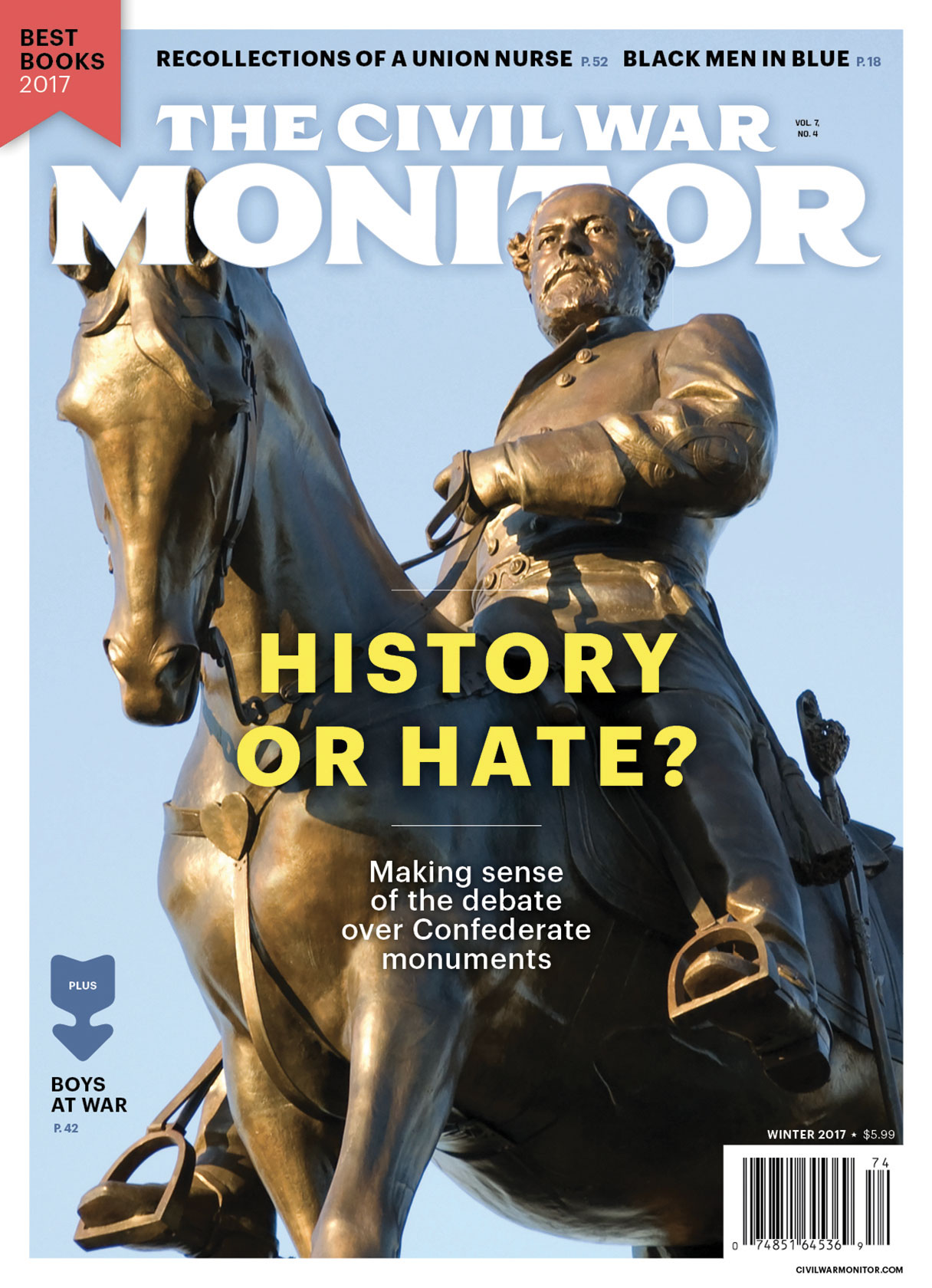
OF MONUMENTS AND MEN
Allen C. Guelzo and John M. Rudy are right to speculate in their article in your latest issue [“Of Monuments and Men,” Vol. 7, No. 4] that the actual Robert E. Lee would have “damned the alt-righters” in Charlottesville, but that’s the nub of the current problem. The Robert E. Lee memorialized in Charlottesville, and all over the South, is not the man himself, who could at least attempt to determine the meaning of his own life. He is a statue and therefore necessarily a symbol—and created explicitly to be one—representing something to the people who see and live with it.
Guelzo and Rudy’s suggested framework about how to decide the fate of Confederate monuments could be a useful starting point in setting agreed criteria for making such decisions, something that could make the process clearer and less contentious.
I suggest a couple of additional questions for their list. Does the monument misrepresent historical facts? (One of the New Orleans monuments repackaged a white riot as a defense of law and order.) Does the subject of the monument represent ideas and/or movements that do harm to individuals or groups today? The white supremacist and neo-Nazi riot in Charlottesville represents a big “yes” to the latter.
As Guelzo and Rudy note, the issue involves a lot of decisions, including whether to remove or recontextualize individual monuments, as well as what to do with removed monuments. If I lived in Charlottesville, I would support removing the statue of “Marse Robert” and his horse to a museum, and replacing it with one of Heather Heyer, the woman killed in Charlottesville during the protests. But that’s a choice for the people of Charlottesville, and I wish them every success in achieving a wide, thoughtful, fact-based consensus, and acting on it.
M.S. Burgher
Via email
* * *
To those who want to remove Confederate statues: Confederate statues represent and honor our ancestors who fought and died to defend their homes from an invader bent on dominating them in an economic empire. Their actions were no different than what the colonists did in their fight against the British. Secession is treason? How so when America was founded in treason by seceding from the rule of the British crown? The fact is that it is easier to control a society and the strings of government when it is dominated by an overbearing central authority. This was the strategy Abraham Lincoln and his cronies sought, and the beginnings of an American empire is what they achieved. We’ve exchanged one empire for another and now dishonor those who stood against this abomination. It is truly unfortunate to see that those honored in this fight for self-determination and liberty are sacrificed today by our so-called “leaders” for their own political and economic gain. They would do well to emulate the character of the men honored by these statues.
Jonathan Varnell
Elm City, North Carolina
* * *
An important element of the current debate about Confederate monuments is the failure by both sides to consider these to be works of art deserving of the First Amendment’s protection of free speech. Since the artists who created them are no longer alive to give permission for their destruction or removal, they should be left alone.
To do otherwise and assault them is no different than what the Taliban have done in Afghanistan. They took control of the Bamiyan Valley and destroyed the magnificent statues of Buddha dating from the fourth century because they were erected by people they disagree with. How is the assault on Confederate monuments any different in principle?
We in the West have long held that no one has the right to destroy the artistic expression of another person; hence the widespread condemnation of the Taliban. The same principle holds that Americans on both the left and the right should defend Confederate monuments. If we don’t we have joined the Taliban.
David Paul Davenport
Fresno, California
* * *
When I saw the cover of the Winter 2017 issue I felt compelled to buy it off the shelf at the Chickamauga Battlefield Visitors Center to see if I could make sense of the actions taking place across the country regarding the removal of Confederate monuments. I didn’t know what to expect. The article by Allen Guelzo and John Rudy presented the positions admirably. I can now understand why some monuments should be re-evaluated on their appropriateness and feel I have a cogent opinion when controversy arises.
I want to thank you, the editors, and thank the authors for their work and perspectives. I would only hope this information would be more widely available so that a well educated society can better fulfill the responsibilities of a free society.
Steve Boone
Via email
ST. LOUIS OVERSIGHT
We noticed that in The Civil War Monitor’s Winter 2017 issue, in an article focused on the “best” sites (especially Civil War ones) to visit in St. Louis [“Travels: St. Louis,” Vol. 7, No. 4], a slave plantation called White Haven at the Ulysses S. Grant National Historic Site was excluded. At this historic site, Grant lived from 1854 to 1859, his father-in-law owned over a dozen enslaved African Americans, his wife Julia was assigned four enslaved African Americans, and Grant owned one whom he emancipated in 1859. The exclusion of a slave plantation site from a Civil War travel guide suggests that African-American history is a minor theme for Civil War studies.
A few Americans would disagree. Abraham Lincoln wrote, “These slaves constituted a peculiar and powerful interest. All knew that this interest was somehow the cause of the war. To strengthen, perpetuate, and extend this interest was the object for which the insurgents would rend the Union.” Grant himself concluded, “The cause of the great War of the Rebellion against the United States will have to be attributed to slavery.” Other Americans honored in the National Park System—such as Frederick Douglass, Harriet Tubman, Clara Barton, and Susan B. Anthony—also agreed with these conclusions.
Those who perpetuated the “Lost Cause” myth would, of course, applaud the slave plantation’s exclusion, as they maintained that the enslavement of African Americans had no role in the causes of, or the story of, the Civil War. But another significant American would have certainly disagreed with White Haven’s exclusion. One of my former professors contended that the best book on the Civil War contained no descriptions of battles; it was The Adventures of Huckleberry Finn, written by Samuel Clemens, a Missourian, who was also a great admirer of Ulysses S. Grant.
Timothy S. Good
Superintendent, Ulysses S. Grant National Historic Site
St. Louis, Missouri
Ed. Thanks for bringing the Ulysses S. Grant National Historic Site to the attention of Monitor readers, Timothy. I can assure you that we consider African-American history to be an essential part of Civil War studies. Our Travel pieces rely on local experts to share their own personal favorites, and aren’t intended to be comprehensive lists.
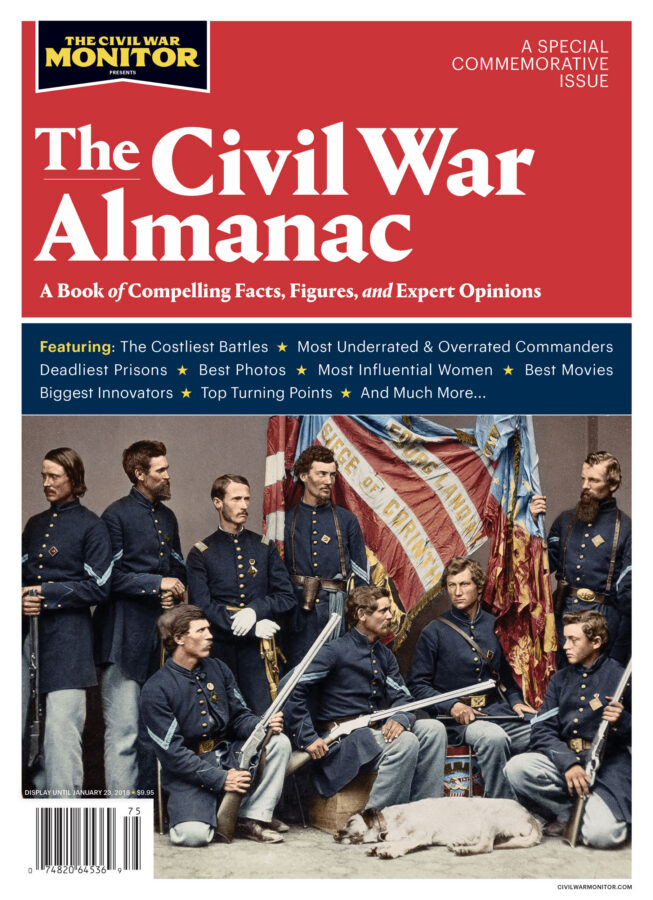
THE CIVIL WAR ALMANAC
I just bought a copy of The Civil War Almanac. I would like to add my two cents on who the war’s most underrated commanders were—one of the questions you asked the panel of historians you assembled for the issue. I know the experts are experts for a reason, but I think they overlooked General George Thomas.
Thomas’ stand at the Battle of Chickamauga prevented the collapse of the Union army and garnered him the nickname “Rock of Chickamauga.” His breakthrough at Missionary Ridge during the Battle of Chattanooga helped secure victory for the Union, as did his subsequent actions at Franklin and Nashville.
I believe Thomas was just as accomplished a commander as Ulysses S. Grant and William T. Sherman. History, for whatever reason, has neglected his accomplishments.
Rick Breze
Via email
Ed. Thanks for the feedback, Rick. Readers who would like to pick up a copy can do so by visiting civilwarmonitor.com/the-civil-war-almanac.