 Courtesy William F. Howard
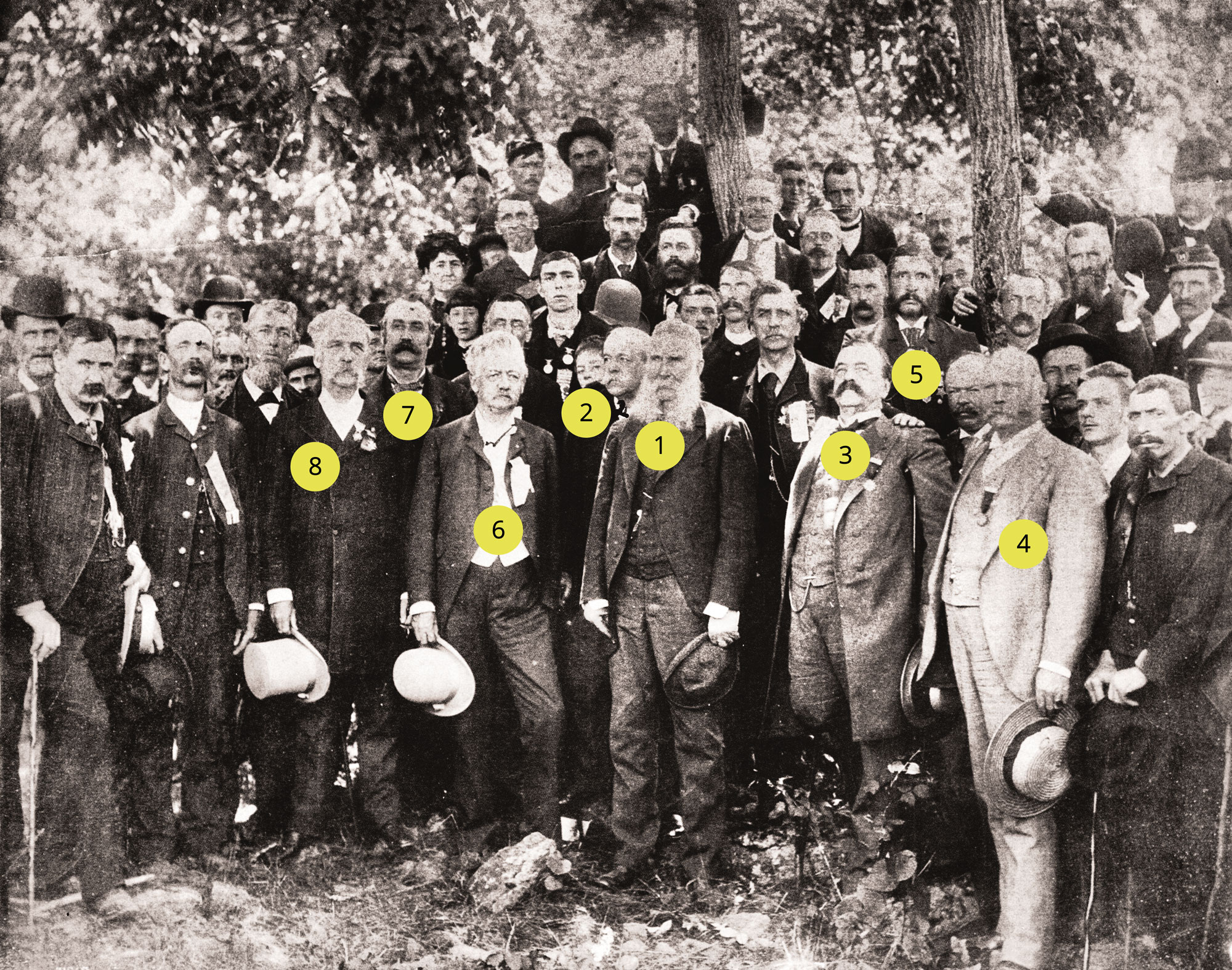
Former Confederate general James Longstreet (1) poses for the camera on the 25th anniversary of the Battle of Gettysburg’s final day. With him are former Union generals Dan Butterfield (2), Daniel Sickles (3), Joseph Carr (4), John Hartranft (5), and Henry Slocum (6), as well as U.S. Senator Warner Miller (7) and former 20th Maine commander Joshua L. Chamberlain (8).
The old Southern general had returned to Gettysburg, the little Pennsylvania town where, a quarter-century earlier, an epic battle had raged through its streets and across its farm fields. Traveling on horseback with a small group of men—including Warner Miller, a Civil War veteran and former U.S. senator from New York, and Dan Butterfield, chief of staff to the Army of the Potomac’s commanding general during the battle—James Longstreet was now at the spot where the Rebel battle line had smashed against the Union position on Cemetery Ridge, an action remembered to history as Pickett’s Charge or Longstreet’s Assault. The charge came to be understood as “the high-water mark of the Confederacy,” the line separating its opportunity for victory from its slow decline toward eventual defeat.
It was July 3, 1888, the 25th anniversary of the day when the Battle of Gettysburg had reached its apex. Longstreet—dignified, rail thin, bushy white sideburns framing his face—stood at the spot known as the Bloody Angle, where the Army of Northern Virginia had come to the beginning of that end. A New York Times reporter, also attending the anniversary reunion that had brought the men to town, spotted him there, alone in his thoughts, staring “long and intently” off toward the “gloomy woods of Seminary Ridge,” across the fields over which thousands of Confederate soldiers had “dashed to make the memorable charge that decided the fortune of the day”—and, some still argue, the fate of the republic.
From this place, Longstreet and his companions rode off to Cemetery Hill, then to Little Round Top, the rocky incline where the Union army had anchored its left flank on the afternoon of July 2, 1863. There, in a now-famous heroic defense, a handful of Union soldiers under Colonel Joshua L. Chamberlain fought to hold the position and save the Union line from total rout. When his ammunition was exhausted, Chamberlain ordered a bayonet charge, and pushed back the advancing enemy until fresh Union troops arrived to secure the position. Chamberlain was celebrated as one of the genuine heroes of the fight and awarded the Medal of Honor.
As Longstreet and his party climbed Little Round Top’s rocky slope, he was surprised to find other distinguished tourists already gathered there. Several former Union generals and veterans, fresh from attending a monument ceremony on another part of the field, were milling around talking to some reporters. Longstreet attempted to shy away from the scene when a photograph was taken of the group. He was preparing to leave when another throng of visitors, including former Union generals Daniel Sickles and Henry Slocum, appeared. Sickles, the controversial and notoriously self-promoting general who had lost a leg at Gettysburg, had arrived in a carriage and been helped up the slope of Little Round Top by veterans still devoted to their old leader. There was little of Sickles’ bluster on this day, however, as he made his way over to Longstreet and shook his hand, joking to the crowd that “this was General Longstreet’s second reception on Little Round Top.” A photographer suggested that another image be taken. As the group jostled and moved together for position, the Times reporter noted how uncomfortable Longstreet seemed before the camera. When he was first asked to join the photo, he had initially faded to the back of the crowd and “attempted to hide behind a large rock.” Now there was no escaping as he was guided to a prominent spot next to Sickles.
 Library of Congress
Helen Dortch Longstreet, the general’s second wife, kept the July 3, 1888, photograph of her husband and his old adversaries featured above. It was found in her personal archives.
While Sickles talked with Longstreet, the photographer readied his camera. As the photographer shouted, “All ready!” the reporter noted that many of the former officers raised their chins in a proud pose. In distinction, the photo depicts Longstreet as resigned or unnerved. Standing to his right is Slocum, who had commanded the Army of the Potomac’s XII Corps at Gettysburg, and just over his shoulder, Dan Butterfield. To Longstreet’s left stand Sickles and two other Civil War generals, Joseph B. Carr and John F. Hartranft.
Longstreet may or may not have been aware of another officer who posed with him that day. Standing next to Slocum and holding a light-colored top hat is Joshua L. Chamberlain, who, like Longstreet, had stumbled into the group of visitors. A few months later, Chamberlain would give a speech at the monument dedicated to the service of his old regiment, the 20th Maine Infantry, which would help to define Gettysburg’s symbolic power in American history.
In that speech he said:
In great deeds something abides. On great fields something stays. Forms change and pass; bodies disappear, but spirits linger, to consecrate ground for the vision-place of souls. And reverent men and women from afar, and generations that know us not and that we know not of, heart-drawn to see where and by whom great things were suffered and done for them, shall come to this deathless field to ponder and dream; and lo! The shadow of a mighty presence shall wrap them in its bosom, and the power of the vision pass into their souls.
Chamberlain’s words seem fitting when looking at this old photograph—a split second of memory recorded by chance and discovered in the personal archives of Longstreet’s second wife, Helen Dortch Longstreet. The old Confederate general who had reconciled with his nation had returned to Gettysburg, the battlefield of his greatest defeat, and stood for a brief moment in the company of his former adversaries. Today, the spot where the photo was taken is graced by an impressive castle-like monument to the 44th New York Infantry. Early on the afternoon of July 3, 1888, however, an impromptu meeting there bore testimony to the power of forgiveness, respect, and reconciliation as a nation divided by bloody war emerged reunited from its horrific trial by fire.