Civil War era patriotic-themed parade float.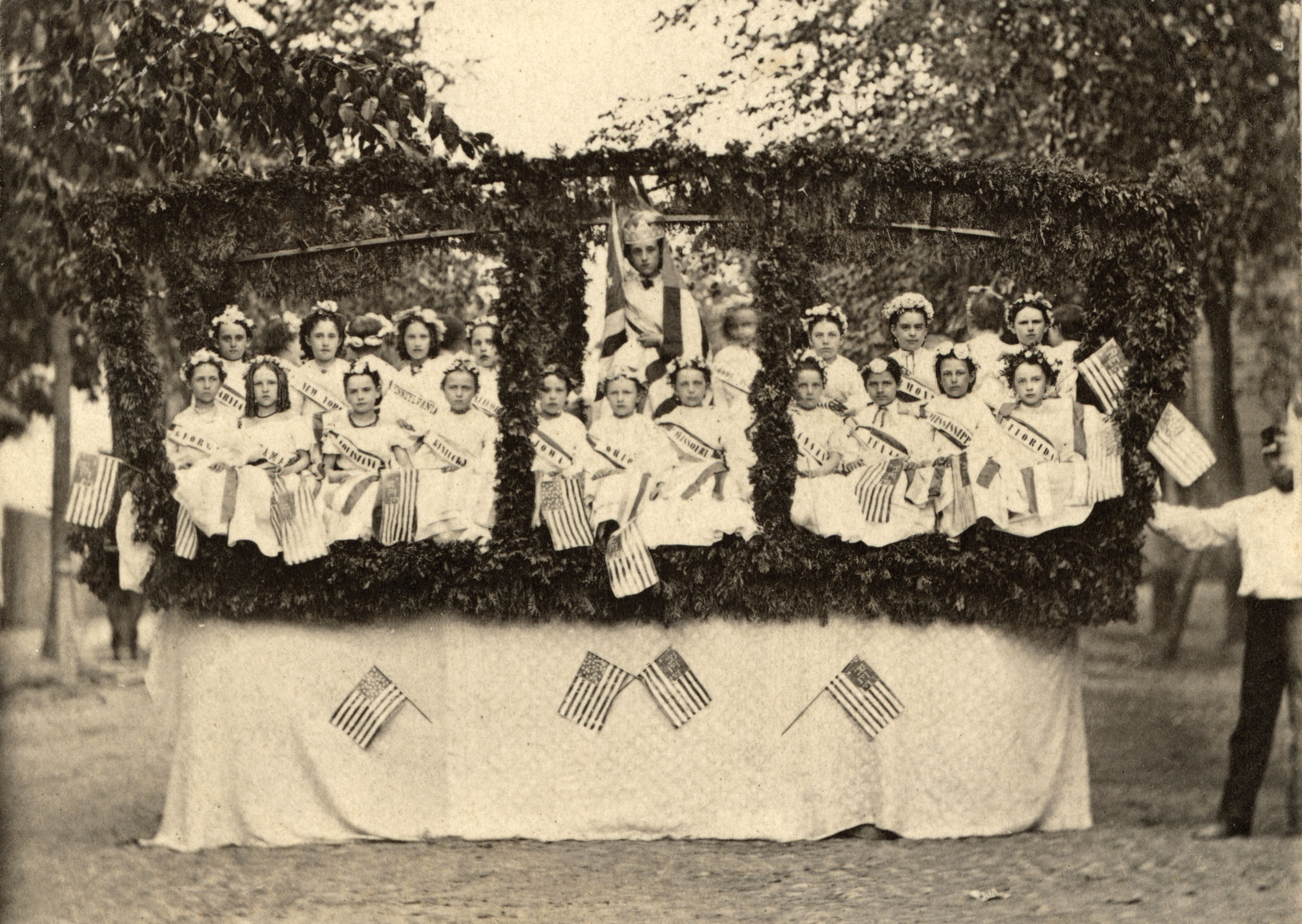 Ronald S. Coddington Collection
A man in a military cap stands beside a patriotic-themed parade float, its platform decorated and resting on a wagon covered in white material embossed with stars. Lady Liberty is center, under a crown of stars and draped in the Stars and Stripes, surrounded by girls whose sashes bear states’ names and, behind them, more girls facing the opposite way.
What to make of the flags in this image, some held by the girls and others affixed to the float? There are two variations of the star pattern on the blue cantons. One is fairly common—35 stars arranged in rough concentric circles. The other is specific to the 1864 presidential campaign of incumbent Abraham Lincoln—35 stars that spell “FREE.” The word proclaims in no uncertain terms the position of Lincoln’s Republican Party on slavery.
A 36th single star along the lower left of the canton represents Nevada, which was being rushed into statehood by pro-Union, pro-Lincoln adherents. Nevada gained admission on October 31, 1864, eight days before Election Day. Lincoln won the state with about 60 percent of the vote, ahead of the Democratic Party candidate, Major General George B. McClellan.
Through much of the 19th and into the 20th century, campaign flags were popular—until in 1912 President William Howard Taft issued an executive order standardizing the size, shape, and distribution of stars in the canton.
Ronald S. Coddington is publisher of Military Images, a magazine dedicated to showcasing and preserving photos of Civil War soldiers and sailors.
Related topics: Abraham Lincoln