Painting of Pickett’s Charge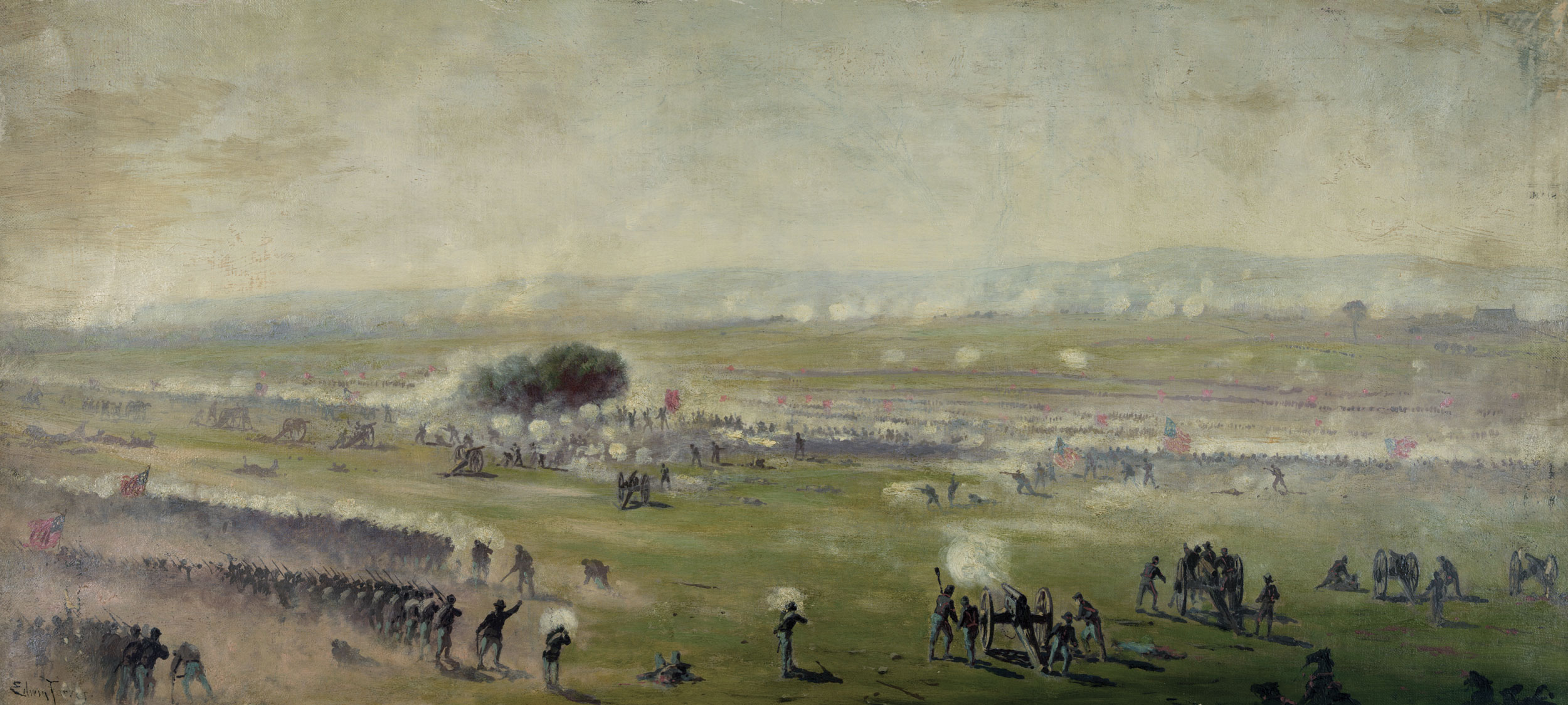 Library of Congress
On the third day of the Battle of Gettysburg, General Robert E. Lee—looking to deal a decisive blow to the Army of the Potomac after two days of attacks against its flanks had failed to do so—ordered a massive infantry advance upon the center of the Union defensive position on Cemetery Hill, which he reasoned was the weak point of the Union line. Little went right during the attack, known to history as Pickett’s Charge after Major General George Pickett, one of three Confederate generals whose men made up the assaulting force. The massive artillery bombardment that preceded the attack was rendered largely ineffectual as many of the Confederate shells overshot their marks.
The infantry advance conducted over open ground under a sweltering July sun—withered under devastating Union artillery and rifle fire as it moved toward a salient in the Union line known as “The Angle.” In less than an hour, the assault was over and its survivors were trickling back toward the safety of Confederate lines, prompting a despondent Lee reportedly to remark that the attack that lost the Battle of Gettysburg for his army was “all my fault.”
Here we highlight various figures about the failed assault, which many still regard as the war’s turning point.
Pickett’s Charge by the Numbers
Time the Confederate artillery bombardment of the Union center began: 1:07 p.m.
Number of Confederate cannon involved in the bombardment: 159
Approximate number of hours the bombardment lasted: 2
Temperature, in degrees Fahrenheit, at 2 p.m.: 87
Approximate number of Confederate troops involved in Pickett’s Charge: 12,500
Approximate number of Union troops awaiting the assault: 6,000–7,000
Yards of ground Confederate troops crossed during the charge: 1,000–1,300
Feet of ground Confederate troops covered every 60 seconds during the charge: 225
Number of Confederate troops who reached the Union line on Cemetery Ridge: 2,000–3,000
Number of Confederate troops who breached the Union line at The Angle: 150
Number of Confederate casualties suffered during the charge: 6,000–7,000
Number of regimental commanders killed or wounded in Pickett’s division (out of 15): 14
Approximate number of Confederate regimental battle flags lost during the charge (out of 50): 31
Number of Union casualties suffered repelling the charge: 2,300
Sources
James A. Hessler and Wayne E. Motts, Pickett’s Charge at Gettysburg (2015); Jay Jorgensen, ed., Top Ten at Gettysburg (2017); Noah Andre Trudeau, Gettysburg: A Testing of Courage (2002); Carol Reardon, Pickett’s Charge in History and Memory (1997); Stephen W. Sears, Gettysburg (2003). With thanks to Gettysburg Licensed Battlefield Guide Larry Korczyk for his assistance.