 Library of Congress
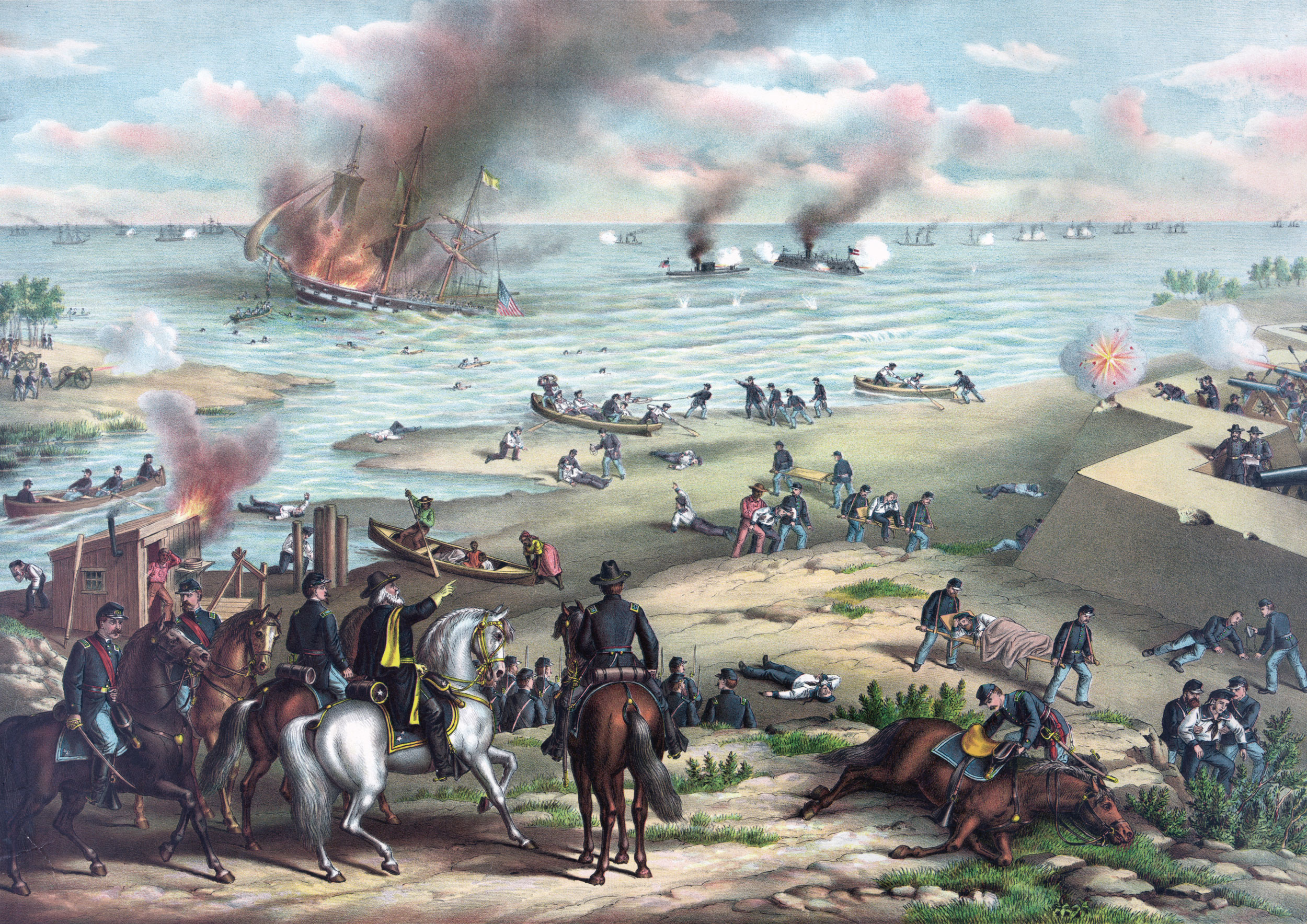
USS Monitor and CSS Virginia (known to most as Merrimack) exchange fire in this dramatization of the Battle of Hampton Roads by Kurz & Allison. While theirs was not the only battle between ironclads during the war, it remains the most famous.
The war at sea occupies a comparatively minor place in the American Iliad, which consists overwhelmingly of battles, leaders, and episodes associated with land operations. Most general works on the Civil War treat the naval conflict in a single chapter, and many combine that chapter with the conflict’s diplomacy. Its most important element, the northern blockade of southern ports, consisted largely of tedium. There are a few dramatic exceptions—including Admiral David G. Farragut shouting, “Damn the torpedoes! Full speed ahead!” as his flotilla opened the Battle of Mobile Bay on August 5, 1864. One could add Admiral David Porter’s dramatic run beneath the thunderous guns as his flotilla sailed past the batteries atop the Vicksburg, Mississippi, bluffs on the night of April 16, 1863, or the battle between the commerce raider CSS Alabama and sloop USS Kearsage off the coast of Cherbourg, France, on June 19, 1864.
But these episodes are known primarily to serious students of the Civil War. In contrast, even those casually acquainted with the war have heard of the duel between the ironclads USS Monitor and CSS Virginia (its name during the battle, though it is known to fame as Merrimack). They may know neither the date of the engagement—March 9, 1862—nor its location, Hampton Roads, Virginia. But they have clear mental images of Merrimack, a casemate ram resembling a barn submerged to its eaves, and Monitor, often described as looking like “a cheese box on a raft.” Their battle was not the only one between ironclads during the Civil War, but it is by far the most famous. What gives this episode such outsized importance?
An obvious explanation is that this was the first such engagement. But perhaps more importantly, it was one of the few between ironclads alone. Most such encounters also involved land forces. Key to the Battle of Mobile Bay, for example, were the Confederate Forts Gaines and Morgan. But beyond this distinction, the clash between Merrimack and Monitor involved both high drama and obedience to Aristotle’s dramatic unities of time, space, and action.
The story began in April 1861, when U.S. servicemen scuttled the steam sloop Merrimack in the Gosport Navy Yard at Norfolk, Virginia, to prevent it from falling into the hands of the Confederates. The effort was only partly successful. Merrimack burned to the waterline, but its hull remained intact, and Confederate engineers were also able to salvage its engines. In the months that followed, the Confederates constructed a 170-foot armored casemate on Merrimack’s 263-foot hull and bolted a seven-foot ram below the waterline. They armed the vessel with 10 heavy cannon as well as two lighter howitzers that would be manned by a crew of about 320 men.
By March 7, 1862, Merrimack was ready for action, and the following day it steamed forth to attack the wooden Union warships stationed off Newport News, at the mouth of the James River. She struck first at the frigates USS Congress and USS Cumberland, sending both to the bottom, then forced a third frigate, USS Minnesota, to run aground in order to avoid sinking. Nothing seemed able to stop Merrimack, and President Abraham Lincoln and Secretary of War Edwin M. Stanton peered anxiously down the Potomac River, for fear that Merrimack might be making its way northward via the Chesapeake Bay.
In point of fact, Merrimack was only marginally seaworthy and limited in range. The voyage imagined by the Union leaders was out of the question. And in any event, by one of the great coincidences of the Civil War, on March 8 a Union ironclad arrived at Hampton Roads to challenge Merrimack, having made a multiday voyage from Brooklyn Navy Yard. This was of course USS Monitor, perhaps the most unusual warship of its time.
Unlike Merrimack, whose casemate hull was fairly orthodox in design, Monitor was a bizarre-looking affair, the brainchild of Swedish-born inventor and engineer John Ericsson. It was 179 feet in length, with a freeboard barely above water level, and it carried only two 11-inch smoothbore Dahlgren guns. These were mounted on a massive turret capable of turning 360 degrees. Critics called it “Ericsson’s folly.” According to legend, it might not have been constructed at all but for Lincoln’s endorsement. Looking over a model of Ericsson’s design, he reportedly remarked, “All I have to say is what the girl said when she stuck her foot into the stocking. It strikes me there’s something in it.”
It took about 100 days to construct Monitor, whose crew of 49 was far smaller than that of Merrimack. But it was more nimble than Merrimack, whose guns were mounted in the traditional broadside fashion. The fact that Monitor’s guns could swivel in any direction gave it a substantial advantage.
Both vessels were equivalent in speed—about six knots per hour—and when Monitor sallied forth to engage Merrimack, the two ironclads circled one another, each trying to achieve a decisive advantage. But Monitor’s armor was eight inches thick, and Merrimack’s was four inches thick and slanted at a 36-degree angle so that Monitor’s solid shot simply bounced off it. It also took a great deal of time to load and fire the immense cannon. During the four-hour battle Monitor fired just 41 shots, scoring 20 hits. No one kept track of the rounds fired by Merrimack, but it is known that 23 shells hit Monitor.
Neither vessel could get the better of the other. A Confederate officer said ruefully of the rival warship, “It is quite a waste of ammunition to fire at her…. I find I can do the Monitor as much damage by snapping my finger at her every five minutes.” Eventually Merrimack drew off toward the sheltered waters of the Elizabeth River, and for the next two months neither ironclad could get at the other.
What, then, had this duel between the first ironclads accomplished? Clearly, the timely arrival of Monitor had saved the wooden Union flotilla from further destruction. But perhaps more importantly, the very presence of Merrimack rendered the James River too dangerous for passage by wooden Union warships and transports. As a result, until Merrimack was scuttled on May 11, the day after the Federals’ capture of Norfolk, it prevented Major General George McClellan’s Army of the Potomac from bypassing the Confederate fortifications at Yorktown.
As significant as this might be, however, it did not live up to the dramatic expectations one might expect from such a novel clash. A 1959 book for young readers tried to grasp at it. Thanks to Merrimack, it claimed, “Billy Yank came within a whisker of losing the contest for control of the sea.” This fate of course was unlikely. Even had Monitor not materialized, Merrimack was not seaworthy enough to enter the open ocean and sweep aside the Union naval blockade of the southern shore. The reason for the battle’s fame lies elsewhere.
To begin with, most Civil War naval engagements were asymmetrical in nature, consisting largely of fights between Union warships and Confederate fortifications. These might generate drama of a kind, but nothing like a duel between two vessels. Second, the Civil War is widely considered the world’s first modern war, owing to the presence of the railroad, telegraph, and extensive field fortifications like those of World War I. And the battle between Monitor and Merrimack—the first ironclads ever to clash in battle—surely smacks of modernity. Indeed, when one lists the hallmarks of the Civil War as a modern war, Monitor and Merrimack are often the first items mentioned. If a key element in the American Iliad is the conflict’s modernity, then the duel between Monitor and Merrimack constitutes Exhibit A.
Mark Grimsley, a history professor at The Ohio State University, is the author of several books, including And Keep Moving On: The Virginia Campaign, May–June 1864 (2002) and The Hard Hand of War: Union Military Policy Toward Southern Civilians, 1861-1865 (1995). He has also written more than 50 articles and essays.
Notes
1. Quoted in James M. McPherson, War on the Waters: The Union and Confederate Navies, 1861–1865 (Chapel Hill, 2012), 210.
2. Quoted in William C. Davis, Duel Between the First Ironclads (Garden City, NY, 1975), 20.
3. Quoted in Davis, Duel Between the First Ironclads, 127.
4. Earl Schenck Miers, Billy Yank and Johnny Reb: How They Fought and Made Up (New York, 1959), 43.
Related topics: naval warfare