 Photo by Sharona Jacobs
Megan Kate Nelson
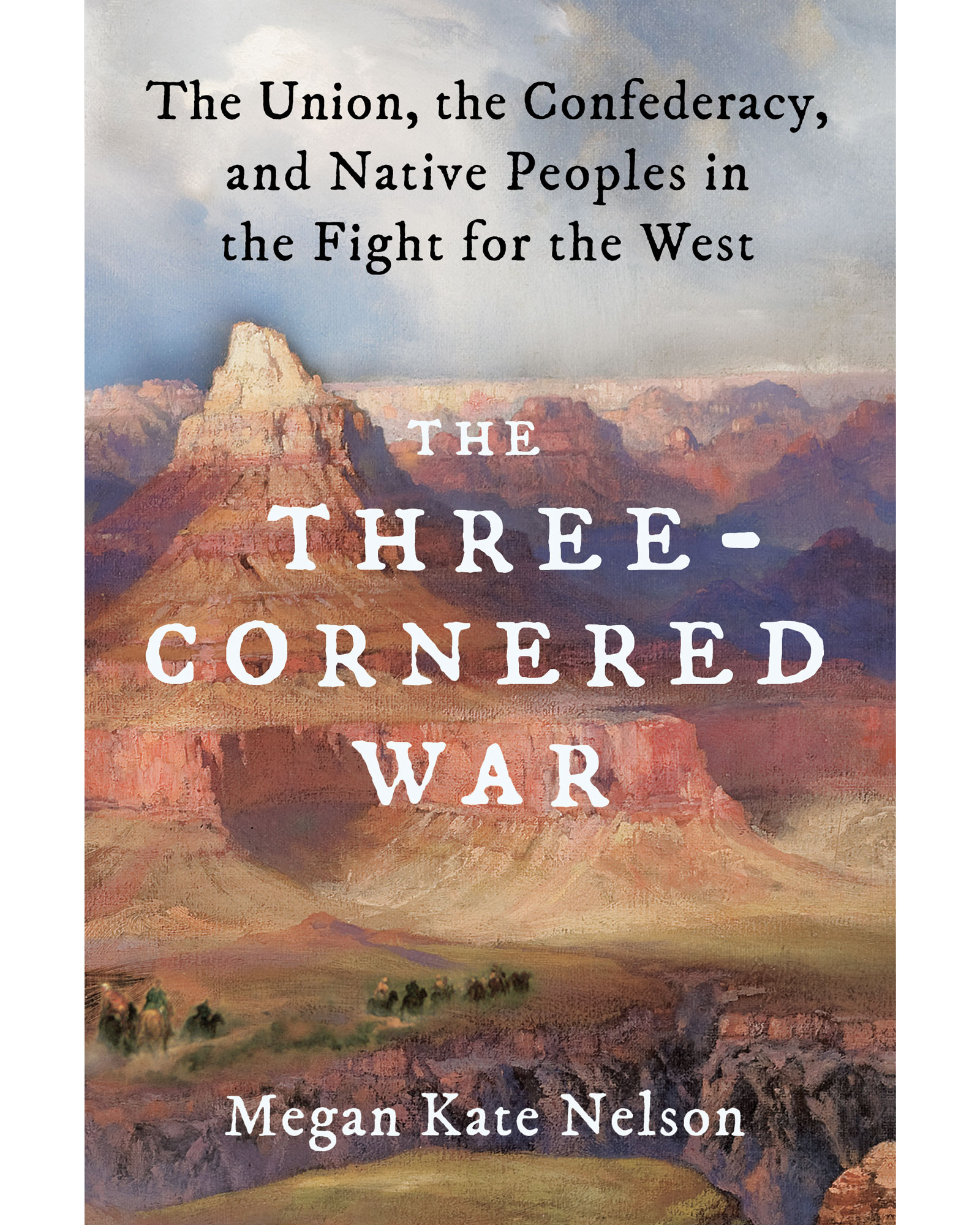
In her latest book, The Three-Cornered War: The Union, the Confederacy, and Native Peoples in the Fight for the West (to be published in February by Scribner), Massachusetts-based writer and historian Megan Kate Nelson examines the struggle for control of the American West that took place during the Civil War, a fight that had great significance but remains largely absent from most studies of the conflict. We recently sat down with Nelson—who also authors the Monitor’s regular “Stereoscope” column—to learn more about her work on those hostilities waged far from the battlefields of Virginia.
Why did you decide to write a book about the Civil War in the West?
First, let me clarify what I mean when I use the term “West” in The Three-Cornered War. Most Civil War historians understand this to mean the Trans-Mississippi theater. I think we should call the Trans-Mississippi the Trans-Mississippi, and use “the West” to refer to the battles and conflicts over land and resources from the Pacific coast to the 100th meridian. Most of the action in The Three-Cornered War takes place in New Mexico and Arizona and parts of Texas, California, and Colorado. Both the Union and the Confederacy saw this region as the gateway to establishing control over the larger West.
Now, I’ll answer your question! When I was doing research in 2004 to prepare for teaching Civil War history at Texas Tech University, I learned that several battles took place in New Mexico Territory early in the war: Valverde, Apache Canyon, Glorieta Pass. This was news to me. Growing up in Colorado, I had never heard about these battles as part of Civil War history. Or that Colorado gold miners had been recruited to fight in the Union army, to defend the region from Confederate invasion. Or that both the Union and the Confederacy fought campaigns against Native peoples whose lands they wanted to claim for themselves.
So I became interested in two things: the nature of the Civil War in the West, and the reasons that many westerners—and most Americans—are unaware that this region was a theater of the conflict. It is a story that I think all Americans should know, and so I decided to tell it.
How important was the conflict waged in the West to the outcome of the Civil War? What were the stakes?
The war in the West was important for two reasons.
First, the Union and the Confederacy were interested in controlling this region to have access to its gold mines and Pacific ports, both significant resources for funding the war. When the Union succeeded in turning back Brigadier General Henry Sibley’s invasion of New Mexico Territory and reclaiming Arizona in the summer of 1862, the Confederacy was struck an economic blow. The Union’s blockade of ports in the Gulf and along the Atlantic coast began to work and the Confederacy was increasingly strapped for cash. This undermined the strength of its armies in the field, while also putting a financial strain on southern civilians.
Second, the Union and Confederacy both saw the West as the center of future empires, a key feature of their evolving nationalisms. For the Confederacy, the Southwest would be the crossroads of an empire of slavery; for the Union, the entire West would be a site of settlement, a pivotal region in the creation of its empire of free labor.
The defeat of Sibley’s Brigade meant that the Confederacy was surrounded on land by Union states and territories. It had no options for expansion. The vision of a coast-to-coast Confederacy that would extend southward into Mexico and Central America lingered, but it was no longer a central component of Confederate nationalism.
For the Union, the victory resulted in the passage of several legislative acts that worked toward the Republican goal of an empire of free labor. In 1862, after Sibley’s troops retreated back to Texas, the U.S. Congress passed the Homestead Act, the Pacific Railway Act, the Morrill Land Grant Act, and created a Department of Agriculture. The imperial vision motivating these acts propelled the Union army’s turn to campaigns against Apaches and Navajos in Arizona and New Mexico, bolstering Union nationalism with a belief in the North’s expansion of power across the continent.
Is there a person or an event whose decisions or consequences stand out as particularly important in determining the outcome of the war in the West?
There are several contenders, but the Battle of Apache Pass in Arizona on July 15–16, 1862, was a particularly important moment in the Civil War West.
This battle between Brigadier General James Carleton’s California Column and Mangas Coloradas’ and Cochise’s Chiricahua Apaches had three results: It confirmed rumors that the Californians were on their way to the Rio Grande in large numbers, convincing the last of the Confederate troops holding Mesilla, New Mexico, to retreat, thus ending the Sibley Campaign; it gave Union troops control over a vital water source in Arizona Territory, thus supporting a foothold for the military there; and, lastly, it convinced Carleton that the Apaches were a more significant threat to Union power in Arizona than he had believed. From that point on, he abandoned attempts at treaties and instead launched campaigns against the Chiricahuas and the Navajos in New Mexico in order to secure the West for the Union.
What sources did you find particularly useful or important in your research?
Government documents were incredibly useful: The War of Rebellion: A Compilation of the Official Records of the Union and Confederate Armies contains many of the military records of the Civil War West, as does the Records of California Men in the War of the Rebellion, 1861 to 1867.
Senate records containing first-person testimony about the Union army’s treatment of Native peoples across the nation during the conflict were vital for understanding the wartime incarceration of Navajos and Apaches.
Local newspapers, many of which have been digitized (such as the Santa Fe Gazette), gave me an excellent idea of what life was like on the ground during the war in the West.
It was also important for me to visit many of the sites I discuss in The Three-Cornered War. To walk around these places, many of which have not been developed or paved over, gave me great insights into events that had taken place there more than 150 years ago.
Did you learn anything about the Civil War in the West that surprised you?
As readers of The Three-Cornered War will discover, many of the individuals who shaped the conflict in the West were connected in some way. I was surprised to learn that some had met before, others had common origins, and some became friends in the course of the war.
This is why I wrote the book the way that I did. Instead of structuring it like most academic histories (with thematic chapters), I wrote it as a series of interlocking narratives from multiple perspectives. As the story unfolds, readers can see how many communities were involved in the fight in this theater, and how intimately they were related to one another.