 Library of Congress
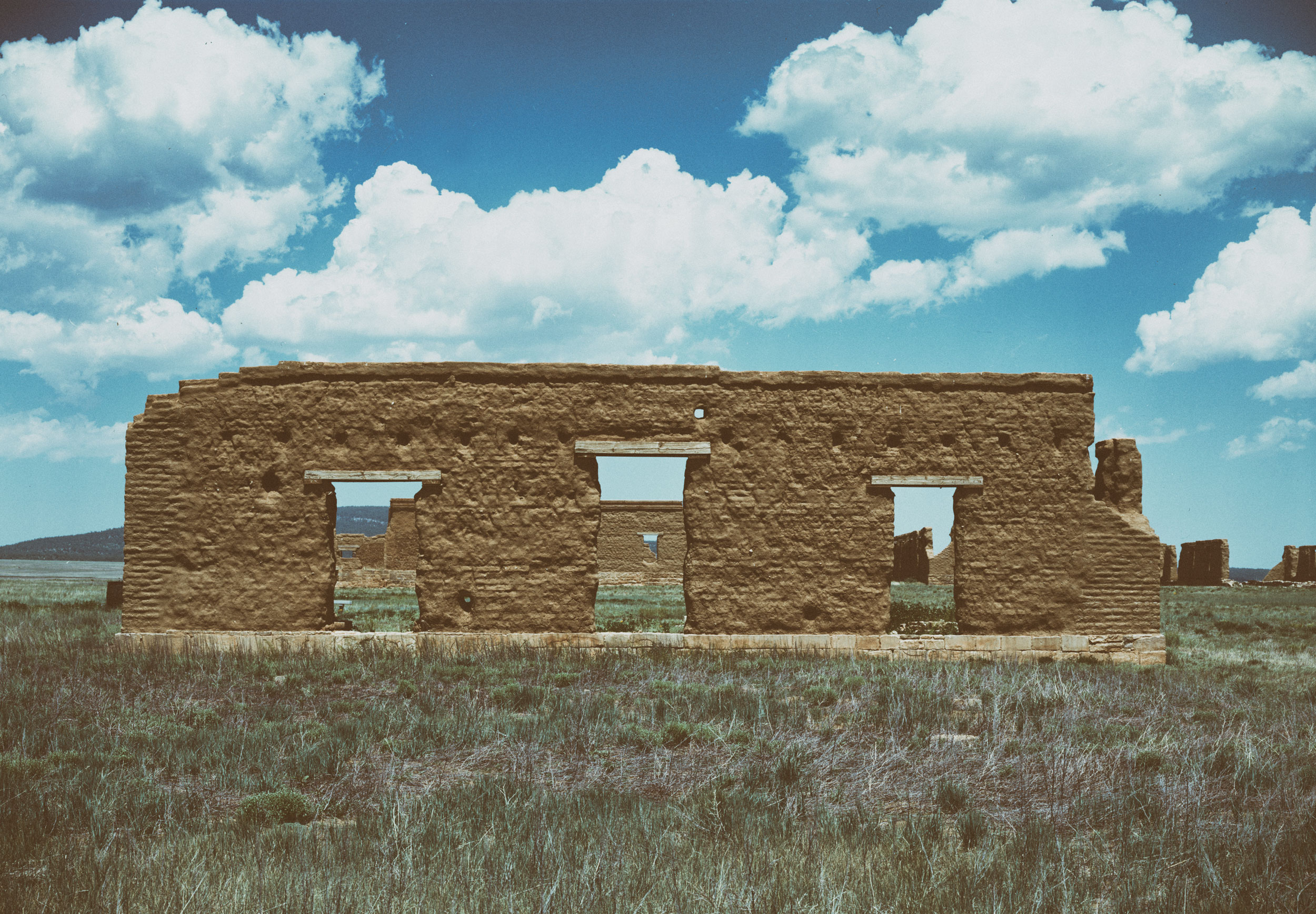
The ruins of Fort Union, New Mexico, as they appeared in the mid-20th century. The fort was one of several U.S. military installations that Confederate general Henry H. Sibley had hoped to capture during his failed 1862 campaign in New Mexico Territory.
Brigadier General Henry Hopkins Sibley’s movement up the Rio Grande Valley in 1862 has garnered a good deal of recent attention. Long relegated to the periphery of the Civil War, the Confederate invasion of New Mexico figures in the work of historians who call for a closer alignment of scholarship devoted to the Civil War and to the trans-100th-Meridian West. This region extended from the Texas and Oklahoma panhandles to the Pacific Ocean and embraced, but was not limited to, modern-day New Mexico, Arizona, Colorado, and California. Scholars who find increased significance in Sibley’s campaign see it as reflective of Confederate imperial ambitions in the West that must be taken seriously. Only by shifting the focus westward, they contend, can the true scope and nature of the Civil War era be appreciated.
This interpretive trend speaks to the vitality of scholarship in the field of Civil War history, which has experienced expansion, both geographically and chronologically, as historians apply fresh analytical lenses in search of previously undetected patterns or connections. Increased scrutiny of New Mexico, as part of this larger historiographical phenomenon, invites a reconsideration of how best to frame Sibley’s campaigning along the Rio Grande between February and May 1862. Did it represent a peripheral operation of little consequence? Or should it be cast as an important element of Confederate hopes to create a western empire beyond the territorial reach of the slaveholding republic’s 11 original states?
The writings of four historians convey the tenor of how Sibley’s operation has been given enhanced prominence as part of Confederate imperial designs. Nearly 25 years ago, Donald S. Frazier anticipated a good deal of current scholarship when he argued that for “more than thirty years prior to Sibley’s campaign, Southern writers, statesmen, and warriors had urged the occupation and development of the American Southwest and parts, if not all, of Mexico.” Following the establishment of the Confederacy in 1861, “the time and conditions for a Southern empire had arrived.” The invasion of New Mexico, as a feature of that imperial striving, “was the heir of Manifest Destiny, filibustering, and the American drive for expansion.” Frazier quoted A. Latham Anderson, who wrote about the campaign in the 1880s for the Century Company’s Battles and Leaders of the Civil War, to underscore the campaign’s importance. Anderson had served in New Mexico in 1862 as a lieutenant in the 5th U.S. Infantry and took a challenging stance: “The remote and unimportant territory of New Mexico was not the real objective of this invasion. The Confederate leaders were striking at much higher game—no less than the conquest of California, Sonora, Chihuahua, New Mexico, Arizona, and Utah—and above all, the possession of all the gold supply on the Pacific coast.” Although Sibley failed, Frazier thought the stakes had been momentous, seeking “creation of a Confederate Empire [that] would have secured western wealth and European recognition…. The empire, like the Confederacy, was not to be, despite the investment of so much blood and treasure.”1
A pair of shorter pieces by Kevin Waite and Megan Kate Nelson add weight to the idea that Sibley’s campaign should be linked to Confederate empire building. Waite emphasizes Jefferson Davis’ antebellum interest in the Southwest and Far West and suggests that it carried over into the war. Although conceding that Davis knew “the war would be won or lost in the major military theaters of the East,” Waite sketches a Confederate president who from “the first flush of secession to the rebellion’s collapse … never turned his back on the Far West.” Davis’ government targeted the Southwest with a “modest invasion” by approximately 250 Texans under Lieutenant Colonel John R. Baylor in 1861 and then “a far larger invasion force” of 2,700 troops under Sibley that “captured the New Mexican capital, Santa Fe, and seemed poised for further conquest.” Waite quotes Trevanion T. Teel, an artillerist under Sibley who, like Latham Anderson, wrote for Battles and Leaders of the Civil War. “The objective aim and design of the campaign,” wrote Teel, in text he italicized for emphasis, “was the conquest of California.” According to Waite, Sibley’s retreat closed “the high water mark of Confederate empire in the Far West” but did not end “proslavery western fantasies” or stop Davis from authorizing several more “ambitious southwestern campaigns.”2
 Battles and Leaders of the Civil War
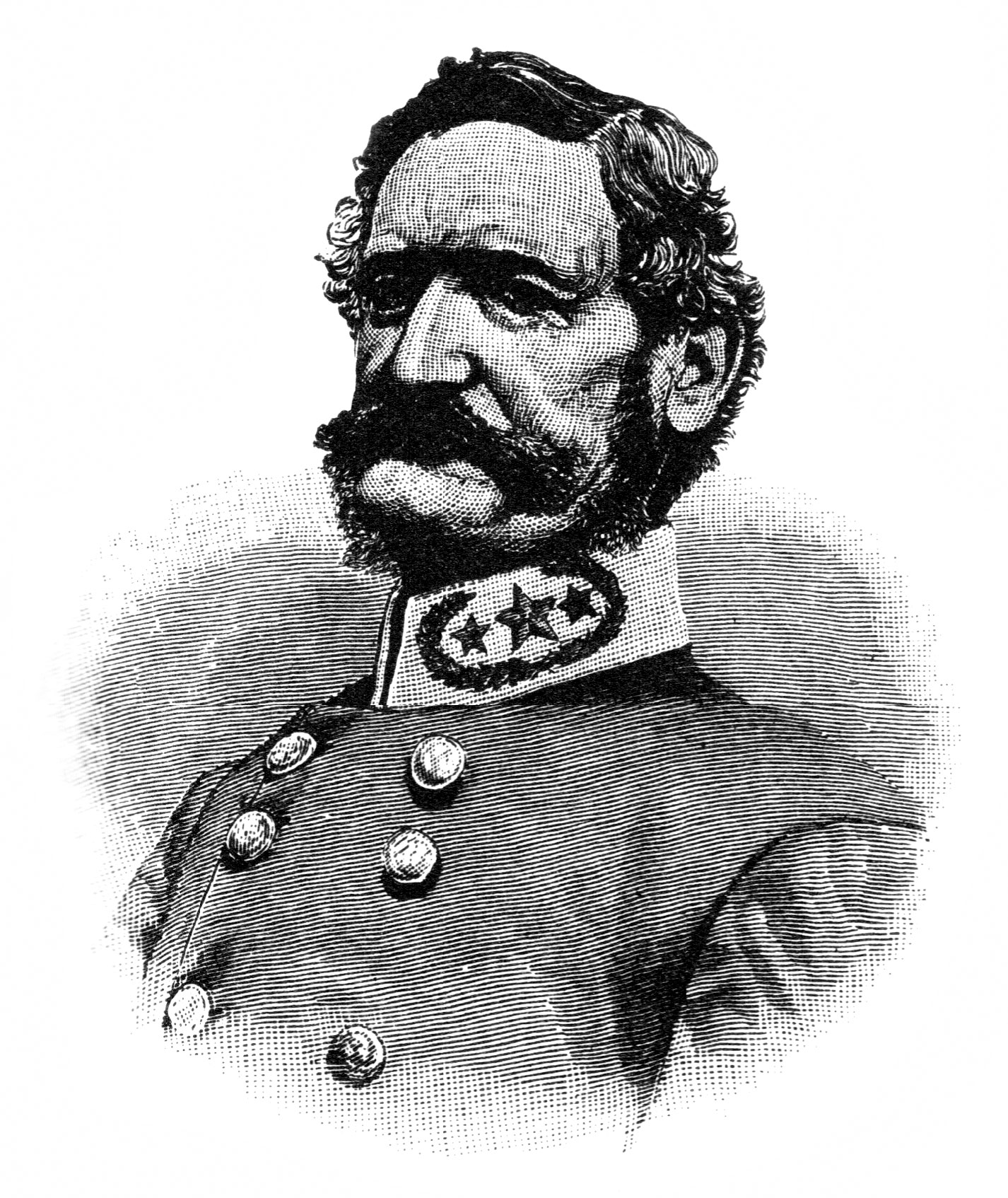
Historians continue to debate the significance of Brigadier General Henry H. Sibley’s campaign along the Rio Grande between February and May 1862. Was it an important element of Confederate imperial ambitions to create a western empire, or a minor operation of little significance? Above: A sketch of Sibley based on a wartime photograph.
Nelson similarly connects antebellum hopes for a slaveholding empire in the Southwest, including those of Jefferson Davis, to Confederate actions. She references Frazier’s argument (which drew on Teel’s account) that “Building a Confederate Empire from the rubble of the Union was a basic goal of Southern independence, not an afterthought.” Given his “already strong emotional and political investments in the West,” states Nelson, Davis readily accepted Sibley’s proposal for an invasion of New Mexico. The plan embraced “the central tenets of Confederate Manifest Destiny” and offered a military path to achieve long-held goals. In the end, the environment of New Mexico frustrated Sibley and left him to brood over a “story of failure, of dreams of conquest dashed in the harsh land and climate of the southwestern desert.”3
Sibley’s campaign also appears in broader interpretive studies such as Steven Hahn’s recent book, A Nation Without Borders: The United States and Its World in an Age of Civil Wars, 1830–1910. Echoing Frazier, Waite, and Nelson (and by extension Anderson and Teel), Hahn posits great interest on Jefferson Davis’ part and ascribes to Confederates an intention “not only to seize control of New Mexico and Arizona but also to occupy the gold-mining areas of Colorado and California.” Sibley convinced Davis of the plan’s potential and, after being named commander of Rebel forces in New Mexico, by March 1862 had taken control of Albuquerque and Santa Fe and “looked north toward Colorado.” Hahn quotes the ubiquitous Latham Anderson: “The conquest alone of this vast domain … would have insured the recognition of the Confederacy by the European powers,” to which Hahn appends: “And, Anderson might have added, an independent and increasingly powerful Confederate state.” Hahn treats the Rio Grande campaign as significant, placing Sibley’s eventual retreat alongside defeats at Fort Donelson, Pea Ridge, and Shiloh and the loss of New Orleans as notable southern failures during the first months of 1862.4
The National Park Service’s website for Glorieta Pass highlights how such scholarly interpretations migrate into public history. Pronouncing the climactic battle of Sibley’s campaign “the high water mark for a bold Confederate offensive into Union Territory on the western frontier,” the text invites consideration of how Confederate victory “would be a necessary prelude to detaching the western states from the Union and expanding the Confederacy to the Pacific Ocean.” The fight at Glorieta, “[r]eferred to as the ‘Gettysburg of the West’ by many historians,” was thus a “great turning point in the Civil War, the battle that shattered the western dreams of the Confederate States of America.”5
 VLW Cartography
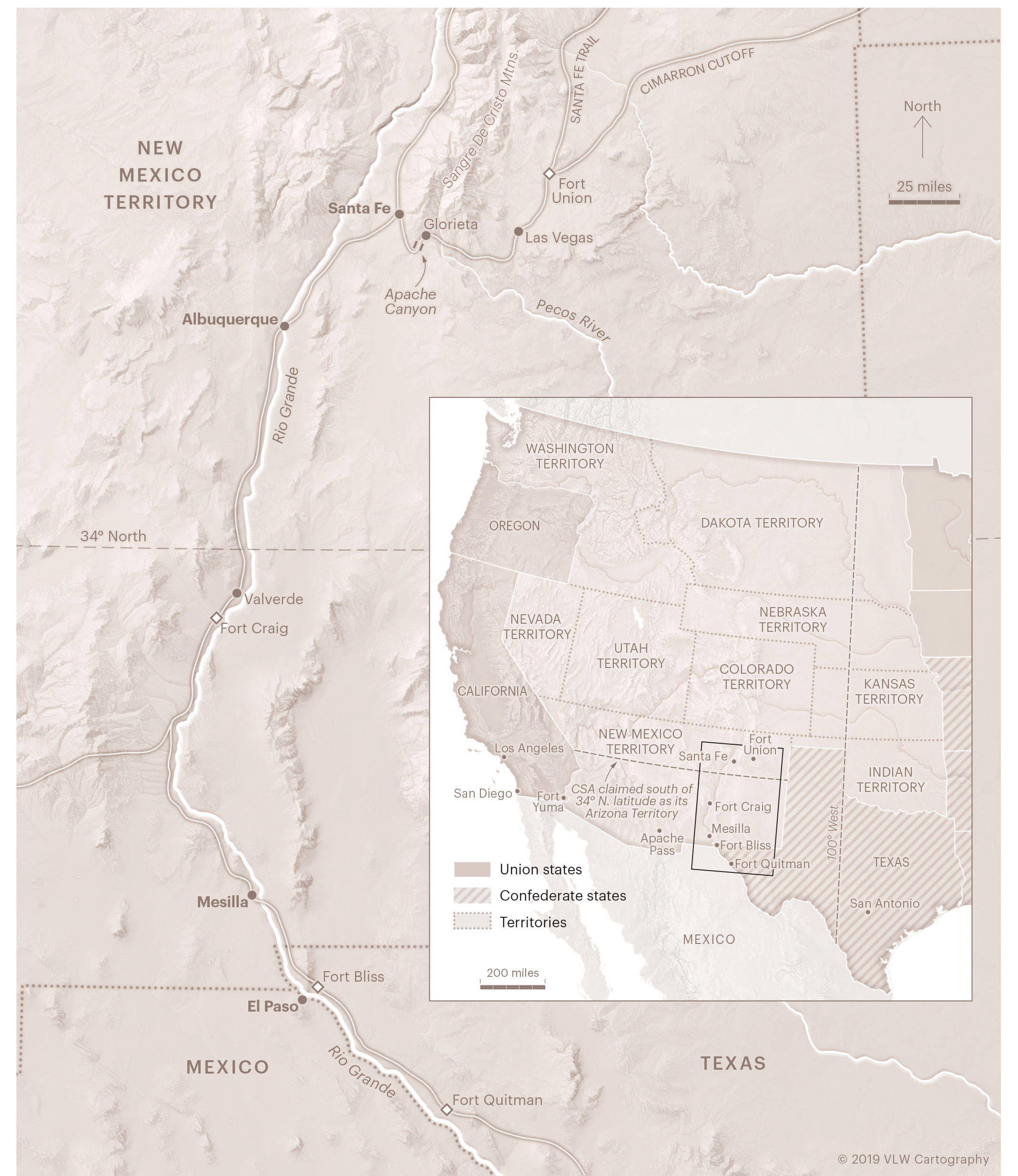
The War in the Far West | New Mexico Territory | February – May 1862
In February 1862, Brigadier General Henry H. Sibley led a brigade of Confederate soldiers on a mission to drive Union forces from New Mexico Territory. They marched north along the Rio Grande from Fort Bliss in Texas toward Union-controlled Fort Craig. Sibley’s men engaged enemy troops in battle at Valverde (February 21), Apache Canyon (March 26), and Glorieta (March 28). While the Confederates had experienced some tactical success and temporarily controlled both Albuquerque and Santa Fe, they could not sustain their offensive as planned with an advance toward Fort Union. Isolated and low on provisions, Sibley ordered a retreat. He and his surviving men reached El Paso in early May before continuing on to San Antonio. Confederate hopes for taking New Mexico were over.
A brief review of Sibley’s campaign will set the stage for an assessment of how it and the trans-100th-Meridian West figured in Confederate planning and national aspirations. In April 1861, three regiments of U.S. regulars garrisoned various posts in New Mexico Territory, including Fort Craig, on the Rio Grande more than half way from El Paso to Albuquerque, and Fort Union, northeast of Santa Fe. Most of those troops were ordered elsewhere in June and July—to be replaced by January 1862 with several thousand New Mexico volunteers and militia. Sibley initially met with Jefferson Davis in the summer of 1861 and received orders on July 8 to drive the Federals from New Mexico. The principal Rebel movement commenced in early February 1862, when 2,600 Texans in a brigade Sibley grandly denominated the “Army of New Mexico” marched north along the Rio Grande toward Fort Craig. The preceding December, from Fort Bliss, Texas, Sibley had issued a proclamation to the people of New Mexico. “By geographical position, by similarity of institutions, by commercial interests, and by future destinies,” he announced, “New Mexico pertains to the Confederacy. Upon the peaceful people of New Mexico the Confederate States wage no war. To them we come as friends, to re-establish a governmental connection agreeable and advantageous both to them and to us….”6
Between February and May, the Texans covered an impressive distance across inhospitable terrain that became a bit less forbidding as the column reached Santa Fe, where the western foothills of the Sangre de Cristo Mountains contained stands of piñon and other evergreens. The Rebels fought battles upriver from Fort Craig at Valverde (on February 21) and just beyond Santa Fe at Apache Canyon (on March 26) and Glorieta or Pigeon’s Ranch (on March 28). Casualties in the major engagements totaled about 600 for the Federals, who slightly outnumbered their opponents, and more than 400 for the Confederates. Although the Rebels gained some tactical success in two of the battles and controlled both Albuquerque and Santa Fe for a short time, they could not sustain their strategic offensive with a movement toward Fort Union. Isolated and exposed in northern New Mexico, unable to provision his troops locally and far from sources of supply in Texas, Sibley, who drank heavily throughout the campaign, ordered a retreat. The exhausted survivors of his little force reached El Paso in early May and then continued on to San Antonio.
An embittered Sibley informed Richmond on May 4 that severe shortages of supplies had forced the retreat. “[I]t is proper that I should express the conviction, determined by some experience, that, except for its political geographical position, the Territory of New Mexico is not worth a quarter of the blood and treasure expended in its conquest,” he wrote, in stark contrast to the scenario of expansionist triumph he had articulated to Davis in the summer of 1861. He could not “speak encouragingly for the future, my troops having manifested a dogged, irreconcilable detestation of the country and the people.” Sibley took a more positive stance in an address to his men dated May 14. He congratulated “the Army of New Mexico upon the successes which have crowned their arms in the many encounters with the enemy during the short but brilliant campaign which has just terminated.” Future generations, Sibley prophesied, would judge the campaign “one of the brightest pages in the history of the Second American Revolution.”7
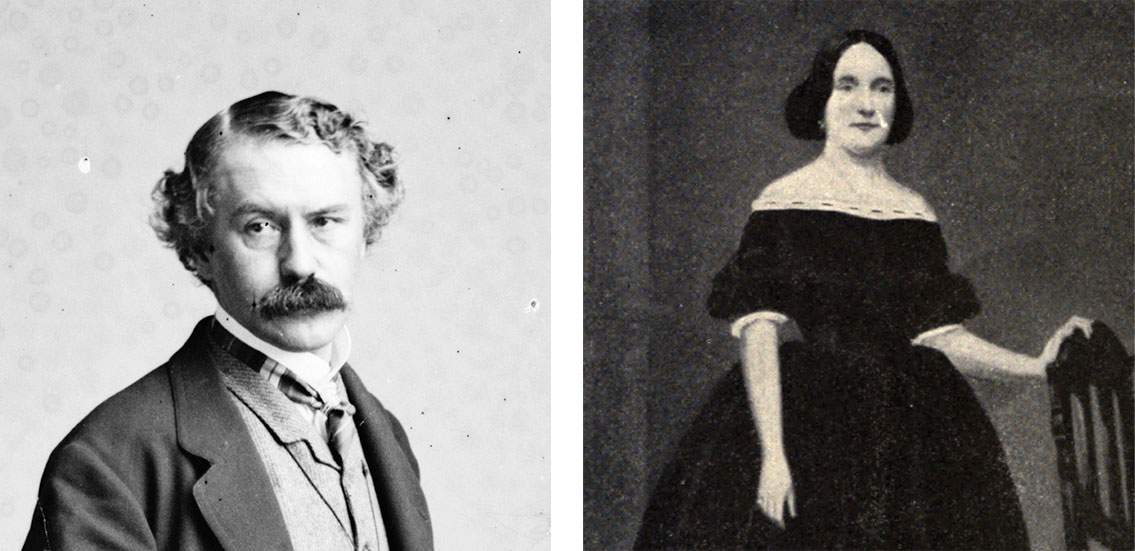
Contemporary evidence reveals minimal interest in what Sibley predicted would become a memorable chapter in the Confederacy’s story. As historian Martin Hardwick Hall noted almost 60 years ago, “Confederate public opinion concerning the New Mexican campaign was confined almost exclusively to the state of Texas. For while Sibley’s small army was engaged in distant New Mexico, the attention of the rest of the nation was held by the spectacle of far larger armies clashing in great bloody conflicts close at home.”8 Three of the most quoted and detailed Confederate civilian accounts—published editions of which comprise nearly 2,500 pages—support Hall’s statement about public interest. John Beauchamp Jones, the clerk in the Confederate War Department whose voluminous diary chronicled myriad aspects of the conflict, devoted not a single sentence to Sibley, New Mexico, or an incipient Confederate empire in the trans-100th-Meridian West. Similarly, renowned southern diarists Mary Chesnut and Catherine Ann Devereux Edmondston, who read newspapers assiduously and commented about a stunning range of people and topics, recorded nothing about Sibley, events along the Rio Grande, gold from Colorado and California, or gaining a Confederate foothold on the Pacific.
 Library of Congress (Strong); A Diary from Dixie (1905) (Chesnut)
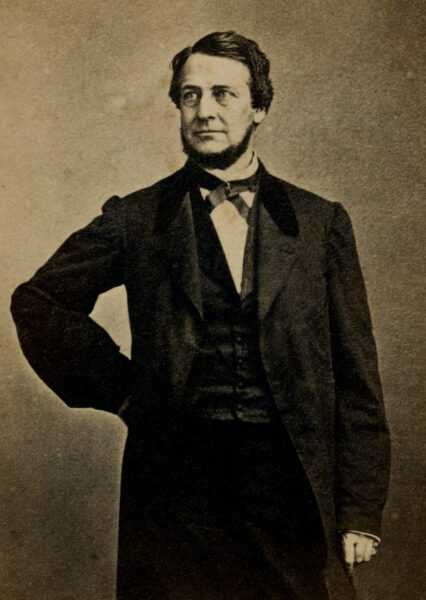
Contrary to Sibley’s prediction that his campaign in New Mexico would become a memorable chapter in the Confederacy’s story, contemporary evidence reveals minimal interest in his activities among prominent easterners, including southern diarist Mary Chesnut (right) and New York lawyer George Templeton Strong (left).
Frequently quoted northern sources are comparably silent. Within the Lincoln administration, the diaries and journals of Secretary of the Navy Gideon Welles and Secretary of the Treasury Salmon P. Chase contain nothing about Sibley’s campaign or fears of Confederate designs on the Southwest. Prominent New York lawyer George Templeton Strong’s diary, which like Chesnut’s and Edmondston’s casts an eye on untold characters and episodes of the war, similarly offers nothing. Perhaps more important, Abraham Lincoln’s first inaugural address and annual messages to Congress in December 1861 and December 1862 convey no sense of concern about Confederate threats to the Southwest. In December 1861, the president affirmed, “So far the authority of the United States has been upheld in all the Territories, as it is hoped it will be in the future.” A year later, he made no allusion to Sibley’s campaign, New Mexico, or Arizona in stating that the “Territories of the United States, with unimportant exceptions, have remained undisturbed by the civil war, and they are exhibiting such evidence of prosperity as justifies an expectation that some of them will soon be in a condition to be organized as States, and be constitutionally admitted to the federal Union.”9
Newspapers in Texas did accord considerable space to Sibley’s campaign, which also garnered sporadic notice from editors in Richmond and New York City. Some papers in Texas, exemplified by an article in Houston’s Telegraph, cheered the idea of conquering New Mexico as “the entering wedge to the breaking off from the United States of all that coast we desire. It is also the opening scene for our manifest destiny.” In contrast, Austin’s State Gazette insisted that the few men deployed in New Mexico would have done better service “somewhere within the bounds of civilization, where the soil is not sand, and water the essence of bitterness, towns hovels in mud, the comforts fleas and rattlesnakes, and the people cayotes.” Texas governor Francis R. Lubbock also shared doubts in a letter to President Davis on May 1. Unless reinforced, remarked Lubbock, Sibley’s troops in New Mexico, “so distant from friends and supplies,” should be withdrawn lest they be “cut to pieces or captured.” Two months earlier, a doctor in Texas had recommended to Davis that Sibley’s regiments could do better service protecting the state’s exposed areas: “I say the sacrifices made by that army & the government might be worth more to the country nearer home, had they have remained on this side of the Wilderness….” Texas needed troops to guard against Indians on the frontier, the doctor urged, and “Arizona & New Mexico would materially increase that frontier.”10
Readers of newspapers in Richmond and New York between February and June 1862 could glean tidbits, sprinkled amid exhaustive coverage of events in Tennessee and Virginia, about activity along the Rio Grande. Richmond’s Daily Dispatch and Enquirer, often reprinting items from Texas newspapers, reported victories at Valverde and Glorieta and the capture of Albuquerque and Santa Fe. A handful of the reports presented Sibley’s movements as contributing to Confederate expansion toward the Pacific, as when the Enquirer’s semi-weekly edition trumpeted “A Cheering Victory in Arizona” on April 15. This article, which incorrectly claimed the capture of Fort Craig, described Valverde as a battle “of more importance to the Southern Confederacy than any that has been fought during the war. It will give us the Territory of Arizona and New Mexico … and will greatly add to the prestige of our arms.” On June 17, long after the campaign had dissolved in chaotic ruin, the Dispatch published a letter signed “A Soldier” summarizing Sibley’s campaign as “the most successful one of modern times” before going on to claim that “Gen. Henry Sibley … will show the enemy west of the Mississippi, that there is a ‘Stonewall’ on both sides of the river.” If the Confederate government reinforced Sibley, this writer claimed, “he would dip the Confederate flag into the Pacific at San Francisco before another year.”11
New York papers printed brief accounts of various stages of the campaign—including Valverde, the Rebels’ withdrawal after Glorieta, and their final departure from the Rio Grande Valley. On September 19, both the Daily Tribune and the Herald ran summaries that stressed Union triumph and incorrectly reported Sibley’s death. Conceding the loss of Albuquerque and Santa Fe for a time and “a temporary success at Valverde” for Sibley, the Herald described a Confederate retreat during which a “great number were killed or wounded, and about one-half the whole force were taken prisoners.” The Daily Tribune asserted Confederate “survivors were so much exasperated that they assassinated Gen. Sibley … during their retreat.” Union forces “took possession of El Paso and Fort Bliss” and, having vanquished the Texans, controlled everything as far as Fort Clark, just more than 100 miles from San Antonio. “Sibley’s brigade was the great effort of Texas, and contained the best fighting material in the whole State,” concluded the Herald. “Great things were expected of it, but it has failed as signally as it deserved.”12
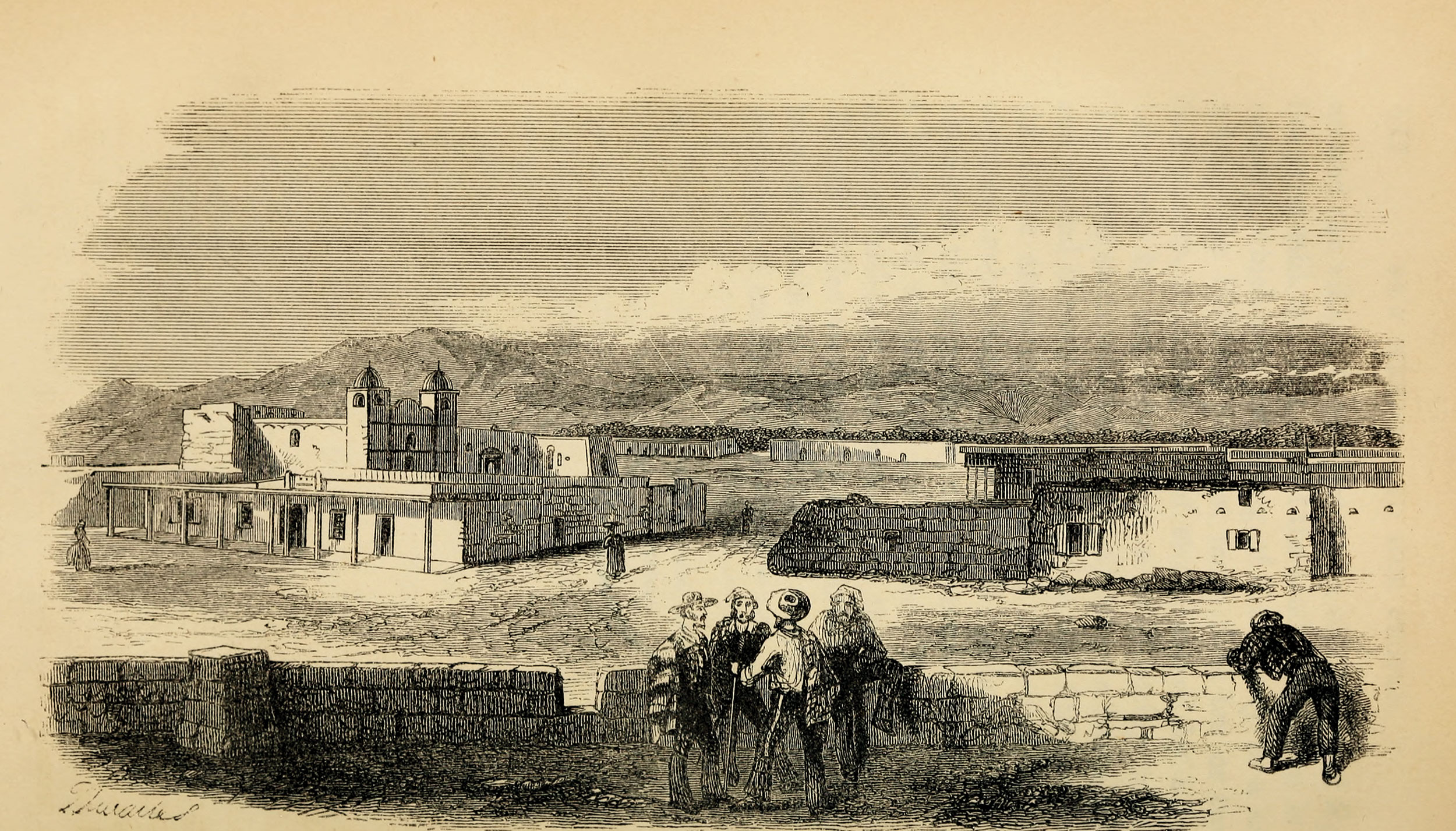 El Gringo; or, New Mexico & Her People (1857)
Readers of eastern newspapers, however, did receive occasional updates on Sibley’s campaign, including the captures of Santa Fe and Albuquerque (pictured above in an 1850s sketch).
A reprinted northern account gave readers of the Daily Dispatch in Richmond their last information about Sibley and his men. “The news from Arizona,” read the text on August 18, 1862, “… states that Gen. Carleton, with the California volunteers, had reached the Rio Grande without opposition. The rebel General Sibley had withdrawn his forces from New Mexico into Texas.”13
The paucity of popular attention to Sibley’s activities when battles of far greater magnitude and strategic importance contended for headlines is not surprising. But how did the campaign figure in Confederate long-term planning? More specifically, did Jefferson Davis, as is often suggested, see it as an important element of an imperial project? Did his indisputable prewar interest in southwestern expansion carry over into the Confederate years?
Davis’ major public statements in 1861–1862 do not mention the territories and states of the Southwest or Far West. His provisional and regular inaugural addresses delivered in February 1861 and February 1862, as well as his messages to the Confederate Congress on April 29, 1861, and February 25, 1862, betray no imperial pretentions. Indeed, his message in April 1861 affirms the stance he typically took—namely, that the Confederacy would “seek no conquest, no aggrandizement, no concession of any kind from the States with which we were lately confederated; all we ask is to be let alone….”14 Moreover, the published Davis papers—10 volumes in the 1923 edition and 14 in the modern edition completed in 2015—do not buttress the idea of a committed Confederate expansionist. Neither does Davis’ two-volume postwar memoir discuss Sibley’s operations in New Mexico.
Davis did issue a proclamation on February 14, 1862, declaring a congressional act “to organize the Territory of Arizona” to be “in full force and operation.” Congress had responded to John R. Baylor’s proclamation of August 1, 1861, establishing the “Territory of Arizona,” which in theory extended westward, below the 34th parallel, from the Texas border through modern-day New Mexico and Arizona to California. Baylor’s excursion had secured a foothold at Mesilla, on the Rio Grande just north of the border with Texas. Confederates never controlled the proclaimed territory, and within a few months of Davis’ declaration Union forces had displaced the few Rebels. In sum, the Confederate territory of Arizona, with its capital at Mesilla, was illusory and the presidential proclamation merely symbolic.15
The documentary skeleton for Sibley’s campaign in the Official Records reveals a modest, and transitory, flirtation with imperial expansion. The key items include Adjutant and Inspector General Samuel Cooper’s communication to Sibley on July 8, 1861, which followed the latter’s meeting with Davis in Richmond. “In view of your recent service in New Mexico and knowledge of that country and the people,” wrote Cooper, “the President has intrusted you with the important duty of driving the Federal troops from that department, at the same time securing all the arms, supplies, and materials of war.” Proceeding to Texas at once, Sibley should, “in concert with Brigadier-General Van Dorn, organize, in the speediest manner possible, from the Texas troops, two full regiments of cavalry and one battery of howitzers, and such other forces as you deem necessary.” If successful in clearing out Union troops, Sibley should, “in the exercise of a sound discretion, proceed to organize a military government within the Territory.” On December 14, 1861, General Orders No. 10, issued from Fort Bliss, announced Sibley’s taking “command of all the forces of the Confederate States on the Rio Grande at and above Fort Quitman and all in the Territory of New Mexico and Arizona.” The Official Records also includes Sibley’s proclamation to New Mexicans and his reports to Cooper on the campaign between February and May. The reports do not lay out an imperial purpose.16
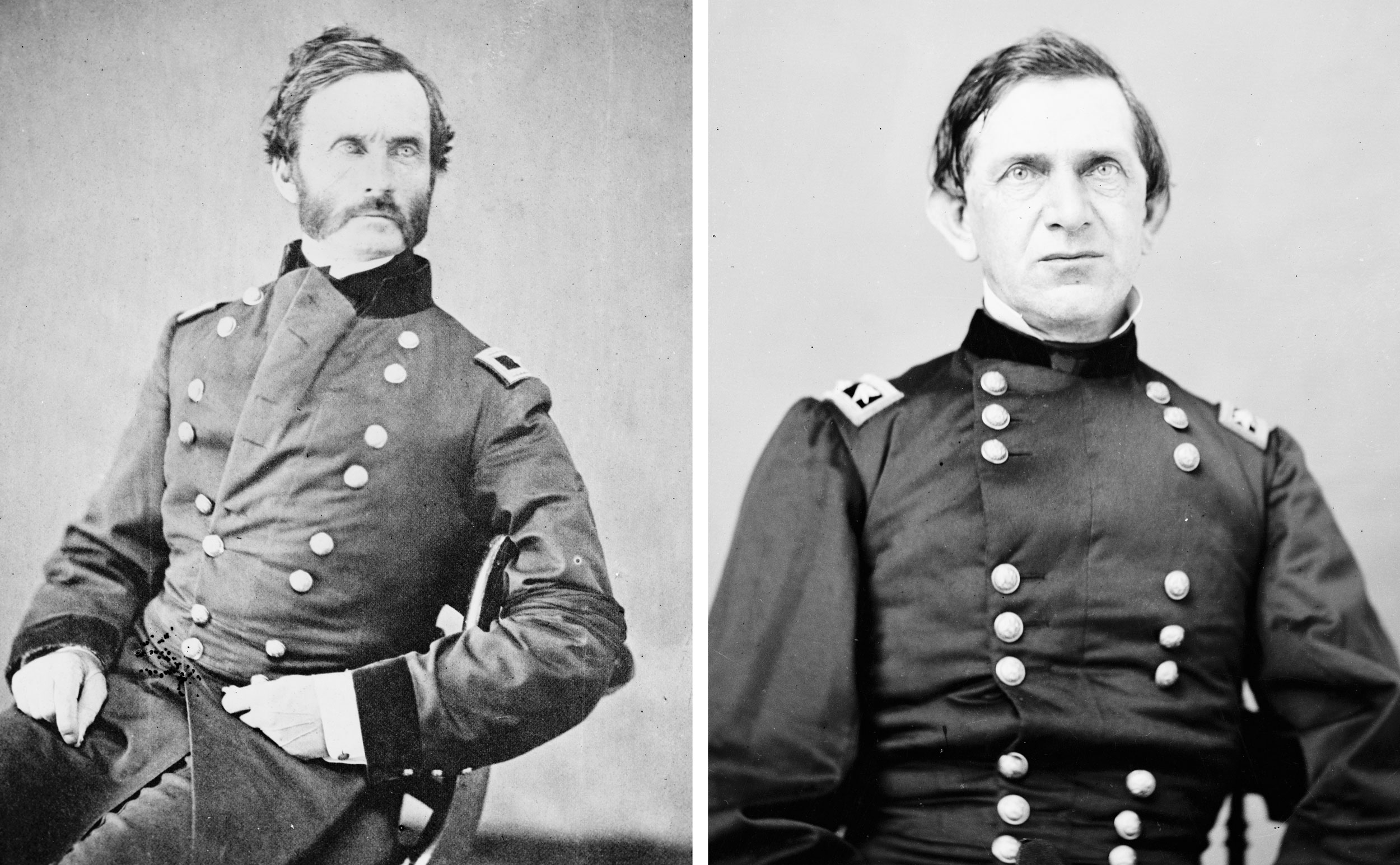 Library of Congress (2)
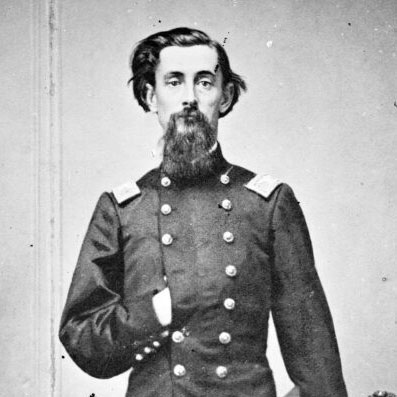
By the late summer of 1862, Union officers on the ground—including Brigadier General James H. Carleton (left) and Brigadier General E.R.S. Canby (right)—knew Confederates posed no real threat in the Southwest. In a letter to Canby in August, Carleton wrote that the former’s successful movements against Sibley “left us nothing to do on the Rio Grande.”
The one direct communication between Davis and Sibley in the Official Records indicates how little support the president committed to the New Mexican adventure. Dated June 7 and written before Davis knew of Sibley’s retreat, it applauded “the distinguished successes of your command” in the face of “the superior number and means of supply of the enemy, and the other difficulties under which you have labored.” Two additional regiments would be coming to Sibley from Texas, stated Davis, who made clear that would be the extent of the government’s contribution. “I trust that you will be able to meet the more immediate and pressing exigencies that may arise,” the president cautioned, “and that your own ability and military resources and the valor of your troops may supply comparative inferiority in numbers and munitions of war.”17
The president’s leaving Sibley to his own devices made sense within the overall strategic situation in early June 1862. Massive threats on multiple fronts directly menaced the existence of the Confederacy. George B. McClellan’s 100,000-man Army of the Potomac had reached the outskirts of Richmond, another 100,000 Union soldiers under Henry W. Halleck had pushed into northern Mississippi and occupied Corinth, and, the day before Davis wrote to Sibley, Memphis had fallen into Federal hands. In contrast to these powerful Union offensives in the western and eastern theaters, whatever might transpire in New Mexico that summer, good or bad, could have had little or no impact on determining Confederate independence.
Anyone seeking to situate Sibley’s campaign within the hierarchy of Confederate national commitments should look to how resources were allocated. Such an examination underscores the marginality of New Mexico and the Southwest. Sibley explained his grandiose goals to Trevanion Teel “just after the former had assumed command of his army”—the conversation around which Teel, whose account is uncorroborated by other testimony, constructed his much-quoted article in Battles and Leaders of the Civil War. According to Teel, Sibley pitched the idea of advancing up the Rio Grande based on his knowledge of Arizona “and of New Mexico; and as to the condition of the United States forces in those Territories, the quantity of Government stores, supplies, transportation, etc.” Sibley assured the president he could raise the requisite troops and arm and supply them from sources in Texas and New Mexico. Davis “authorized him to enlist three regiments in Texas, to constitute a brigade to be mounted and mustered into the service, with such arms as could be obtained in Texas, and, upon arriving in New Mexico, the brigade was to be furnished with arms and equipments out of the supply already captured or that might be captured.” Sibley’s campaign, averred Teel, “was to be self-sustaining.”18
A “self-sustaining” operation by definition requires no commitment of resources from elsewhere. The president’s response to Sibley in the summer of 1861 thus indicates neither deep interest in the Rio Grande Valley nor determination to assert Confederate imperial authority over the greater Southwest. What could have been easier for Davis than to approve a scheme requiring no reallocation of existing military assets? His signing off on the campaign meant only that Sibley was free to recruit a few regiments in Texas, arm and provision them, and do what he could in New Mexico.
It was Teel’s retrospective piece, rather than anything from Jefferson Davis’ wartime or postwar testimony, that laid out a blueprint for Confederate empire. Teel related a fantastic scenario: “[A]s soon as the Confederate army should occupy the Territory of New Mexico, an army of advance would be organized, and ‘On to San Francisco’ would be the watchword; California had to be conquered, so that there would be an outlet for slavery … which would greatly strengthen the Confederate States.” If successful in occupying California, New Mexico, and Arizona, Sibley, in Teel’s telling, envisioned opening “negotiations to secure Chihuahua, Sonora, and Lower California, either by purchase or by conquest….”19
Sibley’s biographer, while admitting the “seizure of California was not specifically mentioned” in his orders, nonetheless expresses “little doubt that it was the eventual objective of the impending campaign.” Other scholars have relied on Teel to clinch a point about Confederate imperial aspirations—or supplemented Teel with Latham Anderson’s assertion that the entire Southwest and Far West were in play during Sibley’s maneuvering along the Rio Grande. Because of California’s vulnerability, insisted Anderson, “and of the momentous consequences of its capture by the Confederates, the conflict in New Mexico should be regarded as one of the decisive campaigns of the war.”20
By the late summer of 1862, Union officers on the ground knew Confederates posed no real threat in the Southwest—never mind in the Far West. Brigadier General James H. Carleton, who had led the “California Column” from Fort Yuma across the fictive Confederate territory of Arizona to the Rio Grande, made this point in a letter to Brigadier General E.R.S. Canby, the Union commander in New Mexico. Dated August 2, it explained that Carleton’s small force, composed of the 1st California Infantry, five companies of the 1st California Cavalry, and four guns of Company A, 3rd U.S. Artillery, had been ordered to “cross the Yuma and Colorado Deserts, and recapture the posts in Arizona and Southern New Mexico, then supposed to be in the hands of the rebels, and open the Southern Overland Mail Route.” By the time the column approached New Mexico in early August, having encountered a few Indians at Apache Pass and elsewhere but no Confederate military force of note, Carleton discovered that Canby’s successful movements against Sibley “left us nothing to do on the Rio Grande.”21
The absence of a Confederate military presence in New Mexico distressed Carleton. “[T]he marches of this column,” he stated, “tend always toward the heart of the rebellion; the men will forget their toils and sufferings on the Great Desert in their hope ultimately to reach the enemy…. [I]t would be a sad disappointment to those from California if they should be obliged to retrace their steps without feeling the enemy.” Because New Mexico offered no Rebel target, Carleton proposed taking the war into the Confederacy. “I hope I do not ask too much,” he wrote, “when I inquire whether a force could not profitably be thrown into Western Texas, where it is reported the Union men are only waiting for a little help to run up the old flag.” Carleton soon replaced Canby as head of the Department of New Mexico, set up headquarters in Santa Fe, and spent most of his ensuing time in the region dealing with Native Americans rather than Rebels.22
Back in Washington, officials in the War Department exhibited comparable assurance that Sibley’s fiasco left New Mexico and the Southwest safely under Union control. In his 19-page annual report to Congress in early December, Secretary of War Edwin M. Stanton dealt with events along the Rio Grande in one sentence. “The rebels under Sibley were driven from the department of New Mexico by General Canby,” his matter-of-fact recounting read, “and the force in that department, now under command of General Carleton, will be able to protect the inhabitants of that remote territory.” As for the Far West, Stanton declared, “The department of the Pacific has been free from any of the calamities occasioned by the rebellion….”23
Andrew E. Masich’s recent study, titled Civil War in the Southwest Borderlands, 1861–1867, observes that “Jefferson Davis never had great confidence in the scheme for a Confederate empire in the Far West” and “dedicated little financial support and manpower” to Sibley’s effort. Yet “the invasion of New Mexico and Arizona did serve to divert significant federal resources that relieved pressure in other theaters.”24 It is incontestable that only the most modest amount of Confederate “blood and treasure” had been expended along the Rio Grande—though that phrase, whether deployed by Sibley or by later historians, sets a nice melodramatic tone. The United States, however, did not divert substantial resources to deal with Sibley. Canby commanded approximately 5,000 Union troops in New Mexico in early 1862—1,500 of them regulars. Reinforcements sent to arrest Sibley’s advance included more than 900 Colorado volunteers, who played a key role at Glorieta, and the California Column, which numbered just fewer than 1,300 when it approached Messila. Without Sibley’s presence along the Rio Grande in 1862, the large majority of those troops would not have been deployed to any of the hotly contested theaters farther east.
Something about Sibley’s campaign leads to fanciful comparisons and extravagant musings about what might have been. Glorieta Pass often has been labeled the “Gettysburg of the West.” Two books carry that phrase as their subtitle—including one whose authors, somewhat confusingly but to their credit, assure readers that they “reject the phrases ‘Battle that saved the West’ and ‘Gettysburg of the West.’” No one at the time or since, it seems safe to say, described Gettysburg as the “Glorieta of the East.” Even careful scholars fall into the trap of mentioning highly improbable outcomes. In this vein, Thomas W. Cutrer’s Empire of Sand: The Struggle for the Southwest, 1862, closes its exploration of Sibley’s campaign with the comment that available Federal troops “likely would have stopped the Confederates and pushed them back” even if Forts Craig and Union had fallen. Rather than leave readers with that point, Cutrer speculates that had invading Texans been able “to accomplish Sibley’s grandiose vision of crossing the deserts of Arizona and California and reaching San Diego and Los Angeles, the American Civil War might well have had a different outcome.”25
In reality, Sibley’s campaign had no potential to shift the Civil War’s trajectory toward a different outcome. Many Confederates, Jefferson Davis among them, would have welcomed acquisition of New Mexico, Arizona, southern California, Colorado, and parts of northern Mexico, together with the attendant mineral wealth and commercial possibilities. But such expansionist calculations always remained tangential, if not irrelevant, as Davis and others performed the hard task of determining strategic goals and allocating limited human and material resources in a life-or-death struggle to establish a nation. Overwhelmingly, the Confederacy expended its blood and treasure, to revisit that phrase one last time, far to the east of the 100th Meridian. Anyone at the time gazing eastward from Arizona or New Mexico would have known they stood well beyond the boundaries of the real conflict, the one that would decide the fate of the rebellion and, profoundly shaped by which side prevailed, the long-term future of the Southwest and Far West.
Gary W. Gallagher is the Nau Professor of History emeritus at the University of Virginia. The author or editor of more than 40 books, he most recently co-edited, with J. Matthew Gallman, Civil War Places: Seeing the Conflict through the Eyes of Its Leading Historians (University of North Carolina Press, 2019), and co-authored, with Joan Waugh, The American War: A History of the Civil War Era (revised edition, Flip Learning, forthcoming 2019).
Notes
1. Donald S. Frazier, Blood & Treasure: Confederate Empire in the Southwest (College Station, 1995), 22, 5, 298, 300–301.
2. Kevin Waite, “Jefferson Davis and Proslavery Visions of Empire in the Far West,” The Journal of the Civil War Era 6 (December 2016): 554–556.
3. Megan Kate Nelson, “Death in the Distance: Confederate Manifest Destiny and the Campaign for New Mexico, 1861-1862,” in Adam Arenson and Andrew R. Graybill, eds., Civil War Wests: Testing the Limits of the United States (Oakland, 2015), 36–37, 45.
4. Steven Hahn, A Nation Without Borders: The United States and Its World in an Age of Civil Wars, 1830–1910 (New York, 2016), 236–237, 266.
5. “The Battle of Glorieta Pass, A Shattered Dream,” National Park Service website, nps.gov/nr/twhp/wwwlps/lessons/91glorieta/91glorieta.htm, accessed November 19, 2019.
6. U.S. War Department, The War of the Rebellion: The Official Records of the Union and Confederate Armies, 127 vols. (Washington, 1880–1901), ser. 1, vol. 4:63-65, 89 (hereafter cited as OR; all references are to ser. 1); Frazier, Blood & Treasure, 54; Thomas S. Edrington and John Taylor, The Battle of Glorieta Pass: A Gettysburg in the West, March 26–28, 1862 (Albuquerque, 1998), 15.
7. Ibid., vol. 9:511–512; Theophilus Noel, A Campaign from Santa Fe to the Mississippi; Being a History of the Old Sibley Brigade (1865; reprint, Raleigh, 1961), 38–39.
8. Martin Hardwick Hall, Sibley’s New Mexico Campaign (Austin, 1960), 214.
9. Abraham Lincoln, Collected Works of Abraham Lincoln, ed. Roy P. Basler, 9 vols. (New Brunswick, 1953-55), 5:46–47, 521.
10. Hall, Sibley’s New Mexico Campaign, 215–217; Jefferson Davis, The Papers of Jefferson Davis, ed. Lynda L. Crist and others, 14 vols. (Baton Rouge, 1971–2015), 8:83–84, 84n6.
11. Richmond Enquirer (semi-weekly edition), April 15, 1862; Richmond Dispatch, June 17, 1862. See also the Enquirer (semi-weekly edition), March 4, April 8, 1862; the Dispatch, March 22, May 30, 1862; and the Daily Dispatch, April 16, May 31, July 12, 1862.
12. New-York Daily Tribune, September 19, 1862; New York Herald, September 19, 1862. See also the Daily Tribune, March 14, 18, 26, April 14, 24, June 9, 1862; and the Herald, March 9, 10, April 4, 26, 1862.
13. Richmond Daily Dispatch, August 18, 1862.
14. Dunbar Rowland, ed., Jefferson Davis Constitutionalist: His Life and Letters, 10 vols. (Jackson, 1923), 5:84.
15. James D. Richardson, ed., The Messages and Papers of Jefferson Davis and the Confederacy, Including Diplomatic Correspondence, 1861–1865, 2nd ed. with introduction by Allan Nevins, 2 vols. (New York, 1966), 1:167. Baylor’s proclamation is in OR, vol. 4:20–21.
16. OR, vol. 4:93, 157. For the reports, see OR, vol. 9:540–541, 507–512.
17. Ibid., vol. 9:717–718.
18. T.T. Teel, “Sibley’s New Mexico Campaign.—Its Objects and the Causes of Its Failure,” in Robert Underwood Johnson and Clarence Clough Buel, eds., Battles and Leaders of the Civil War, 4 vols. (New York, 1887–88), 2:700 (hereafter cited as B&L).
19. Ibid.
20. Jerry Thompson, Henry Hopkins Sibley: Confederate General of the West (Natchitoches, 1987), 219; Latham Anderson, “Canby’s Services in the New Mexican Campaign,” in B&L, 2:698.
21. OR, vol. 9:557–559.
22. Ibid., 559.
23. Edwin M. Stanton, “Report of the Secretary of War,” in U.S. House of Representatives, 37th Congress, 3d Session, Executive Document No. 1, Message of the President of the United States to the Two Houses of Congress at the Commencement of the Third Session of the Thirty-Seventh Congress, vol. 4 (Washington, 1862), 7 (report dated December 1, 1862).
24. Andrew E. Masich, Civil War in the Southwest Borderlands, 1861–1867 (Norman, 2017), 110.
25. Edrington and Taylor, Battle of Glorieta Pass: A Gettysburg in the West, 114; Thomas W. Cutrer, Empire of Sand: The Struggle for the Southwest, 1862 (Buffalo Gap, 2015), 114. See also Robert Scott, Glory, Glory, Glorieta: The Gettysburg of the West (Boulder, 1992), and the chapter titled “Gettysburg of the West” in Alvin M. Josephy Jr., The Civil War in the American West (New York, 1991).