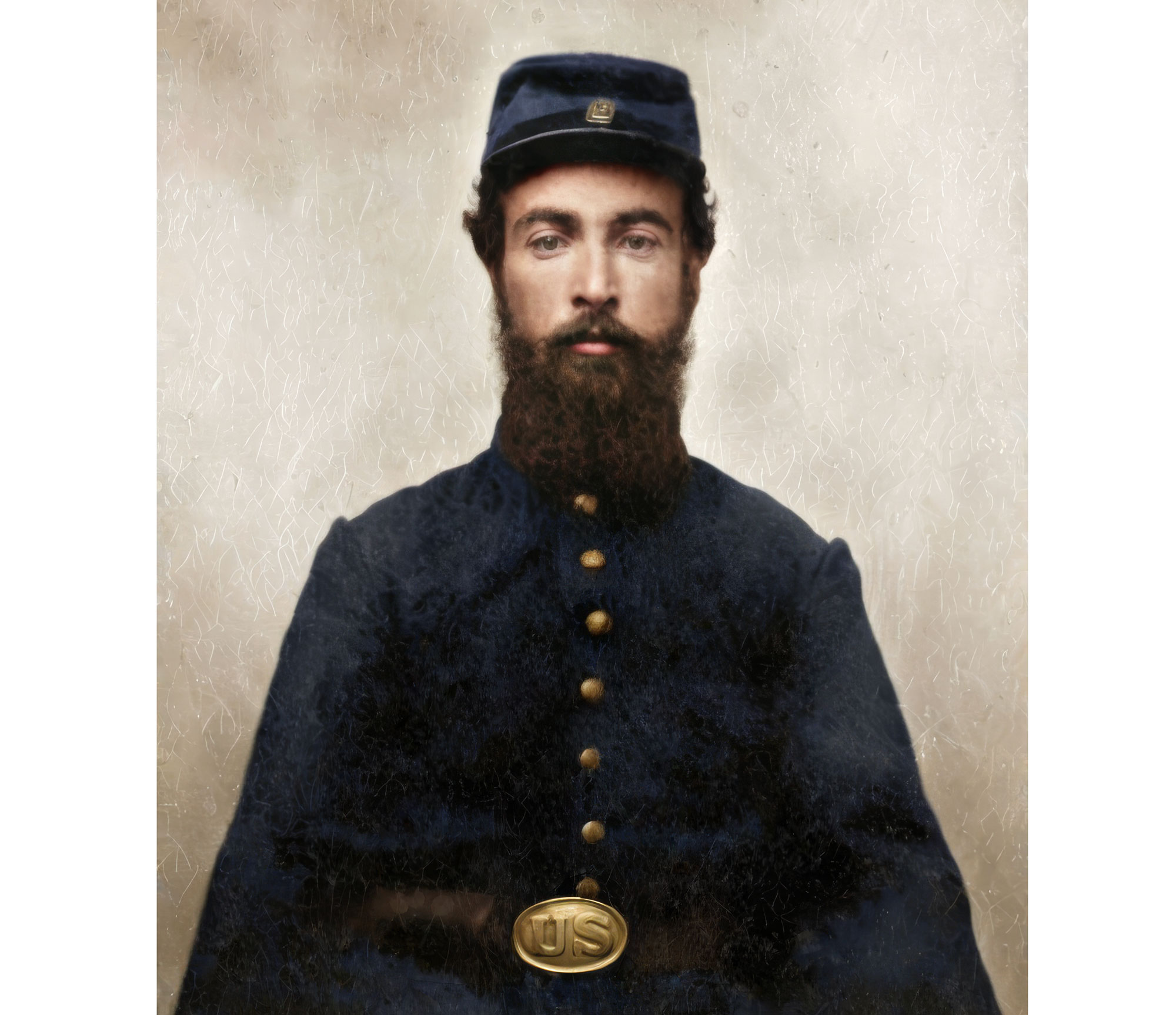
 Harlan Paige Papers, Silver Special Collections, University of Vermont (colorized by Patrick Brennan)
Harlan Paige, 4th Vermont Infantry
Harlan Paige arrived in Washington on September 24, 1861, fresh from his family’s farm near the town of Barnard, in the green hills of eastern Vermont. At 22, he enlisted as a private in the 4th Vermont Infantry, which was brigaded with the state’s 2nd, 3rd, 5th, and 6th regiments in what was soon dubbed the Vermont Brigade, commanded by William F. “Baldy” Smith. It would become well known as one of the most dependable, hard-fighting units in the Army of the Potomac.
The son of a church deacon and farmer, Paige was accustomed to manual labor on Vermont’s rugged soil and adapted easily to army life. Hardy, good-natured, and patriotic, he rarely complained of the rigors of campaigning and was sustained through some of the war’s bloodiest battles by an almost mystical conviction that he would survive. Highly literate, he wrote regularly and vividly to his younger brother Asa, his fiancee, Carlin Elizabeth Moulton, and other family members and friends. His letters, never before published, eloquently chronicle his evolution from a callow farm boy into a tough veteran soldier.
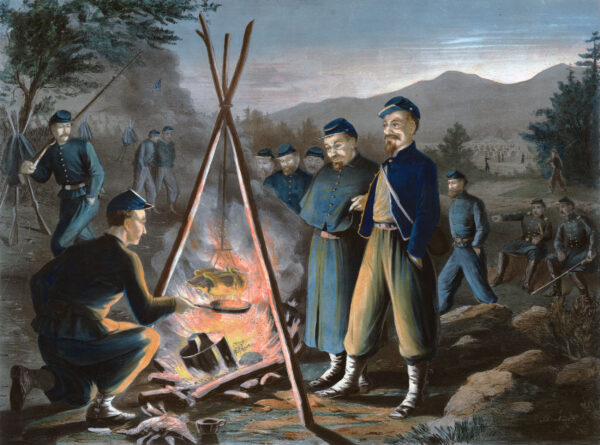
The 4th Vermont was initially billeted near Chain Bridge, one of the strategic crossings of the Potomac River into Virginia. “Although it is Sunday,” Paige wrote home, “it seems very much like the Fourth of July; the band is playing and companies are marching; men are at work on all sorts of business. I am well and think this life will agree with me. Still, I would not have any suppose that I like to be fooling about doing nothing, as we are, for I am here to work.”1 Like most volunteers in the war’s early months, Paige expressed confidence that the war would be brief. “We are in plain sight of old Virginia, and all I want is a word to send us over there pell mell,” he wrote cockily, on September 24. Six weeks later, he still remained buoyant. “I think the war will be pushed forward with the greatest possible vigor now and be closed up soon.”2
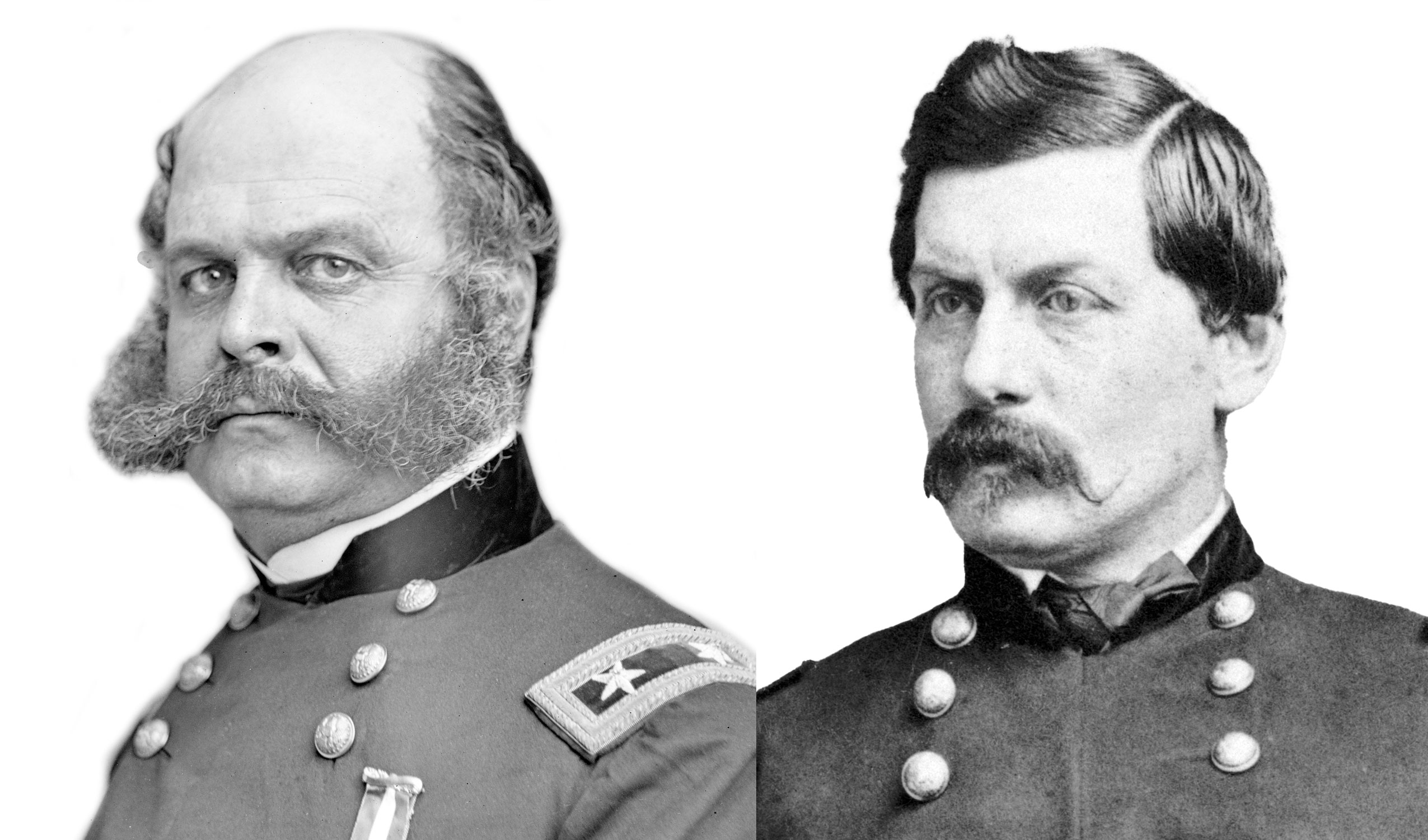 Library of Congress (McClellan), National Portrait Gallery
Ambrose Burnside (left) and George B. McClellan
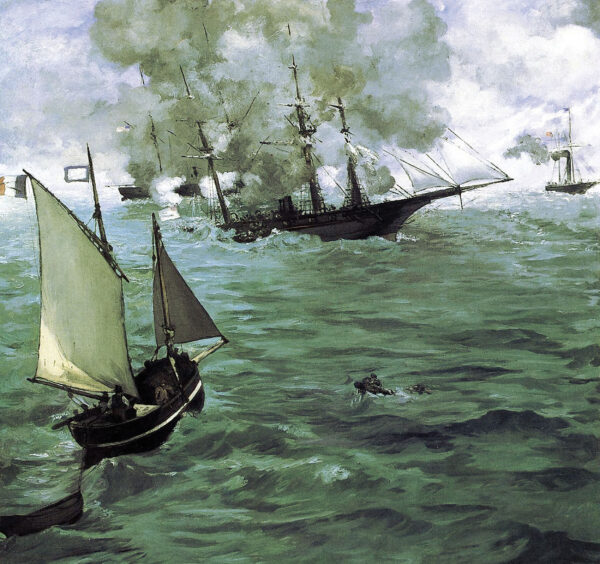
The months passed slowly. With little else to write about, Paige reported on his health (generally good except for a bout of dysentery), his occasional battles with the “white horse cavalry” (that is, lice), and his receipt of boxes from home.3 Paige fretted that the war would end before he even saw a battle. In March 1862, he finally got his wish when the Vermont Brigade moved south as part of William B. Franklin’s newly formed VI Corps to join the 120,000 soldiers mobilized for George B. McClellan’s Peninsula Campaign against Richmond. (En route, at Fortress Monroe, Paige saw “the little iron gun-boat, Monitor, which gave the rebel Merrimac so good a service. It looked like a little mud scow among the many large vessels around.”4) He had his first taste of battle on April 16, near Yorktown, where the Vermont Brigade “had a little squabble with Secesh.” He lightly reassured Asa, “I am not scratched, though I thought I heard humming birds”—that is, bullets—flying past his ears.5 At Williamsburg, he was again close enough to the action to hear “the whizzing of shot and shell, the popping of muskets and the yells of the men, as they made several charges.”6 Afterward, he saw the debris of battle for the first time: “the road was strewn with wagons, horses, mules, quartermasters’ stores, parts of cannon, and all sorts of camp equipage. Everything spoiled, of course, especially the horses and mules, which were smelling nicely.”7
By May 27, the 4th Vermont was camped 8 miles from Richmond. Paige brightly quipped, “I would like to go over to Richmond and take dinner some day, but we are not allowed so far from camp yet.”8 He wasn’t alone in wondering why the army was moving so slowly when it was close enough to the Confederate capital to hear church bells ringing. “[S]till it is better to move slow and sure than to move fast and make bad mistakes. I think McClellan is doing nobly and, if let alone, will do the work before him to the satisfaction of all concerned.”9
In fact, McClellan’s hapless campaign had already passed its high-water mark. He was forced by repeated Confederate jabs at Mechanicsville, Gaines’ Mill, Savage’s Station, White Oak Swamp, Glendale, and Malvern Hill to back away from Richmond. By July 10, to Paige’s puzzlement, the army had retreated to the James River. He reported, “I certainly can’t see the need of falling back…. [W]e took our time and whipped the scoundrels in every battle.” But he remained irrationally hopeful. “We are now near Harrison’s Landing. We have any amount of boats here, and I hope some move will be made to prove that our retreat was not made merely to save our bacon.”10
In truth, of course, McClellan’s campaign had been a strategic failure. In the following weeks, a note of discouragement began to surface in Paige’s correspondence. On July 26, he confessed to Carlin, “Many hours, too, the soldier passes in solitude, his mind far away among his friends, where he himself would soon be, could he be free to do as he chose. But can we gain a lasting and honorable peace, I, for one, will never regret the inconvenience and privations incident to a soldier’s life. But what is the use of talking of war, and things we cannot prevent?”11 More caustically, he wrote to Asa, “What this war is agoing to amount to, I don’t know, nor care much. I am getting sick of it, and would be glad were I never to see or hear another sight or sound of war.”12 By the end of August the Vermont Brigade was back at Alexandria, which it had left armed with high hopes in the spring. To Carlin, he groused, “Quite a tour we have had, exploring the Chickahominy and other places on the Peninsula. I don’t know, or care, what is to be done now, hope [the generals] will drive their team to suit them.”13
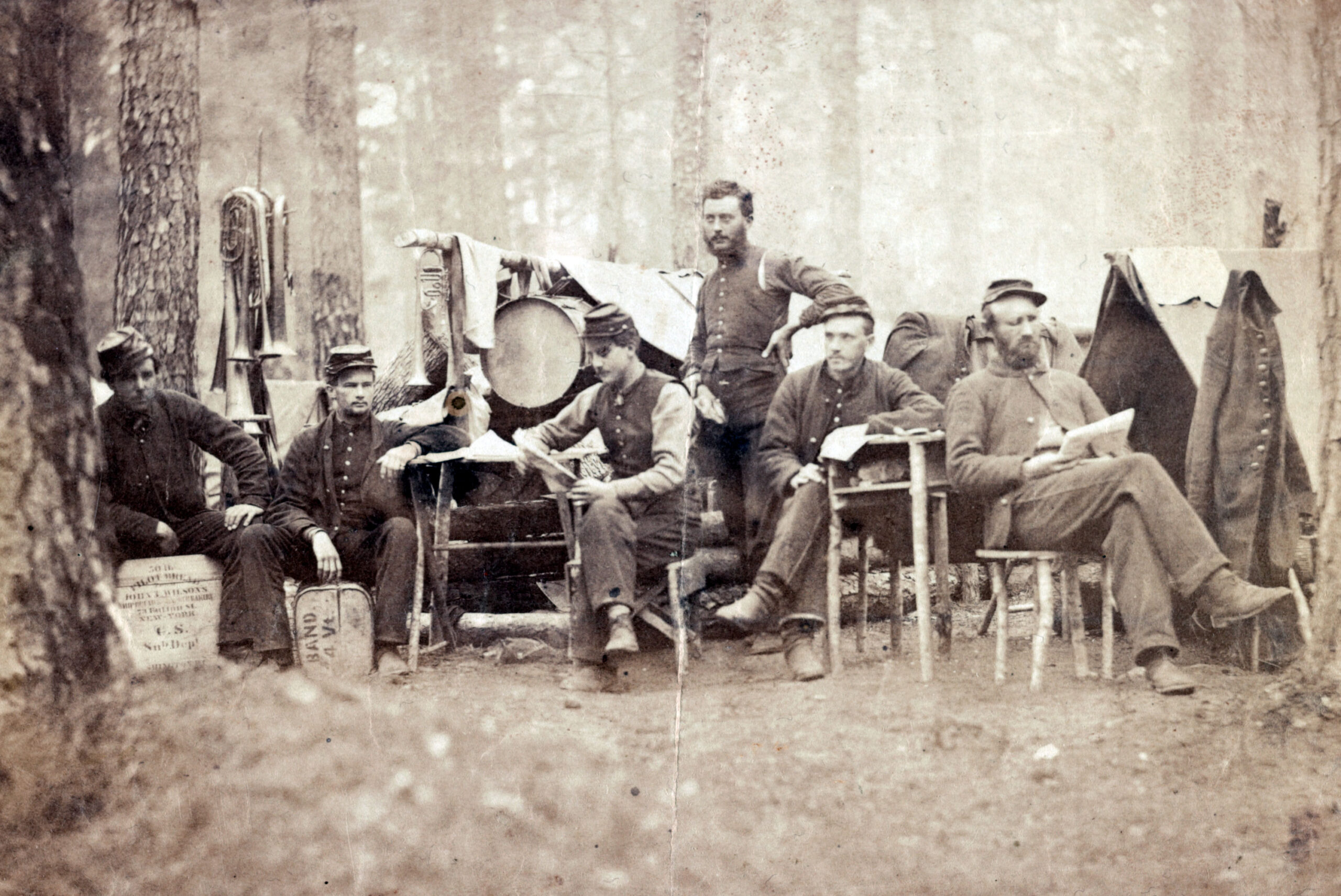 Library of Congress
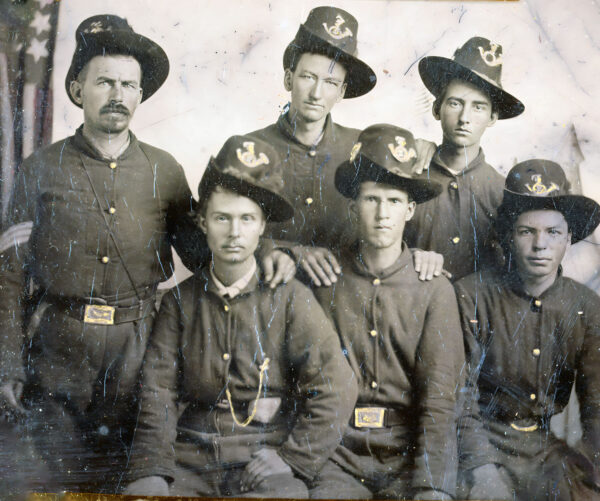
 As with many wartime volunteers, Harlan Paige’s first months in the army went smoothly and without incident. “[I]t seems very much like the Fourth of July; the band is playing and companies are marching…. I am well and think this life will agree with me,” he wrote home shortly after arriving in Virginia with the 4th Vermont Infantry. Above: Members of the 4th Vermont’s band.
Although some units of the Army of the Potomac arrived in northern Virginia in time to take part in Second Bull Run, the VI Corps was not among them in that Union defeat. However, the Vermont Brigade soon saw enough action during the Maryland Campaign to make up for what they had missed. On September 20, 1862, Paige reported to presumably worried friends in Boston, “I scratch a few words to let you know that I survived two battles.”14 On September 14, the Vermonters overran the Confederate lines to seize Crampton’s Gap at South Mountain, taking 75 prisoners and the colors of the 16th Virginia Infantry. Three days later, in the charnel house of Antietam, the brigade was held in reserve in a cornfield near the Piper farm, but it was no picnic. “We marched through a piece of corn, with a small rise of ground between us and secesh,” Paige wrote to Asa. “We threw out skirmishers, on the top of the rise, and were then ordered to lie down. Cannonading and infantry firing was kept up that day, and ceased only with the shades of evening, when the groans of the wounded only disturbed the quiet of the night. The next morning all was gone in the shape of rebs. We then took a view of the field, which was strewn with dead and wounded; the dead very much swollen and black. Everywhere fences were torn down, houses shattered and burned, horses and man—parts of cais[s]ons stove up all in confusion. We then left the field, which I hope is the last I ever shall see of that kind.”15
By November, the Lincoln administration had finally lost patience with McClellan, whose dilatory behavior had repeatedly hobbled his army and was felt to have cost it a more decisive victory at Antietam. To replace him, the president selected the reluctant Ambrose Burnside, commander of the IX Corps, who had performed well as a subordinate but doubted his ability to lead the entire army. Even after his dismissal, “Little Mac” remained widely popular with ordinary soldiers, including Paige. To Carlin, Paige grumbled, “Was not McClellan all we could ask for in a leader? Ask the soldiers of the Army of the Potomac where their confidence is. Their answer will be, ‘In God and McClellan.’” Recently promoted to sergeant, Paige blamed McClellan’s removal on the unfriendly northern press. Writing to Asa from “Camp Desolation, in the cursed wilderness of Virginia,” he furiously declared, “All those miserable newspapers are good for is to keep soldier’s friends in anxiety, and to ruin Geo. B. McClellan, the best general our army ever had. Oh! I could shoot some of those editors, with a relish, and ’twould be a blessing to the country, too.”16
Barely a week later, on December 13, Burnside led the army to disaster in what Paige caustically described as “the grand squeegee” at Fredericksburg.17 The 4th Vermont lost some 50 men killed and wounded as they fought in support of John Gibbon’s division at the so-called “Slaughter Pen,” on the southern part of the battlefield. On December 18, Paige wrote to Asa: “I had the best chance for a view that I have ever had; that is, the nearest to ’em. We had a reb battery in front of where our company was skirmishing, and Co. B of the 4th, got a charge of cannister from it which killed two and wounded eighteen; pretty good shot that! But our batteries kept playing on them, and soon blew up a caisson for them (which made the third blown up that day) and we boys played the Minnies to them and soon had the satisfaction of seeing the cannoneers skedaddle.” Paige emerged from the battle unscathed. The army as a whole was less fortunate, losing twice as many men as the enemy in its worst defeat of the war. Paige added gloomily, “Give us little Mack again is all I ask, and that is the cry generally among the soldiers here.”18
The winter’s chill only added to Paige’s discouragement, a feeling he shared with the rest of the army. “The nights are cold enough to freeze the feathers off a cast-iron chicken,” he told Asa.19 His depression grew after Burnside’s attempted offensive in January—the hapless “Mud March”—was derailed by days of heavy rain. “Well, the whole thing made a charge on a mud-hole and we carried everything before us,” he complained to a friend. “But you ought to have seen the mud fly, ha! Wasn’t it fun? No sir, I reckon not!”20
In May 1863, Paige was on furlough in Vermont during the Chancellorsville Campaign, where the Vermont Brigade saw fierce action in the capture of Marye’s Heights and then at Salem Church. In July, at Gettysburg, the brigade was held in reserve at the extreme left of the Federal line. The Union triumph renewed Paige’s hope that the war’s end might actually be at hand after all. “The rebels were well whipped, and if the reports [of the fall of Vicksburg] are correct, the rebellion is near an end,” he wrote excitedly to Carlin on July 8.21 Two days later, the Vermont Brigade found itself in fierce, if little-remembered, combat, at Funkstown, Maryland, where it bravely fended off a spirited Confederate attack by George T. Anderson’s Virginians, in the last blood shed before the Army of Northern Virginia slipped back across the Potomac River into Virginia. Paige wrote to Carlin, “We found the rebels plenty, but gave them better than they sent,” losing two men killed and about twenty wounded.22 To Asa he added a few days later, with what amounted to a verbal shrug, “I suppose we shall start for Richmond again, very soon and, as it is the third time, I hope it may be the last and I think it will.”23
While the Army of the Potomac rested and refitted, in mid-July New York City exploded in bloody riots against the new federal military draft. For five days, mobs of working men and women, many of them Irish, battled city policemen and a handful of soldiers, attacking the homes of abolitionists and prominent Republicans, and murdering at least a dozen black civilians. Approximately 500 New Yorkers may have died before the turmoil was finally quelled by veteran troops hurriedly dispatched from the Army of the Potomac. The 4th Vermont was among the units sent “to keep order among the miserable foreigners,” as Paige put it in a letter to Carlin, on September 7.24 (Betraying a nativist streak not uncommon among New England Yankees, Paige later wrote to Asa, on December 19, “I wouldn’t care if those N.Y. Paddies could be put to sea in a leaky boat; I think the country would be well off.”)25
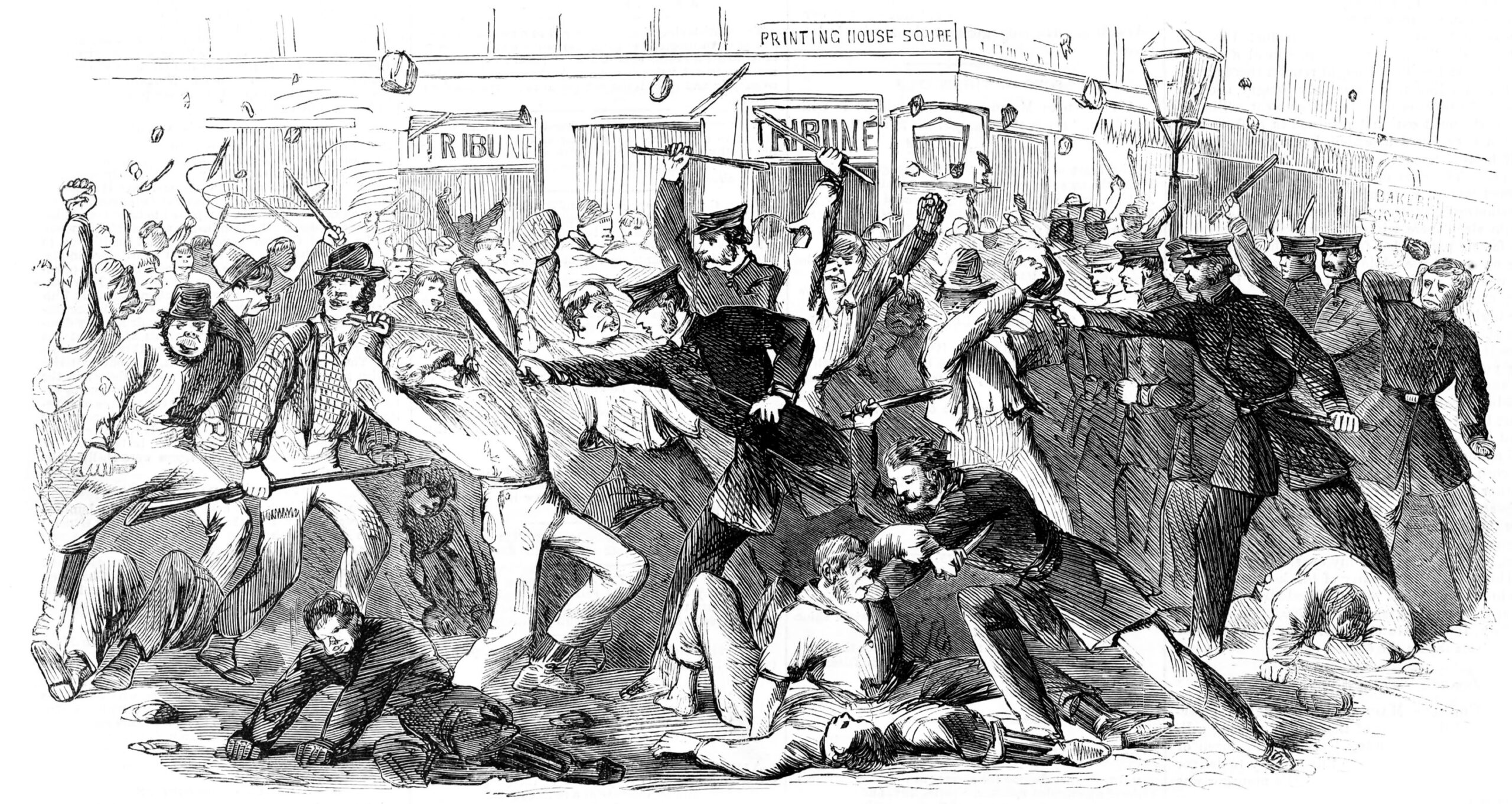 Harper’s Weekly
Not long after taking part in the Union victory at Gettysburg, Paige and the 4th Vermont were among the troops dispatched to New York City to aid in quelling violent riots (depicted above in an illustration from Harper’s Weekly) that had broken out protesting the federal military draft.
Paige’s brief tour of duty in Manhattan was a welcome holiday from campaigning. The Vermonters were billeted in Washington Square Park, in the heart of Greenwich Village. “There is quite a difference, soldiering in the wilderness of Virginia, and soldiering in the heart of New York City; I think I prefer the latter,” Paige wrote dryly to Asa, on August 24. “Were on the boat three days and nights; I was not much sea-sick, though there were a great many of the boys who raised things at a terrible rate. We arrived here last Friday and have been having a very good time ever since. If I could get a short furlough, you would see me over in Boston some morning, but that I cannot do. But perhaps you might contrive to get up a little riot, and get us ordered over there.” Grateful New Yorkers brought the Vermonters books, papers, religious tracts, and foodstuffs. “All sorts of people are in here to see us, for old troops from the field are something like a menagerie, everyone wants to see how they look,” he wrote to Carlin on the 29th. “Then we have music plenty, of all kinds; hand organs, violins, harps, accordions, and all sorts of instruments are made to squeak from morning till night.”26 To Asa, he dryly added, the regiment also enjoyed “the amount of feminines in the park, who style themselves ladies, though I reckon there is some doubt about it.”27
In the autumn, Paige and the 4th Vermont returned to Virginia. They spent weeks marching and countermarching to little effect as the Army of the Potomac jockeyed with Robert E. Lee’s Confederates for advantage across the region. The Vermonters eventually settled with resignation into winter quarters at Brandy Station. “This makes the sixth time this brigade has crossed to the south side of the Rappahannock.” Paige added, with an almost audible sigh, “What more is to be done, I don’t know.”28
The Union’s ranks were sorely depleted. Draft evasion was widespread, and desertions on the rise. With the three-year enlistments of Paige and the rest of the Vermont Brigade—as well as scores of other regiments—due to expire in 1864, official pressure built on veteran units to reenlist. States, counties, and towns were offering generous bounties. But Paige declared to all and sundry that once his term expired he was done with soldiering. To Carlin, he asserted, “Money never hired me to go into the army, and never will. They may pile greenbacks as high as a mountain but it will not tempt me, for money should not tempt men to risk their lives. This is my last winter in Dixie.”29 To Asa, he wrote on November 15, “The big bugs at home, and here too, are trying to get us to reenlist, but it is a long day hence that will see my name on their papers. I do not wish you to think that I am losing my patriotism, or that I am sorry in the least that I came out here, but I do curse the dastardly hounds”—presumably politicians—“who are making capital out of our misery and sufferings, and are still trying to keep us in the field.”30
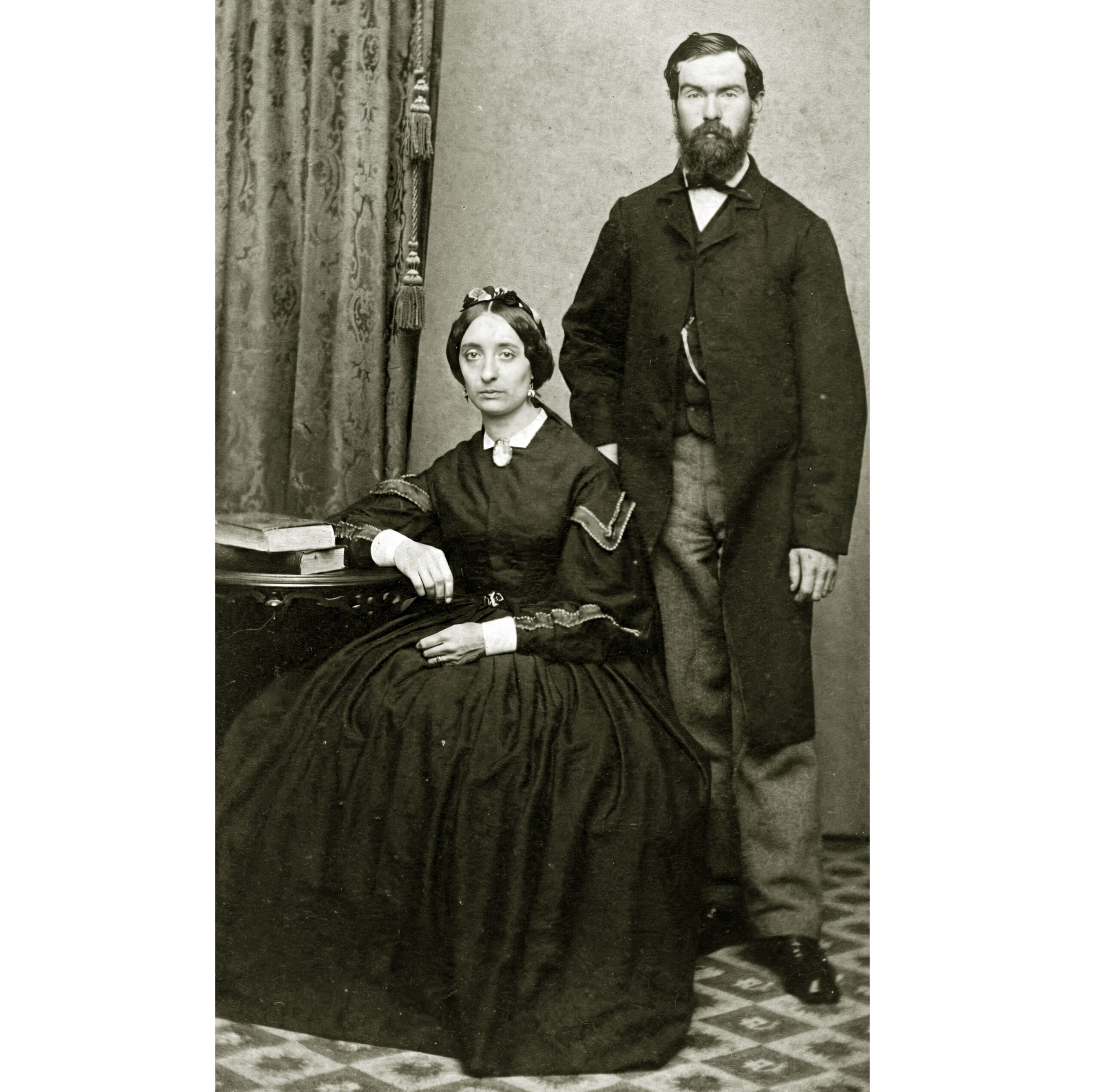 Harlan Paige Papers, Silver Special Collections, University of Vermont
Paige was adamant that his younger brother Asa (pictured above with his wife) stay out of the army. In March 1864, he wrote Asa, “I will do the fighting for us both…. I never want to see you in the service, and never will, so long as I can keep you out.”
On December 19, in a letter to Asa, he added, “I guess the reenlisting of this regiment will pretty much fall through; it is a regular pack of nonsense anyway and only makes a bother. Yesterday the boys had a chance to witness an affair that will encourage them to enlist greatly. Two men were executed, by shooting in our Brigade; Blowers, of Co. A, 2nd Vt., and Tague, of Co. A, 5th Vt., both for desertion. The ceremony was performed in the usual way; the men rode in ambulances, on their coffins, to the place of execution. Reaching the place, the coffins were placed at the ends of their graves, and the men came forward, took off their hats, received their sentence, then went back beside their coffins and a short address was made by the chaplain of the 5th, after which they kneeled on their coffins and were shot; both were very cool. This seems rough, but I think it is just, for a man has no excuse for doing what they did.”31
Although Asa’s letters to his brother do not survive, they may have discussed Asa’s suggestion that he take Harlan’s place in the regiment. In his replies, Paige had usually avoided overly graphic details of suffering and battlefield horrors, instead opting for a tone of jaunty self-confidence that minimized what he had seen and experienced. If Paige had borne the trial of war so well, Asa may have reasoned, then he could too. But Paige was adamant, virtually ordering Asa to pay for a substitute in case he was drafted. He wrote to Asa on February 2, 1864, “If money will clear you, keep out, and if you have not money enough I have some for you.”32 In March, he wrote again: “If there is a draft, look out for No. 1, sharp. (Don’t you come.)”33
But after his months of promises to come home to civilian life, Paige’s friends and family were in for a shock. “Perhaps you will be surprised by what I am going to tell you, but when you hear my reasons, I think you will say I am right,” he wrote to Asa on March 28. “I have reenlisted and my reasons are that I am in the service, have become accustomed to the life and can get along here as well as at home. Then I have just got to where I can get some benefit of this thing. I have served so long for merely nothing, now I want to get some of the greenbacks.” He had totaled up the rewards: his sergeant’s pay of $20 per month, plus another $7 from the state of Vermont, a federal bounty of $702, plus another bounty of $300 from the Town of Barnard. Paige continued, “I have been Orderly Sergeant for nearly two months and stand a good chance to get a commission before many months, that is another inducement. Now, were I to go home at the expiration of my first term, I should not have money enough to start with; but as I am, I am coming out with a decent pile. I will do the fighting for us both and you go home onto the farm, what do you say? I never want to see you in the service, and never will, so long as I can keep you out.”34
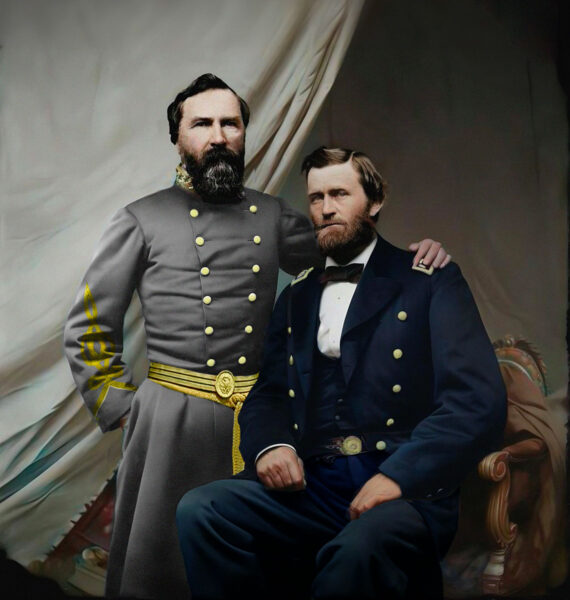
Reenlistment also rewarded Paige with another monthlong furlough, during which he married Carlin, on April 27. His absence from the army delayed his return to Virginia just long enough to ensure that he missed the initial hellish battles of Ulysses S. Grant’s Overland Campaign—the Wilderness and Spotsylvania Court House—where the Vermont Brigade suffered heavy losses. “Don’t you think I was lucky reenlisting? I dodged the greatest ball of the season,” he wrote to Asa on May 21.35 Four men were killed and about 20 wounded in his company, several of them men from Barnard. Despite the regiment’s losses, he felt a renewed optimism. “I think this fight will decide the thing,” he wrote to Carlin on May 16. “I think Grant is coming out all right.”36 It was the first time he had praised a commander since McClellan.
Paige rejoined his regiment in time to fight with it at Cold Harbor. The Vermont Brigade was one of those tapped to charge the maze of impregnable Confederate breastworks, in what Grant later admitted was his worst decision of the war. Grant lost almost 13,000 men, more than 1,800 of them killed in the hopeless assaults. Paige wrote to Carlin, with almost unbelievable nonchalance, on June 5, two days after the battle, “I will say that I got a little tunk on my head yesterday by a stray ball, but it is not worth mentioning. I am not hurt scarcely at all, just a graze of the skin. I am in the best of spirits, and feel that I shall come out all right.”37 To Asa, he added, the next day, “I have bled a few drops for my country. But I am all right, and the little scratch is getting fast well.”38 In fact, he had nearly been killed, having been struck by a bullet on the left side of his head halfway between his ear and his crown. Three weeks later, the wound still had not healed, although he again insisted to his wife that “it had been of no trouble to me, more than to make it quite sore.”39 Nonetheless, against the odds, Paige had once again survived. At the start of the Overland Campaign, the Vermont Brigade had mustered 2,850 men; now only 1,200 were left.
By the end of June, the Vermonters were in the trenches before Petersburg. There, they lived in relative comfort, Paige assured Asa, “as we have splendid earthworks, and can sit or stand in them, read, write, or cook as we like, and are relieved often to go back and rest up.” At Petersburg, he also encountered black troops for the first time. To Carlin he wrote, “We have just been laughing at the remarks of some negro soldiers who are here. They are death on rebs, and when they get a chance at one, he has to suffer. They want to fight and we fellows want they should. [They] were guarding the rebs [prisoners], and it was terribly galling to the consciences of the Graybacks.”40 Paige’s ambivalence toward blacks reflected that of many—probably most—northerners, even those from New England, the heartland of the abolitionist movement. Paige opposed slavery, but sprinkled his letters with occasional racial slurs, and at least implicitly supported the idea of sending emancipated slaves back to Africa, a policy known as “colonization,” as an alternative to integrating them into American society. (Back in 1862, on May 28, he had written, “We see plenty of slaves, and I am heartily tired of it; and God speed the time when the negro shall be free and on his own side of the Atlantic.”)41
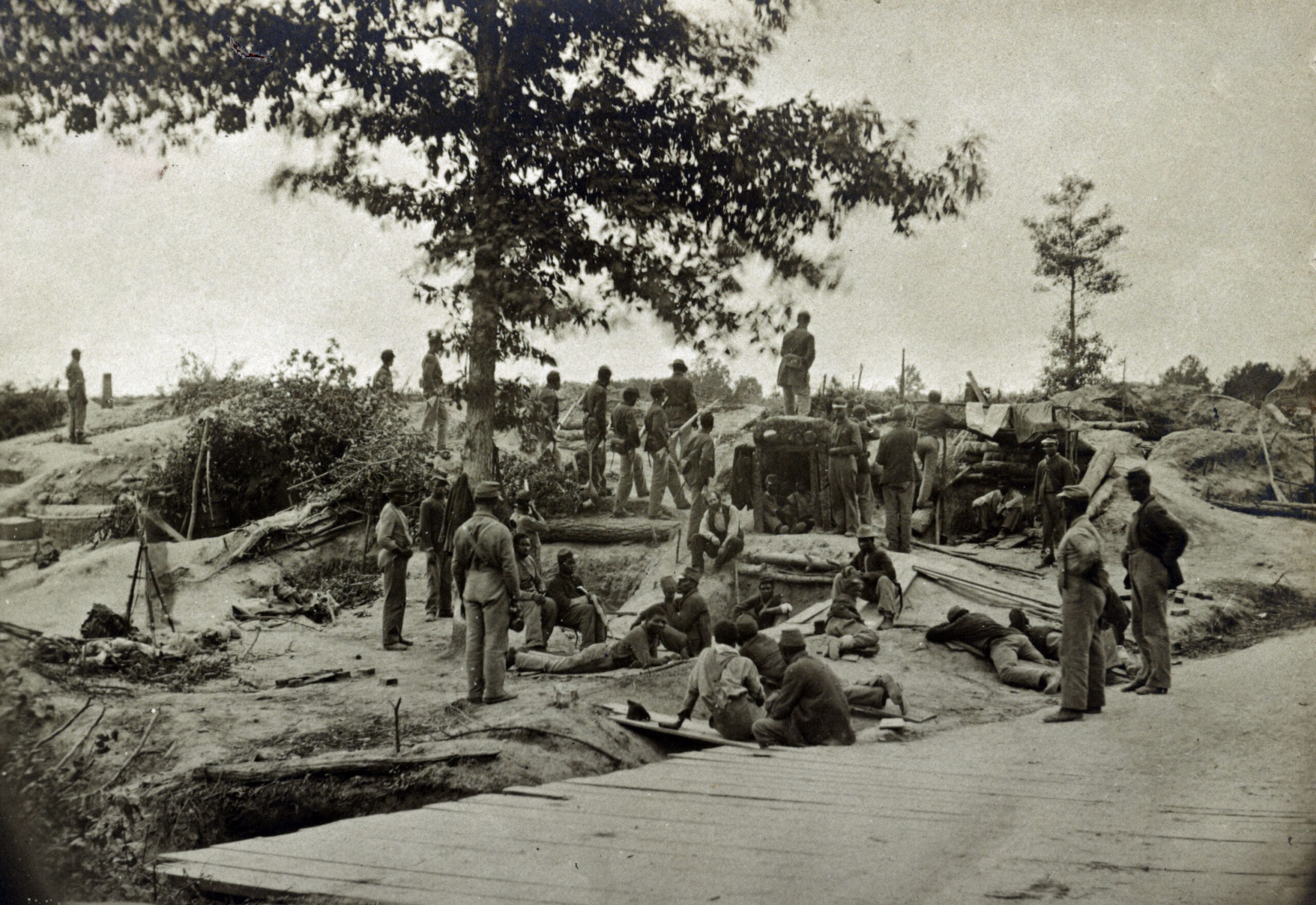 Library of Congress
Paige first encountered black soldiers in the trenches at Petersburg (some of whom are shown in the above photo from August 1864). He noted in a letter home, “They are death on rebs, and when they get a chance at one, he has to suffer. They want to fight and we fellows want they should.”
In the weeks and months to come, the Army of the Potomac steadily pushed its lines westward around Petersburg in an effort to isolate the city and cut the railroads that carried supplies from the Confederacy’s hinterlands to Richmond. In a movement against the Weldon Railroad, on June 23, the 4th Vermont was deployed as skirmishers and found itself far in advance of the rest of the brigade. Confederate troops from Mississippi and Florida suddenly appeared from the surrounding woods, cutting the Vermonters off and taking prisoner nearly 400 of its men in the regiment’s worst defeat of the war. As many as 70 percent of the captured men may have died in Confederate prison camps. When the regiment reassembled, only 110 men were left. One of them, in another instance of his extraordinary good fortune, was Harlan Paige. “We had close work and I thought I had a through ticket for Richmond sure, but I am all right, safe and healthy,” he wrote to Asa. “We saved our colors and are now organized into two companies. Our colors have over a hundred bullets in it.”42 To Carlin he added, on June 24, “I have always felt that I should be protected, and I am still sure of it.”43
In an attempt to loosen Grant’s grip on Petersburg, Lee embarked on a bold and risky strategy by ordering an army corps under Jubal Early to surge north through the Shenandoah Valley to threaten Washington and Baltimore—and prompt Grant to weaken his besieging army by sending reinforcements northward. After breaking through an outnumbered Union line at the Monocacy River, Early’s force bore down on the nation’s capital, which had been nearly denuded of troops. On the night of July 9, the Vermont Brigade and other elements of the VI Corps were suddenly pulled out of the Petersburg lines and ordered posthaste to the defense of Washington. On July 12, Early’s exhausted troops were defeated by Union forces at Fort Stevens, inside the boundary of the District of Columbia, within sight of the Capitol dome, and forced to fall back toward their base in the Shenandoah Valley.
Paige wrote to Carlin on July 13, “I had just got fairly asleep when the order came to pack up and fall in, which we did, and marched to City Point and took transports and came to [Washington]. We found that the rebs were within four miles of Washington and the citizens of that little place well frightened, all armed and very glad to see us. We know that the Capital is safe, for the 6th Corps is here, and if Secesh wants a quantity of the biggest kind of shell, we want them to come, but we do not fear that they will. Yesterday a lady went on the line and fired away at the rebs a number of times. Old Abe was out, but he did not shoot.” He added blithely, “It is a beautiful day and I have been picking blueberries this morning.”44
With the siege of Petersburg settling into a stalemate, Grant had dispatched the VI Corps to the Shenandoah Valley to lend additional heft to the new army that was gathering to pursue Early. Under that army’s aggressive commander, Philip Sheridan, the Vermont Brigade played a pivotal role at the Battle of Opequon, or Third Winchester, on September 19. The 4th Vermont formed part of the VI Corps’ left flank, charging through low, swampy terrain to appear in the face of Stephen Ramseur’s Confederate division, which they decisively put to flight. Paige was exhilarated. The regiment, he wrote to Carlin, “had the most splendid fight that I ever saw. The Vermont Brigade was in the front line and did nobly. I came out without a scratch and feeling first rate, well and hearty. We drove them like a herd of sheep. We are doing a glorious business. Hurrah! How we did scatter them!”45 Two weeks later, on October 4, he wrote again to Carlin: “I never enjoyed a campaign as I have this. Oh! We have had a splendid time!” Paige also liked the well-stocked larders of the valley, enjoying quantities of—presumably looted—beef, pork, mutton, chickens, turkeys, geese, ducks, as well as plentiful fruits and vegetables. “We have lived tip-top here. The boys do not scruple to take apple-butter, honey and anything else they can find in the houses.”46
As Sheridan’s army pushed up the valley, the presidential election was climaxing. As recently as July, Lincoln had feared defeat by McClellan—now his foe as the Democratic candidate—as war weariness beset the North, the appalling toll of the Overland Campaign sank into public consciousness, and antiwar Copperheads stridently attacked the administration. Like most soldiers after three years of bloody struggle, Paige felt outrage at those who called for peace at any price. There were even Copperheads in staunchly Republican Vermont, he learned. To Asa, he wrote, “It seems that your Secesh throw stones at your speakers, in public meetings, why don’t you fellows shoot a lot of the *****? Curse the hounds they deserve it! I would as soon fight a secesh in N.E. as in the south! And of the two, I think the southern rebs have the most honor about them. Old Abe is the man, and Abe we will have.”47 Bolstered by William Tecumseh Sherman’s capture of Atlanta on September 2 and by other Union victories, Lincoln would ultimately trounce McClellan in November.
For Sheridan’s overconfident army in the Shenandoah Valley, the party ended, albeit only temporarily, at Cedar Creek. Early’s battered force proved to have more fight in it than the Federals expected. Early on the morning of October 19, the Confederates launched a surprise attack on the unsuspecting Union camp. They came close to crushing Sheridan’s entire army, overrunning the still-sleeping soldiers of the VIII Corps and much of the XIX Corps, harvesting prisoners by the thousands, and capturing scores of cannon. They were halted by the Vermont Brigade, which anchored the center of the VI Corps’ line. The Vermonters managed to cover the Union retreat until Sheridan arrived on the battlefield, stabilized his shaken troops, and led a triumphant counterattack that won the day. The Union lost some 4,000 men that day, more than 300 of them from the mauled but unbroken Vermont Brigade.
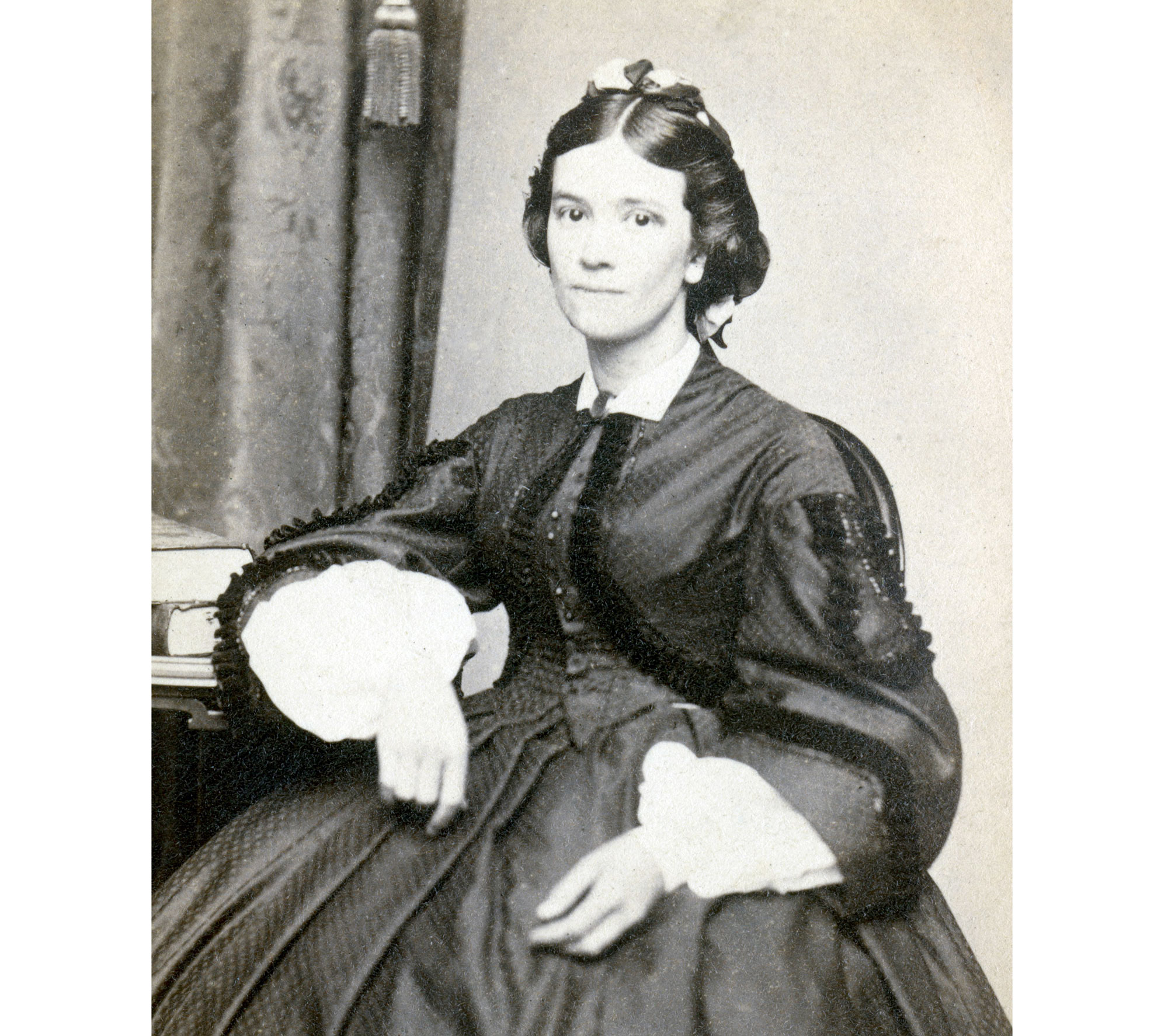 Harlan Paige Papers, Silver Special Collections, University of Vermont
Shortly after news of Robert E. Lee’s surrender reached him, Paige wrote his wife, Carlin (above), “I hardly know how to express my feelings. It seems as though I had awakened from a horrid dream…. Yes, thank God, the awful work is done.”
On the cusp of his 26th birthday, Paige wrote to Carlin: “Yesterday was a blue day with us but we came out alright. We had a hard fight, got driven in the morning, but charged them in the afternoon and captured fifty pieces of artillery, all the rebel wagon train, and a large number of prisoners. I was not injured, though a shell cut my saber and scabbard in two and hit my foot, so that I thought part of it was gone for a minute, but I am all right now. Three cheers for Gen. Sheridan and our glorious flag! I don’t think the Secesh will pitch into us again, as they got more than they bargained for.”48 Paige’s assessment was correct. Early’s depleted army had no fight left in it. The Shenandoah Valley was now Union territory.
By December, the VI Corps was no longer needed in the valley and had returned to the trenches at Petersburg. Promoted to lieutenant, Paige now enjoyed the relative comfort of a large, well-heated tent shared with one fellow officer and furnished with a comfortable bunk, chairs, table, and plenty of good wool blankets. “And further we have a smart little Irishman to build our fire, cut the wood, bring water, black boots, make bed and keep tent in order,” he informed Carlin on January 1, 1865.49 With Sherman’s capture of Savannah on December 22, and swelling numbers of Confederate deserters flowing into the Union lines, Paige felt that the end, at last, was near.
On April 2, the Vermont Brigade spearheaded the final, triumphant Federal assault on the overstretched and weakened Confederate line at Petersburg. At 4:30 a.m., the Vermonters broke from Fort Fisher to dash in the predawn gloom across a half-mile of open ground, tearing away obstructions, to take the Confederate breastworks in a storm of hand-to-hand fighting. The Confederate line soon crumbled. Thousands of Rebels surrendered as others fled into the surrounding woods. Although the Vermont Brigade lost 33 men killed and 161 wounded, Paige emerged from the battle, his last, once again unscathed.
On April 3, he wrote to Carlin, “Glory Hallelujah, Petersburg is ours! and Lee’s army is awfully whipped. Richmond is reported officially to be ours. I was in the fight all day yesterday, and am, thank God, still safe and unharmed. The 6th Corps, with the Vermont Brigade at its head, charged the Reb works yesterday morning at half an hour before daylight, and carried at the first onset. We then moved by the left flank, and charged down the line toward Hatcher’s Run, and swept everything before us for two miles, when we met the 24th Corps. Then we faced about and rushed for Petersburg, and charged the enemy about two miles in that direction. We lost but few. I am so much excited that I can hardly stop to write. Three cheers for the old flag—Hip! Hurrah!”50
With the rest of the VI Corps, the Vermonters then joined Grant’s dogged pursuit of Lee’s dwindling army, sweeping up thousands of prisoners every day as they neared Appomattox Court House. News of Lee’s surrender reached Paige at the 4th Vermont’s bivouac at Farmville. On April 11, he wrote to Carlin, “I hardly know how to express my feelings. It seems as though I had awakened from a horrid dream, but Petersburg is taken and Lee has surrendered. We have heard the whistle of the last bullet, the whizz of the last shell. Yes, thank God, the awful work is done. Now we are indeed free; now the soldier can go home and feel that his work is well done; now we have a government that will stand come what may.”51 The next day, he wrote to her again, from his camp near Burkeville: “We see the Rebels, officers and men, traveling along with our own army; and when we ask them where they are going, they say ‘Home.’ Everyone here is talking of going home. Home is the word now; war is done. There is an intense satisfaction in knowing that I have done my duty in the war, and seen it closed.”52
After the war, Paige and his wife moved to Dorchester, Massachusetts, a part of Boston. He never returned to farming. He served for a time as a policeman in Boston, “but the duties were not congenial,” his obituary somewhat cryptically stated. For the rest of his life Paige worked as a researcher and collector of fees for the publisher of the Dorchester city directory, a forerunner of what would later become the White Pages. In his 50s, he served on Dorchester’s common council and as a commander of the local branch of the Grand Army of the Republic. His war record was an honorable one, his obituary noted, “but one of which he is very modest in speaking.” He died on December 6, 1901, at 63, survived by his wife and two sons.53
Fergus M. Bordewich’s most recent book is Klan War: Ulysses S. Grant and the Battle to Save Reconstruction (Knopf, 2023).
Notes
1. Harlan Page Paige (hereafterHPP) to (probably Asa H. Paige, hereafter AHP), September 29, 1861, Harlan Page Paige Papers, Silver Special Collections Library, University of Vermont, Burlington, VT.
2. HPP to (probably AHP), November 14, 1861.
3. HPP to AHP, March 12, 1862.
4. HPP to AHP, March 30, 1862.
5. HPP to AHP, April 20, 1862.
6. HPP to AHP, May 8, 1862.
7. HPP to AHP, May 15, 1862.
8. HPP to AHP, May 27, 1862.
9. HPP to Carlin Elizabeth Moulton (hereafter CEM; after marriage to HPP in 1863, she becomes CEP, i.e., Carlin Elizabeth Paige), June 6, 1862.
10. HPP to AHP, July 5, 1862.
11. HPP to CEM, July 26, 1862.
12. HPP to AHP, July 17, 1862.
13. HPP to CEM, August 27, 1862.
14. HPP to “Friends in Boston,” September 20, 1862.
15. HPP to AHP, October 30, 1862.
16. HPP to AHP, December 7, 1862.
17. HPP to “Brothers and Sisters all,” December 15, 1862.
18. HPP to AHP, December 18, 1862.
19. HPP to AHP, January 18, 1863.
20. HPP to Laura L. (Paige) Burroughs (uncertain), January 25, 1863.
21. HPP to CEM, July 8, 1863.
22. HPP to CEM, July 12, 1863.
23. HPP to AHP, July 18, 1863.
24. HPP to CEM, September 7, 1863.
25. HPP to AHP, December 19, 1863.
26. HPP to AHP, August 24, 1863.
27. HPP to AHP, September 3, 1863.
28. HPP to AHP, November 13, 1863.
29. HPP to CEM: October 9, 1863.
30. HPP to AHP, November 15, 1863.
31. HPP to AHP, December 19, 1863.
32. HPP to AHP, February 2, 1864.
33. HPP to AHP, March 20, 1864.
34. HPP to AHP, March 28, 1864.
35. HPP to AHP, May 21, 1864.
36. HPP to CEP, May 16, 1864.
37. HPP to CEP, June 5, 1864.
38. HPP to AHP, June 7, 1864.
39. HPP to CEP, June 19, 1864.
40. HPP top CEP, June 18, 1864.
41. HPP to CEM, May 28, 1862.
42. HPP to AHP, June 25, 1864.
43. HPP to CEP, June 24, 1864.
44. HPP to CEP, July 13, 1864.
45. HPP to CEP, September 21, 1864.
46. HPP to CEP, October 4, 1864.
47. HPP to AHP, October 18, 1864.
48. HPP to CEP, October 20, 1864.
49. HPP to CEP, January 1, 1865.
50. HPP to CEP, April 3, 1865.
51. HPP to CEP, April 11, 1865.
52. HPP to CEP, April 14, 1865.
53. Obituary, December 6, 1901, Dorchester (MA) Beacon.