 The George F. Landegger Collection of District of Columbia Photographs in Carol M. Highsmith’s America, Library of Congress, Prints and Photographs Division
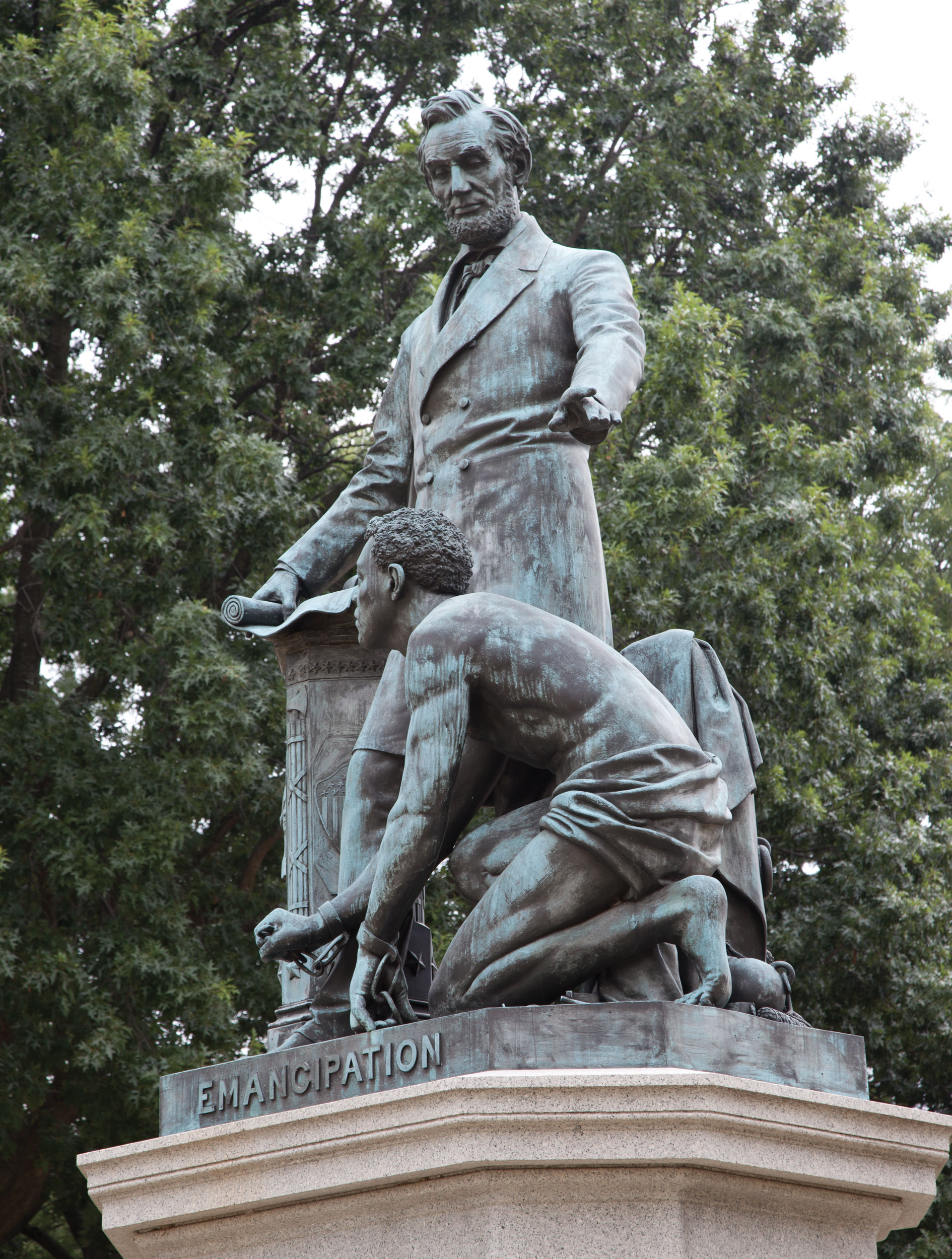
Thomas Ball’s Freedmen’s Memorial, which stands a few blocks east of the U.S. Capitol, is a clear representation of a white man’s interpretation of emancipation in which Lincoln is portrayed as the Great Emancipator.
Ask most Americans who freed the slaves and they will respond, “Lincoln.” Yet Lincoln himself would have been the first to disagree. His Emancipation Proclamation, issued on January 1, 1863, specified that only slaves in areas not already occupied by Federal troops were free. It carefully excluded all areas in the Confederacy held by Federal troops, as well as the four border states—Missouri, Kentucky, Maryland, and Delaware—and even the entire Confederate state of Tennessee.1 (The exclusions were considered necessary so that the proclamation could be issued under the president’s war powers, apart from the Constitution’s due process clause, which both recognized and protected the institution of slavery.) Over a million slaves were unaffected by the proclamation, and most would not receive their freedom until the abolition of slavery by the Thirteenth Amendment in December 1865.
The belief that Lincoln freed the slaves is misleading in another sense. It implies that he did so as a voluntary act of racial justice, yet a case can be made that many slaves had already liberated themselves by the time Lincoln issued the Emancipation Proclamation. A chaplain in Major General Ulysses S. Grant’s Army of the Tennessee observed that by November 1862, thousands of slaves were streaming into Union lines: “The arrival among us of these hordes was like the oncoming of cities.”2 By this interpretation, Lincoln acted because the actions of the slaves made any other course untenable. He was, as one critic has said, “forced into glory.”3
Yet the idea that Lincoln liberated the slaves remains a central feature of the American Iliad. This should not be surprising. During the 19th century the Emancipation Proclamation was seen only through the lens of great statesmanship. Artist Francis Bicknell Carpenter, who in 1864 spent six months at the White House working on a magisterial painting commemorating the event, chose to portray Lincoln at the moment he first read the proclamation to his cabinet. He carefully placed Lincoln slightly to the left of center on the canvas, and set Secretary of War Edwin M. Stanton and Secretary of the Treasury Salmon P. Chase on Lincoln’s right, symbolizing their status as the two strongest advocates of emancipation. On Lincoln’s left were Secretary of the Navy Gideon Welles and Secretary of State William H. Seward, followed by Postmaster General Montgomery Blair, Secretary of the Interior Caleb B. Smith, and finally Attorney General Edward Bates—all deliberately ordered from those most in favor of emancipation to those most skeptical of its utility.
Lincoln holds the proclamation in his left hand, facing Seward, who sits with folded arms and a pensive look. Lincoln had told Carpenter how Seward had disagreed with the timing of the proclamation’s announcement. The July 22 cabinet meeting portrayed in the painting was less than a month after the grave Union defeat in the Seven Days’ Battles outside Richmond, and Seward had warned that issuing the proclamation then would have looked like an act of desperation. “It may be viewed as the last measure of an exhausted government,” Lincoln quoted Seward as saying, “a cry for help; the government stretching forth its hand to Ethiopia, instead of Ethiopia stretching forth her hands to the government.” Seward’s idea, Lincoln continued, “was that it would be considered our last shriek, on the retreat.”4
Lincoln did as Seward suggested and put away the document for a more propitious moment. On September 22, five days after the Battle of Antietam, he summoned his cabinet again. Carpenter could easily have chosen this moment as the subject of his painting, for it was just as dramatic. After an incongruous beginning—the president read a story by the humorist Artemus Ward—Lincoln told them that the time had come to announce the proclamation. Lincoln had made a vow, Secretary Welles
informed his diary, “that if God gave us the victory in the approaching battle, he would consider it an indication of Divine will, and that it was his duty to move forward in the cause of emancipation…. God had decided this question in favor of the slave. [Lincoln] was satisfied that it was right—was confirmed and strengthened in his action by the vow and the results.”5
The idea of Lincoln as God’s instrument would have been a good source of artistic inspiration, and to some extent it comes through in a second major artistic project commissioned in the years immediately after the president’s assassination. This was the Freedmen’s Memorial, a life-size sculpture by Thomas Ball that now stands in Washington’s Lincoln Park, a few blocks east of the U.S. Capitol. Despite its title, the sculpture was sponsored by whites and its features represent a white man’s interpretation of emancipation. Here once again is Lincoln as the Great Emancipator. He stands with his right hand resting on the Emancipation Proclamation while he holds his left above a kneeling slave, bidding him to arise from his broken chains. This depiction gives Lincoln’s act a quasi-divine aura, reinforced by the awed expression on the face of the slave. At the base of the statue is the word “EMANCIPATION,” attesting that the audience is looking at the essence of the act of emancipation.
Ball’s statue has come under heavy criticism for its portrayal of the enslaved African American as the passive recipient of freedom. Another sort of artistic statement was possible even in the mid-1860s, as evidenced by Freedman, an 1863 statuette by John Quincy Adams Ward, which shows a freedman alone, rising proudly from chains he has broken himself.6 But in mythic terms, if Lincoln is to be the Great Emancipator then the slave must be the passive recipient of freedom, not its co-equal author. The question, then, is why has the American Iliad insisted upon this image of emancipation?
The idea of Lincoln as the Great Emancipator is itself defensible. Historian James M. McPherson made a strong case for it in his “Who Freed the Slaves?” essay, a rebuttal to the argument that Lincoln was a reluctant liberator or, as expressed in most extreme form, that the slaves liberated themselves: “Lincoln did not accomplish this in the manner sometimes symbolically portrayed, breaking the chains of helpless and passive bondsmen with the stroke of a pen by signing the Emancipation Proclamation.”7 But without the total impact of Lincoln’s presidency—the way his mere election caused the slave-holding South to secede, to his choice to preserve the Union through war, his decision that the war could not be won without the destruction of slavery, and thereafter his insistence on emancipation as a Union war aim—it is unlikely that slavery would have come to an end.
But the idea that Lincoln acted to liberate millions of slaves who did nothing to liberate themselves is historically untenable. In mythic terms, however, the concept has protected the American Iliad as a white man’s Iliad focused on the morally equivalent military valor of the white soldiers in the Union and Confederate armies. Such a focus would be impossible if we moved the strivings of enslaved African Americans to center stage and recognized their activism in deserting their masters and their valor in fighting on behalf of the Union cause. If we do accept this view, the popular image of Lincoln as the Great Emancipator could be revised, with his role reduced to that one triumphant act of statesmanship. If the American Iliad is a living myth, subject to change and improvement, then here is a worthwhile opportunity for change.
Mark Grimsley, a history professor at The Ohio State University, is the author of several books, including And Keep Moving On: The Virginia Campaign, May–June 1864 (2002) and The Hard Hand of War: Union Military Policy Toward Southern Civilians, 1861-1865 (1995).
Notes
1. “Emancipation Proclamation,” January 1, 1863, Roy P. Basler, ed., The Collected Works of Abraham Lincoln 8 vols. (New Brunswick, NJ, 1953), vol. 6, 28–30.
2. John Eaton, Grant, Lincoln, and the Freedmen: Reminiscences of the Civil War (1907; reprint, New York, 1969), 2.
3. Lerone Bennett Jr., Forced into Glory: Abraham Lincoln’s White Dream (Chicago, 2000).
4. F.B. Carpenter, Six Months at the White House with Abraham Lincoln: The Story of a Picture (New York, 1866), 22.
5. Entry for September 22, 1862, The Civil War Diary of Gideon Welles, ed. by William E. Gienapp and Erica L. Gienapp (Urbana, 2014), 54.
6. Fig. 3-1, John Quincy Adams Ward, Freedman, 1863, in Kirk Savage, Standing Soldiers, Kneeling Slaves: Race, War, and Monument in Nineteenth-Century America (Princeton, NJ, 1997), 53.
7. James M. McPherson, “Who Freed the Slaves?” in McPherson, Drawn with the Sword: Reflections on the American Civil War (New York, 1996), 207.