Uniform coat worn by Confederate Lieutenant Francisco Moreno Jr. at Shiloh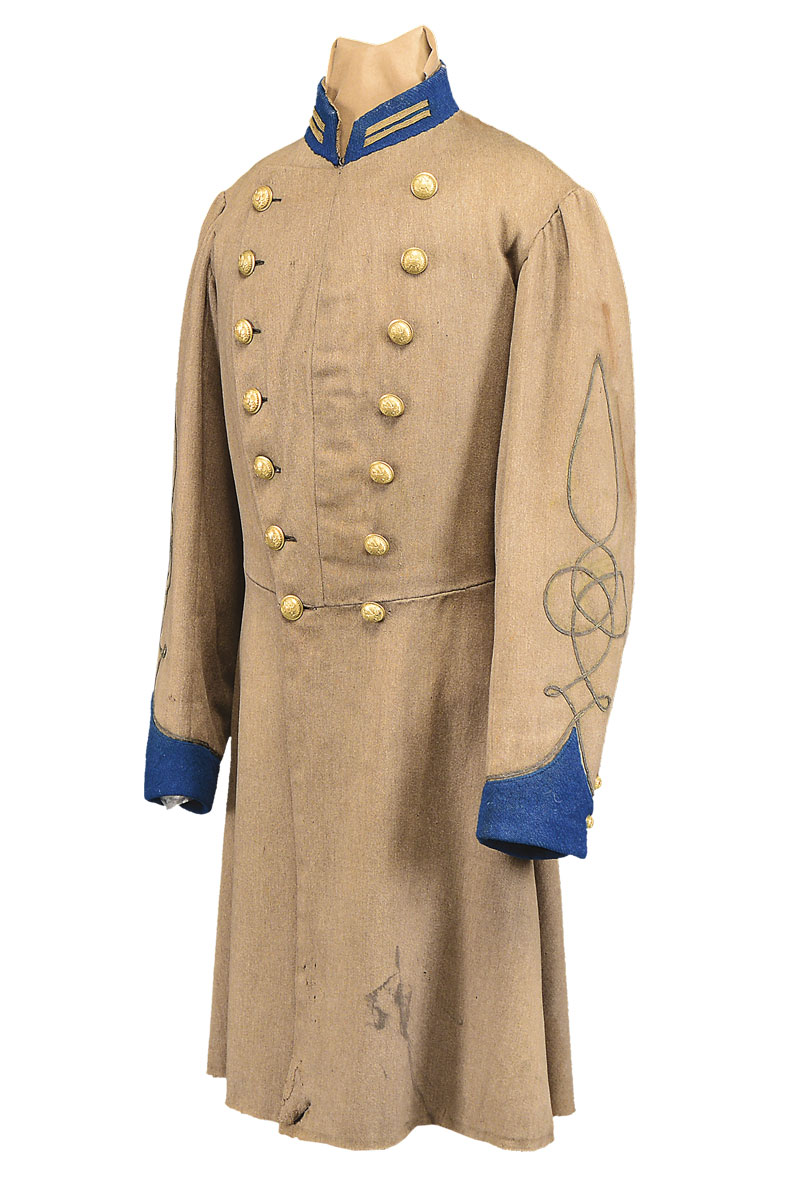 Poulin Antiques & Auctions, Inc.
The Artifact
Uniform coat worn by Confederate Lieutenant Francisco Moreno Jr. at Shiloh
Condition
The coat is in very good overall condition. Its original brown cotton lining is complete with minor reductions; the cotton sleeve and pocket linings are complete, with light soiling, scattered mothing, and some staining.
Details
In late 1861, Francisco Moreno Jr. joined the Orleans Guard Battalion, a six-company militia unit from New Orleans, as a lieutenant. Moreno, 44, married and a father, came from an elite Spanish-American family and was a partner in a commercial merchant firm in the city; his brother-in-law was Confederate Secretary of the Navy Stephen Mallory. Moreno’s father was the largest banker in Pensacola, Florida; his grandfather served as a surgeon in the Spanish army when it was stationed in that state; and his great-grandfather commanded the Spanish colony of New Iberia, Louisiana, in the late 1770s. In March 1862, the roughly 400 men of the Orleans Guard Battalion were mustered in to Confederate service for 90 days. On April 6–7, Moreno and his comrades served as part of the Army of Mississippi’s Second Corps at the Battle of Shiloh, where, wearing this gray wool frock coat, he was wounded in both legs. When General P.G.T. Beauregard, who took over command of the Confederate force after General Albert Sidney Johnston was killed, withdrew the defeated army southward, Moreno was among the wounded left behind. A week later, Beauregard, himself a former member of the battalion, sent a message to Union general Don Carlos Buell in search of Moreno, who it turned out had been sent to a Union hospital in Louisville, Kentucky. Soon after, Moreno was permitted a transfer to the local home of a personal friend, where he died from his wounds on May 4. The following year, his body was returned to New Orleans and interred in St. Louis Cemetery No. 2.
Quotable
Colonel Preston Pond Jr., in whose brigade the Orleans Guard Battalion served at Shiloh, wrote about the conditions they encountered on the battle’s first day when they were ordered to assault a Union artillery position: “My brigade was filed, left in front, up a deep ravine, in a direction flanking the enemy’s battery, and … I ordered the charge. This brought my troops under the fire of the enemy’s battery and three of his regiments in an oblique column instead of line of battle, and the fire became so destructive that the troops recoiled under it…. As my troops were advancing … we … received a severe fire from our own troops on the right, which, added to the fire of the enemy, almost disorganized the command…. The charge … was not in accordance with my judgement. I did it reluctantly and in obedience to peremptory orders.”
Price
$37,600 (realized at Fairfield, Maine, in December 2020). “This is truly a stunning, historically important, KIA Confederate officer’s frock coat,” a representative of Poulin Antiques & Auctions Inc. noted at the time. “All in all, it is in well-above-average condition compared to other surviving frock coats.”