A pair of inspector-marked Civil War brogans.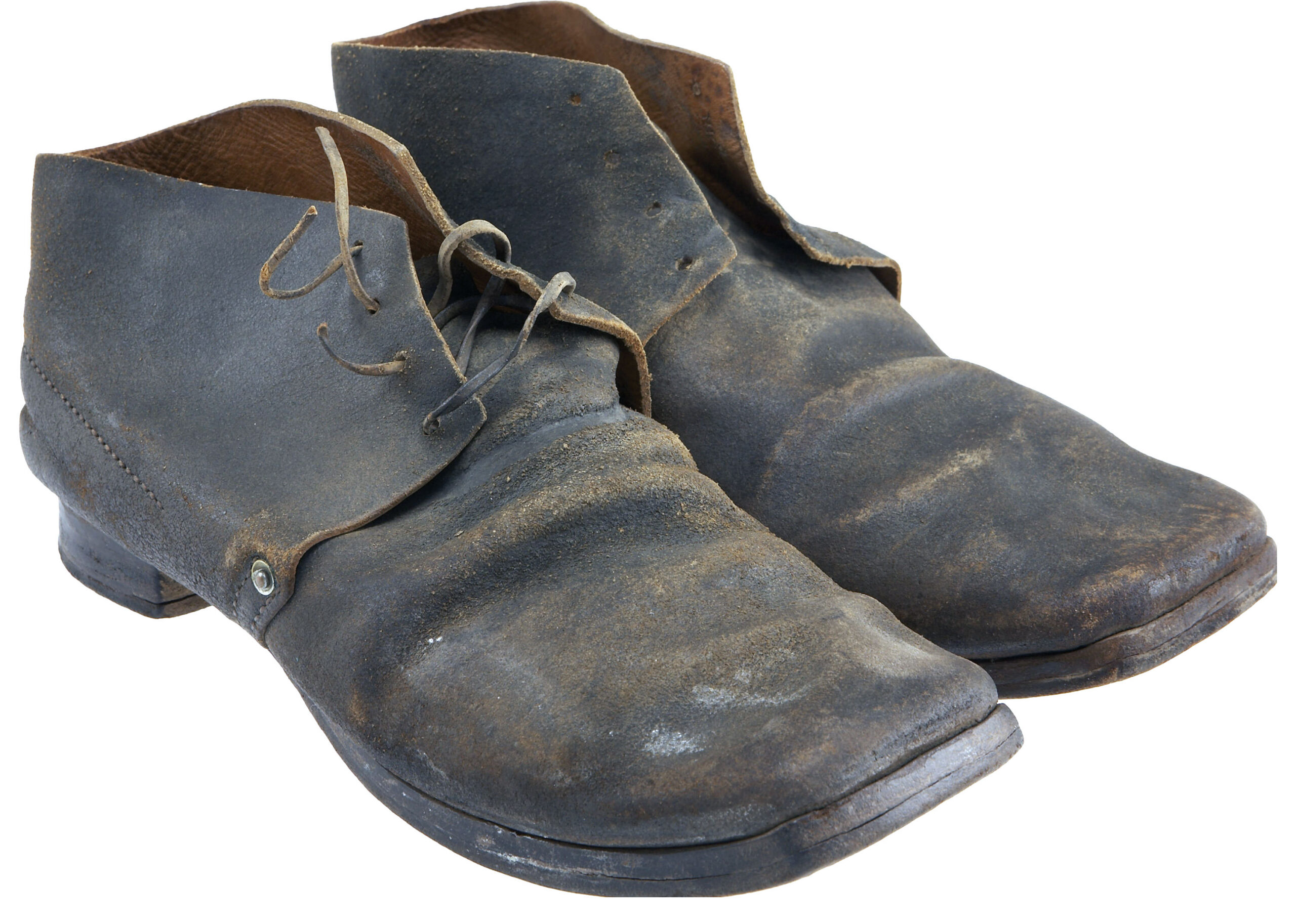 Heritage Auctions (ha.com)
An unknown soldier’s shoes earn big
The Artifact
A pair of inspector-marked Civil War brogans
Condition
The shoes are in excellent, used condition showing period wear and some scuffing. The pegged heels and soles show modest wear and one even retains some hardened mud and grass at the instep. One original leather lace remains.
Details
At the outbreak of the Civil War—needing to outfit the fast-swelling ranks of the Union armies—the federal government contracted with a variety of manufacturers throughout the North to produce footwear for the troops. While cavalrymen received boots, infantryman were outfitted with square-toed shoes made with rough-side-out blackened leather and popularly known as “bootees” or “brogans,” the latter term derived from the English “brogue,” meaning a shoe that almost covered the ankle. Brogans, which had four eyelets and leather laces, were made on straight lasts, meaning they were interchangeable (no “left” or “right”), and would shape themselves to the wearer’s foot through use. Clearly stamped inside one of the pair shown here is “W.H. KING/INSP. CIN,” the mark of the federal inspector who accepted them for use by the U.S. government. By war’s end, the U.S. Quartermaster’s Department had purchased over eight million pairs of the shoes for Union soldiers.
Quotable
In his memoirs, former Union soldier Charles Bardeen remembered his brogans. “I wore the regular army shoe, and always the first day of a march after breaking camp my heels became a mass of blisters. I grew to expect it, and to know if I pricked them at night they would begin to harden the next day; but this first experience gave me only the present pain, and I had not learned it would not be permanent. Coarse as army shoes were, I am not sure but with their broad soles and heels they were better than a more fashionable boot. I tried the home kind once or twice but was glad to get back to those dealt out by the government, ungainly as they were.”
Value
$23,900 (price realized at Heritage Auctions in Dallas, Texas, in 2008). “This was a very common item to the Civil War soldier but quite uncommon and desirable today,” a Heritage representative noted at the time. “Soldier footwear is rarely encountered today and those with inspector markings are found in very few collections.”