After the Civil War, Union veteran John Billings recalled his observations of an army on the move. “What an interesting spectacle it presents, the bright sunlight glinting from the thousands of polished muskets, the moving masses of light and dark blue inching along over the uneven ground….” Of particular note were “the various flags streaming proudly in the air”—not just the national and state colors carried by individual regiments, but also the banners that indicated the army’s various corps, divisions, and brigades. Shown here are examples of Union army designating flags, which “told stories of their own” with their shapes (swallowtail for corps headquarters, rectangular for division, triangular for brigade), symbols (colored red for first brigade, white for second, blue for third), and field colors (a combination of red, white, and blue, depending on brigade).
 National Museum of American History
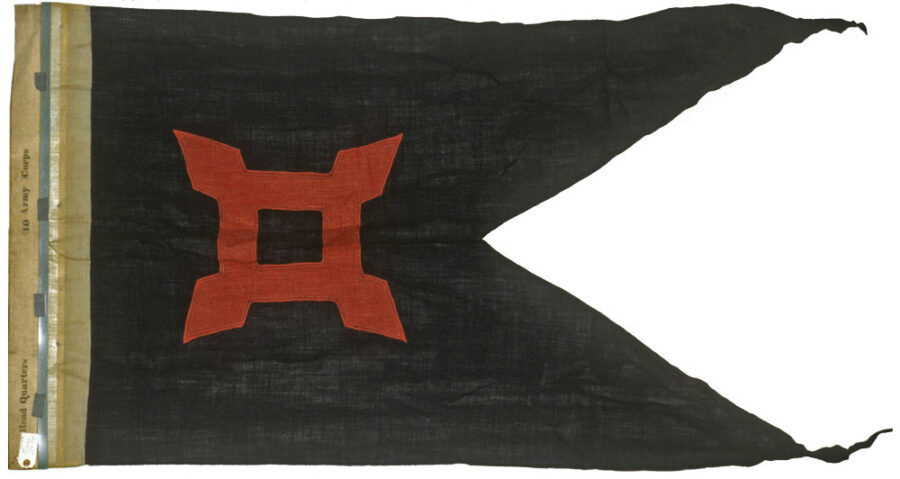
This blue wool bunting swallowtail flag designated headquarters for the X Corps, whose symbol was a square with a diamond on each corner. Formed in 1862, the X Corps served in South Carolina before being transferred to Benjamin Butler’s Army of the James, with which it saw action in the Bermuda Hundred and Petersburg campaigns.
 National Museum of American History
The Fourth Brigade, First Division, I Corps carried this flag. The I Corps was led by a number of well-known commanders, including Irvin McDowell, Joseph Hooker, George Meade, John F. Reynolds, and briefly at Gettysburg, Abner Doubleday.
 National Museum of American History
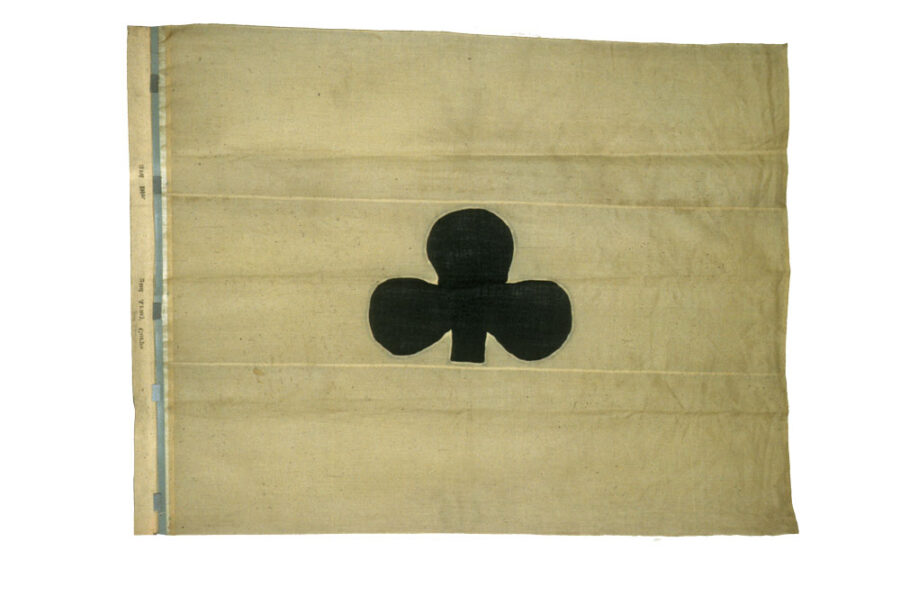
This flag, with its white field and large blue trifold, designated the Third Division of the army’s II Corps. The II Corps saw action in most of the biggest battles in the eastern theater—most notably at Gettysburg, where, under the command of Winfield Scott Hancock, it helped repulse Pickett’s Charge on the battle’s decisive third day.
 National Museum of American History
This flag’s various colors and symbol identifies it with the Third Brigade (triangular shape with red border), Second Division (blue field), VI Corps (St. Andrew’s Cross). The VI Corps’ most notable commander, John Sedgwick (whom his men affectionately called “Uncle John”), was killed by a Confederate sharpshooter at the Battle of Spotsylvania in May 1864.
 National Museum of American History
The two diagonal stripes and “11” on this swallowtail flag indicate an association with the chief quartermaster of the XI Corps, which was composed primarily of German-American regiments and figured prominently in the battles at Chancellorsville and Gettysburg.
 National Museum of American History
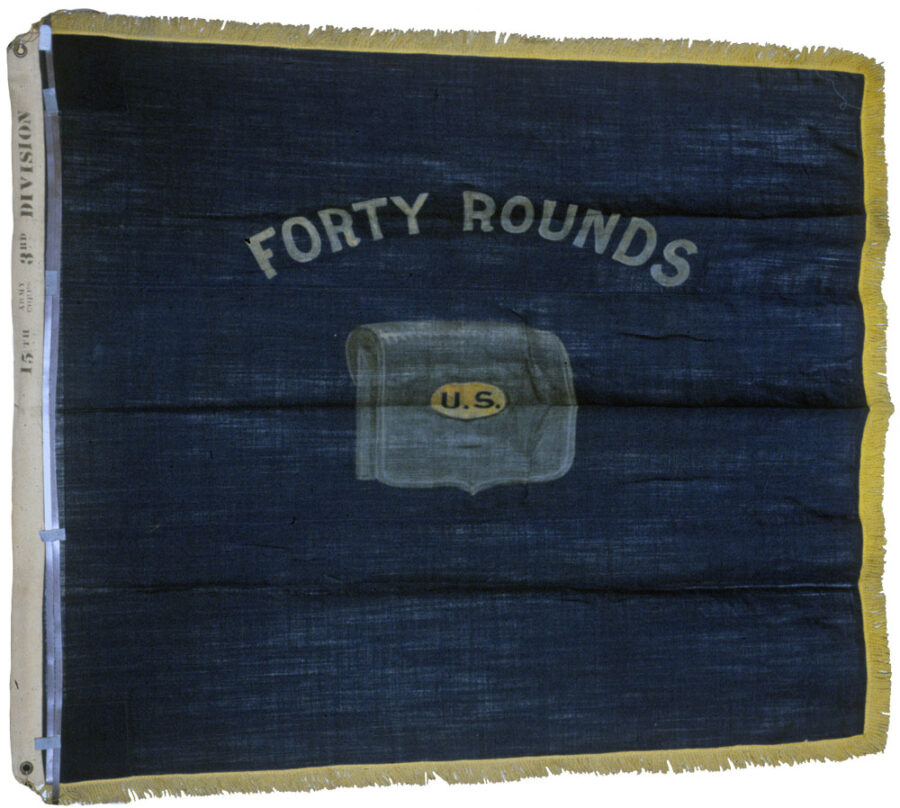
The flags of the western Army of the Tennessee’s XV Corps employed a different color scheme than did most other Union army corps. Instead of designating the Second Division as it would a corps of the Army of the Potomac, this flag’s blue field instead denoted the XV Corps’ Third Division. The corps’ distinct badge—a cartridge box with the motto “Forty Rounds” above it—was said to have been inspired by a soldier in the corps when he was asked what the XV’s badge was. He reportedly responded, “Why, forty rounds in the cartridge box, and twenty in the pocket!”
 National Museum of American History
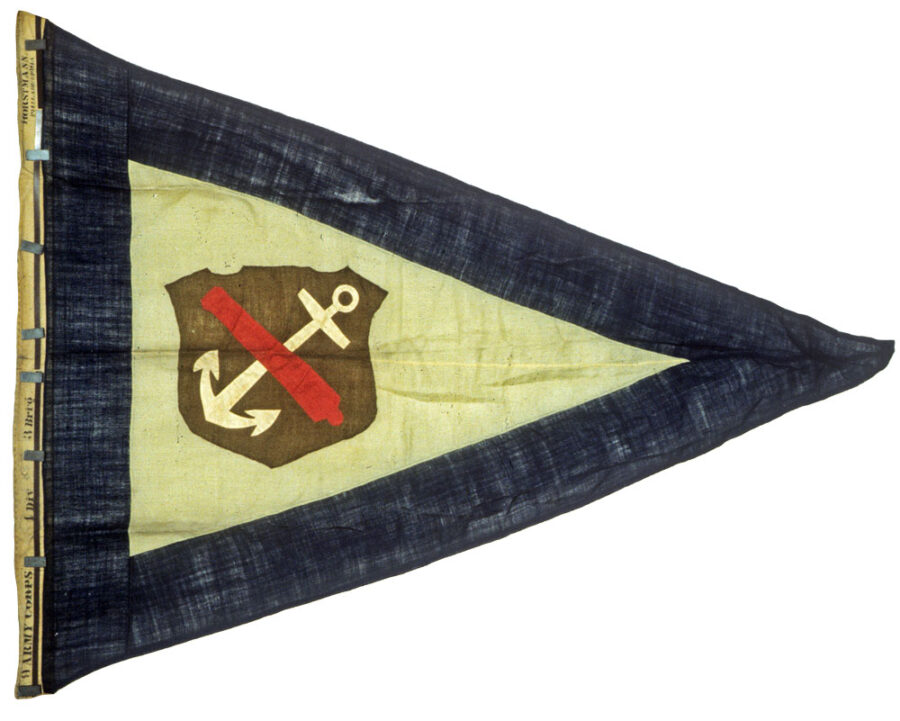
The shield of the IX Corps logo is green on this flag, linking it to the corps’ Fourth Division. The band of blue around its triangular field indicates its association with that unit’s Third Brigade. It’s speculated that the shield represents the seal of Rhode Island, birthplace of the corps’ original commander, Ambrose Burnside, while the fouled anchor is a nod to the corps’ coastal service in 1862.
 National Museum of American History
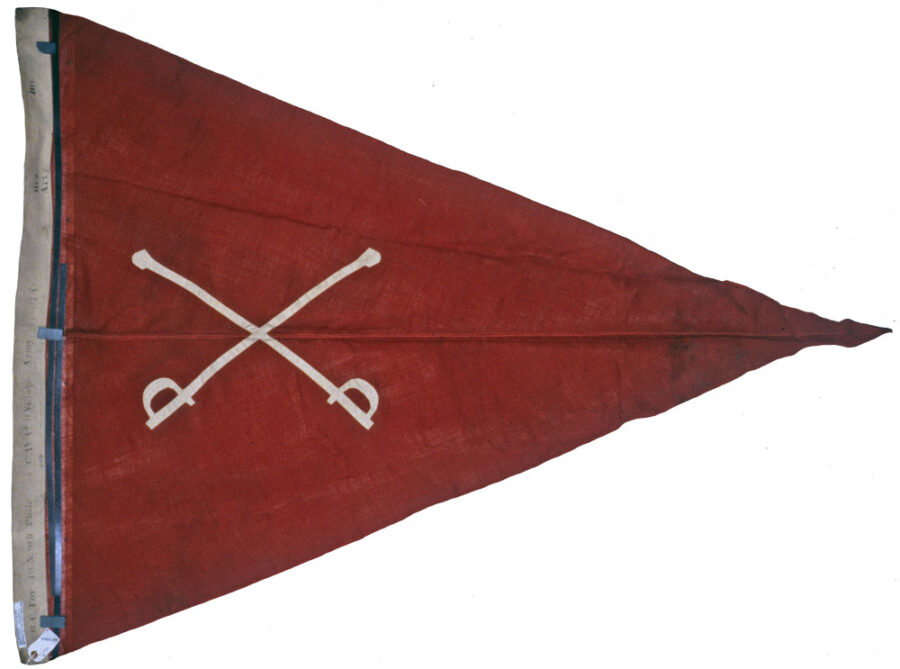
This flag’s color (red), shape (triangular), and symbol (crossed sabers) identifies it as the flag of the artillery brigade of the Army of the Potomac’s Cavalry Corps.