This wartime sketch by Edwin Forbes depicts a fugitive slave searching for Union lines in hopes of securing his freedom. The thousands of enslaved men, women, and children who made the same hazardous journey during the war were commonly called “contrabands,” derived from “contraband of war.”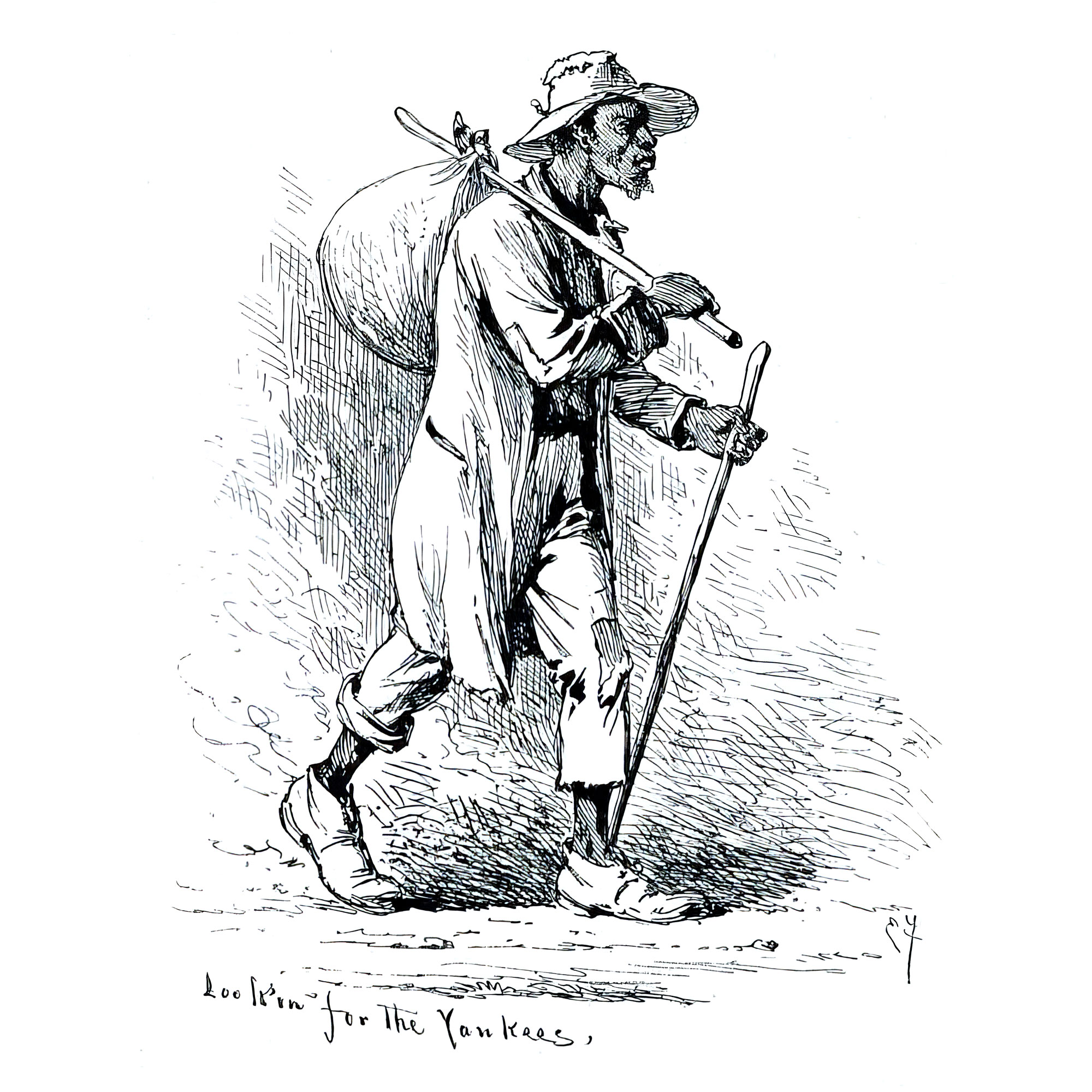 Thirty Years After (1890)
Con•tra•bands | adjective or noun | 1) Prohibited or excluded by proclamation, law, or treaty. 2) Anything by law prohibited to be imported or exported. 3) In the United States, during the civil war, a negro slave, especially an escaped or captured slave: so called from a decision of General B.F. Butler, in 1861, that slaves coming into his lines or captured were contraband of war, and so subject to confiscation.1
Exhausted and terrified, Frank Baker, Sheppard Mallory, and James Townsend arrived at Fort Monroe on the evening of May 23, 1861. Not long after the Battle of Fort Sumter and the start of the Civil War, the three men had been impressed by their enslaver, Colonel Charles K. Mallory, to help construct a Confederate artillery battery across Hampton Roads, near modern-day Norfolk, Virginia. As the project neared completion, Colonel Mallory planned to send the men south—away from their families—to build another Confederate outpost. With the prospect of loneliness and hard labor before them, the men took a bold risk. As their enslavers celebrated the ratification of Virginia’s Secession Ordinance, they stole a small boat and rowed under cover of darkness across the James River to Union-controlled Fort Monroe. There they promptly surrendered to the blue-clad pickets and asked for protection. They had no way of knowing their future: a whipping, imprisonment, the death sentence, or forcible return to enslavement.2
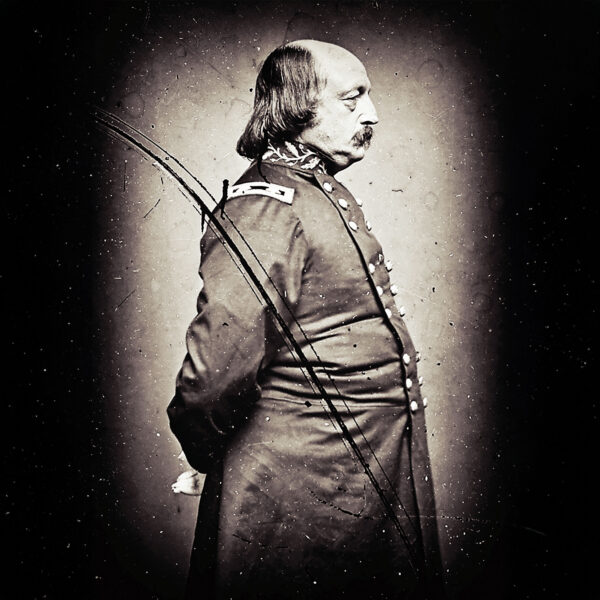
Fort Monroe’s commander, Benjamin Franklin Butler, promptly ordered the men to be “fed and set to work.” 3 On the next day, May 24, he met with each of them, hearing among other things their firsthand knowledge of the Confederate military defenses at Hampton Roads. Then, around 3 p.m., a Confederate major arrived under the white flag of truce to request the return of his commander’s slaves. Butler, however, “refused to surrender them … claiming that they were ‘contraband of war.’”4 Further justifying his decision, Butler said, “I mean to take Virginia at her word, as declared in the ordinance of secession passed yesterday. I am under no constitutional obligations to a foreign country, which Virginia now claims to be.” Butler reasoned that the Fugitive Slave Act of 1850, which had made it a federal mandate to return escaped slaves to their enslavers, no longer applied to Virginia. He said, “I shall hold these negroes as contraband of war, since they are engaged in the construction of your battery and are claimed as your property. The question is simply whether they shall be used for or against the Government of the United States.”5 Colonel Mallory refused to take the Oath of Allegiance to the United States, and, in turn, Butler refused to return the confiscated property.
Butler’s novel concept became an overnight sensation, and political leaders, journalists, cartoonists, and ordinary Americans—North and South—began using the term “contraband” to identify runaways or self-liberated enslaved people in a wartime context. “Never was a word so speedily adopted by so many people in so short a time,” wrote New York lawyer Charles Cooper Nott in 1862. The word “leaped instantaneously to its new place, jostling aside the circumlocution ‘colored people,’ the extrajudicial ‘persons of African descent,’ the scientific ‘negro,’ the slang ‘nigger,’ and the debasing ‘slave.’”6
Butler, a former trial lawyer, later admitted, “I do not claim for the phrase ‘contraband of war,’ used in this connection, the highest legal sanction.”7 Although a military officer could legally confiscate coal found aboard an enemy vessel, that same officer could not under current law confiscate all the coal—or, in this case, enslaved people—found within an enemy nation. “It was a poor phrase enough…. The truth is, as a lawyer I was never very proud of it, but as an executive officer I was very much comforted with it as a means of doing my duty,” Butler said.8 Promptly writing to his two superiors, General-in-Chief Winfield Scott and Secretary of War Simon Cameron, Butler extolled the virtues and importance of enslaved labor to Union military operations at Fort Monroe—labor that, if returned to Colonel Mallory, would instead benefit the Confederacy.9
A wartime depiction of a contraband camp at Hilton Head, South Carolina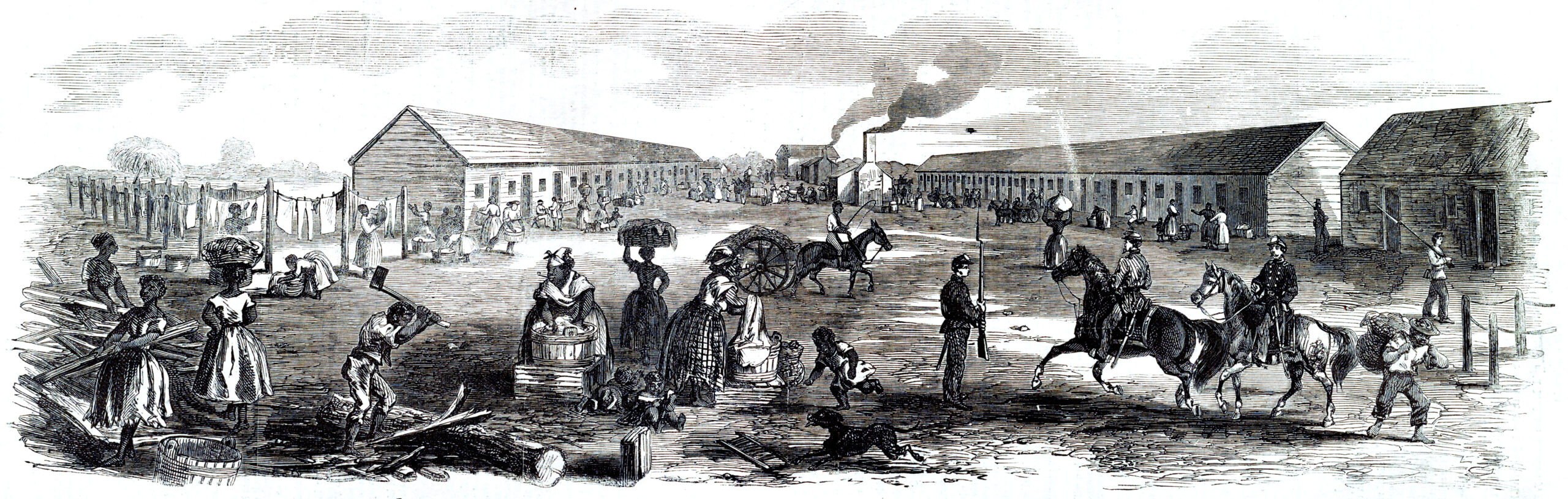 Library of Congress
By classifying Frank Baker, Sheppard Mallory, and James Townsend as “contrabands of war,” Butler knowingly or not provided a path toward freedom for thousands of enslaved men, women, and children. As news of his decision circulated, enslaved people made the hazardous journey to Fort Monroe, which soon became known as “Freedom Fortress.” By the end of May, Butler reported the presence of $60,000 worth of enslaved human chattel. He explained, “I had found work for them to do … and had appointed a ‘commissioner of negro affair’ to take this business off my hands, for it was becoming onerous.”10 They continued to come in “by twenty’s, thirty’s, and forty’s,” and, by July 30, over 900 contrabands sought refuge at the Union outpost.11 The sheer number of enslaved people flocking to Union lines expanded by the hour—a reality that was rapidly “becoming onerous” to other Union commanders.
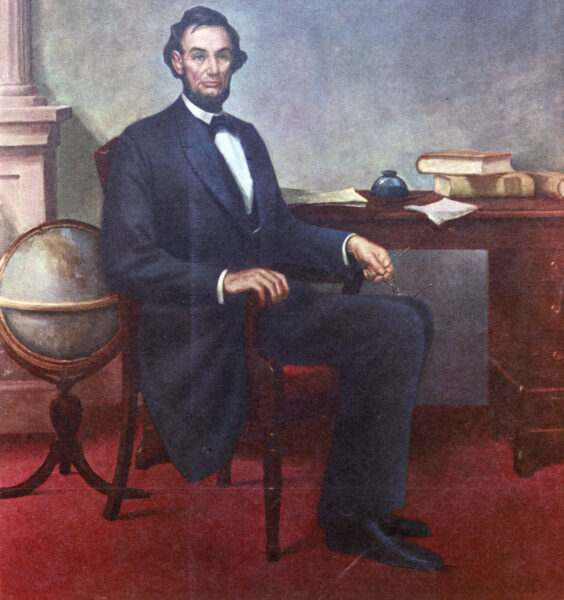
Without a uniform military policy in the war’s earliest days, Union officers acted on their own initiative. Some honored the Fugitive Slave Act of 1850 and returned runaways to their enslavers. Others acted in ways similar to Butler and accepted the labor provided, assigning the men and women as military cooks, laundresses, army drivers, and manual laborers. Although strictly emphasizing the need for military victory over the emancipation of enslaved people, President Abraham Lincoln and the War Department tacitly endorsed Butler’s policy. Then, in August 1861, Congress passed the First Confiscation Act, which formally authorized the seizure of Rebel property, including enslaved property, being used to aid the Confederacy.12 Although limited in scope, the act paved the way for the Emancipation Proclamation of January 1, 1863—and, it might be said, for the emancipation of four million enslaved people at the end of the Civil War.
Between April 1861 and April 1865, around 500,000 enslaved people fled bondage and made their way toward Union lines. As impoverished wartime refugees facing an uncertain future, most flocked to the Union army for protection, support, supplies, medicine, and the prospect of some paid employment. Some contrabands existed in a near constant state of movement alongside the marching Union armies while others established makeshift contraband camps in the shadow of large Union military sites and fortresses, living in castoff military tents or hastily constructed slab huts for months or years at a time. Caught in a state of legal limbo between the shackles of slavery and a state of permanent freedom, contrabands existed in a state of wartime transition, subsisting day-to-day while hoping for true freedom.13 Visiting a contraband camp in Virginia, a white missionary said, “the transition state through which these people are passing is truly a wilderness of suffering.”14 The overcrowded and unsanitary accommodations were rife with contagious diseases, sickness, and death—conditions that also plagued many army camps. At the Duff Green’s Row camp in Washington, D.C., Harriet Jacobs, an activist who had once been enslaved, “found men, women and children all huddled together, without any distinction or regard to age or sex. Some of them were in the most pitiable condition. Many were sick with measles, diptheria, scarlet and typhoid fever. Some had a few filthy rags to lie on; others had nothing but the bare floor for a couch.” Refugees looked at her as if to ask, “Is this freedom?”15 Elizabeth Hobbs Keckley, a formerly enslaved woman who worked as Mary Todd Lincoln’s dressmaker, founded the Contraband Relief Association in 1862. For the contrabands themselves, reprieve came only after the Confederacy’s surrender and the ratification of the 13th Amendment in 1865. At that moment, black Americans were no longer legally considered confiscated property in a wartime nation—but were full-fledged Americans.
Despite the term’s popularity among whites, enslaved people hardly ever referred to themselves as contrabands.16 The Liberator, an abolitionist newspaper in Massachusetts, noted that “it is not a proper term to be applied to human beings,” preferring instead the term “Colored Refugees.” “We prefer this designation of the people who are fleeing to our camps and fleets to that of ‘Contrabands,’ ‘Freedmen’ or ‘Vagrants,’ because the first implies property in man, the second described the ex-slaves as actually free, when their condition is otherwise, and the third indicates a degradation and status which the Refugees do not deserve.”17 In 1877, John Russell Bartlett added countless new words—most created by the war—to the Fourth Edition of Dictionary of Americanisms, which had first been published in 1848. Among the “words and phrases usually regarded as peculiar to the United States,” he added “Contrabands,” which was defined as “Negro slaves, first so called by General B.F. Butler, and treated as Contraband of War.”18 Today, those displaced by wartime conflicts are called “refugees.”
Tracy L. Barnett is visiting assistant professor of History at Old Dominion University in Norfolk, Virginia. She earned her doctorate in American History from the University of Georgia this year. Firearms—their meaning to men and their availability in 19th-century America—are at the center of her scholarship.
Notes
1. William Dwight Whitney, ed., The Century Dictionary: An Encyclopedic Lexicon of the English Language, Vol. II (New York, 1889), 1231.
2. Elizabeth D. Leonard, Benjamin Franklin Butler: A Noisy, Fearless Life (Chapel Hill, 2022), 66.
3. Benjamin Franklin Butler, Autobiography and Personal Reminiscences of Major-General Benj. F. Butler (Boston, 1892), 256.
4. Ibid., 263.
5. Ibid., 257-258.
6. [Charles Cooper Nott], The Coming Contraband: A Reason against the Emancipation Proclamation, not given by Mr. Justice Curtis, to whom it is addressed, An Officer in the Field (New York, 1862), 2–3; Kate Masur, “A Rare Phenomenon of Philological Vegetation”: The Word “Contraband” and the Meanings of Emancipation in the United States,” Journal of American History, Volume 93, Issue 4 (March 2007): 1050–1052.
7. Butler, Autobiography, 259.
8. Ibid.
9. Leonard, Benjamin Franklin Butler, 66–67.
10. Butler, Autobiography, 258.
11. Leonard, Benjamin Franklin Butler, 68.
12. House of Representatives Journal, 37th Cong., 1st Sess.
13. Amy Murrell Taylor, Embattled Freedom: Journeys through the Civil War’s Slave Refugee Camp (Chapel Hill, 2018), 5–7, 8–9.
14. H.S. Beal to Rev. Jocelyn, October 27, 1863, American Missionary Association Archive, Amistad Research Center as quoted in Taylor, Embattled Freedom, 9.
15. The Liberator (Boston, Massachusetts), September 5, 1862.
16. Taylor, Embattled Freedom, 9–10.
17. The Liberator, February 14, 1862.
18. John Russell Bartlett, Dictionary of Americanisms: A Glossary of Words and Phrases Usually Regarded as Peculiar to the United States, Fourth Edition (Boston, 1877), 140.
Related topics: African Americans, emancipation