 Anne SK Brown Military Collection
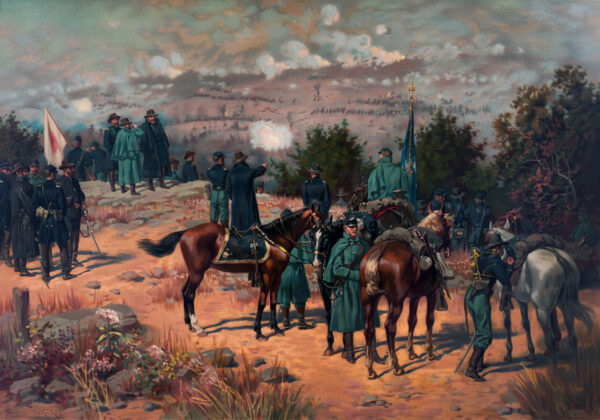
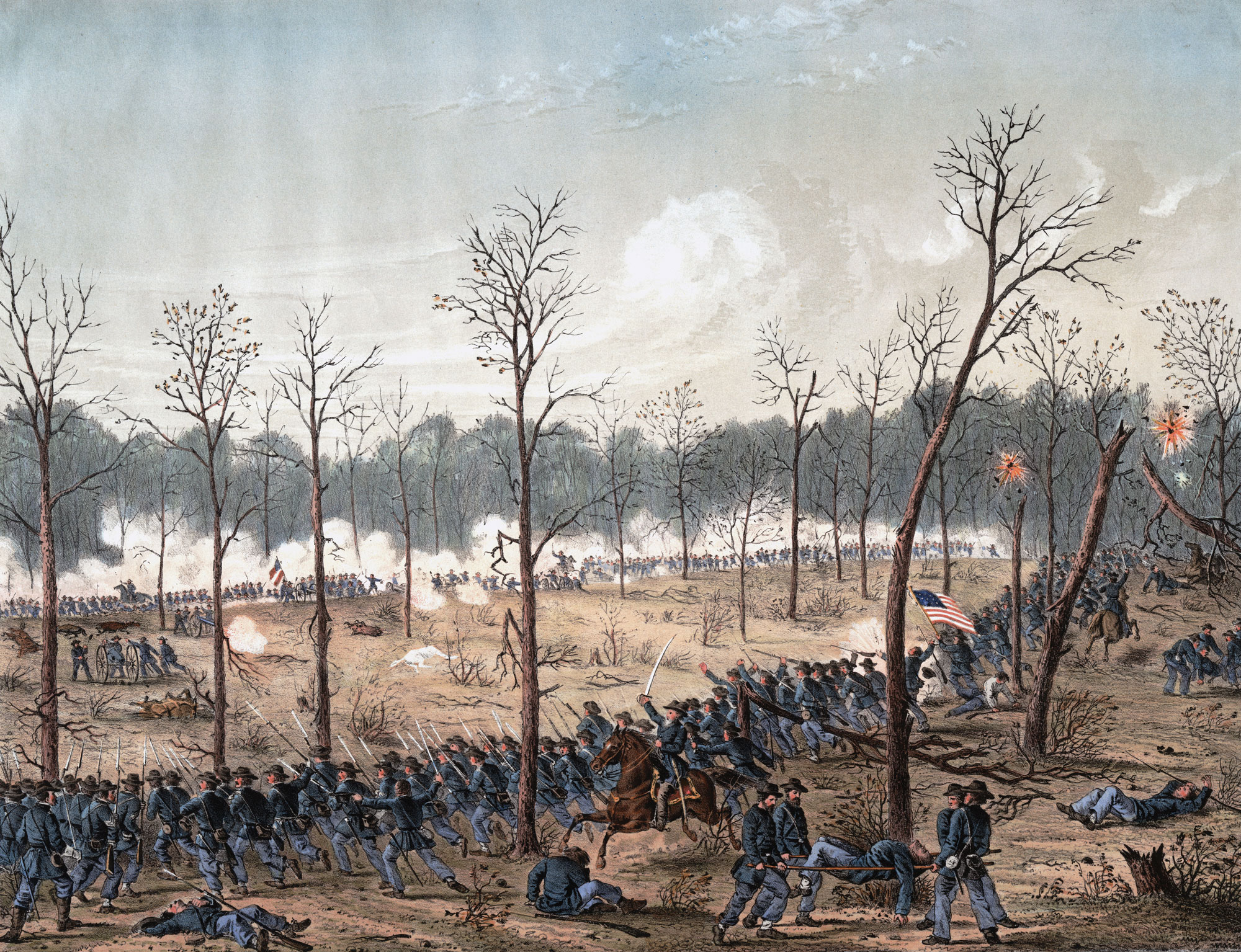
Union and Confederate soldiers clash during the Battle of Shiloh, in this color lithograph produced in 1862.
Twenty-one is rather young to lead men into battle. Yet, in April 1862, Lieutenant Ephraim Cutler Dawes, at 21 a recent college graduate with no military experience, found himself attempting to hold back catastrophe in the opening moments of the Battle of Shiloh. As adjutant of the 53rd Ohio Volunteer Infantry, Dawes expected his responsibilities to consist mainly of helping his commanding officer, Colonel Jesse J. Appler, oversee the details of regimental organization and paperwork. The 53rd Ohio, like most other units in the Union Army of the Tennessee that spring, was a new outfit full of green recruits. The Ohioans had received their muskets in Paducah, Kentucky, only a few weeks before. Most of the volunteers had never fired their weapons, nor been drilled in their use by their novice officers. Even worse, by the time the 53rd arrived at its camp near Pittsburg Landing, Tennessee, about two-thirds of the regiment were incapacitated by illness and unfit for duty. To cap things off, Colonel Appler was in a nervous state, and the toll of his mental stress was already grating on the men around him, including his corps commander, William T. Sherman.
Upon the Confederates’ April 6 surprise attack, Colonel Appler panicked and had what we would probably today call an emotional meltdown. According to Dawes, Appler flew into hysterics, told his regiment to flee for their lives, and then quit the field, leaving his men at a loss. As Dawes tells it, “We were in the front of a great battle. Our regiment never had a battalion drill. Some men in it had never fired a gun. Our lieutenant-colonel had become lost in the confusion of the first retreat, the major was in the hospital, and our colonel was a coward!”1 Dawes went on to describe how he took charge, helped rally the other company commanders in the regiment, and formed a makeshift line of battle long enough to prevent his unit’s destruction. Because of these quick decisions, the regiment and many other lives were saved, and Dawes survived to tell the story in later years; Appler, on the other hand, was forced out of the army soon after Shiloh.2
Inexperienced soldiers, a lack of training and preparation, young officers with no combat history, and anxious leadership—all of these obstacles, common in the early months of the Civil War, were indeed daunting if hardly unique. Sorting out how and why armies and commanders succeed or fail is a natural pursuit of military history. But why should we, living now in the 21st-century world of pandemics, economic and environmental catastrophes, the possibility of global wars, and the pressures and concerns of modern life, care what a 21-year-old volunteer company-grade officer did or did not do in the remote woods of southwest Tennessee in April 1862?
I suggest that that terrible experience on the Battle of Shiloh’s first day—and how and why young Dawes survived it—can teach us something about the nature and art of history itself.
Human history is often a story of decisions. Each day, people are confronted with choices; some, like what to have for breakfast or which tie to wear, are mundane and usually inconsequential. Others are more significant—which career path to pursue, whether to buy a house or a car, to get married or to have children—and can affect our lives and futures tremendously. Still others are split-second, seemingly thoughtless decisions, such as whether to slip through a gap in traffic, or get on an airplane or a train, or myriad other decisions subject to factors beyond our knowledge and control. Decisions large and small are central not only to our lives, but also to our past—and to the essence of warfare. And, as the proverb goes, kingdoms rise and fall “all for the want of a horseshoe nail,” where apparently inconsequential or minor acts or omissions can spiral into unforeseen and momentous outcomes. If junior officers like Dawes failed to take charge in a time of crisis, and instead left it to others or allowed fear and panic to master them, the past might be different. Historians of war are concerned with not only the “why” and “how” of past conflict, but also, most importantly, “what did it mean for what came after,” always tempered by context and the understanding that things need not have turned out as they did.
History is a story about people, and war history is a story of people’s decisions as much as it is a chronicle of events, moments, and change over time. The past will remain veiled to us unless we see connections, decisions, and agency among those people through both their experiences and the possibilities—not always visible or knowable—before them. Human actions can and do make a difference, though these actions do not always (or even often) follow logical paths. Studying decision-making in war also teaches us about how war was waged, something that, while occupying mountains of paper and oceans of ink over the years, still remains an elusive concept, particularly to those who have not experienced combat firsthand. How decisions were made in the Civil War depended very often on the nature of command and control at the tactical level, where a field or company officer’s command presence was restricted to his ability to communicate his wishes to his unit. This meant that orders had to be given either directly by voice, relayed from element to element through vocal commands, or transmitted in written form and delivered by mounted courier. Clearly, it was difficult for commanders at the division level or higher to exercise direct control over their commands in a fast-developing combat crisis. This is an easy thing to forget, given our modern reliance on instantaneous long-distance communication, and a reminder of the importance of seemingly minor figures like Lieutenant Dawes at Shiloh.
Finally, a clearer understanding of wartime decisions produces a more complete picture of their consequences and the complex factors that led to their being made. When officers and men lacked experience, as in Dawes’ case, the outcome was usually not positive. In some instances, inexperience could lead combatants to push themselves to the point of annihilation. At the Siege of Petersburg in June 1864, for instance, the grossly unpracticed 1st Maine Heavy Artillery experienced the costliest engagement of any single Civil War regiment, and through a combination of bravery and naiveté was almost wiped out in a matter of moments. The 1st Maine was an oversized infantry regiment composed of members of former garrison troops from the Washington defenses. Veterans watched in dismay as the green Maine volunteers launched an unsupported attack across open ground. “The enemy’s firing along their whole line was now centered into this field,” remembered a witness. “The earth was literally torn up with iron and lead. The field became a burning, seething, crashing, hissing hell, in which human courage, flesh, and bone were struggling with an impossibility, either to succeed or to return with much hope of life.”3 The outcome was predictable. Having begun the charge with 900 men, the 1st Maine Heavy Artillery left seven officers and 108 men dead on the field, with another 25 officers and 464 men wounded; another 19 would die of their wounds, and one man was taken prisoner. These casualties represented over 68 percent of the regiment, the largest loss of men or officers in any one unit on any one day of battle in the Civil War.
Understanding small decisions takes us a long way toward understanding their sometimes greater, sometimes tragic consequences, and thus woven with sectional and political and even heroic narratives, a better picture emerges of the American Civil War. In future installments, we’ll consider some of those decisions and their impact on the course of the conflict.
Andrew S. Bledsoe is professor of history at Lee University in Cleveland, Tennessee. He is the author of Citizen-Officers: The Union and Confederate Volunteer Junior Officer Corps in the American Civil War (Louisiana State University Press, 2015); co-editor, with Andrew F. Lang, of Upon the Field of Battle: Essays on the Military History of America’s Civil War (LSU Press, 2019); and author most recently of Decisions at Franklin: The Nineteen Critical Decisions That Defined the Battle (University of Tennessee Press, 2023).
Notes
1. Ephraim C. Dawes, “My First Day Under Fire at Shiloh,” Sketches of War History, 1861–1865, Papers Prepared for the State of Ohio Commandery of the Military Order of the Loyal Legion of the United States, Volume 4 (1896), 10–11.
2. For a full account of what happened to Appler, Dawes, and the 53rd, I refer you to my first book, Citizen-Officers: The Union and Confederate Volunteer Junior Officer Corps in the American Civil War (Baton Rouge, 2015).
3. Horace H. Shaw, The First Maine Heavy Artillery, 1861–1865 (Portland, ME: n.p., 1903), 122.