Soldier fires a Coehorn Mortar in a Harper’s Weekly illustration.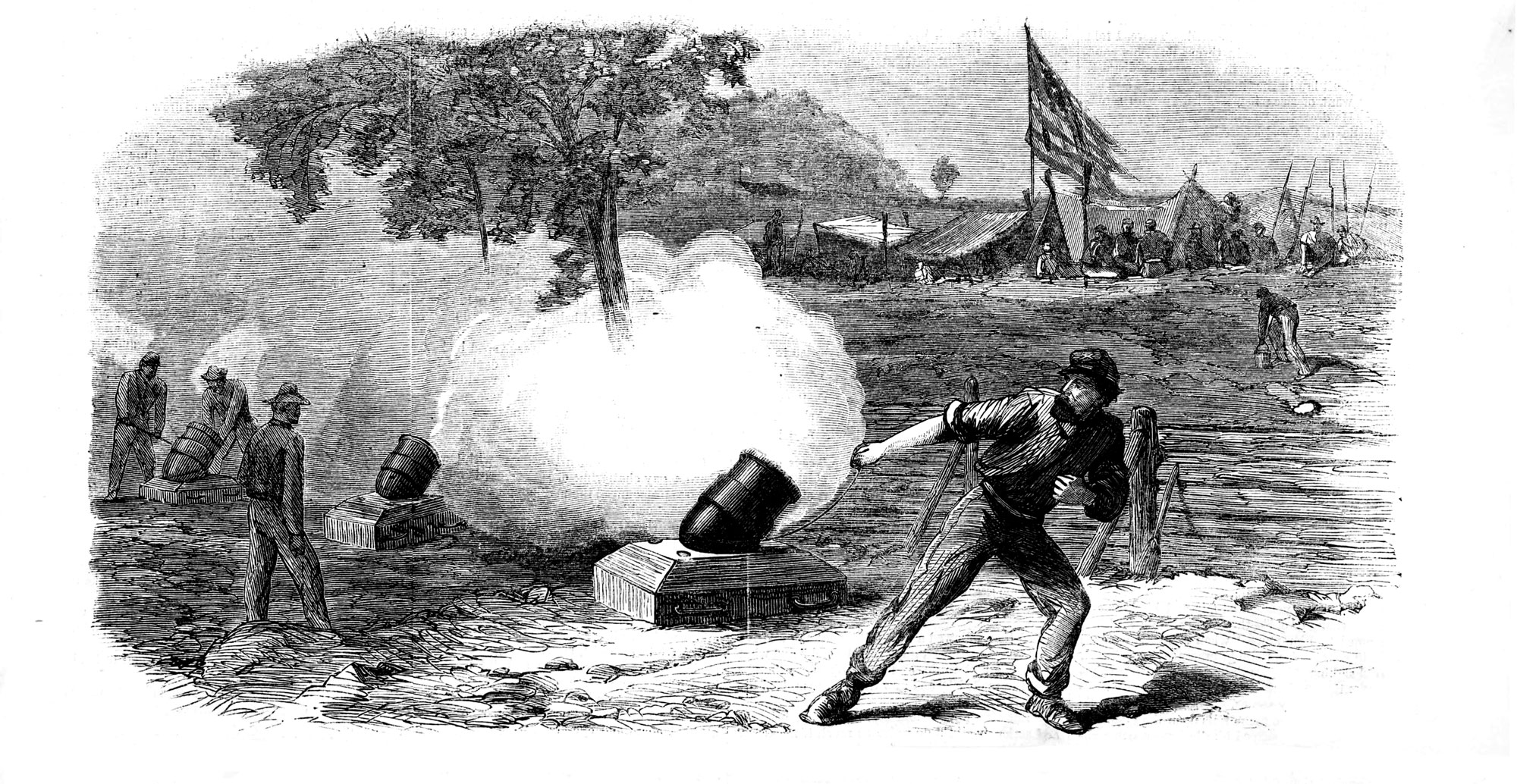 Harper's Weekly
“The effect was excellent, and in about half an hour the rebels ceased to fire entirely. The position was such that the damage caused by the explosion of the shells was plainly discernible; and it was reported furthermore by our skirmishers that great execution ensued and the utmost consternation was visible among the enemy.” So wrote Captain James H. Wood, 4th New York Heavy Artillery, in July 1864, reporting on the effectiveness of his battery of six Coehorn mortars during the Siege of Petersburg, Virginia.
Named after its inventor, Menno, Baron van Coehoorn, a 17th-century Dutch military engineer, the Coehorn was a small smoothbore mortar that employed high-arcing “vertical” fire to lob fuse-detonated explosive shells at fortified enemy troops. Unlike bulkier siege weapons, the Coehorns were easily transported and allowed their users to quickly change their direction of fire, so that “a single mortar, moved from place to place, might to the enemy appear to be a whole battery,” noted one Union artillerist. The Union weapon was made of brass, the Confederate one of cast iron.
Both sides relied more heavily on Coehorns as the opposing armies increasingly dug in over the war’s final year. Shown here are statistics associated with the 24-pounder model 1838 Coehorn, the standard version employed by Union forces.
Coehorn Mortar by the Numbers
Total length of the Coehorn: 16.32″
Length of the bore: 13.07″
Diameter of the bore (caliber): 5.82″
Length of the powder chamber: 4.25″
Number of Coehorn shells ordered by the federal government in October 1864: 20,000
Weight of the Coehorn: 164 lb
Suggested number of men needed to transport the Coehorn and its bed by hand: 4
Number of men necessary to service a Coehorn (one gunner and two cannoneers): 3
Additional men needed to prepare and transport its ammunition: 2
Weight of the Coehorn’s wooden mortar bed: 132 lb
Elevation of the Coehorn: 45°
Number of Coehorns ordered by the federal government from February 1862–January 1865: 248
Price paid for these Coehorns, or an average of $132 per Coehorn: $32,806.57
Sources
Executive Documents Printed by Order of The House of Representatives During the Second Session of the Fortieth Congress, 1867–68 (1868); James C. Hazlett, Edwin Olmstead, and M. Hume Parks, Field Artillery Weapons of the Civil War (1983); Siege Artillery in the Campaigns Against Richmond (1867); Story of Co. F, 23d Massachusetts Volunteers in the War for the Union, 1861–1865 (1896); The Hand-Book of Artillery for the Service of the United States (1863); United States War Department, The War of the Rebellion: A Compilation of the Official Records 129 vols. (Washington, 1880–1901), Series I, Vol. 36, Part 1.
Related topics: weapons