Library of Congress
In this Currier & Ives rendition of the Lincoln assassination, Major Henry Rathbone and his fiancée, Clara Harris, look on in helpless horror as the president, seated next to his wife, Mary Todd Lincoln, is shot by John Wilkes Booth.
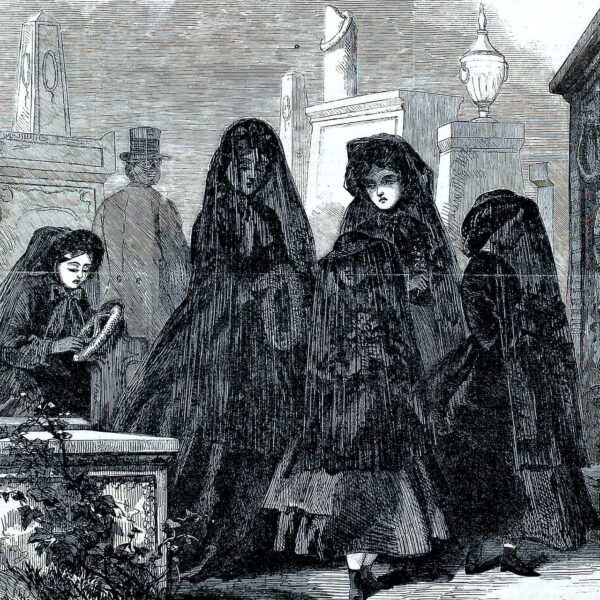
As news of the assassination rippled out, a distracted nation looked up from its varied pursuits and focused for a single collective moment on a shared spectacle. A president had never been assassinated before, and there were no emotional precedents. Walt Whitman spent the day with his mother. “We heard the news very early in the morning,” he remembered. “Mother prepared breakfast—and other meals afterward … but not a mouthful was eaten all day by either of us. We each drank half a cup of coffee; that was all. Little was said. We got every newspaper, morning and evening…and pass’d them silently to each other.” An unknown diarist was too agitated to remain at home. He wandered the streets of New York for miles, hours, sketching the hastily hand-painted memorials that adorned the city’s businesses. “Oh how solemn this day,” he wrote on the cover of his sketchbook. “What a great calamity has fallen upon our country. Never in the history of our government has such a gloom pervaded every mind, sadness is seen on every countenance.”1
The psychological damage was greater the closer one got to the epicenter of the disaster. Mary Lincoln had been sitting next to her husband, holding his hand, during the play. Even so, her love had had no power to protect him, and her mental tether, never the strongest, now snapped. At the president’s deathbed, James Tanner thought Mary Lincoln’s wail worse than anything he’d heard in the Manassas hospital where he’d had both his legs sawed off. “I have witnessed and experienced much physical agony,” he noted, “but of it all nothing sank deeper in my memory than that moan of a breaking heart.”2
If one listened carefully, one could hear the breaking of a mind too. For the rest of her life, Mary never felt truly safe. People were out to steal from her, she said, or murder her. She kept stocks and bonds secreted on her person; she fled the country; when she returned home she carried a gun until her family worried that, in her mental twilight, she might hurt someone, including herself.
No one has ever pointed out the similarities in the mental aftermaths of Mary Lincoln and Henry Rathbone. Henry and his fiancée, Clara Harris, completed the quartet in the Lincolns’ box that night. Clara was the daughter of New York senator Ira Harris, a man who had been so often underfoot at the White House that Lincoln joked he always checked under his bed before retiring to make sure the senator wasn’t waiting to ambush him first thing in the morning. Clara performed heroically in the assassination’s aftermath and was Mary’s main support both at Ford’s Theater and at the Petersen House, where they took Lincoln to die after. It was only much later that Clara felt the full mental weight of what had happened. “I [cannot] settle myself quietly,” she wrote a friend a week after the assassination. “When I [sit] down to write, I [do] not intend alluding to these fearful events at all, but I really cannot fix my mind on anything else—though I try my best to think of them as little as possible, I cannot sleep, & really feel wretchedly.”3
Her fiancé was even more haunted. Like Clara, Henry Rathbone had conducted himself faultlessly that evening. He had been the first to register what was happening; he was the only man in the theater to actually grapple with Booth, a courage that won him a savage knife wound from his elbow to his armpit. Bleeding profusely on his fiancée’s dress, hair, and face, he helped carry Lincoln out of the theater before beginning to swoon. In a pale delirium, he was carried back to the Harris household where he still had no concern for himself but only raved about Lincoln: “The president has been shot!” “God in heaven save him!”
Henry recovered, but like Clara, he could not immediately shake the experience, and in him the damage took deeper root. He seems never to have gotten over the possibility that he had not done enough or had failed some critical test. In truth, Booth’s bullet had penetrated all their brains and, as in Mary’s case, Henry’s tortured feelings of helplessness and insecurity became generalized as he aged. He and Clara married in 1867 and had three children in the years after, but Henry became gradually obsessed by the idea that Clara would leave him. He may have been dimly aware that his possessiveness was the only thing driving her away, but after the assassination nothing could be held tightly enough, nothing dear was secure. Mary Lincoln had the same reaction. She clutched her son Tad, her brooches, laces, and calfskin gloves, and held on for dear life in the midst of a mental maelstrom. Rathbone clutched his wife the same. And he too began to carry a gun.
Just before Christmas 1883, the Rathbones were in Germany, where they had lived for seven months. The children were in bed, and Henry wanted to check on them, but Clara led him back toward their bedroom. There he slipped into the chamber, raised a gun and pulled the trigger, failing yet another person he was pledged to protect. He then turned a knife on himself.4 In all his years at the asylum, he could never quite admit that he had committed the crime. He preferred to think that he had suffered his new wound while struggling with his wife’s assassin, which in a sense he had.
Memory must run clean all the way back to its headwaters, to pure origins in the mist of childhood. When bad things happen the mind may get stuck in an eddy and turn stagnant circles for a time. Sometimes the eddy releases the mind; sometimes the eddy becomes a whirlpool, and draws the whole of a man down into dark water. “There is a fatality,” Nathaniel Hawthorne knew, “a feeling so irresistible and inevitable that it has the force of doom, which almost invariably compels human beings to linger around and haunt, ghost-like, the spot where some great and marked event has given the color to their lifetime; and still the more irresistibly, the darker the tinge that saddens it.”5
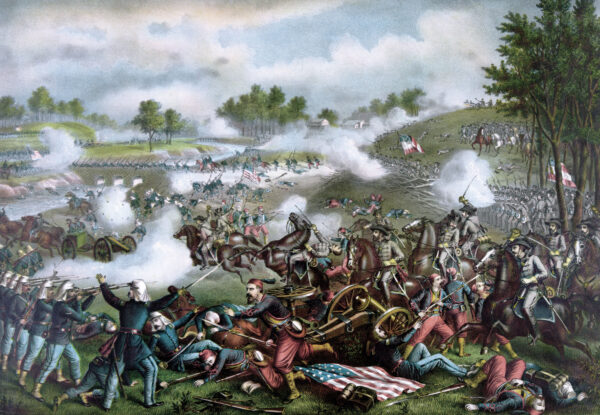
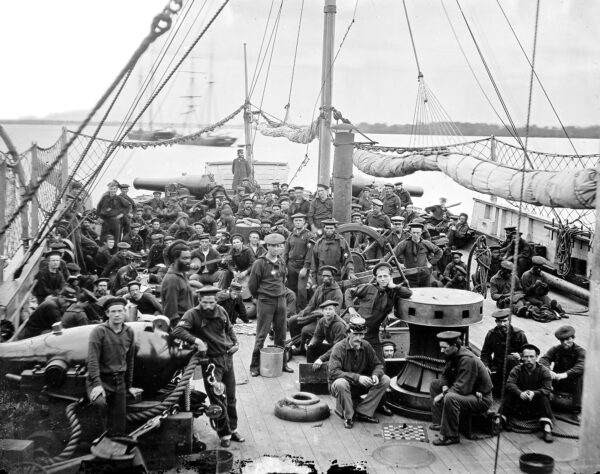
We recognize the 620,000 men who died in the war. To some lesser degree, we recognize the other battlefield casualties: the wounded and the missing and those whom artillery reduced to “pink mist.” But war’s damage has a way of piling up, rippling out, to claim even those far removed from it in place and time. Clara Harris Rathbone belongs on that list of unfortunates, for she too was a casualty of war.
Stephen Berry is associate professor of history at the University of Georgia. He is the author or editor of four books on America in the Civil War era, including House of Abraham: Lincoln and the Todds, A Family Divided by War (Houghton Mifflin Harcourt, 2007).
Notes
1. Whitman, Memoranda During the War (1875), 82; Ted Widmer, “New York’s Lincoln Memorial,” The New York Times, April 16, 2009.
2. James Tanner, “Last Hours of President Lincoln,” New York Legislative Documents, vol. xxxvii (1920), 334.
3. Harold Holzer, “Eyewitnesses Remember The ‘Fearful Night’,” Civil War Times Illustrated (March/April, 1993): 14.
4. For details of Rathbone’s crime, see “Colonel Rathbone’s Mania,” New York Tribune, December 31, 1883, p. 1.
5. Nathaniel Hawthorne, The Scarlet Letter (New York, 2011), 21.
Related topics: women