z Library of Congress
“PLEASE DROP PAPERS.”
—Message on a sign made by Union soldiers on guard duty along the Louisville and Nashville Railroad, in hopes that passengers might toss them reading materials
“While we were bringing water he sat down on the ground, and pulled from his bosom a copy of Andrews’ Latin Grammar. It was covered thick with his blood. He turned to the fifth declension and began with res, rei. He said that … he found this book, and had carried it under his blouse in the fight, thinking if he was wounded or taken prisoner he would be able to go on with his Latin.”
—Rev. E.P. Smith, U.S. Christian Commission, on the wounded soldier he encountered after the Battle of Missionary Ridge
“You see I must read something, or my mind would become as rusty as a boy’s jack knife that has been lost in a rubbish pile for a year or two, and in the absence of anything better I devour every novel I get hold of.”
—Major James A. Connolly, 123rd Illinois Infantry, explaining why he had read David Copperfield and The Confessions of Con Cregan, in a letter to his wife, February 14, 1864
“I wish I had some books. The best I can do now is to repeat over and over such pieces of poetry as I have committed to memory.”
—Charles B. Hayden, 2nd Michigan Infantry, in his diary, June 21, 1861
x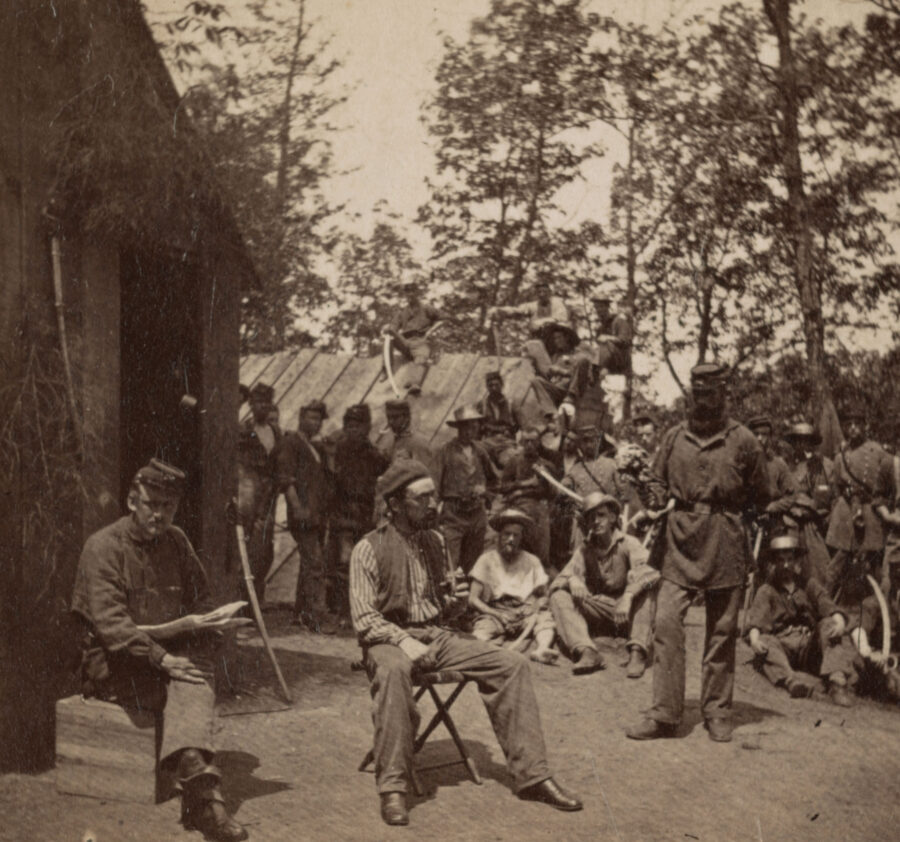 Library of Congress
“We opened one morning at nine o’clock with a stock of four thousand books and papers, and at two o’clock P.M. all were gone, and almost every one taken from the counter,—a book or paper to each man who presented himself.”
—Rev. William A. Lawrence on the soldiers’ reading room established by the U.S. Christian Commission in Savannah, Georgia, after the city’s capture by Union forces in December 1864
y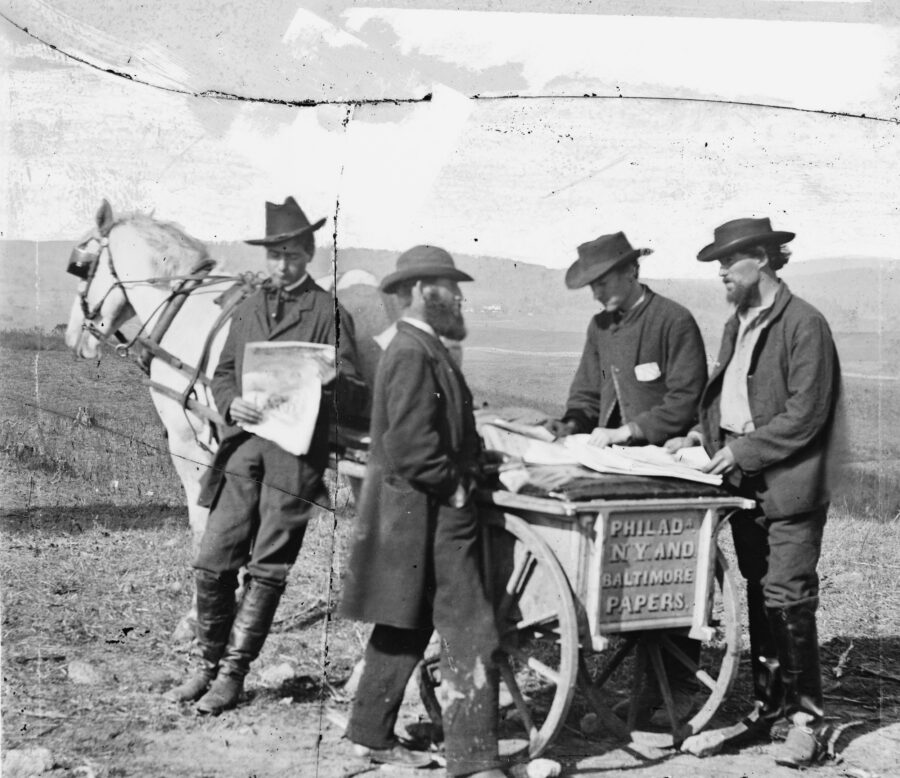 Library of Congress
“No sooner did an army halt within reach of these enterprising fellows than they were to be seen galloping from brigade to brigade distributing daily newspapers to eager buyers…. With what delight the veterans read descriptions of actions they had taken part in….”
—War correspondent George F. Williams, on the arrival of newspaper vendors in camp, in his reminiscences of the conflict
Sources
Annals of the United States Christian Commission (1868); David Kaser, Books and Libraries in Camp and Battle (1984).