 Harper’s Weekly
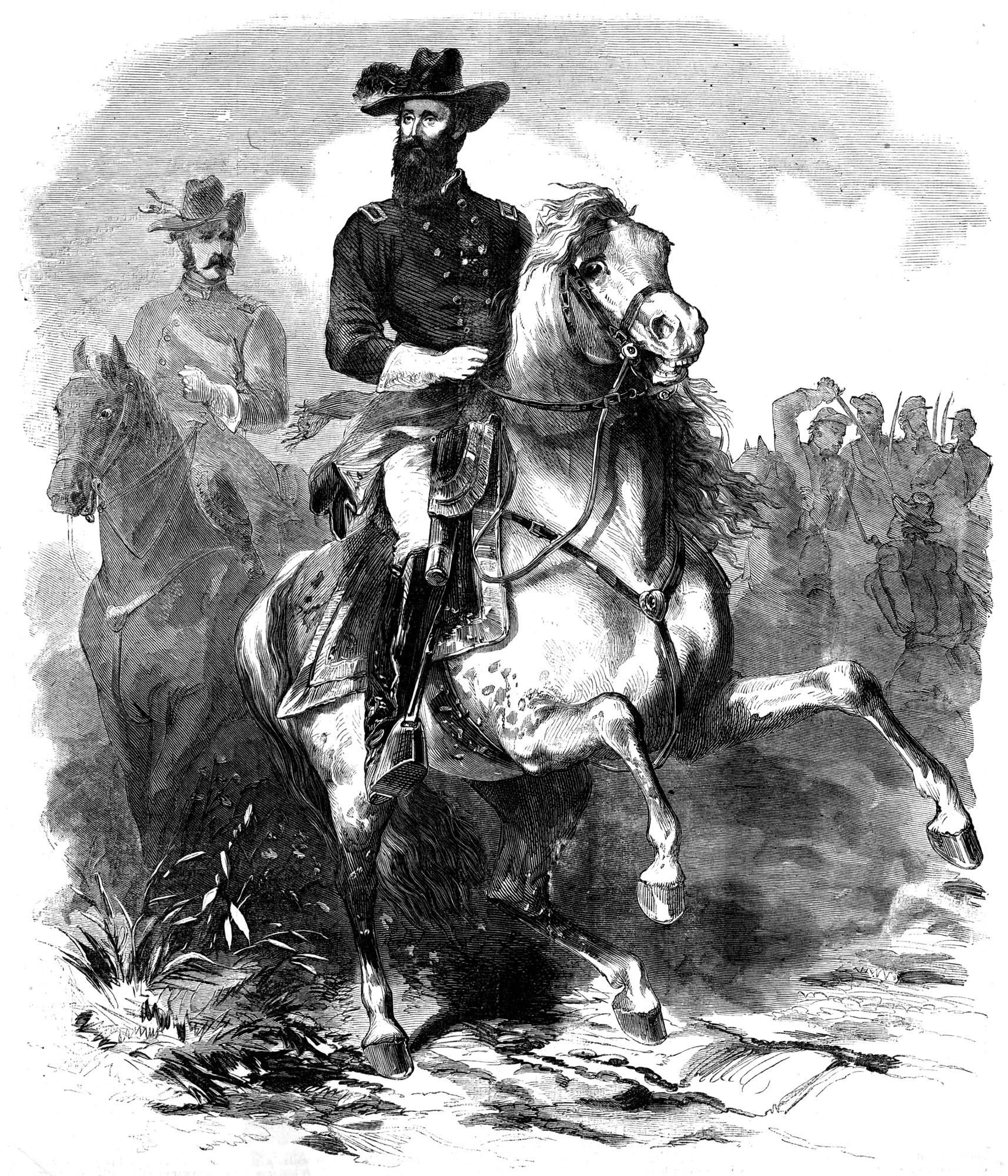
Harper’s Weekly published this full-page illustration of Benjamin Grierson on the cover of its June 6, 1863, edition. An accompanying article lauded the “famous” colonel’s “magnificent raid through Mississippi.”
On the morning of April 17, 1863, three columns of Union cavalry, some 1,700 men, waited for the order to move out of the village of La Grange, Tennessee. The troopers adjusted equipment, checked weapons, and reassured the nervous mounts. Theirs was a dangerous errand, and at their head sat a former music teacher and multi-instrumentalist, a man rumored to not even like horses.1
Colonel Benjamin Grierson—wiry, heavily bearded, and soft-spoken—hardly looked the part of a cavalry raider. As a boy in Pennsylvania he had been kicked in the face by a spooked horse, an experience that left him comatose, scarred, and temporarily blind. Though he recovered, Grierson always remembered the incident as a cautionary lesson against recklessness.2 Yet on that golden spring morning he was about to lead his brigade of Midwesterners on one of the boldest and most consequential raids of the war, deep into the bowels of Confederate territory.
Over 16 days, the 6th and 7th Illinois and 2nd Iowa cavalry regiments, accompanied by a battery of horse artillery, would ride 600 miles through the heart of Mississippi, tearing up railroads, burning depots, scattering Confederate units, to arrive mud-caked and triumphant at Union lines in Baton Rouge, Louisiana. The operation known as Grierson’s Raid would not win the war, but it had the potential to affect an important campaign at a critical moment. It would go down in legend as one of the most daring feats of the conflict and later inspire both a novel and a Hollywood film (1959’s The Horse Soldiers) starring John Wayne. And, most importantly, it did help ensure a major Union strategic victory.
By the spring of 1863, the Union war effort in the West hinged on one place: Vicksburg, Mississippi. Perched on bluffs overlooking a sharp bend in the Mississippi River, the city was the Confederacy’s Gibraltar. As long as it held, the South controlled the continent’s central artery, keeping Texas, Arkansas, and Louisiana connected to the eastern Confederacy, along with vital supplies and materiel its armies needed. Cut Vicksburg off, and the Confederacy would be split in two.
Major General Ulysses S. Grant clearly understood this reality. From his perspective, getting at Vicksburg was the problem. Swamps, bayous, failed canal projects, and stubborn Confederate defenses had frustrated him for months. By April, Grant was ready to execute a daring maneuver: march his army down the west bank of the Mississippi, cross below Vicksburg, and attack the city from the south. In order to do that, Grant had to separate from his line of communications; to be successful, he needed the Confederates to be distracted.
The plan had been in the works for some time, and it was deceptively simple: send a large cavalry force deep into Mississippi to destroy railroads and telegraph lines, and thus compel
Confederate general John C. Pemberton to make a decision. If Pemberton believed the raid threatened the state’s interior, he might strip forces from the Vicksburg works to pursue the raiders, and thus weaken the city’s defenses for Grant’s siege and assault there. But cavalry raids in the Civil War were notoriously fragile undertakings. One wrong turn, one encirclement, and an entire column could be swallowed up and destroyed. The Union plan would have to rely not on brute force, but on speed, deception, and uncertainty.
Grierson’s Raid is instructive, because it presents students of the war with clear instances of command decisions yielding measurable and consequential results. The raid’s success would depend largely on Grierson’s ability to keep Confederates off-balance and guessing as to his whereabouts, and throughout the operation, the colonel exercised the art of disappearing.
For instance, very early on Grierson made a critical decision to ignore basic military principles and divide his command. Within days of crossing into Mississippi, he detached men under Colonel Edward Hatch, Captain Henry C. Forbes, and others on several mini-raids and ordered them to ride in all directions, make noise, and draw attention. Grierson decided to focus on speed over destruction; he forbade looting except for necessary supplies and required his troopers to treat southern civilians with restraint, and not to linger long in one place. Their mission was not destruction but deception, and Grierson’s men proved very effective in that regard.3
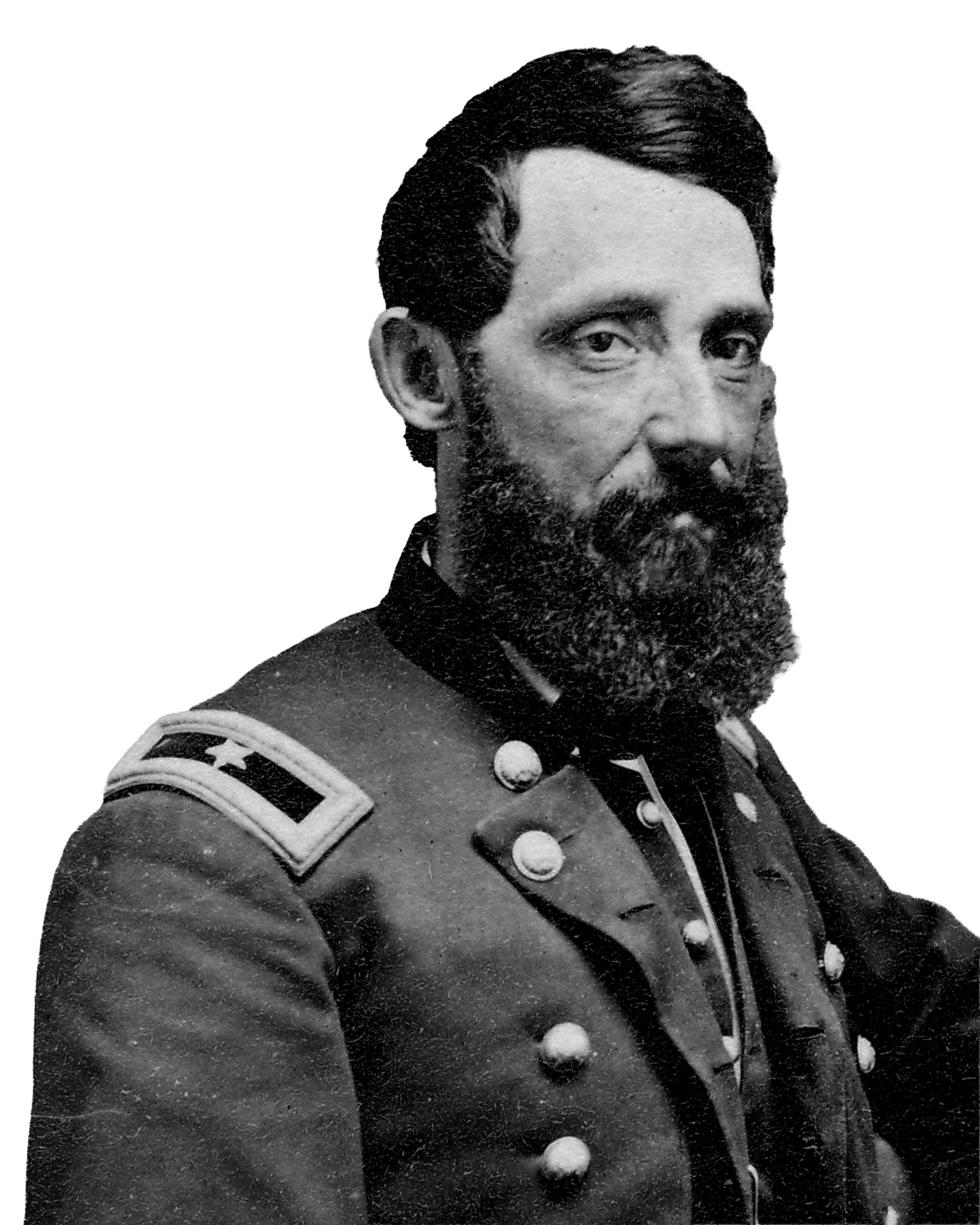 Missouri Historical Society
Benjamin Grierson
Confederate pursuers struggled to determine the raid’s true direction. Reports conflicted. Some swore the Yankees were headed for the Mississippi Central Railroad, others claimed they were aiming for Jackson, and telegraph lines flickered with the confusion.4 The uncertainty the raiders provoked among Confederates was central to Grierson’s strategy. Civilians awoke to rumors that thousands of Union horsemen were galloping through the Mississippi countryside. Wild stories abounded. Militia units formed and dissolved. Slaves watched carefully; some slipped away to join Grierson’s raiders as guides, and others cautiously approached them to help in other ways.5
Meanwhile, Grierson veered deeper south, deliberately zigzagging his raiders through small towns like Pontotoc, Starkville, and Louisville to keep Confederate scouts guessing. The Southern Railroad of Mississippi and the Mobile & Ohio line were lifelines to Vicksburg. By tearing up and otherwise destroying rails, Grierson disrupted the Confederacy’s ability to move reinforcements. Each mile of ruined track or cut telegraph line was time stolen from Pemberton, and time bought for Grant.
On April 24, near the town of Newton Station, Grierson faced another pivotal choice. Scouts reported Confederate cavalry closing in. The railroad lay ahead, an attractive target but a dangerous one. To attack it would mean halting in one place and inviting encirclement by the enemy.
Grierson attacked. His troopers overwhelmed a small Confederate force, burned several train cars loaded with ammunition, tore up track, and destroyed telegraph equipment. The destruction was thorough. For hours, smoke billowed over the pine woods.
It was another calculated risk that paid off. Had Confederate forces converged quickly, Grierson’s column, deep in hostile territory, might have been trapped. But he gambled that speed and confusion remained on his side, and he won the wager.6 Confederates, receiving fragmentary intelligence, misread the raid’s objective. Convinced that Jackson or Meridian were the true targets, they diverted troops that might otherwise have reinforced Vicksburg.
Still, Grierson’s horsemen were not out of the figurative woods after the Newton Station fight. Spring rains had turned roads into mud, horses went lame, rations dwindled, and soldiers fell ill. The men would often sleep in the saddle, moving at night to evade pursuit and trying not to fall off their horses in their exhaustion.
At one point, with ammunition low and Rebel forces rumored ahead, Grierson convened his officers. Some urged turning west toward the Mississippi River for safety, but Grierson refused. To turn back would signal failure—and allow Confederate forces to claim victory. Worse, it would free Pemberton to concentrate on Grant. Instead, Grierson pressed south, toward Union-held Baton Rouge. It was the longer route to safety, but it also cut across the grain of Confederate expectations. This decision marked the raid’s most daring moment.7
By then, Grierson’s raiders had penetrated so deeply into the Mississippi interior that retreat was nearly as dangerous as advance. His quiet confidence helped hold the command together, and his willingness to engage in calculated gambles had seen the brigade through to this point. Pemberton realized the size and scope of Grierson’s raid too late; he ordered Confederate cavalry under Wirt Adams and Robert V. Richardson to track down and defeat Grierson, but to no avail.8
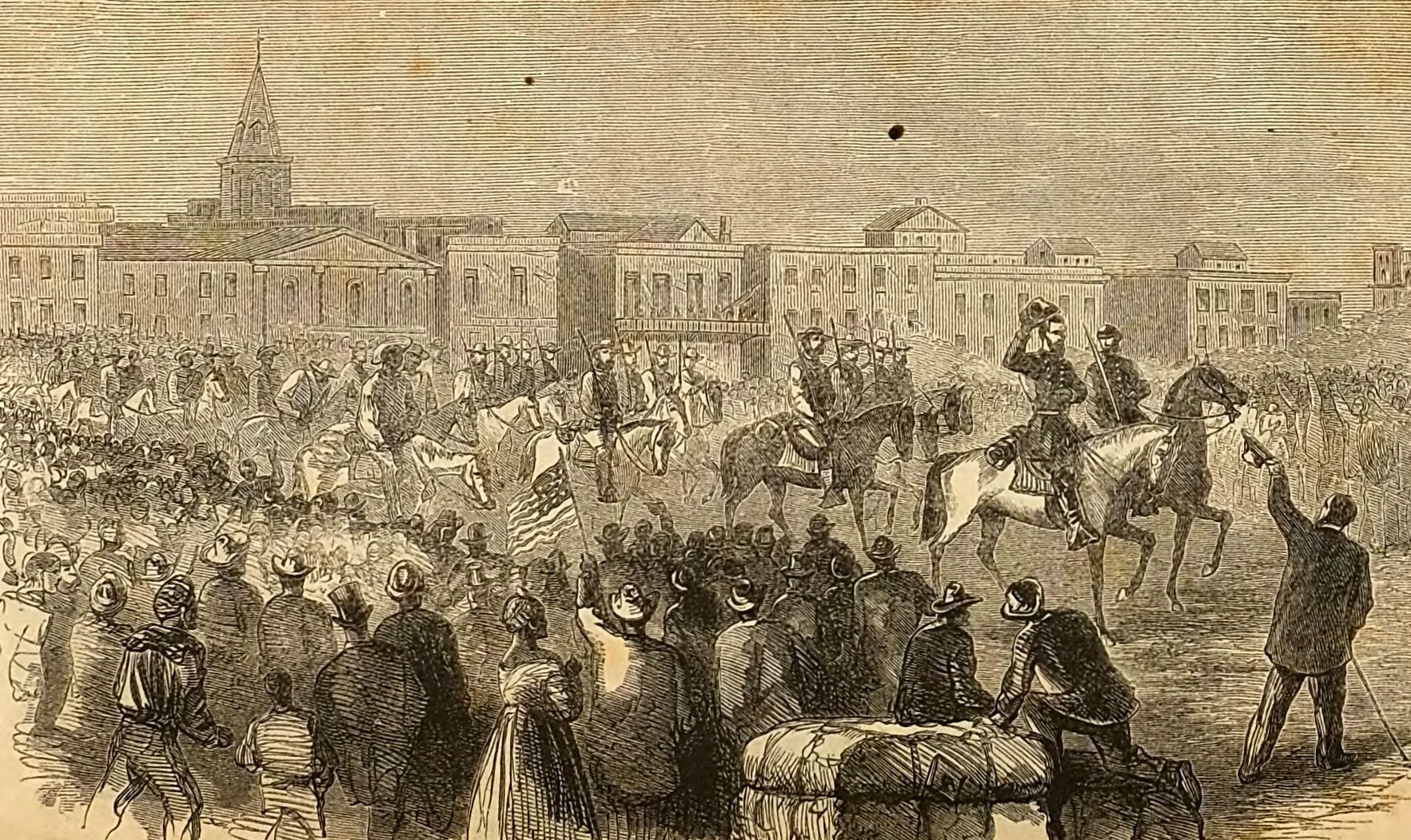 Harper’s New Monthly Magazine
In this wartime illustration, Colonel Benjamin Grierson and his horsemen are depicted entering Union-occupied Baton Rouge, Louisiana, at the end of their daring diversionary raid.
While Confederate leaders argued over the raiders’ intent, Grant executed his river crossing at Bruinsburg, Mississippi, on April 30. Within weeks, Union forces would isolate Vicksburg entirely. On May 2, muddy and tired but exultant, Grierson’s men rode into Baton Rouge. They had lost fewer than 100 men killed, wounded, or captured. They had destroyed miles of railroad, burned depots, captured prisoners, and tied down thousands of Confederate troops. More than that, they had demonstrated that Union cavalry, long dismissed as inferior to its southern counterpart, could strike deep behind enemy lines and survive. Grant was effusive in his praise for the operation. “Colonel Grierson’s raid from La Grange through Mississippi has been the most successful thing of the kind since the breaking out of the rebellion,” he proclaimed. “The Southern papers and Southern people regard it as one of the most daring exploits of the war.”9
In the weeks that followed, the Union army pounded Vicksburg relentlessly. On July 4, Pemberton surrendered Vicksburg to Grant. Confederate reinforcements that might have shifted the balance had been delayed or misdirected, in no small part due to Grierson’s ability. At multiple moments—by detaching and dividing his command, attacking Newton Station, refusing to retreat, and cultivating deception—Grierson mixed boldness with careful calculation. Each choice compounded Confederate uncertainty and preserved Union initiative. The raid’s success was not inevitable. A faster Confederate response might have spelled disaster. But war often turns on people like Colonel Benjamin Grierson, leaders willing to make hard decisions under intense pressure.
Andrew S. Bledsoe is professor of history at Lee University in Cleveland, Tennessee. He is the author of Citizen-Officers: The Union and Confederate Volunteer Junior Officer Corps in the American Civil War (Louisiana State University Press, 2015); co-editor, with Andrew F. Lang, of Upon the Field of Battle: Essays on the Military History of America’s Civil War (LSU Press, 2019); and author most recently of Decisions at Franklin: The Nineteen Critical Decisions That Defined the Battle (University of Tennessee Press, 2023).
Notes
1. Timothy B. Smith, The Real Horse Soldiers (El Dorado Hills, CA, 2020), 35–36.
2. Bruce J. Dinges and Shirley A. Leckie, eds., A Just and Righteous Cause: Benjamin H. Grierson’s Civil War Memoir (Carbondale, IL, 2008), 15, 23.
3. United States War Department, The War of the Rebellion: A Compilation of the Official Records 129 vols. (Washington, 1880–1901), Series I, Vol. 24, pt. 1, 522–523, 530 (hereafter OR); Smith, The Real Horse Soldiers, 156–164.
4. OR, Series I, Vol. 24, pt. 1, 524; Smith, The Real Horse Soldiers, 115–119.
5. Dinges and Leckie, eds., A Just and Righteous Cause, 162.
6. OR, 24, pt. 1, 524-525.
7. Timothy B. Smith, The Real Horse Soldiers (El Dorado Hills, CA, 2020), 212.
8. OR, Series I, Vol. 24, pt. 3, 797–799.
9. OR, Series I, Vol. 24, pt. 1, 33–34.