Ambrose Bierce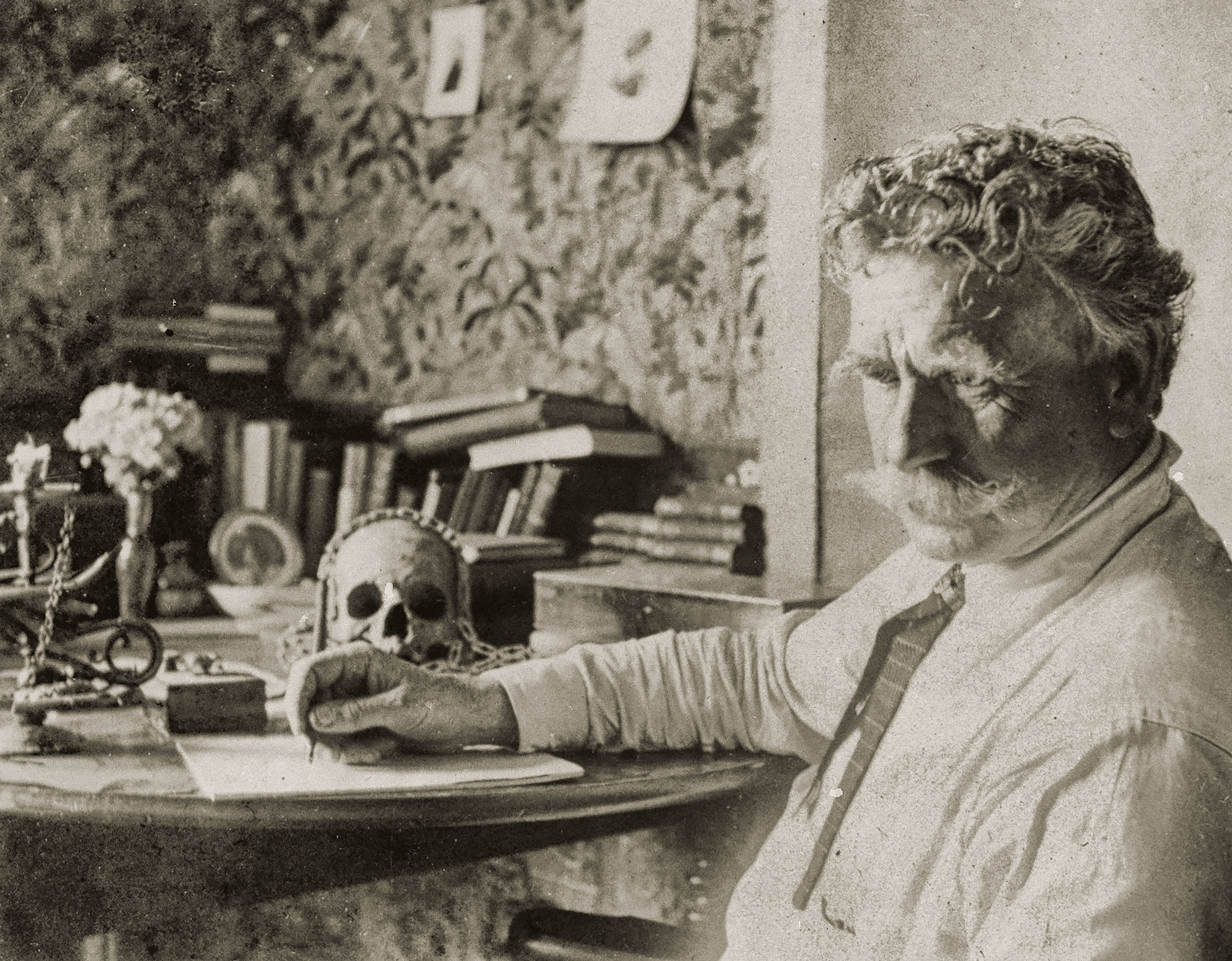 Library of Congress
Civil War veteran and American satirist Ambrose Bierce was a famously hard man. Biographer Roy Morris Jr. begins his book by declaring that at Bierce’s death “he probably had more enemies than any man alive.” An honest-to-God war hero—his daring rescue of a wounded comrade under fire at the Battle of Rich Mountain received press coverage—Bierce’s bloody experiences in the war had nevertheless provided “bitter confirmation of his darkest assumptions about man and his nature,” and he spent the rest of his life disapproving, in his own words, “of human institutions in general, including all forms of government, most laws and customs, and all contemporary literature.” Bierce’s personality showcased paradox after paradox, leading him to seem to modern Americans as “almost lunatically combative.”1
That was not the case with the 70-odd veterans of Bierce’s old regiment, the 9th Indiana Infantry, who in October 1904 gathered for their 18th annual reunion at the Logansport, Indiana, post of the Grand Army of the Republic (GAR), the country’s largest Union veterans’ organization. Many brought wives and some their grown children. Embracing the GAR’s motto of “Fraternity, Loyalty, and Charity” they came to revel in comradeship and recall their roles in the country’s greatest drama. They spent the first morning of the reunion at a reception, where the wives and daughters of post members handled registration and pinned on the veterans’ lapels souvenir badges featuring a “life-like picture” of a beloved regimental surgeon and a “beautiful and fragrant button-hole bouquet.” The men caught up with old comrades and could peruse a collection of nearly 200 photos of officers and men of the regiment, “living and dead.” Some, like those at modern-day high school reunions, were paired pictures of veterans as young soldiers and as now old men. According to an account of the event, “it was early evident to the visiting comrades that a tip-top time and enjoyable reunion was assured.”2
Bierce was not among them. The prolific journalist and author had written dozens of short stories about the Civil War, but may have been better known for the bitterly humorous definitions he published in various newspapers and magazines over three decades that would come to be known collectively as The Devil’s Dictionary. He also wrote iconoclastic newspaper columns and magazine articles for various William Randolph Hearst publications in Washington, D.C., and California on politics and, more recently, the wars with Spain and in the Philippines.
Bierce famously described “History” as “An account mostly false, of events mostly unimportant, which are brought about by rulers mostly knaves, and soldiers mostly fools.” That conception of history goes a long way toward helping us understand his attitude about the epic events through which he had lived and the war he had fought.3
He took a gentler tone when writing about his fellow veterans. We can get a sense of Bierce’s attitude about reunions from a piece he had written in 1886, when the GAR held its national encampment in San Francisco, where he was living. His gently sarcastic poem, “At a ‘National Encampment,’” follows a somewhat detached veteran’s attendance at a gathering of old soldiers. It begins with this observation of his former comrades:
You’re grayer than one would have thought you:
The climate you have over there
In the East has apparently brought you
Disorders affecting the hair,
Which—pardon me—seems a thought spare.
Other verses covered typical conversations at reunions: dead friends and old wounds, marches and illnesses, weather and hardtack. At the end, the poet Bierce—one of the veterans, but not of them—prepares to leave and remarks:
Well, comrades, I’m off now—good morning.
Your talk is as pleasant as pie,
But, pardon me, one word of warning:
Speak little and seldom, say I.
That’s my way. God bless you, Good-bye.4
In 1904, Bierce was close enough with at least a few former comrades that his address was known and an invitation to the Logansport reunion found him. Most of the assembled veterans no doubt knew of Bierce’s writing career and some may well have read some of his war stories. But it is unlikely that anyone was surprised by his absence.
So the reunion of the 9th Indiana proceeded without its most famous comrade, following the same rituals and format as thousands of other such gatherings in the late 19th and early 20th centuries. The formal meeting began in the afternoon, when Captain D.B. McConnell assumed the chair. McConnell called on officers to give their reports and a Committee on Resolutions was appointed to draft ceremonial thanks to various persons and organizations.
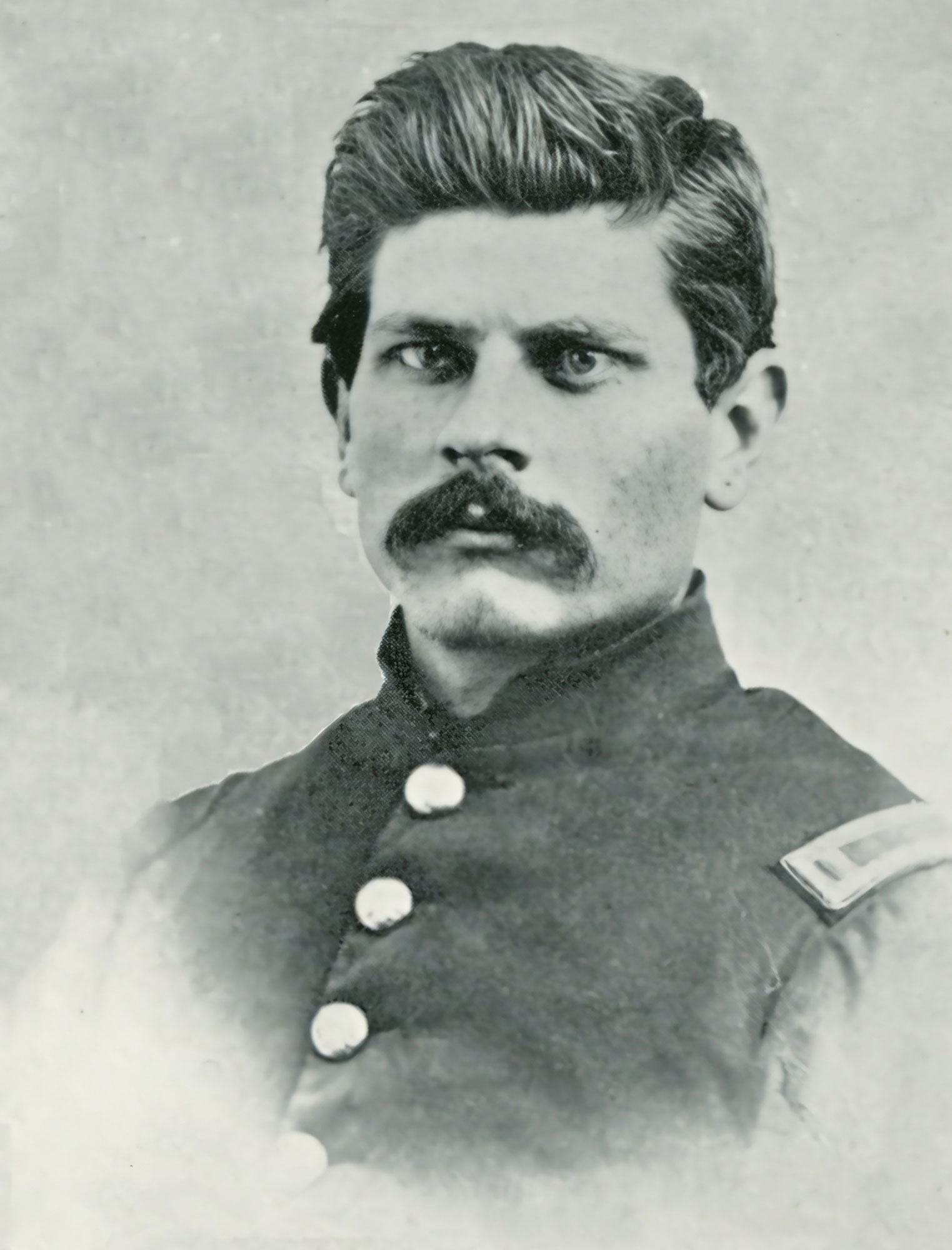 Archives and Rare Books Library, University of Cincinnati
Though he didn’t attend the October 1904 reunion of the 9th Indiana Infantry, Ambrose Bierce offered his thoughts and reflections in a letter to be read there. Above: Bierce in a wartime photo.
The business meeting did not take long, and, “it being too early to adjourn,” McConnell called for a few short speeches—mainly thanking individuals who had worked to locate the Indiana monuments on the Chickamauga battlefield and introducing the speakers lined up for that evening’s festivities. A letter was read from an invited speaker who was unable to attend the reunion; he thanked them for the invitation and explained that he was “in the midst of my fruit gathering,” which took priority. In closing, he wistfully reflected on the many departed comrades who were “making music in Paradise.” “[Y]ou and I will soon have crossed the River Styx, too,” he wrote, “but when we do we will leave the honorable record that we helped save the greatest country under the sun…. As time goes on and the scroll of history is unrolled great deeds and noble action of heroic men of a mighty nation will be recorded, but nothing will ever come that will add so much to the greatness of our country as the noble sacrifice made by the volunteer soldier from 1861 to 1865.” This was earnest but typical GAR boilerplate.5
The same could not be said of the last item on the afternoon’s agenda. McConnell asked the corresponding secretary to read “a letter of historical value written by our old comrade Lieut. Bierce of Company C.”6 One can almost imagine the men—by now at least in their sixties or seventies—shifting a bit in their chairs, cupping ears toward the front of the room, clearing their throats and settling in for one last talk. Perhaps they were looking forward to the free dinner back at the hotel; certainly, they were anticipating the highlight of any reunion, the campfire that would be held that evening in the improbable venue of the local skating rink.
They did not expect to hear a minor classic of Civil War memoir.
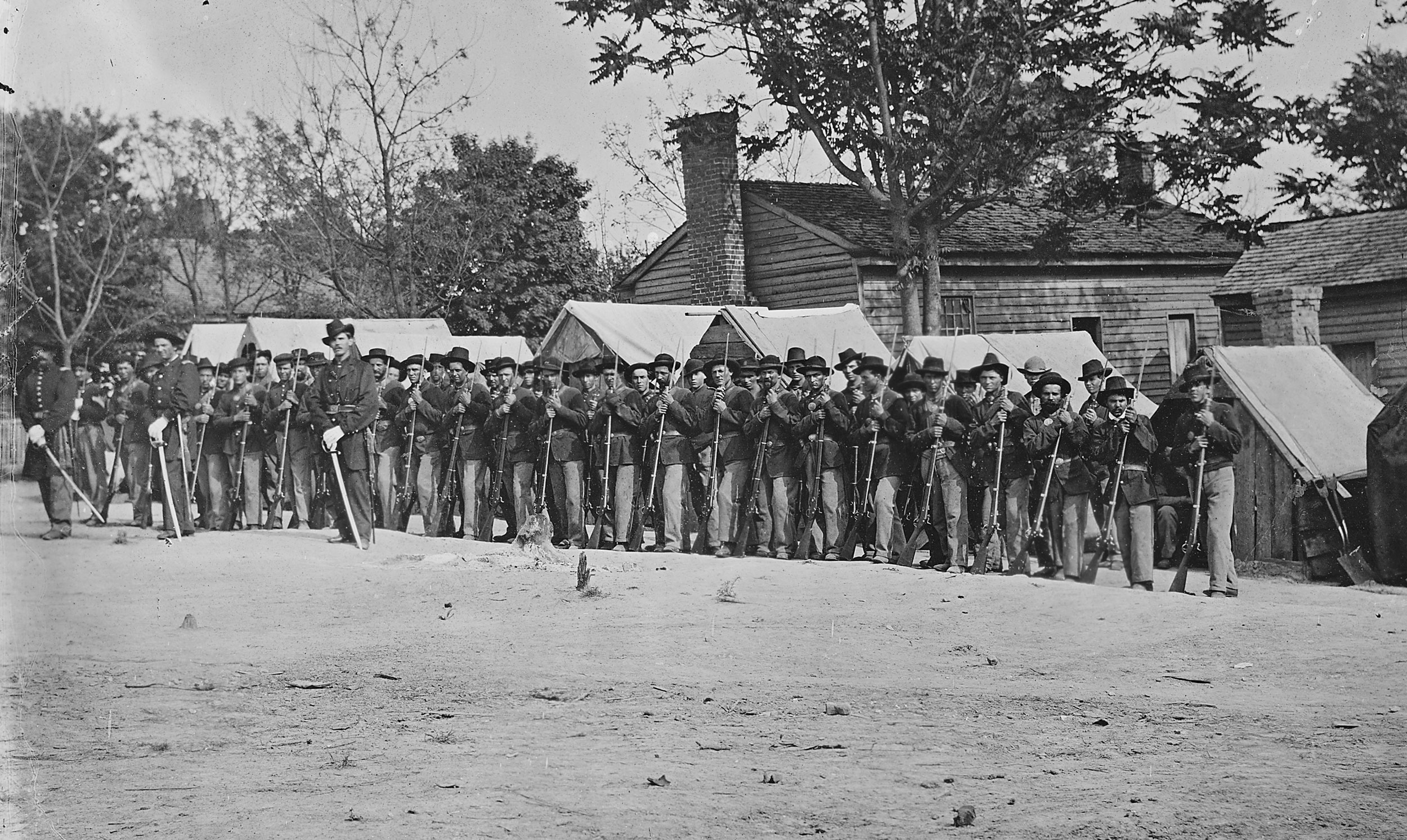 National Archives
The 9th Indiana Infantry, organized in 1861, served in the war’s western theater, from western Virginia to Tennessee to Georgia. Above: The men of the 9th Indiana’s Company A pose for a photograph.
The 9th Indiana, organized as a three-months regiment shortly after the firing on Fort Sumter, was reorganized and mustered in for a three-year term on September 5, 1861. The three-months men spent their service in western Virginia; the three-year men returned soon after to the area (in what was to become the state of West Virginia in 1863). Over the next few months, the 9th fought in the battles at Green Brier and Allegheny and spent the winter at the summit of Cheat Mountain. In February 1862, the regiment was transferred to Tennessee, arriving in time to participate in the second day of fighting at Shiloh. Its service continued throughout the Stones River, Chickamauga, and Lookout Mountain campaigns. After a great majority of the men reenlisted in early 1864, the regiment took part that summer in the Atlanta Campaign against John Bell Hood’s Confederate Army of Tennessee, and clashed with Hood’s men again in November and December at the battles of Franklin and Nashville. They ended their wartime service as part of the Union force occupying Texas before mustering out in September 1865. Eleven officers and 120 enlisted men of the 9th Indiana had been killed in action; two officers and 220 enlisted men had died of disease.7
Bierce had fought in most of these battles, making him the most prominent author of the late 19th century to have served under fire. He had been one of the first men to volunteer from his home county; assigned to Company C, he eventually served as a staff officer and topographical engineer. In their reports, regimental officers mentioned Bierce’s bravery on the battlefield a notable 15 times. Struck in the head by a bullet at Kennesaw Mountain, Bierce was plagued by dizziness and discharged in early 1865—still a young man at 23. He became a rather peripatetic journalist and writer, living for some time in San Francisco but also spending time in the East and several years in London. He became known for his biting satire, critical columns, and harshly honest reviews.8
Bierce was the sort of veteran who could rightly march proudly on Decoration Day (what would become Memorial Day was established in 1868 by the commander in chief of the GAR) and engage in the ceremony and wistful patriotism it encouraged. But he apparently did none of those things. Instead, through dozens of short stories and other writings, Bierce narrated the soldier’s Civil War experience with a unique honesty. He snubbed what he would have called the naïve impulse to speak of war’s glory and noble sacrifice. By 1904, when he was 62, some of his most famous writings had been published. Their often shocking twists included depictions of artillery officers firing on their own homes and comrades after following orders from inadequate superiors; of the fear-induced deaths of officers buckling under the pressures of leadership; of a deaf boy playing among hideously wounded soldiers and returning home to find his house destroyed and mother dead; of an officer euthanizing a horribly wounded dear friend, only to be observed by his arch enemy—the friend’s brother; of feral hogs feeding on the dead and dying; and of a captured spy seemingly escaping his hangman and making his way home, only to have his journey revealed as a dream when a noose snaps his neck.
But the letter Bierce sent to be read in Logansport was of a very different genre. It offered a poignant reflection on a recent trip he had taken to the camps and battlefields of late 1861 and early 1862. Bierce had written about this trip a year earlier for the New York American; that much shorter piece—titled “A Bivouac of the Dead”—did not mention the 9th Indiana, focusing instead on a forgotten and neglected Confederate graveyard. It ends with a plea for honoring the final resting places of “these blameless gentlemen,” who had been “persuaded … to their doom” by “political madmen” and an implied criticism of those southerners and ex-Confederates who promoted the Lost Cause narrative.9
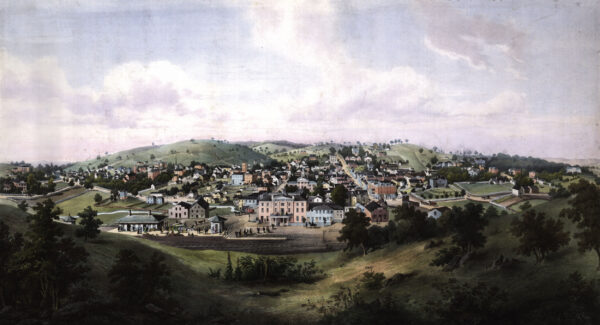
“I passed the greater part of the summer before the last at the little village of Aurora, West Virginia,” Bierce’s letter to the 9th Indiana began. This longer letter captured the same gentle, evocative tone of the earlier piece.10
Bierce’s weeks in the mountains of West Virginia sparked memories of the innocent first days of the war, before the 19-year-old Bierce or any of his fellow green volunteers had understood what they had gotten themselves into. He commented later that the young men from Indiana “had never seen a mountain, or a hill as high as a church spire, until we had crossed the Ohio River,” and his memory of the novelty of their surroundings probably framed some of his fascination decades later.11 As such, Bierce’s Logansport letter resembles in certain ways the genre of veterans’ tourism, when in the 1880s and 1890s individuals—and sometimes entire GAR posts—visited the battlefields of their youth and published their thoughts in the National Tribune or any of the many “soldiers’ papers” produced during that heyday of veterans’ activity.12
Bierce described the “blue and purple valleys, where, with some of the comrades who, I hope, will be with you when this paper is read, I campaigned in those distant days.” He admitted that he had been “reluctant” to visit the region; for four decades it had “been to me … a kind of dreamland.” Perhaps Bierce had been worried about ruining his memory of that early period of the war, when the blood and horror that characterized the regiment’s subsequent campaigns had yet to be realized by its young soldiers. Perhaps he wished that he did not know in 1903 what he had not known in 1861—that death by bullets and disease would inevitably erase the boyish enthusiasm that had accompanied these young men to this relatively safe and still romantic phase of the war. But his exploration of these early war sites led to “a few of the most interesting weeks of my life.”13
Like many veterans who trod the conflict’s battlefields, Bierce followed the tracks of his old regiment, visiting as far as he was able their old campsites, forts, and gravesites, chiefly in and around the Cheat River valley. The way in which his letter most followed the format of other veteran tourists’ writings was in his effort to get things right. He reports on the ways in which the villages through which they had campaigned had flourished or declined, the inevitable physical changes to the landscape, and the extent to which the old gun emplacements, trenches, and winter-quarter cabins were still visible. For instance, the stone foundations from the quarters they built during the winter of 1861–1862 remained, and the fortification they had constructed was in “so good condition that an hour’s work by a regiment would make it serviceable.” He finds the exact spot on which one member of the regiment had lain mortally wounded, although he leaves out the fact that he had carried this comrade, shot in the neck, through enemy fire to safety. He finds that one of the 9th’s old camps was now a racetrack.14
Although the forest near one of their old camps had been thinned by lumbermen, a wooden bridge over the Cheat River at the foot of a nearby hill remained, “still elaborately decorated with the soldiers’ names carven with jack-knives.” The wartime farm that had occupied the hill’s summit was gone; “there is now neither field nor dwelling—just a desolate area of rock and scanty grass, where nothing dwells but memories and ghosts.” This reference to ghosts is a gentle reminder of Bierce’s normal tone and approach.15
Bierce seems to have been particularly interested in cemeteries—perhaps not surprising given his ghoulish approach to death in many of his stories. Like most other soldier-tourists of the era, he was impressed by the large national cemeteries that had been developed near many battlefields and soldiers’ homes in the decades since the war.16 He visited the “beautiful National Cemetery” at Grafton, where 1,200 Federals were buried, including a number from the 9th. Although some were no doubt among the several hundred marked as “unknown,” he sought out the graves of comrades and, in one case, found an error in the cemetery’s record book—which he had corrected at the War Department a few weeks later. But he sounded particularly moved by the smaller, less well-kept graveyard that he had mentioned in the earlier article, as well as another tiny clearing where the dead from more than two-dozen graves had been removed; propped crookedly against a rock was a single headstone “rudely carved” with “W. Wilkerson” and his date of death.17
These smaller burial grounds inspired rather gentle reflections on the nature of war and politics. Throughout his account, Bierce sharply distinguishes the men who fought the war from the men who made the war. Early on he remarks that he visited the graves of his old comrades “and those of the misguided gentlemen whom … [they] sent to their long rest, and who, doubtless, sleep not less soundly.” Late in the letter he reprises his visit to the forgotten Confederate cemetery near the well-preserved fortifications along the Greenbrier River. It contained no more than a hundred graves, marked by slight depressions and nearly covered by weeds and brush. “Fallen into them were eight or ten rude headstones with inscriptions that I copied,” Bierce wrote. “It did not seem quite fair that these poor fellows should lie there under the forest leaves, their graves forgotten even by their own people, while our dead were so well housed under the big flag at Grafton, with monuments and flowers, music and Memorial days.”18
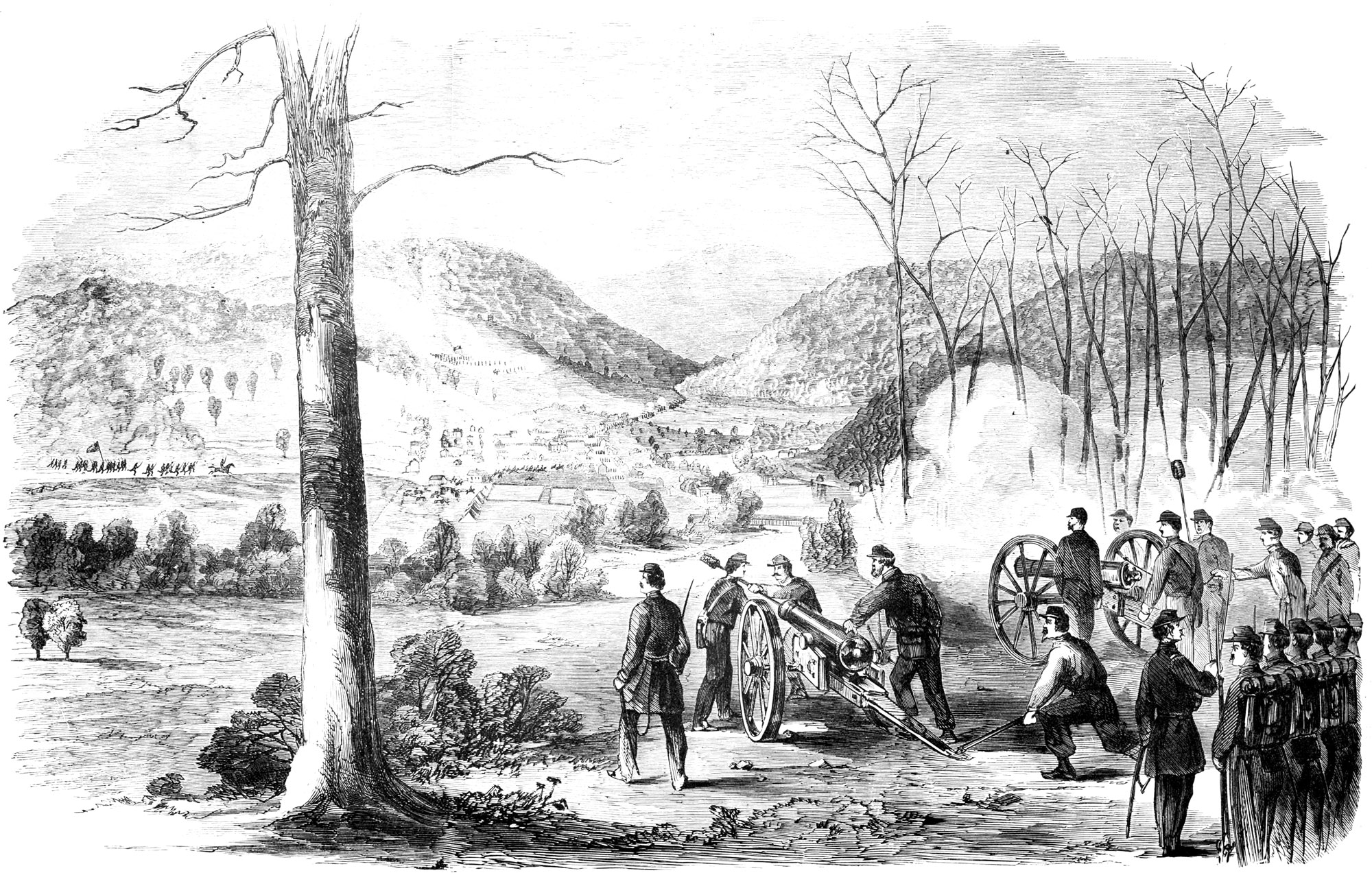 Frank Leslie’s Illustrated Newspaper
While visiting his old Civil War soldiering grounds, Bierce stopped at several cemeteries and at one encountered a Confederate veteran wounded at the Battle of Philippi (depicted above), Bierce’s regiment’s first engagement.
At times, Bierce’s characteristic sly humor emerges, as when he refers to the June 1861 engagement at Philippi, “our first affair with the enemy”—a skirmish that resulted in a Union victory and sudden fame for future general-in-chief George B. McClellan—as beginning with the Yankees’ mistaken belief “that we had the enemy’s camp surrounded.” He meets a Confederate veteran who had lost a leg to Union artillery during the little fight. He still lived near the old battlefield, “a prosperous and respectable gentlemen, but still minus the leg; no new one had grown on.” Another old battleground at Laurel Hill was nearly unrecognizable due to logging and the growth of the nearby crossroads village. Bierce recalled how the opposing forces had spent a day exchanging potshots; “A few dozens of us … grew tired of the resultless quarrel, and by a common impulse, and I think without orders of officers, ran forward into the woods and attacked the Confederate works. We did well enough, considering the hopeless folly of the movement, but we came out of the woods faster than we went in, a good deal.”19
At least one passage seems straight out of one of Bierce’s stories, “Horseman in the Sky,” published several years after his visit to the region. Although the ironic critique of duty as demonstrated by the protagonist is classic Bierce—the young man, guarding a secluded Union encampment on the eve of an attack on a nearby Confederate force, is forced to shoot a Confederate scout, who is none other than his estranged Rebel father—the description of their winter camp on Cheat Mountain closely resembles the description of the vantage point manned by the anti-hero of the story. “In those winter days of ’61 we used to watch the blue smoke of the Confederate camp with intense interest, but that was all we could see of our enemies.” Twenty miles of “valleys and low hills” separated the enemy camps. “But from their position they could see all that we did…. They could see our houses, our fort, our parade ground, all our movements.” The opposing brigades both guarded the same road, the Staunton and Parkersburg turnpike, which was “a fine and famous road in its day, but now fallen into disuse and no longer a ‘main traveled road.’”20
The letter closes with a kind of invitation to comrades to make their own pilgrimages to that time and place where, another veteran had two decades earlier famously declared, “Our hearts were touched with fire.”21 “The whole region is wild and grand, and if any one of the men who in his golden youth soldiered through its sleepy valleys and over its gracious mountains will revisit it in the hazy season when it is all aflame with the autumn foliage I promise him sentiments that he will willingly entertain and emotions that he will care to feel.”22
The response of Bierce’s audience of old comrades went unrecorded. Did they applaud? Sit for a few moments quietly reflecting? What would have filled the necessary silence following such a reading? Perhaps they simply rose and, leaning on canes or friends’ arms, hurried off to the wives and dinners waiting for them at Dunn’s Hotel.
The reunion’s proceedings did not mention Bierce’s letter again (other than to introduce a speaker mentioned in the letter). The stories from that evening’s campfire—of heroism and loss and of camp hijinks—took up more than a dozen pages. The proceedings of the second day featured resolutions of thanks to local organizers and in favor of increased pensions (a staple of such reunions), the election of officers, and the selection of Valparaiso as the location of the next meeting. Brief biographies of a half dozen members who had died in the previous year and a list of 10 additional deaths filled the last few pages.
It is impossible to know what the men thought of Bierce’s letter as the reunion broke up and they scattered to their homes in Indiana and elsewhere in the Midwest. Perhaps it was just another war story to them, one of countless they had heard at local GAR meetings and state and national encampments. It may have made them think about their erstwhile enemies in a more sympathetic light; it may have angered them when it undercut whatever notions they held of cause and country and martial sacrifice.
But Bierce’s last sentence might have resonated with a few of them, those men whose postwar lives had been narrowed by lingering wounds or illness, men for whom the long peace that followed a short war had reflected more failure than success, or men who thought of the long-ago war as the high point of their lives. It seemed so to Bierce, who also promised such men that among the emotions that a passage through those West Virginia mountains would stir, “I fear, will be a haunting envy of those of his comrades whose fall and burial in that enchanted land he once bewailed.”23
James Marten is professor of history emeritus at Marquette University and a former president of the Society of Civil War Historians. He is author, editor, or co-editor of two dozen books. His most recent is The Sixth Wisconsin and the Long Civil War: The Biography of a Regiment (University of North Carolina Press, 2025).
Notes
1. Roy Morris Jr., Ambrose Bierce: Alone in Bad Company (New York, 1995), 2, 3, 4.
2. Proceedings of the Eighteenth Annual Reunion of the Ninth Indiana Veteran Infantry Association, Held October 7 and 8, A. D. 1904, at Logansport, Indiana, 2 (hereafter cited as Proceedings).
3. Morris, Ambrose Bierce, 184.
4. Russell Duncan and David J. Klooster, eds., Phantoms of a Blood-Stained Period: The Complete Civil War Writings of Ambrose Bierce (Amherst, MA, 2022), 328–329.
5. Proceedings, 9, 12–13.
6. Ibid., 9.
7. Report of the Adjutant General of the State of Indiana, Volume IV—1861-1865 (Indianapolis, 1866), 57–64.
8. Duncan and Klooster, eds., Phantoms, 9, 11.
9. New York American, November 22, 1903.
10. Proceedings, 13.
11. Morris, Ambrose Bierce, 25.
12. James Marten, Sing Not War: The Lives of Union & Confederate Veterans in Gilded Age America (Chapel Hill, 2011), 265–270.
13. Proceedings, 13-14.
14. Proceedings, 16; Morris, Ambrose Bierce, 28.
15. Ibid., 16.
16. Drew Gilpin Faust, This Republic of Suffering: Death and the American Civil War (New York, 2008), 217–249.
17. Proceedings, 14, 16.
18. Ibid., 14, 16.
19. Proceedings, 14-15.
20. Duncan and Klooster, eds., Phantoms, 57–61; Proceedings, 17–18.
21. Oliver Wendell Holmes, The Occasional Speeches of Justice Oliver Wendell Holmes, comp. Mark DeWolfe Howe (Cambridge, MA, 1962), 15.
22. Proceedings, 18.
23. Ibid.