 Library of Congress
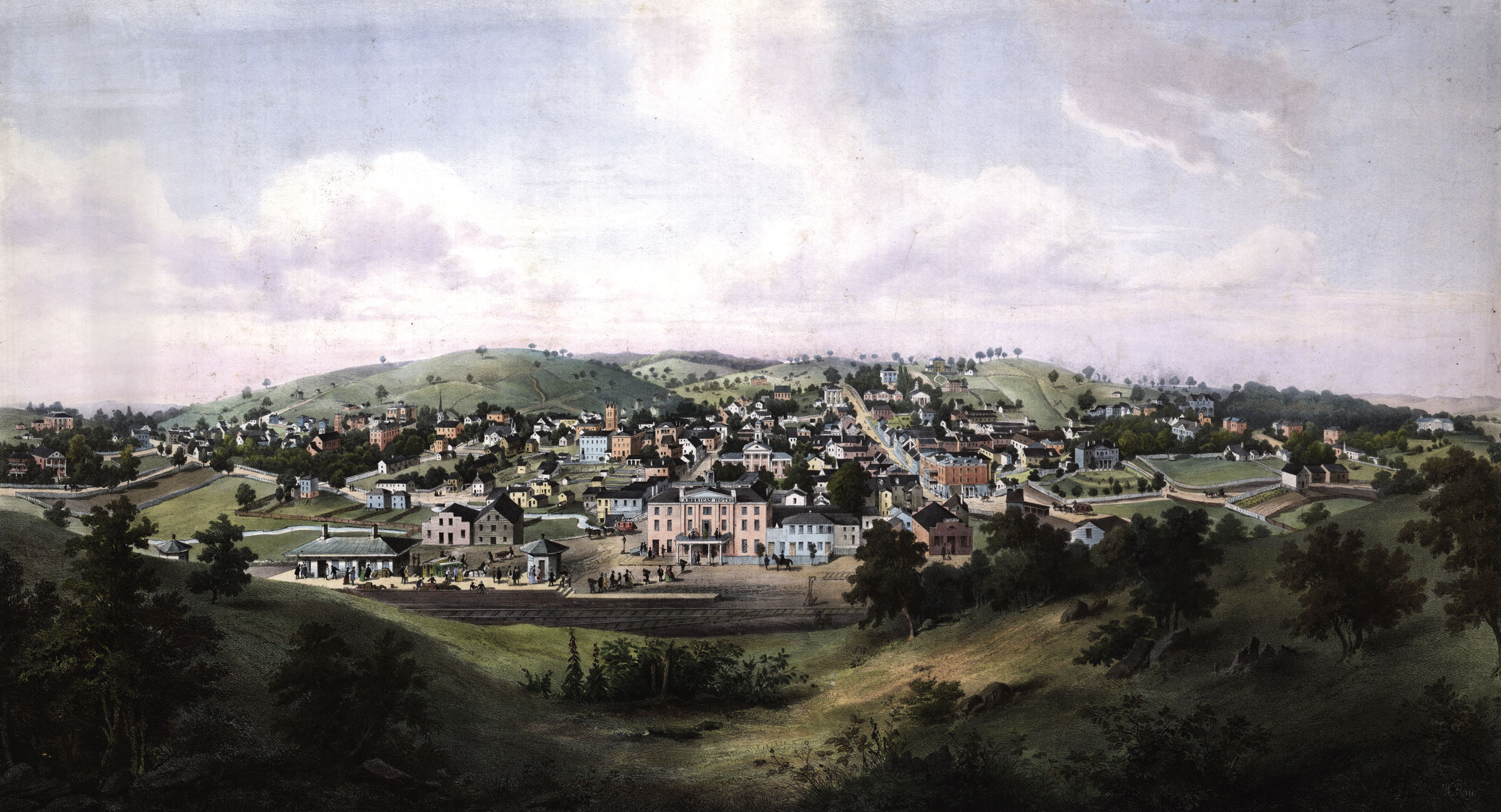
Located in the middle of the Shenandoah Valley, Staunton, Virginia—shown here in a lithograph from 1857—was among many southern towns whose white and black residents struggled to live together in the years following the end of the Civil War.
Americans tested one another in 1866.
With the war and the abolition of slavery behind them, northerners and southerners, Democrats and Republicans, African Americans and white Americans watched and listened warily. Everyone knew what they believed, what they wanted, and what they thought the nation needed. They could not know, however, how far their opponents would go to secure their own principles and desires.
The former Confederates defined their surrender as narrowly as possible. They would rejoin the Union, but they refused to admit moral guilt for secession, for fighting, or for slaveholding. They demanded all the fundamental rights of citizens who had never tried to break apart the United States, and were surprised and outraged that the victors demanded more from them. The Republicans, for their part, were equally surprised and outraged that the former Confederates would not acknowledge that secession had been unconstitutional, a duplicitous slaveholders’ rebellion rather than a principled revolution. They believed that only true repentance could create a lasting reunification, a moral regeneration of the South, a redefinition of loyalty.
Black southerners had to navigate this shifting and treacherous landscape. As the war drew to a close in the spring of 1865, Congress created the Bureau of Refugees, Freedmen, and Abandoned Lands. As its name implied, the Bureau sought to adjust a number of problems created by war in the South. As the months passed, the focus increasingly fell on the freedpeople, who struggled to make a living, gather their families, and find some kind of security in an unstable, unpredictable world.
 Harper's Weekly
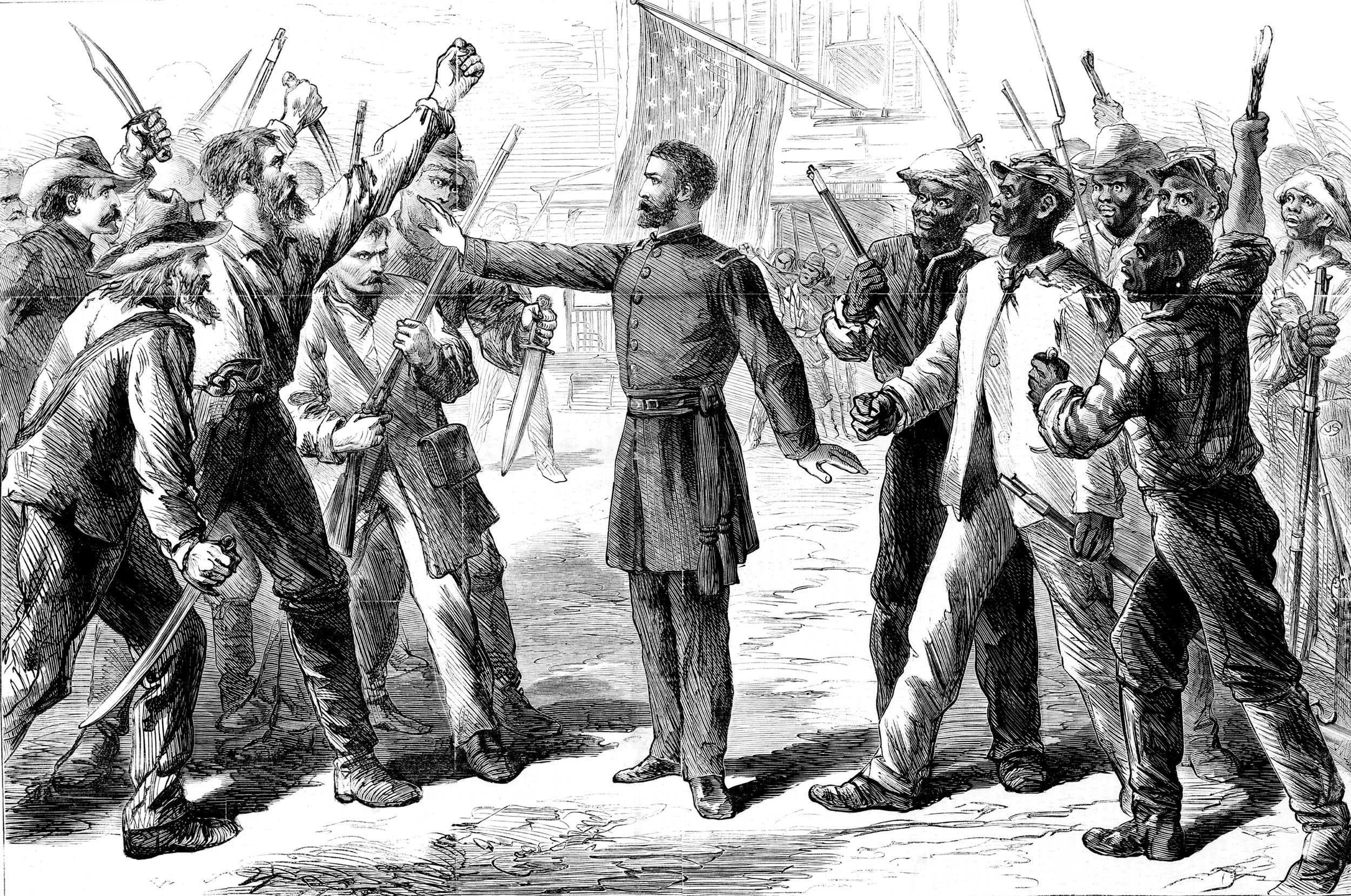
In this sketch by Alfred R. Waud, an agent of the Freedmen’s Bureau attempts to prevent a violent outburst between armed groups of southern whites and African Americans. Such agents, like W. Storer How, who was stationed in Staunton, Virginia, were often witnesses to racial violence in the months following the end of the Civil War. “[T]he air is full of outrages on the Freedmen by the Whites,” How wrote in January 1866, “and will be until just laws are made and executed.”
The Freedmen’s Bureau worked on the front lines, its agents laboring with limited power but large responsibilities. W. Storer How, one of many former Union officers who served as Freedmen’s Bureau agents, reported from Staunton, Virginia, in January 1866 that “the air is full of outrages on the Freedmen by the Whites, and will be until just laws are made and executed.” Staunton, located in the middle of the Shenandoah Valley in Augusta County, was a town of about 4,000 people, a fifth of them African American. It had been an important rail center and military target during the war that had ended nine months earlier.
While “the freedmen dare not testify through fear of yet greater violence,” How wrote, three incidents in three different neighborhoods of Augusta County left visible evidence of the violence. Sam Crawford, a 60-year-old black man, had been scarred in an attack by a white co-worker who assaulted him with a corn knife. Jane Walker, 20 years old, told how her white employer “beat her with his fist, and kicked her, and that his mother threatened to beat her with a shovel.” Mary Ann Jackson, about 35 years old, told the agent that her employer beat her children and “rode a horse over her boy of 12 yrs. who now bears the marks of the horses hoofs on his head.” The white man had “threatened to shoot her if she went away and came back.” Staunton had been on the verge of a riot on Christmas Day 1865, when “bad men who were but lately ‘masters,’” after the “free use of liquors,” shouted that they “would now override any civil laws not in accordance with their notions of a White man’s privilege.”1
When How learned that the Federal troops would be removed from Staunton in January 1866 as the U.S. Army reduced its forces in the South, he warned that the Bureau could not survive “without the presence and support of a military force.” He requested that 20 men be posted in Staunton, “instructed to respond to the requests of any duly authorized agents of this Bureau.” The Freedmen’s Bureau assistant superintendent, Frederick Tukey, pleaded that “a very small number, for the purpose of making arrests, when necessary” would allow the Bureau to function there. He had faced several cases when “men refuse to appear here when summoned, that they refuse to come, and treat the summons with contempt.” Sometimes, too, “persons refuse to comply” with the decisions of the Freedmen’s court, and “in such cases as these I am completely powerless without any troops.” The Bureau’s office in Richmond sent no troops; the Staunton office would be on its own.2
The agents of the Freedmen’s Bureau in Staunton, because of their role as judges and adjudicators, saw the black and white people of the county mainly in moments of conflict. Hundreds of complaints came before the agents, sometimes more than a dozen on a single day. Most of the complaints developed when white employers refused to pay black workers what they were owed. Given how little the freedpeople earned, the amounts were small, often a few dollars, but such amounts could mean the difference between feeding a family or not. White people, for their part, read any resistance or resentment about work and payment as signals of disrespect. White people paid what they thought black people had earned. Blows, threats, and hard words erupted repeatedly.
 Harper's Weekly
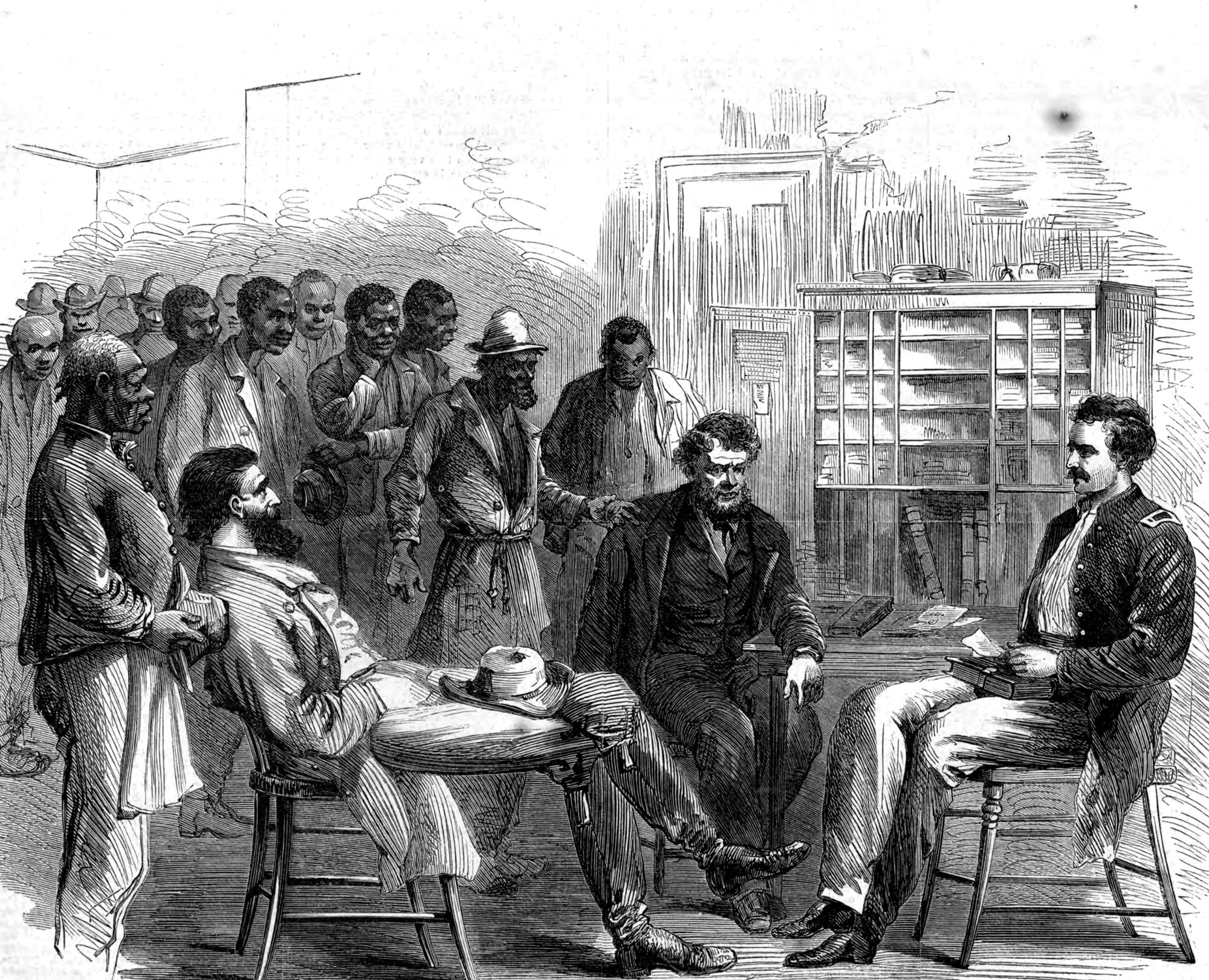
Freedmen’s Bureau agents in Staunton fielded hundreds of complaints, mostly about local whites refusing to pay black workers for their labor, and requests, including for assistance in tracking down family members lost in slavery or war. Above: African Americans wait in line to speak to an agent in the Freedmen’s Bureau office in Memphis, Tennessee, in the summer of 1866.
Among the black people themselves, many conflicts grew out of arguments over pieces of clothing or small amounts of food. Other clashes came when women became pregnant from relations with men whom they thought had promised to stay with them as husbands. Some black men and women came to the courts for divorce or to determine with whom a man or wife belonged when one returned to Augusta after having been sold away years earlier.
In scenes repeated across the South, parents turned to the Freedmen’s Bureau to help find or return family members lost in slavery and war. Federal troops, a letter from one agent to another explained, had taken James Stuart forcibly “from his home and family to act as guide to our forces upon the Lynchburg raid of 1864, he having lived in the county and being familiar with the locality.” Stuart did “good service as a guide for six weeks,” without remuneration, but was now “afraid to return to Va. as it was known in Staunton he acted as a guide.” He was now living in Ohio and requested the Bureau’s aid in reuniting him with his wife. He “has money to defray her expenses to Ohio if the Bureau will aid her in her arrangements and journey.”3
The freedpeople counted on the Bureau for its networks of information as well as transport. Patience Spencer sought her children, James and Melissa Ann, 15 and 11 respectively, who were taken from her by “John Mitchell, a slave trader who then lived at Lynchburg and who sold them at Richmond, Va. in July 1861.” The mother could not learn “who bought them or where they were taken,” but she thought the slave trader himself might know. “The poor woman it appears hid herself in the woods with her children to escape the sale but hunger compelled her to let her children return to the house for food, when they were seized and carried off.” The agent in Staunton worried that “her information is I fear too indefinite for discovery but she is so earnestly desirous of regaining them that I respectfully forward her request in the hope some clue may be obtained” from the former traders.4
Augusta County, a mature slaveholding county with no booming cash crop of cotton or sugar, had seen many enslaved people sold away in the half century before secession. Abraham Doke of Naked Creek in Augusta had heard that his 14-year-old daughter, Estaline, might be in Richmond. She had been sold to Richmond in 1862 by James E. Carson, “a slave trader.” Her father “has heard indirectly she is still in Richmond and he is anxious to find her and have her come to his home where he can take good care of her.” The agent in Staunton wrote his counterpart in Richmond to suggest that “perhaps enquiry through the schools may lead to her discovery.” Despite advertisements in the African-American schools and churches of Richmond, Estaline could not be located.5
Just as agents and freedpeople hoped that former slave traders would help reconstitute families they had broken apart, so did they count on former masters. Ann Wallace longed to find her parents, Isaac and Hester Wallace, in Maryland. The Staunton agent wrote to their former owner, for Ann had “been sold by you” to an owner in Augusta. She was “a good industrious girl and I hope you can give the requested information or if her parents live near you may see them and ask what arrangements they can make for their daughter to reach Baltimore.”6
Parents desperately used whatever scraps of information they had to find their children. Isabella Burton brought a statement to the Freedmen’s Bureau in Staunton. “Horace Bucker sold my two sons (seven & five years age) Benjamin & Horace, sold to Larke & Wright in Maddison County Va. Johnny Gilgarnett & Jeremiah Gilgarnett were playmates.” Burton hoped those details might help locate her young sons, “for I am living in Staunton Now a widow & alone, would like very much to see them.” The census two years later showed that she still lived alone.7
Slavery had taken people unimaginably far from their families. Letters to and from the Staunton office connected with Washington, D.C., New Orleans, Mobile, and Nashville as well as Chester Courthouse, South Carolina; Parkersburg and Shepherdstown, West Virginia; Tuscaloosa, Alabama; Morehead City and Goldsboro, North Carolina; Galveston, Texas; Chillicothe and Cincinnati, Ohio; and Jacksonville, Florida. Family members looked for one another in all corners of Virginia. Without information about their whereabouts, they might as well be in Texas or Florida.
In a few instances, the efforts worked. Benjamin Kiner had moved to Ohio and wrote his wife, Frances, back in Augusta in 1866, through the connections of the Freedmen’s Bureau. “I would like to have you come out here and I hope you will make up your mind and come with the children,” he urged. “I should like to have all the children with me as they can go to school.” If Frances was staying in Virginia because of her mother, Benjamin told his wife to bring her, too, because “the sooner we get together the better it will be for all of us.”8
 Harper's Weekly
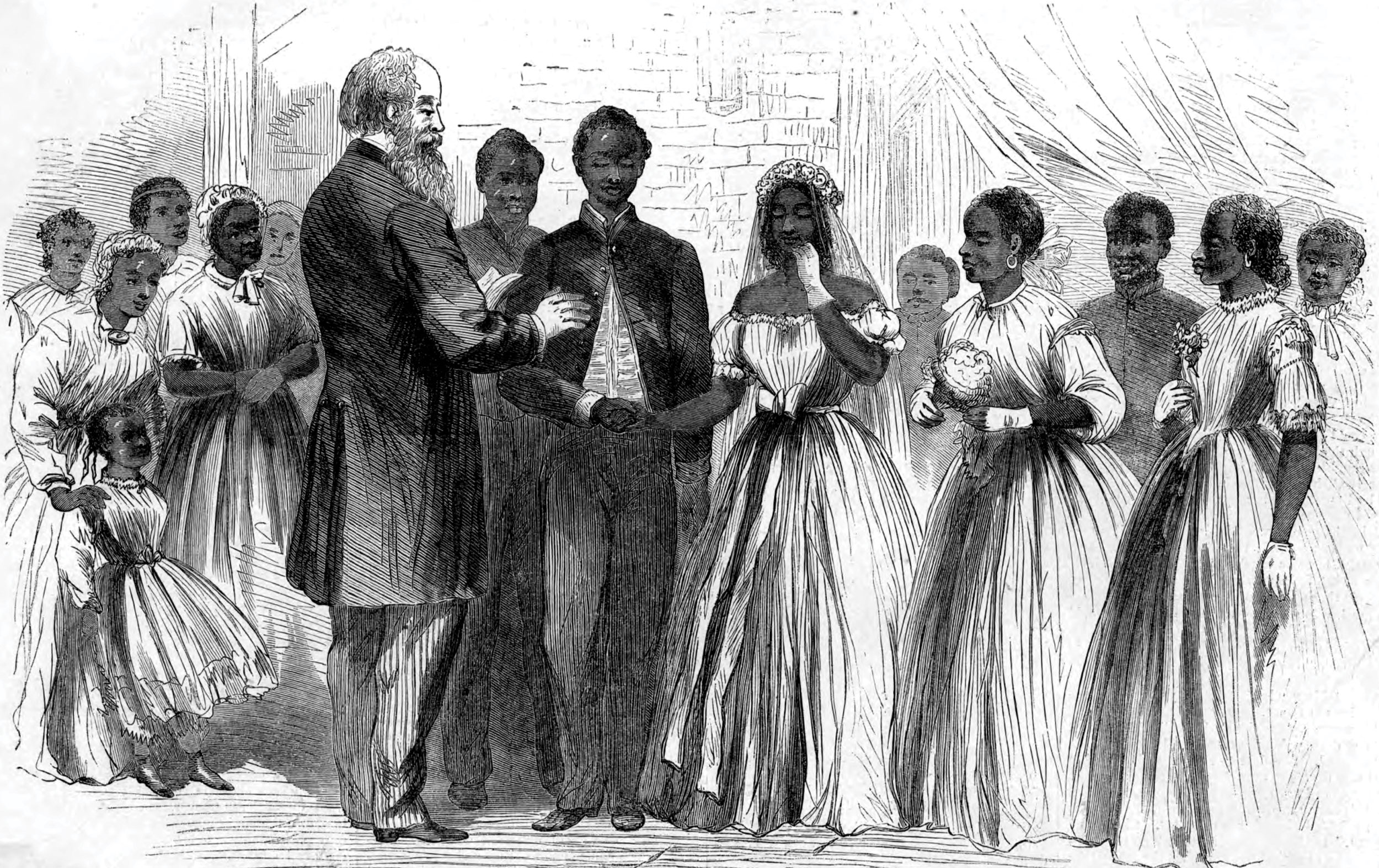
One of the tasks of the Freedmen’s Bureau—in Staunton and throughout the South—was to assist African-American couples in the process of legally marrying. Above: A chaplain attached to the Freedmen’s Bureau marries a couple in Vicksburg, Mississippi, in 1866.
Black children in Augusta became subjects of contention, tangled in connections among family members as well as former masters and white people. Richard Monroe, “a first class hand and entirely able to make a judicious and sufficient provision for his family,” claimed that a boy named James was the much younger brother of his wife. G.L. Peyton, who owned a hotel in Staunton, had James with him. The white man testified that that the boy did not want to go with Monroe, who was not his brother in any case. Peyton had owned James’ mother, but she had died at James’ birth and Peyton had raised the boy. Peyton charged James was “just getting large enough to do a little something—which is the reason for Monroe’s interest.” The hotel owner claimed that he could provide better care for the boy than the freedman could and that “I will not give him up until compelled to.”9
A key responsibility for agents in Staunton, as across the South, was to compile a register of “colored persons … cohabiting together as man and wife.” Only weeks after Appomattox, the Bureau began registering men and women who knew themselves to be married even though Virginia law recognized no marriages between enslaved people. The Bureau’s registration accelerated after the Virginia General Assembly, as part of its recasting of its laws after slavery, declared in February 1866 that formerly enslaved men and women could now legally marry. Most of the couples registered that spring and summer, especially in June, and the files were largely complete by August. The Bureau made copies of the records for state officials and put the originals in the Augusta County courthouse. The register recorded 896 couples and their children by name and age.
The marriage files also traced the tortuous paths the enslaved people of Augusta had followed to their moment of freedom. Of the nearly 900 couples listed, in only 276 had both the husband and the wife been born in Augusta County. While 389 of the men had been born in Augusta, the other 500 men listed in the register had been born in 80 different locations, ranging from Pennsylvania to Tennessee, from North Carolina to Missouri, from Kentucky to Florida. Most had been born in other counties of Virginia and West Virginia, from the Tidewater to the mountains. The women in these couples were more likely to have been born in Augusta—423 of the 896—but the remainder had come from locations as scattered as those of their husbands, from Maryland to Alabama.
The work those men and women did, also recorded in the files, revealed a range of capacities among black people that neither white southerners or northerners acknowledged and that the federal census did not record. The men in Augusta recorded 46 different occupations, from farm laborer to silversmith, from bar keeper to brick molder, from hotel servant to lime burner. They made carriages and chairs, shoes, leather, and wagons. They worked in bars, hotels, and stables; they cut hair and cooked and waited tables; they knew how to forge iron and feed furnaces and lay stone; they built houses and made barrels; they could butcher meat and cultivate gardens; they worked on railroads and at sawmills. The register recorded no occupations for the women, but they too—as their sale advertisements had long testified—possessed the essential skills of the household, the farm, and the town. Many of these couples had been together for years, as the ages of their children attested. About a quarter of those who came before the Freedmen’s Bureau in Staunton had children. Some of the children were over 20 years old, and many had been sold or taken out of Augusta County in the decades of slavery.
Part of the process of marking freedom was claiming a common last name. Though surnames were largely unrecognized by whites among enslaved people, many in the register had long claimed their names and had been known to some by that name. Following Virginia law, the women in the newly recognized marriages took the names of their husbands. The Freedmen’s Bureau and the government of Virginia agreed that a proper family would be overseen by a male and that whatever autonomy a woman had exercised under slavery would now be subordinated to her husband.
Many of the couples took common American names such as Brown, Carter, Green, Hall, Hill, Jackson, Johnson, Jones, Miller, Moore, Smith, White, or Williams. A few chose Franklin, Jefferson, Monroe, Madison, or Washington. Their first names, too, were largely indistinguishable from those of their white neighbors.
Whatever rationale motivated newly freed men to choose names, apparently flattering the richest men in the county was not part of the calculation. The newly married couples seldom adopted the names of the prominent families who had owned them. The 69 men in Augusta who owned at least 15 slaves in 1860, for example, collectively possessed power over 1,371 people. When families registered their names with the Freedmen’s Bureau, only 114 registered names that overlapped with those large slaveholders—and 45 of those names were “Johnson” and “Smith.” Of the 69 largest slaveholders, 31 saw no former slaves adopt their name.
From the first days of freedom in the summer of 1865 the black residents of Augusta County and the Freedmen’s Bureau worked to create schools. The American Missionary Association of Albany, New York, recruited teachers to come south to teach the freedpeople, and the women and men they sent taught with energy and devotion. To black people for whom literacy had been illegal only months before, the coming of schools seemed among the greatest gifts of freedom.
Some of the most heartening scenes of the early days of freedom played out in the schools. “I have a House all ready to receive your Teachers + should be glad if you could forward two besides Mrs Dunn or Miss McLeune as there is plenty of work for them to do and I will strive hard to see that neither the Educational or Missionary interest of your Teachers suffer in Staunton,” Frederick Tukey wrote the Freedmen’s Bureau office in October 1865. He requested readers, spellers, geographies, pencils, pens, outline maps, and song books.10
Tukey later requested a male teacher as well and John Scott arrived. A devoted white New England man in his 20s, Scott threw himself into the work. “It is Saturday night and I am very weary,” he wrote in November 1865. “Our school commenced night before last and we had two rooms full. The first 3 days of the week we spent in hunting for rooms in which to teach, the people being bound to keep us out.” By “the people,” Scott meant the white people of Staunton. While the town prided itself on its excellent private academies for white boys and girls, it, like the rest of Virginia, had not supported public schools before the Civil War. The idea of a government agency and a northern philanthropy teaching black students seemed both a reproach and a threat. Despite such obstacles, Scott reported, “Last night we had three rooms open and full. To day I have been at work fiting up the fourth room ready for Monday. The four will hold at least 200.”
Scott told his northern friends that “we get frequent sneers, but good treatment to the face.” He was frustrated that the white members of a church “have shut the colored People out of a church which they helped to build and own 1/2 of it,” though he hoped they would “allow them to occupy their own church if they will have a white leader.” Despite such problems, Scott reassured his supporters that “I love my work. The books have come that you sent.” On his way to “a colored Prayer Meeting here this eve,” and needing to hurry, Scott ended his letter with “God Bless you.”11
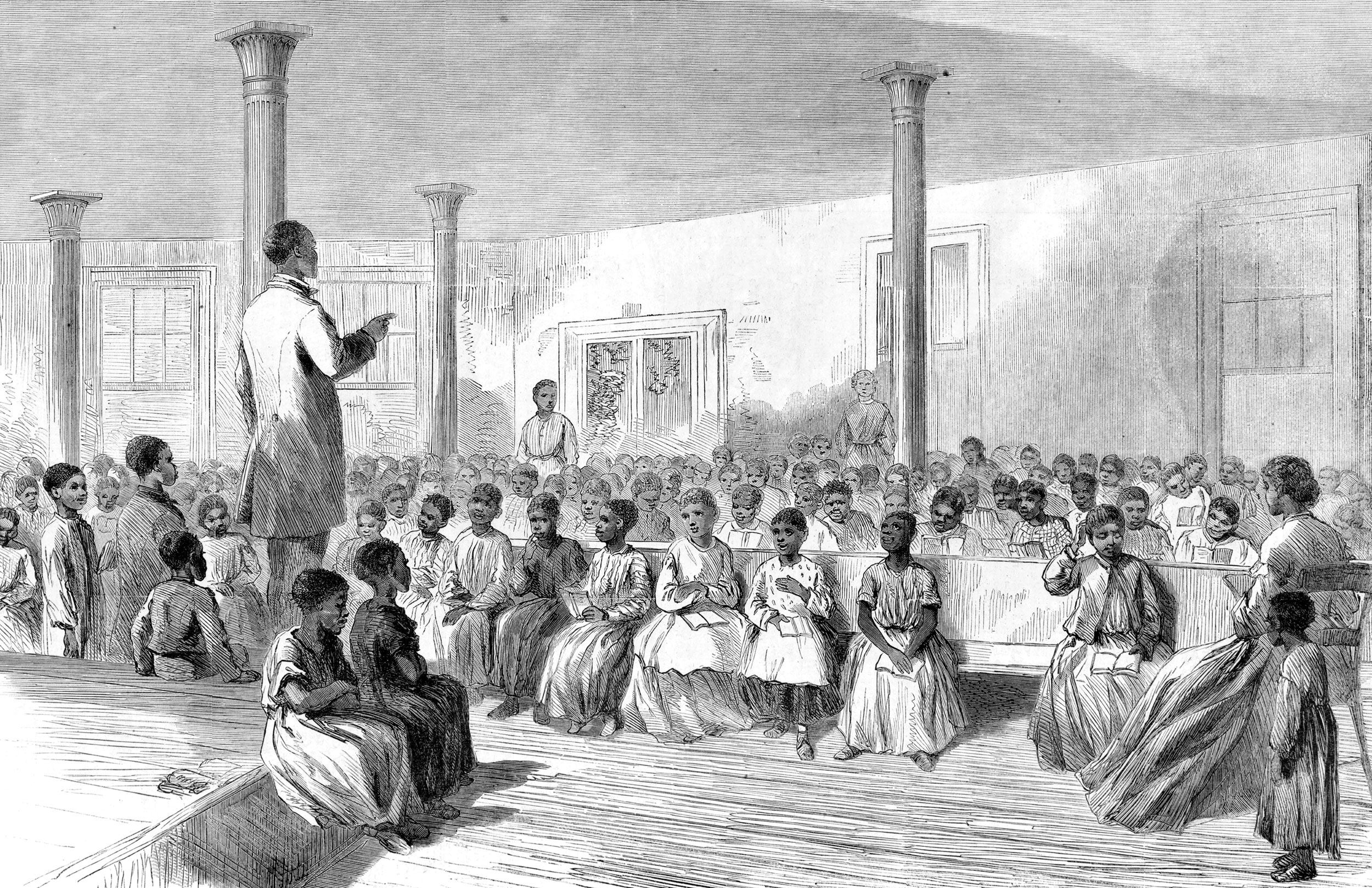 Harper's Weekly
Almost immediately after war’s end, the black residents of Augusta County worked with the Freedmen’s Bureau to create schools—which were among the greatest symbols of freedom to those formerly enslaved. Above: This sketch from 1866 shows a school for African-American children established in Charleston, South Carolina.
Miss C.E. Dewey, a teacher sent to Staunton to work alongside Scott, had been told by parents that “we hear of very many who intend to send after Christmas, whose children are hired out till then. We have new scholars every day.” Though the school had been in session only a few weeks, “I can see an astonishing progress in the acquirements of the children.”
The night schools conducted by the teachers “seem even more important than our day schools. The majority are under twenty years of age,” kept out of day school by the “necessity of labor.” The rooms “are crowded every night, many standing or sitting on the floor all evening rather than lose the instruction of one evening.” Dewey found some local white allies, two women and a man, plus a soldier, who “have offered their assistance in the night school.” Though “not trained to the business” of teaching, they “have commenced teaching with pretty good success.”12
Though the American Missionary Association attempted to supply the teachers and the materials they needed, the organization found itself overwhelmed by the demand. They were grateful for the support of Tukey, who supplied the teachers with room and board at his own expense. An AMA official, in fact, wrote that Tukey “has done and is doing more for the schools than any Bureau Supt I know of.”
Everyday items taken for granted elsewhere mattered a great deal. Meeting in the basement of an African-American church, the classes desperately needed lamps. When lamps did arrive, they were the wrong kind and the students had to write by candles. Scott made jokes about “a brighter day coming” and “we must have light!,” but despaired of trying to teach dozens of students in a dark, cold basement. Frustrated, he rather boldly challenged his supervisor to “extinguish the gas in your office at night, or in your parlor, and there for the next week do your business, or engage in social employment at these places by the dim light of a tallow candle and that without a sconse, or holder, and call upon your friends to do the same, and then think of me and 200 others who can sympathise with you.” Scott begged for books of religious instruction for Sunday school: He dreaded having to “stand before 100 children next Sunday and watch their disappointment, and see them waste sacred time especially precious to them by mere reading a school book.”13
Scott judged that by the end of 1865 “the whites here have little faith about ever making anything of a ‘nigger’ but they are growing more and more used to us and our schools and I think are generally in favor of trying to educate them.” As the Federal soldiers left, though, Scott was not sorry to see them leave. “I am glad this drunken set are going,” for their “influence is bad.”14
The young teacher waited anxiously for a box of donated clothes for the freedmen. “Even 2 or 3 barrels of clothing would be of great use.” They most needed clothes for their children, especially shoes. While Scott believed it was “better for the freedmen to help themselves where they can,” he was troubled by cases “of extreme destitution, mostly among children many of whom have lost one or both parents. I know of some 30 children who are shoeless and otherwise very thinly clad.” Scott and his fellow teachers had “tried to fix up some of these children with a few remnants,” but “it amounts to very little.”15
As the teachers settled in, they saw progress. Miss Dewey reported that she had arrived at class several mornings to “find my children all in their seats, either studying or with folded hands + as quiet + orderly as if I had been present. I asked them one day who had told them to get in order thinking Mr Scott might have been up stairs, but they replied quite proudly ‘Nobody! We’s got ourselves in order.’” Dewey admitted that her job was easier because “my scholars as you will see number among them very few boys + of course are much easier to govern than Miss Williams department which is entirely without the civilizing influence of the gentler sex.” One freedwoman walked six miles to school and back every day, and was never late. “She is much interested in her book and told me she would be willing to walk twice as far for the privilege of learning.” For herself, Dewey wrote, with some surprise, “that I love my work, as well as my people, far better than I did when we began.”
Dewey and her fellow teachers did not forget their missionary motivations. “I think I can detect signs of special religious interest here. I have had conversations of a personal character with several and found their hearts very tender and some really in earnest in seeking the Saviour.” Dewey judged that “the morals of these people, like the colored race everywhere, are much worse than their religion and whenever I have an opportunity I give advice on this subject.” The teacher was relieved to report that “though we are without military protection we have had no trouble and I think the feeling toward ‘Nigger Teachers,’ the little which we have the honor to receive, grows less bitter every day.” Some white ladies had been solicitous and “have even taken the trouble to write excuses when they were obliged to keep their hired people out of school.”16
In April 1866 John Scott suddenly found himself at the center of public controversy in Staunton. “Sunday morning our citizens were shocked and disgusted by an exhibition one John Scott, from Waterbury, Conn., a teacher in the Freedmen’s School, made of himself, by escorting a negro girl down New Street,” the Valley Virginian sputtered in an article titled “Miscegenation in Staunton.” “On coming down the street white persons ‘hissed’ this creature, Scott; soon afterwards, the girl came back by herself, and the coloured people, collected on Crawford’s corner, ‘hissed’ her. She had evidently disgraced herself in their eyes, by associating with this fellow, and we agree with them.”
The paper called on the superintendent of the Freedmen’s Bureau in Staunton to take action. He “owes it to himself; to the ladies who teach in the School, as well as to this community, to discharge this disciple of Miscegenation at once.” As for John Scott, “If he wants to marry the negro, let him do so, if he is willing; and speedily emigrate to Liberia or some congenial clime, where, to his heart’s content, he can dwell in the sweet embrace of the ‘negro de l’ Afrique.’ He don’t suit this country.”17
The young Yankee teacher wrote a polite public response, referring to himself in the plural. “At the close of Sabbath School, a pupil, wishing to obtain a hymn book, was told, that those for sale were at our house.” Scott set out to get a book and she set out beside him. “We thought of asking her to walk behind, lest we might be misrepresented. But the thought that she was, as we supposed, known to be a pupil, and that we were going nowhere else than from School home, and that it was known that our business brings us necessarily into contact with these people, more than it does citizens, would, we thought, save us from being misunderstood in our motives.” Scott, after his formal language, sarcastically noted that “as to ‘Miscegenation in Staunton’ we will not deny so plain a fact; but do most emphatically deny being a ‘Disciple’ ourselves, as no man can be more opposed to the doctrine than we are, and have ever been.” Scott suggested, in other words, what abolitionists had long pointed out: The mixing of the races was far more the result of the advances of white southern men than northern ones.18
Out of such issues of politesse and etiquette, with threats of violence and barely concealed sexual innuendo, did the white South draw the boundaries of the new order. With the omnipresent and all-inclusive boundaries of slavery erased, white southerners slid into crude, vicious, and contemptuous language to help bolster their actions.
As former slaveowners and Confederates jostled with Freedmen’s Bureau agents and white northern teachers, the black residents of Augusta County did not have many opportunities to speak for themselves. White people imagined, and wished, thoughts and words for the African Americans among whom they lived. Those white people generally told themselves what they wanted to believe, that black people were generally satisfied with their progress in the new order.
A lacerating letter in October 1866 from an African-American man named Nelson Irwin to General John M. Schofield showed the limits of white understanding, whether by native southerners or the northern people at work among them. “Living within your military department, I am forced to appeal to you in my own behalf. My case and cause are those of thousands and just as I am effected they will be effected also. There is a deep laid organization here that governs and controls every thing by might in defiance of truth and justice.” Irwin charged that on “even the least pretense a black man is taken up and imprisoned. His color is his condemnation, and every lawless act committed he is accused of. At present my brethren are living in a reign of terror and many of them are locked up in Staunton Gaol.”
Irwin described a recent event in Augusta, in which a “theft has been committed here by one or two black men and lo! four are taken up and all of us are accused. Some of us had to fly, who were and are as innocent of the crime as you are.” The body that was to protect them was useless, for “the Freedmen’s bureau is ineffective, laughed at and despised.” A trial for these men would be held in a few weeks, and “we cannot expect justice unless the strong arm of military protection is reached out to us.”
The moral was clear and painful. “We gave to the rich white man our best years, our strength, our youth, our sweat, and now that we are free, we get in return meaness, tyranny and injustice.” Some of the black men of Augusta live “in a state of perpetual terror. If you turn your back on us, who can we appeal to.” They were content to be “judged impartially by the laws, but let us not be condemned without a cause. From this depth of degregdation we look to you, and in the name of suffering humanity, I trust I do not write in vain.”19
To the credit of the U.S. Army and the Freedmen’s Bureau, officers looked into the matter promptly. The men had been tried before a magistrate in Augusta, with Alexander H.H. Stuart representing the accused. According to the inquiry, most of the evidence against the men came from other freedpeople. They had been committed to jail and awaited the Circuit Court. The author of the report thought that the guilt of the men was “quite evident” and he did not think they should be cleared of the charge. The officer also thought, however, that though the “reign of terror” charge might be “overdrawn,” it was clear that “there is more foundation for the assertion than there should be. A black man, to live peaceably must be very careful.” The danger came because “the whites seem very jealous of them, and any show of impertinence or independence, in so many instances leads to blows on the parts of the whites.” Those white people of Augusta “say a Colored man must keep his place, and not be setting himself up as a rival to the white.” As a result, “the Colored people generally submit quietly, as resistance, they are well aware, is perfectly useless.”20
Nelson Irwin did not appear in any newspaper account of the Circuit Court’s proceedings in the coming months. Two black men were convicted of house breaking and perhaps that was the crime to which he referred. Perhaps Alexander H.H. Stuart, one of the most successful lawyers in the county, was able to get Irwin released. In any case, the black man’s lacerating eloquence testified to the profound injustice that filled the apparently peaceful Valley. White people were drawing new boundaries and enforcing them with law, intimidation, and violence.
The 20 months after Appomattox had witnessed the beginning of the deepest transformation in American history. Black and white people in the South had to learn new ways to live together even as the legal and political atmosphere changed almost weekly. Nearly two years after the end of slavery the shape of freedom had not yet been defined.
Edward L. Ayers is the author of The Thin Light of Freedom: The Civil War and Emancipation in the Heart of America (W.W. Norton, 2017). That book continues the story begun in In the Presence of Mine Enemies, which won the Bancroft Prize.
This article is adapted from THE THIN LIGHT OF FREEDOM by Edward L. Ayers. Copyright ©2017 by Edward L. Ayers. Used with permission of the publisher, W.W. Norton & Company, Inc. All rights reserved.
Notes
1. W. Storer How to Orlando Brown, January 8, 1866. Unless otherwise noted, this and other primary sources cited are in the Valley of the Shadow archive, valley.lib.virginia.edu.
2. W. Storer How to Orlando Brown, January 9, 11, 22, 1866; Frederick S. Tukey to W. Storer How, January 31, 1866.
3. Augusta Jordan to O. O. Howard, April 14, 1866. See Heather Andrea Williams, Help Me to Find My People: The African American Search for Family Lost in Slavery (Chapel Hill, 2012); Ira Berlin and Leslie Rowland, eds., Families and Freedom: A Documentary History of African-American Kinship in the Civil War Era (New York, 1997); Peter W. Bardaglio, Reconstructing the Household: Families, Sex, and the Law in the Nineteenth-Century South (Chapel Hill, 1995); Catherine A. Jones, Intimate Reconstructions: Children in Postemancipation Virginia (Charlottesville, 2015); Amy Feely Morsman, The Big House after Slavery: Virginia Plantation Families and Their Postbellum Domestic Experiment (Charlottesville, 2010).
4. Thomas P. Jackson to John A. McDonnell, July 3, 1867.
5. Thomas P. Jackson to John A. McDonnell, October 3, 1867; In Search of…: Selections from Freedmen’s Bureau Records for Augusta County and Staunton, Virginia (Fishersville, VA, 2012), 10.
6. Thomas P. Jackson to John Selby, November 23, 1867.
7. Statement of Isabella Burton, January 17, 1868.
8. April 21, 1866; In Search of, 19.
9. In Search of, 7-8; G.L. Peyton to David Fultz, June 25, 1867.
10. F.S. Tukey to Samuel Hunt, October 16, 1865; F.S. Tukey to Unknown, November 4, 1865.
11. Included in F.S. Tukey to Unknown, November 4, 1865.
12. C.E. Dewey to Samuel Hunt, December 2, 1865.
13. William L. Coan to Samuel Hunt, December 4, 1865; John Scott to Samuel Hunt, December 20, 1865.
14. John Scott to Samuel Hunt, December 20, 1865.
15. John Scott to Samuel Hunt, December 20, January 11, 1865.
16. C.E. Dewey to Samuel Hunt, January 31, 1866.
17. Valley Virginian, April 4, 1866.
18. Valley Virginian, April 11, 1866.
19. Nelson Irwin to John M. Schofield, October 8, 1866.
20. George T. Cook to R.S. Lacey, October 26, 1866.
Related topics: African Americans, emancipation