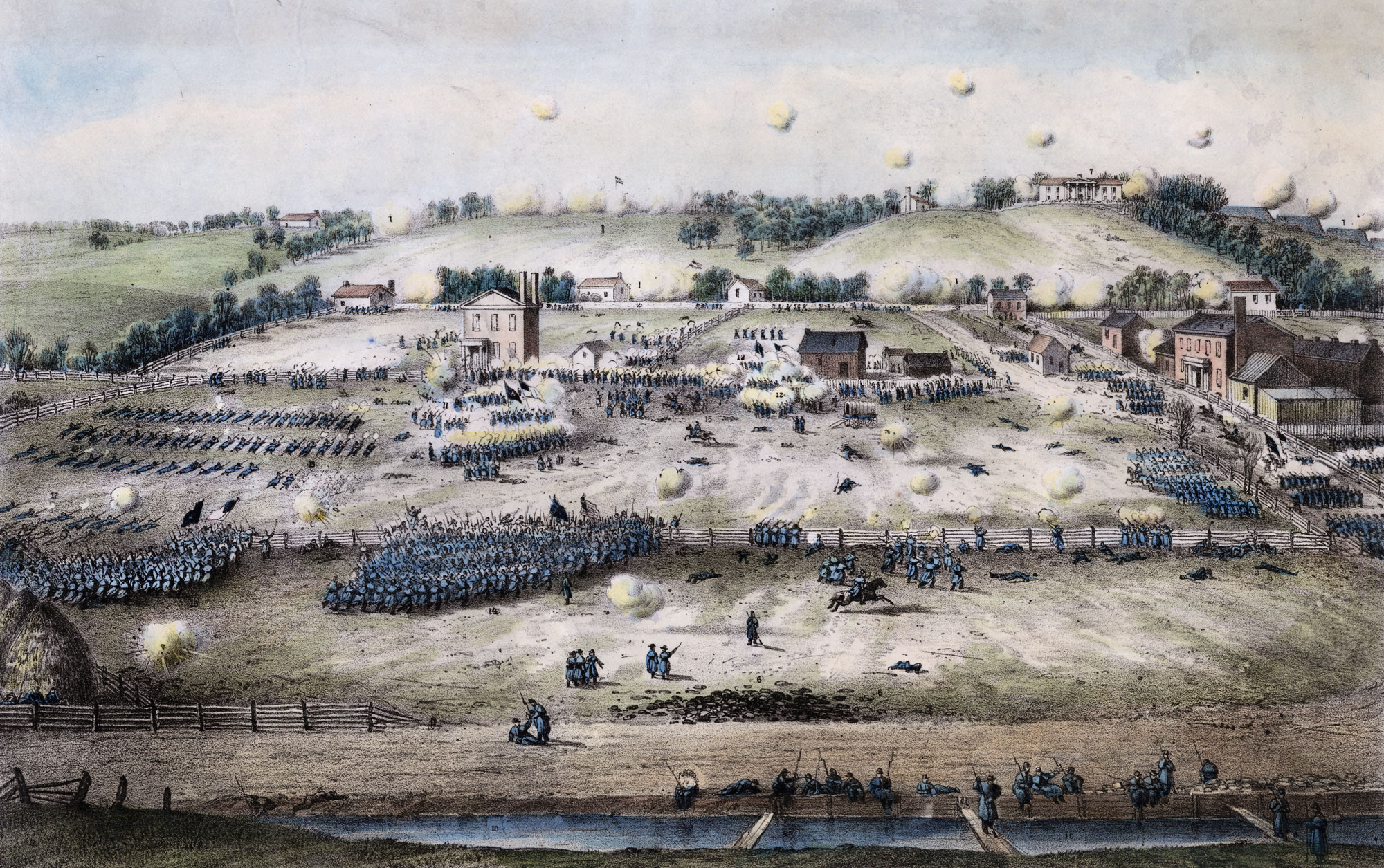
 Anne S.K. Brown Military Collection
In this wartime lithograph by P.S. Duval & Son, Union troops advance toward heavily fortified Confederate positions on Marye’s Heights during the Battle of Fredericksburg on December 13, 1862. The lopsided Confederate victory stunned the North, where confidence in the war effort and the Lincoln administration plummeted.
In November 1862, Abraham Lincoln—anxious to see Union forces act more aggressively (and successfully) against Robert E. Lee’s Army of Northern Virginia—removed George B. McClellan from command of the Army of the Potomac and replaced him with Ambrose Burnside, who soon devised a new offensive against Richmond. Burnside’s plan, which called for a speedy crossing of the Rappahannock River and southward movement through Fredericksburg before Lee suspected his strategy, quickly went awry.
Delays in the arrival of supplies slowed the construction of pontoon bridges; by the time Union troops began to build the bridges on December 11, Lee had surmised Burnside’s intentions and had his troops take up defensive positions in and around the city, in particular on the ridge west of town known as Marye’s Heights. On December 13, Burnside’s army crossed the river and attacked the Confederates with disastrous results. By the time the battle was over, the Army of the Potomac had suffered more than twice as many casualties as the Army of Northern Virginia, making the fight one of the more lopsided of the entire war.
Interested in visiting Fredericksburg? We’ve enlisted two experts on the area—Scott Walker and John Cummings—to offer suggestions for what to see and do in and around the historic city.
 Jimell Greene
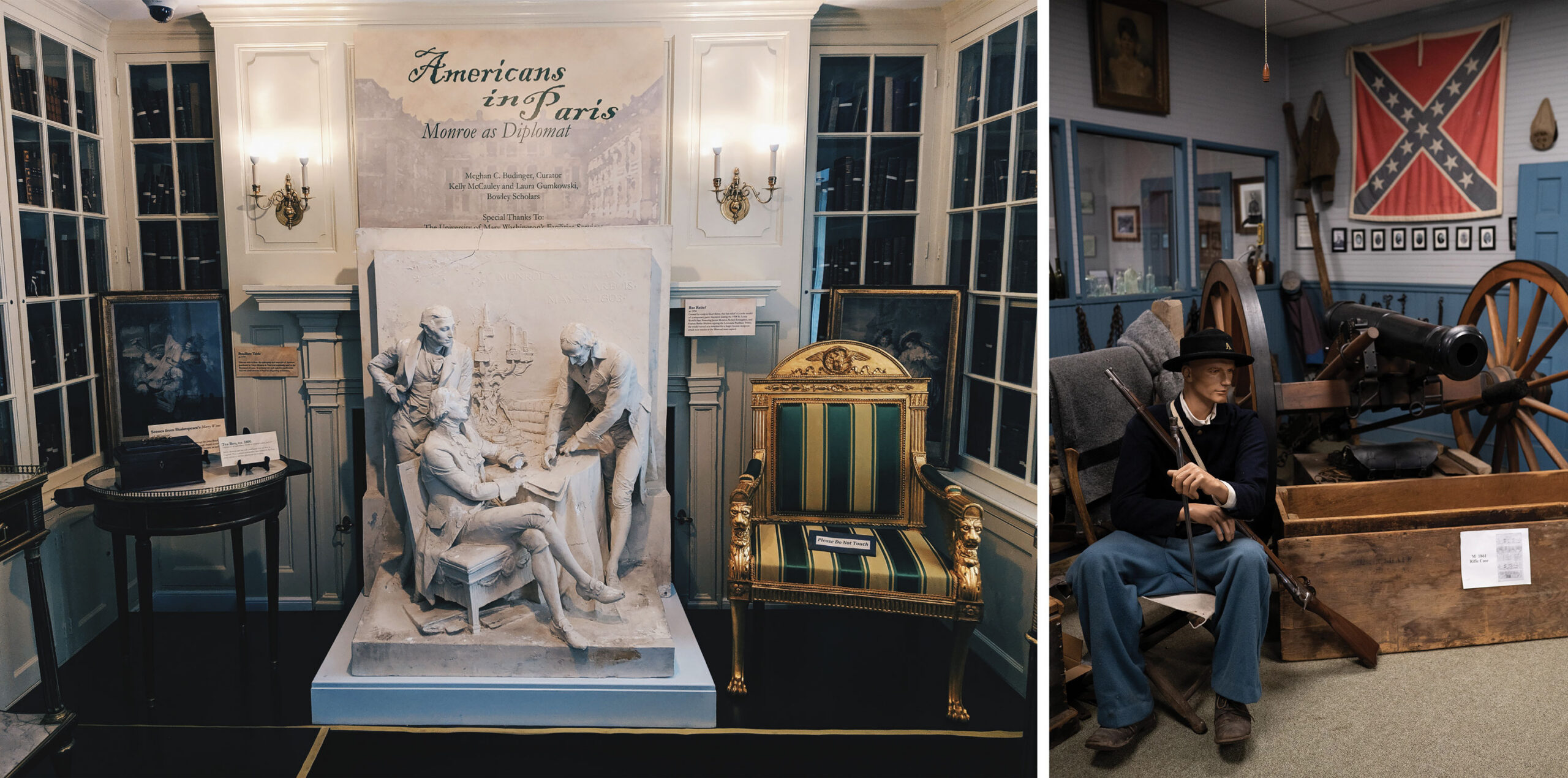
The James Monroe Museum and Memorial Library (left) and the White Oak Civil War Museum
CAN’T MISS
Visitors to Fredericksburg should see The James Monroe Museum and Memorial Library (908 Charles St.; 540-654-1043), which is well managed and curated by the University of Mary Washington. Among our country’s early leaders, James Monroe sometimes gets overlooked. Yet he held more elected or appointed local, state, and national offices than any other U.S. president, and he was president at the time of the Missouri Compromise, which arguably represented the opening act of the Civil War. He practiced law on this site in the 1780s, and the museum highlights his early years and overall career. SW
The White Oak Civil War Museum (985 White Oak Rd.; 540-371-4234) maintains one of the most fascinating collections, public or private, of Civil War artifacts in the country. Located about seven miles east of downtown, the museum displays items obtained by local relic hunter D.P. Newton from the surrounding countryside of Stafford County, where the Union army wintered after the Battle of Fredericksburg and which it occupied again in the spring of 1864 for use as a logistical hub. JC
[Ed. Since this article was published, the White Oak Civil War Museum has closed and the collection was moved to The Winery at Bull Run in Centreville, VA.]
BEST KEPT SECRET
 Jimell Greene
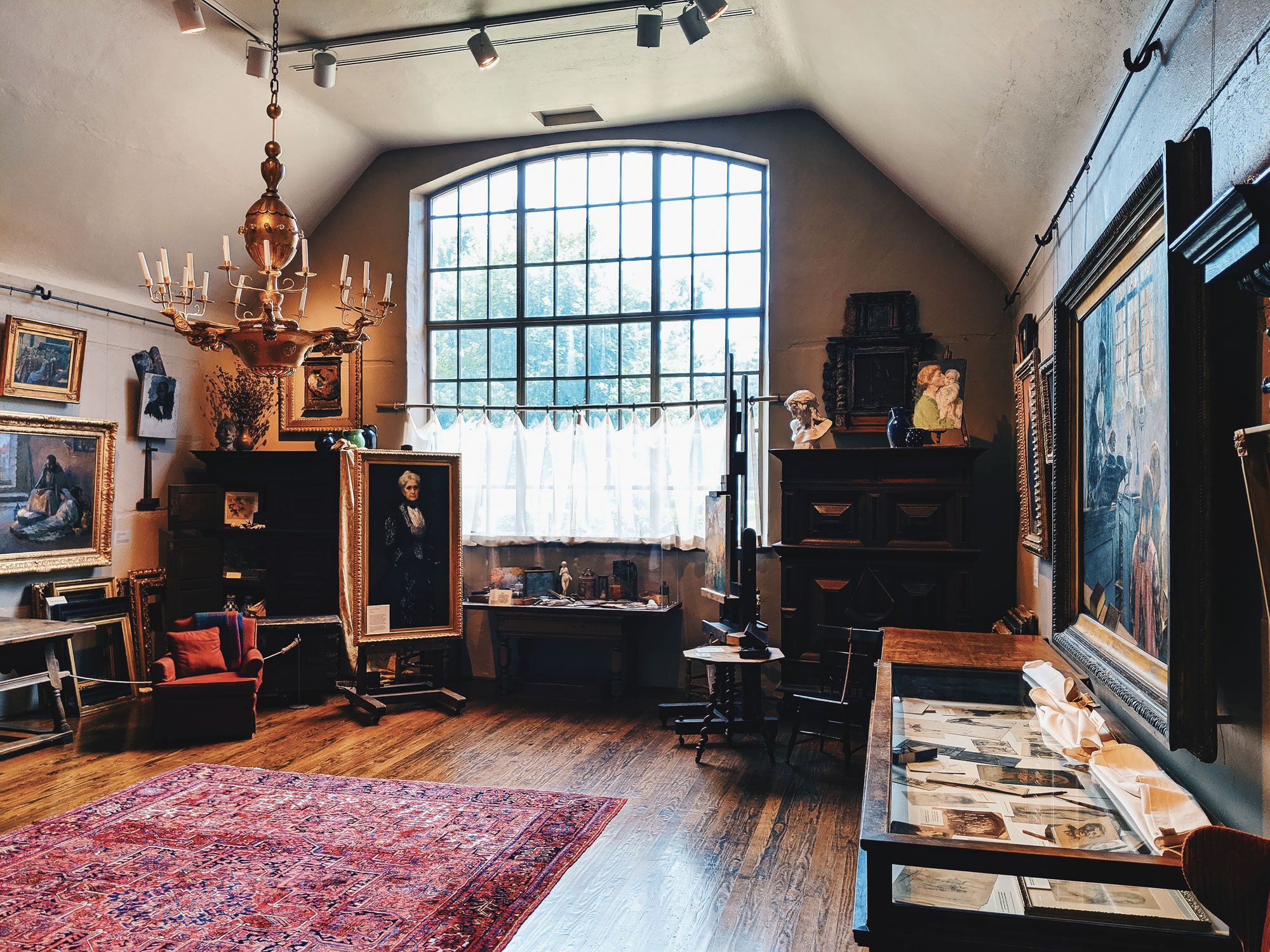
Gari Melchers Home and Studio
Fredericksburg has a fantastic but sometimes hidden art scene. The streets of the downtown historic district are packed with studios, galleries, and co-ops. (To learn about arts and cultural events there throughout the year, visit Rapp-Arts.org.) Just across the Rappahannock River is the Gari Melchers Home and Studio (224 Washington St., Falmouth; 540-654-1015). Melchers was an American-born, European-trained Impressionist who left New York for Virginia in the early 20th century. It’s a fascinating place to see Melchers’ breathtaking art. SW
 Jimell Greene
Central Rappahannock Regional Library
Doing research at the Fredericksburg branch of the Central Rappahannock Regional Library (1201 Caroline St.; 540-372-1144) is always rewarding. Its Virginiana Room has rotating exhibits and a treasure trove of reference material on over 400 years of Fredericksburg’s history. JC
BEST FAMILY ACTIVITY
 Jimell Greene
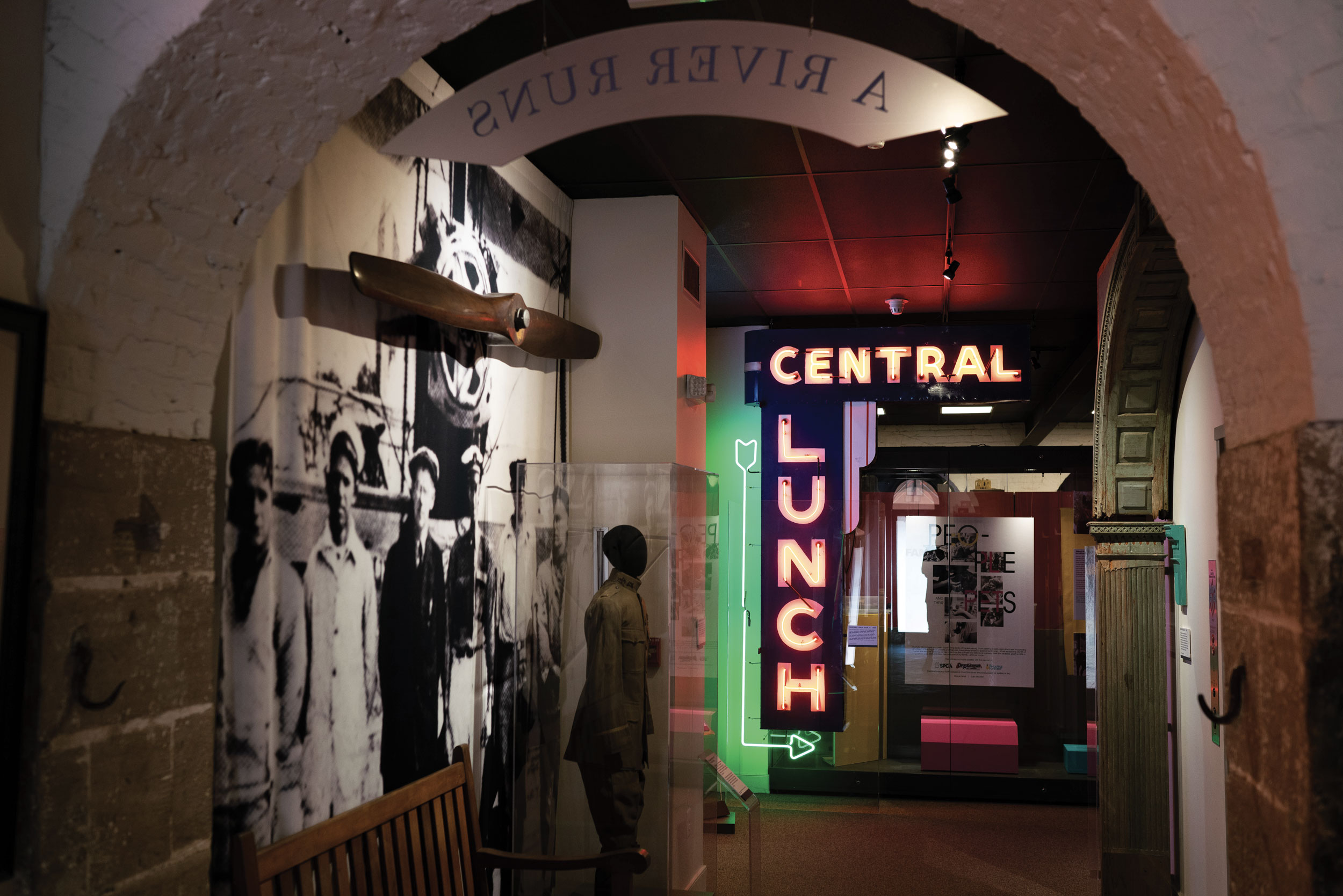
Fredericksburg Area Museum
There’s much more to Fredericksburg than its link to the Civil War. The city’s been around since the 17th century, so there’s a lot of colonial interest here as well. The Fredericksburg Area Museum (907 Princess Anne St.; 540-371-3037) has activities for kids, as does George Washington’s Ferry Farm (268 Kings Hwy.; 540-370-0732), where the first president lived from ages six to 21. For those with kids who love to get wet, try kayaking, tubing, waterboarding, or canoeing on the Rappahannock River. Check with River Rock Outfitter (915 Sophia St.; 540-372-8708) or the Virginia Outdoor Center (3219 Fall Hill Ave.; 540-371-5085) for options. SW
 Jimell Greene
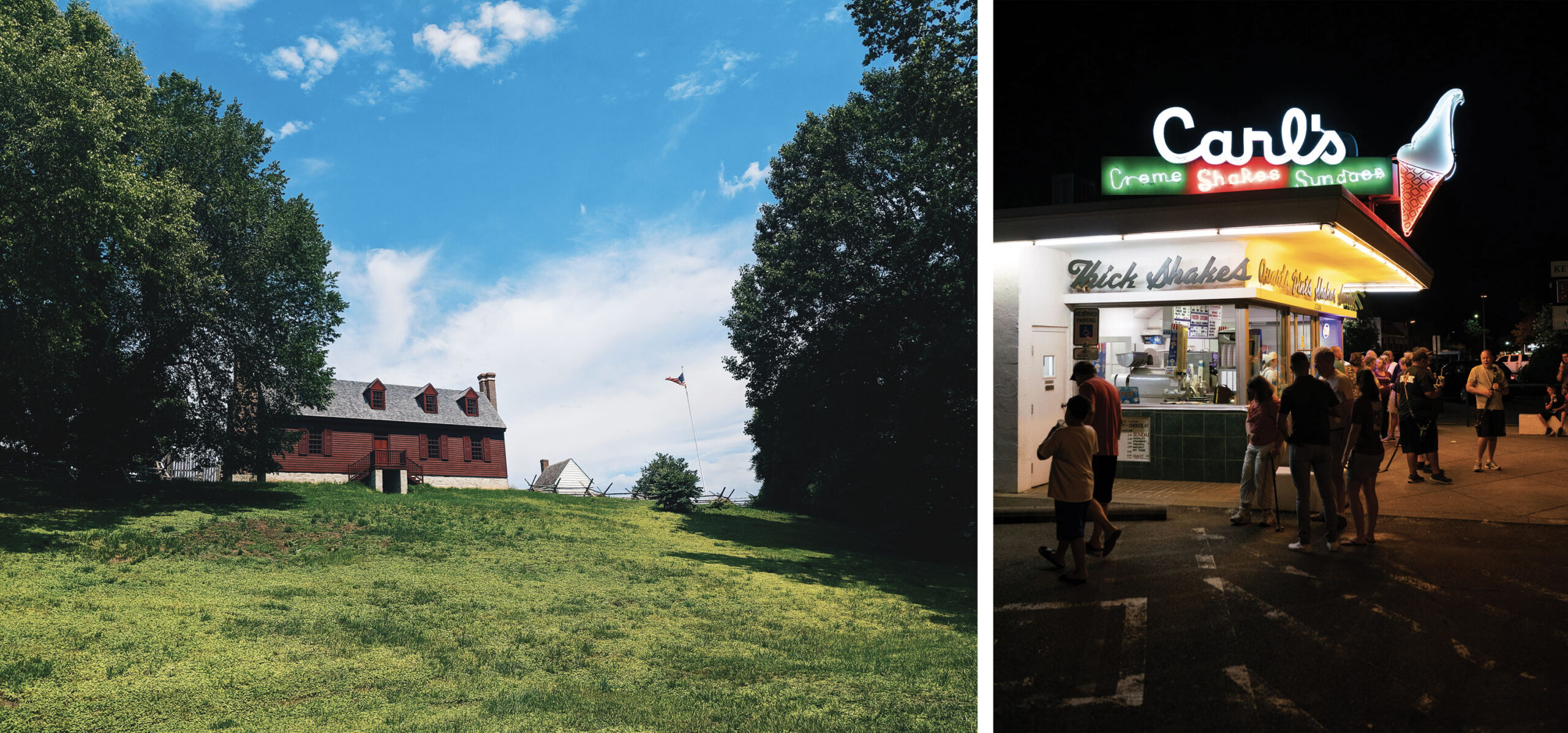
George Washington’s Ferry Farm (left) and Carl’s Frozen Custard
Without a doubt, take the kids to Carl’s Frozen Custard (2200 Princess Anne St.; carlsfrozencustard.com). Since 1947, Carl’s has been the local treat that everyone talks about, and it makes a perfect surprise stop during a long day of touring. JC
BEST CIVIL WAR SPOT
Chatham Manor (120 Chatham Ln.; 540-693-3200), which overlooks the city from across the river, was built in the 18th century, occupied by Union forces (who referred to it as the “Lacy House”) in 1862, and used as a hospital (where Clara Barton helped tend to the wounded) after the Battle of Fredericksburg. Although it was neglected and falling down for years after the war, Chatham was restored in the 20th century and now serves as the headquarters for the Fredericksburg and Spotsylvania National Military Park. While not located on the main battlefield, Chatham is a site that shouldn’t be missed. Its gardens are spectacular, particularly in the spring. SW
 Jimell Greene
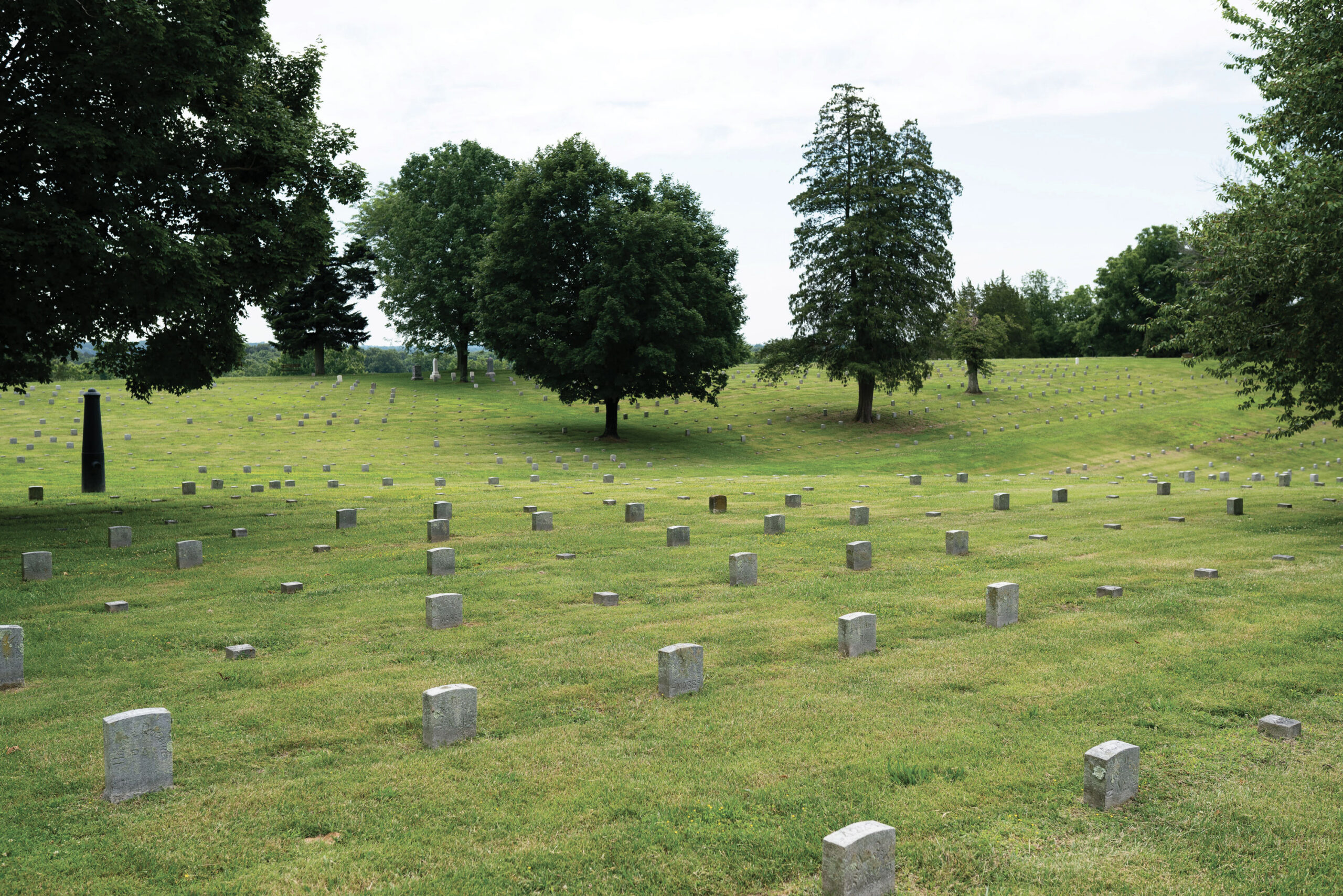
Fredericksburg National Cemetery
Of all locations in the Fredericksburg and Spotsylvania National Military Park (1013 Lafayette Blvd.; 540-693-3200), the heights west of town and the Sunken Road at its base have to be the most poignant. Atop the hill is the Fredericksburg National Cemetery, where more than 15,000 Union soldiers are interred. (Many of them were killed on the area’s four major battlefields.) Behind the infamous Stone Wall along the Sunken Road, Confederate defenders held back the Union attacks of December 13, 1862. The next spring, the same ground was thinly defended during the Chancellorsville Campaign and was overrun by Union general John Sedgwick’s VI Corps. JC
BEST EATS
 Jimell Greene
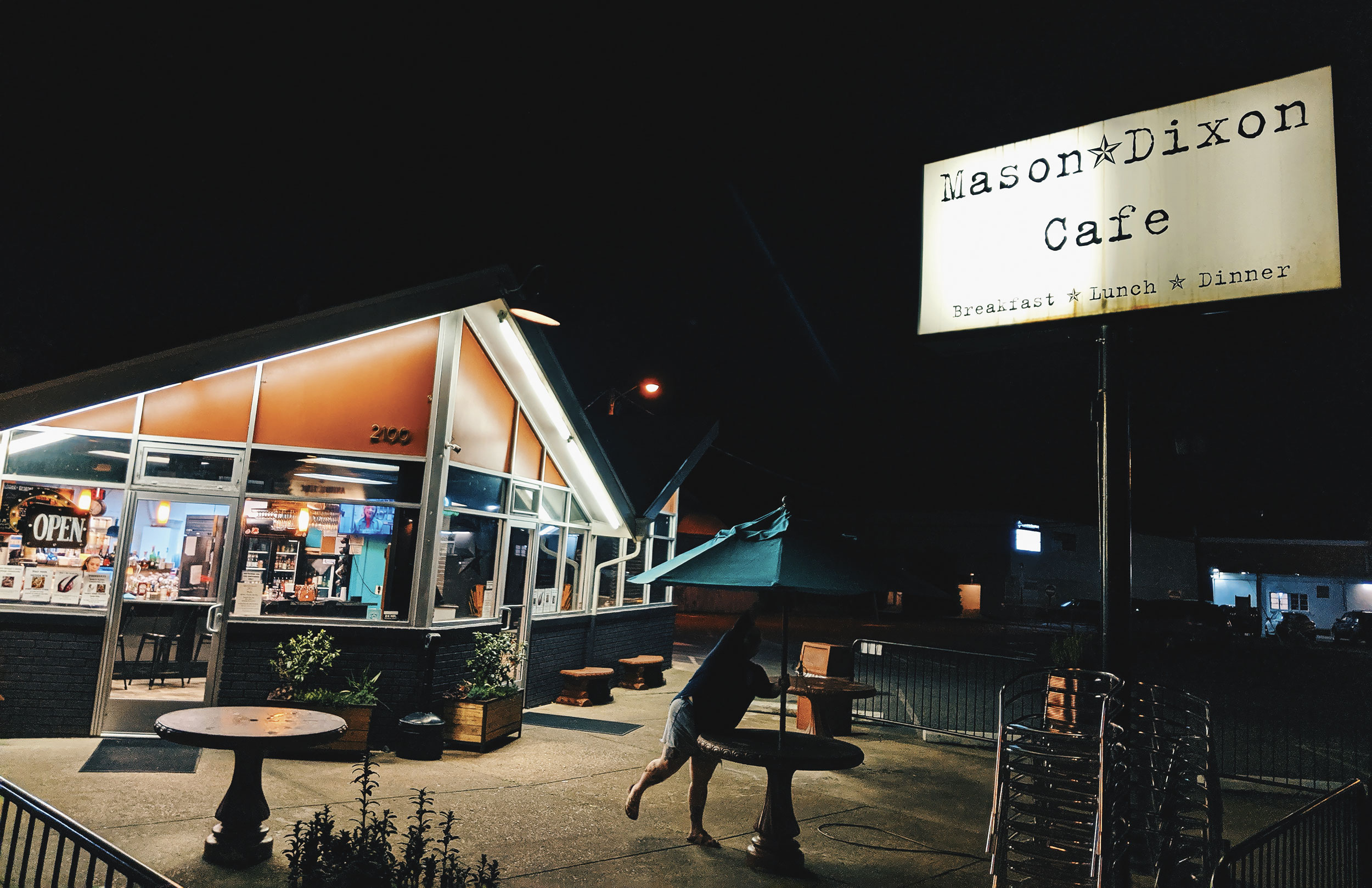
Mason-Dixon Cafe
My favorite breakfast spot is the Mason-Dixon Cafe (2100 Princess Anne St.; 540-371-1950). The shrimp and grits are absolutely the best I’ve ever had. Owned and run by second-generation restaurant folks, this simple-looking place turns out delicious food. The Sunken Well Tavern (720 Littlepage St.; 540-370-0911), located next to the Marye’s Heights area of the battlefield park, is a good lunch option. You can get burgers, salads, wraps, or wonderful soups and specials—all at reasonable prices. For dinner, try one of the amazing eateries on the 300–400 block of William Street downtown. My favorite is Ristorante Renato (422 William St.; 540-371-8228), where the fettuccini alfredo is so rich that my doctor allows me to eat it only three times a year! SW
 Jimell Greene
Sammy T’s
The Sunday brunch at Sammy T’s (801 Caroline St.; 540-371-2008) is worth waiting for its 11:30 a.m. opening. Located in a historic building with large windows that are perfect for people watching, you’ll enjoy the atmosphere and simple, good food. For lunch or dinner, I have three recommendations. Sedona Tap House (591 William St.; 540-940-2294) has an excellent menu with a cosmopolitan flair—as well as hundreds of craft beers. Castiglia’s Italian Restaurant (324 William St.; 540-373-6650) offers old-style favorites made like no others in a brick pizza oven. And The Sunken Well Tavern is a small gem with gastronomic delights, an adequate bar, and live music on Sunday evenings. JC
BEST SLEEP
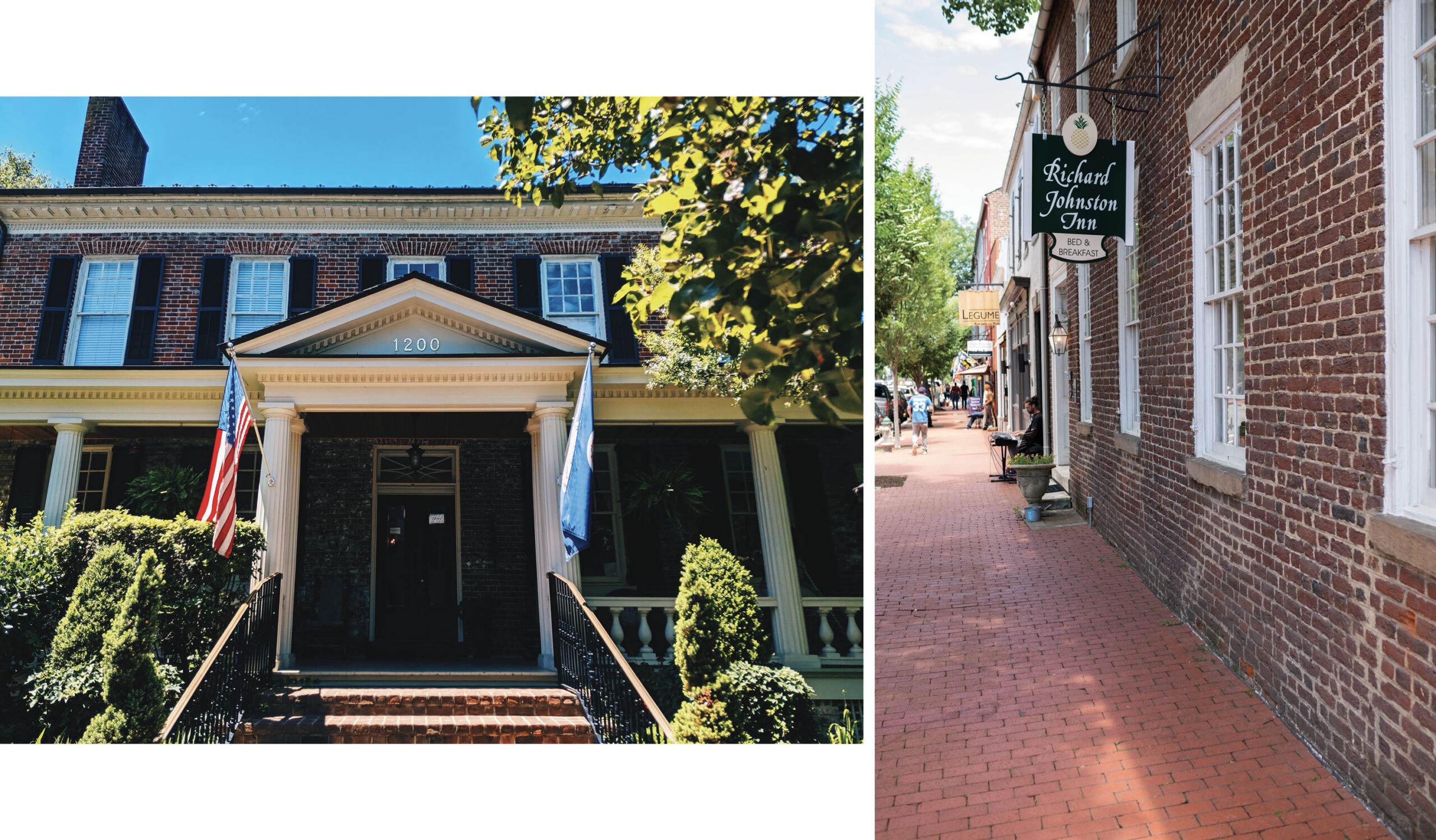
The downtown historic district, where the street fighting during the Battle of Fredericksburg took place, is home to the Courtyard by Marriott Fredericksburg Historic District (620 Caroline St.; 540-373-8300) as well as two inns: The Richard Johnston Inn (711 Caroline St.; 540-899-7606), which still shows visible battle scars, and the Kenmore Inn (1200 Princess Anne St.; 540-371-7622). SW
 Jimell Greene
Kenmore Inn (left) and The Richard Johnston Inn
My clients often stay at The Richard Johnston Inn or the Courtyard by Marriott. Richard Johnston is a period-style B&B, while the Marriott is a first-class stay with all the modern amenities. Either way, you are within easy walking distance of shopping, restaurants, and historic attractions. JC
BEST BOOK
The best battle book would be National Park Service historian Francis Augustin O’Reilly’s The Fredericksburg Campaign: Winter War on the Rappahannock (2003), which, unlike earlier respectable volumes, covers the entire battle instead of emphasizing the Stone Wall–Marye’s Heights–Sunken Road area, where most of the battle’s highly publicized fighting took place. SW
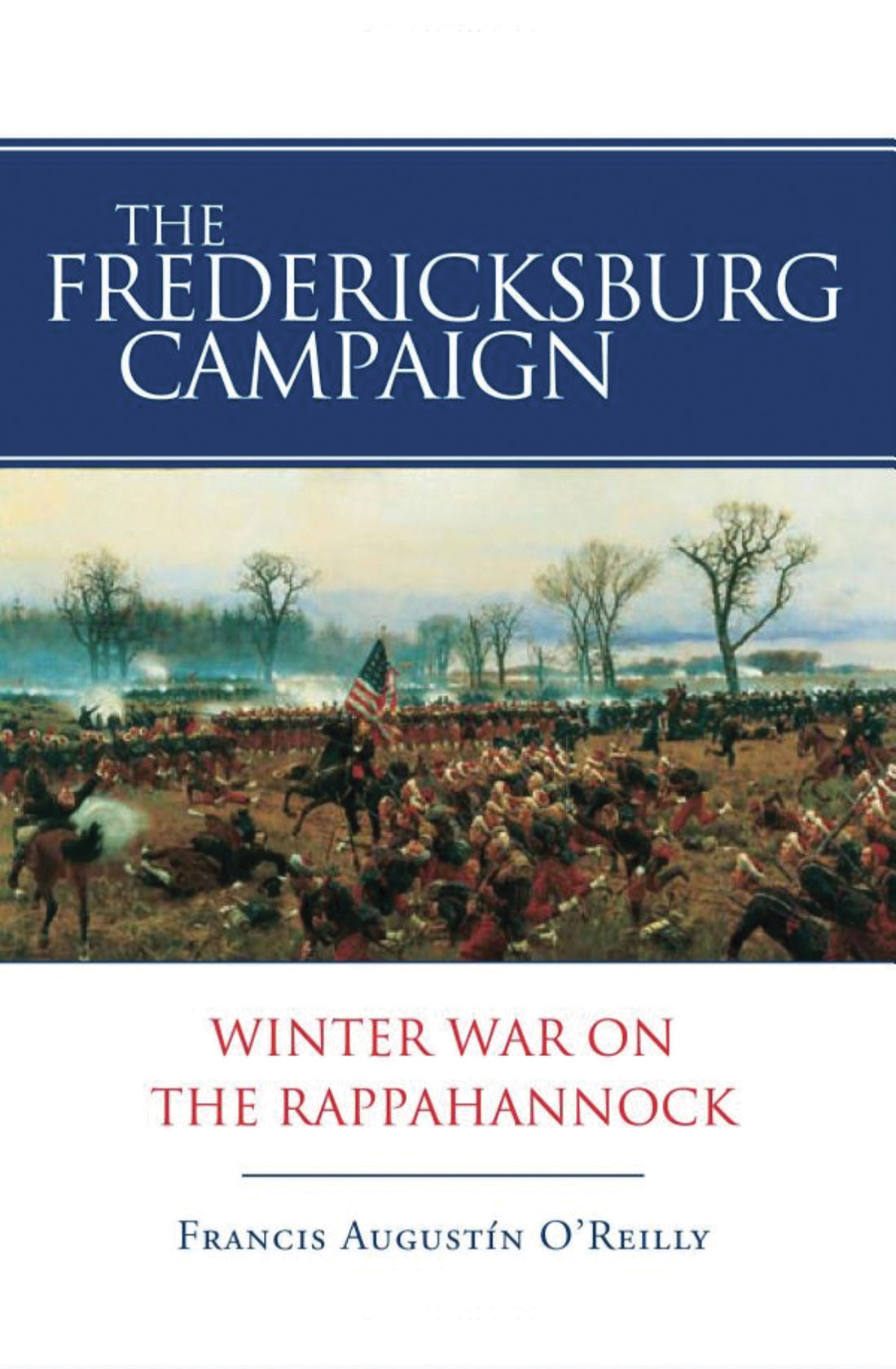
O’Reilly’s The Fredericksburg Campaign is perhaps the best single-volume treatment of the December 1862 battle. Additionally, Chancellorsville’s Forgotten Front (2013) by Chris Mackowski and Kristopher D. White fills a longstanding void regarding the 1863 battles of Second Fredericksburg and Salem Church. JC
ABOUT OUR EXPERTS
Scott Walker, a resident of Fredericksburg for nearly 50 years, is owner of Hallowed Ground Tours (hallowed groundtours.com). (left) John Cummings, the author of three books on the Fredericksburg region, provides battlefield guide services and research assistance to visitors (spotsylva niacw.blogspot.com).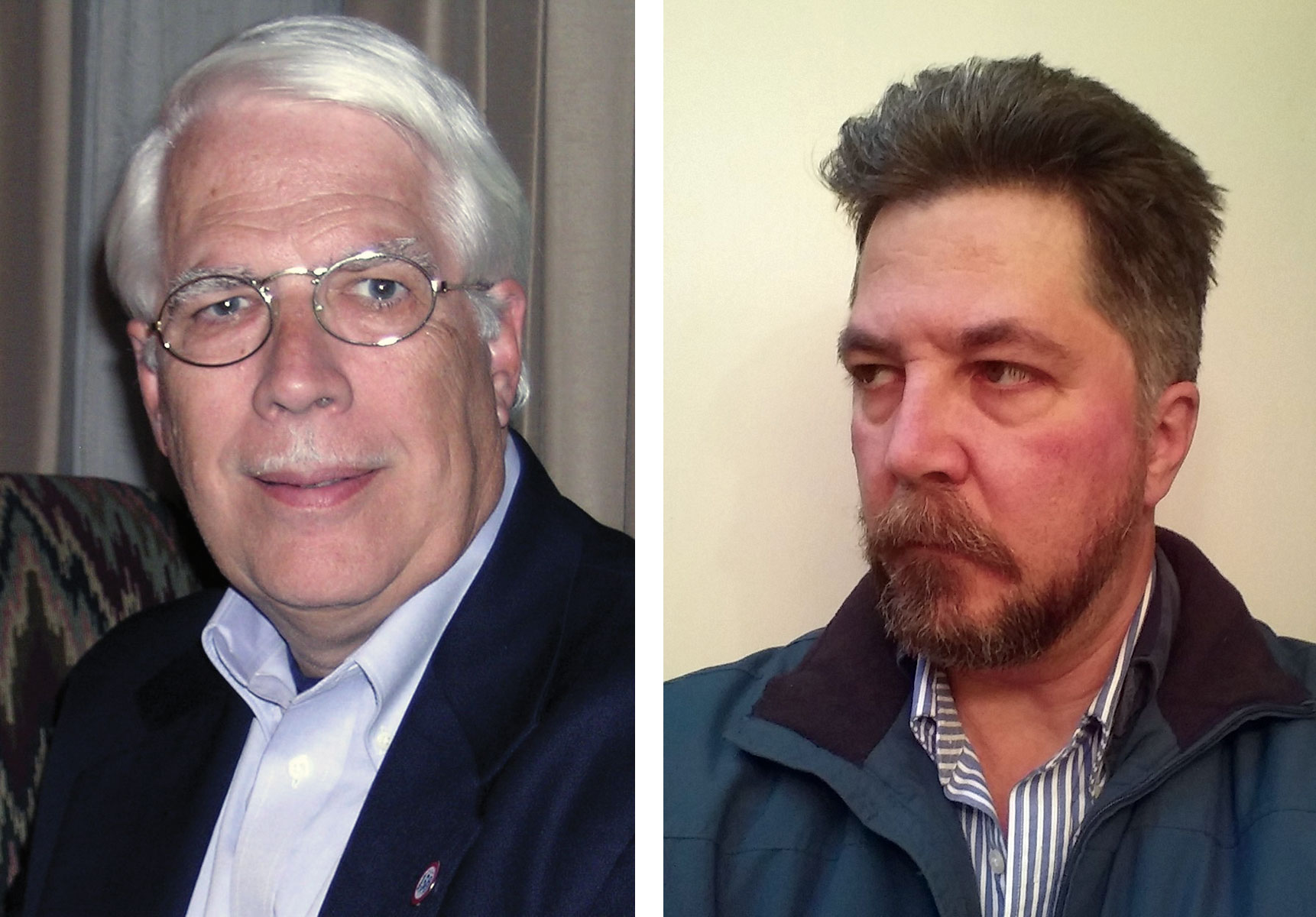
Scott Walker, a resident of Fredericksburg for nearly 50 years, is owner of Hallowed Ground Tours. John Cummings, the author of three books on the Fredericksburg region, provides battlefield guide services and research assistance to visitors (spotsylvaniacw.blogspot.com).