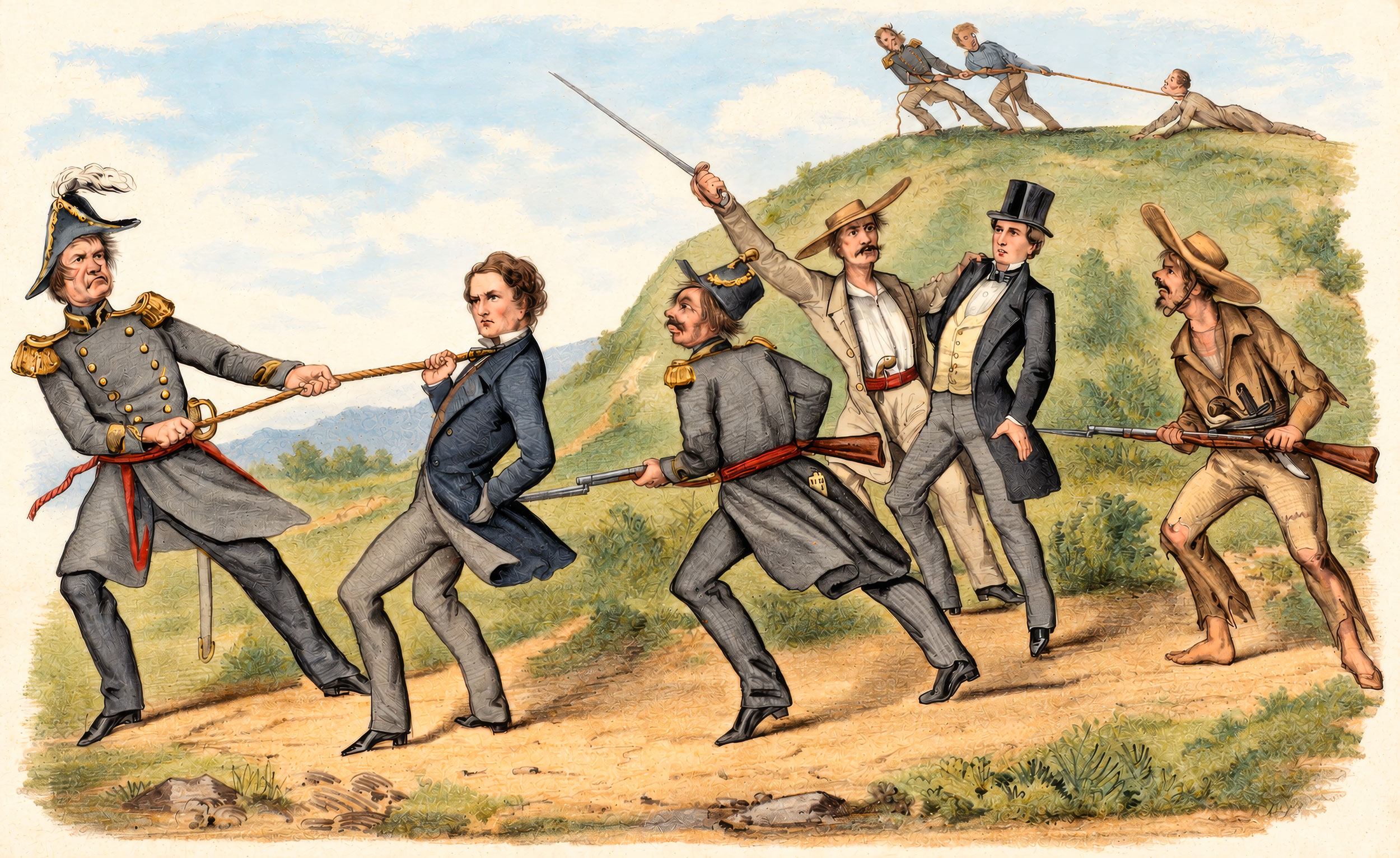
 Digital Special Collections, Lehigh University (colorized by Patrick Brennan)
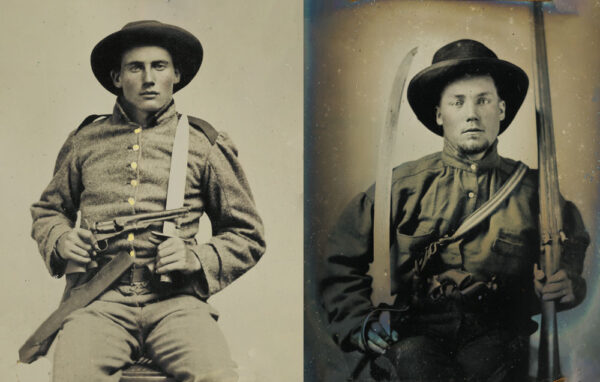
In this 1862 lithograph by Currier & Ives, reluctant southern civilians are depicted being forced into military service after the Confederate Congress had passed a national conscription act that April.
The Civil War created a crisis for southern pacifists. Quaker belief, in particular, held that every human being shared equally in godliness and that to commit violence against anyone was therefore to wage war against God. Quakers also believed that to enslave a fellow human being was, in effect, to enslave a part of God, an unconscionable sin. Such principles made them a small but generally tolerated minority in the prewar South, with their largest concentration in the Piedmont, North Carolina. Although they shunned political agitation, when given a chance to vote on secession in 1861, these southern Quakers heavily opposed it. And initially, the war had little direct impact on them. But in April 1862, recognizing the urgent need for more troops, the Confederate congress enacted the first American draft since the War of 1812, providing for the conscription of all white men aged 18 to 35. A revision of the law made allowance for the pacifist sects—Mennonites and Dunkers and Quakers—but imposed a tax of $500 on each man granted a religious exemption. (The law also exempted the overseers of slaves, and permitted the wealthy to purchase substitutes.)1
Quakers knew the Confederate Conscription Act would severely test their faith. Since the Society of Friends, as they were formally known, had no hierarchy, Quaker meetings allowed each man to decide for himself whether he could conscientiously comply with the tax. Many paid. Among those who felt they could not was Tilghman Ross Vestal. Born in North Carolina in 1844, Vestal was 15 when his family moved to Maury County, Tennessee, near Nashville. There his father, a potter by trade, also farmed and served as a local tax collector. Although Vestal was an avid reader of the Bible and Quaker literature, he had little formal education. Before secession, he paid little attention to politics. His parents hoped the war would somehow end before Tilghman, now 17, had to confront the draft.
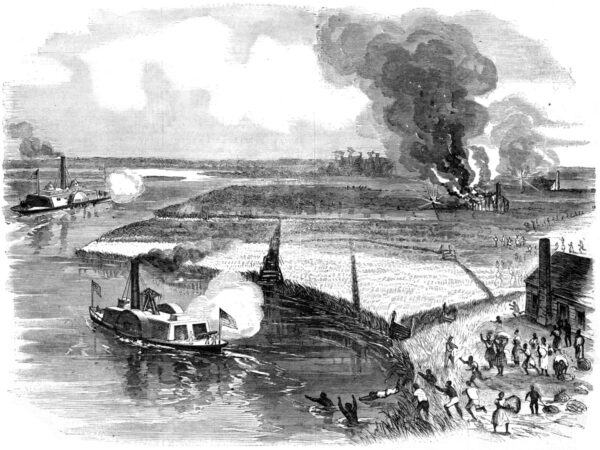
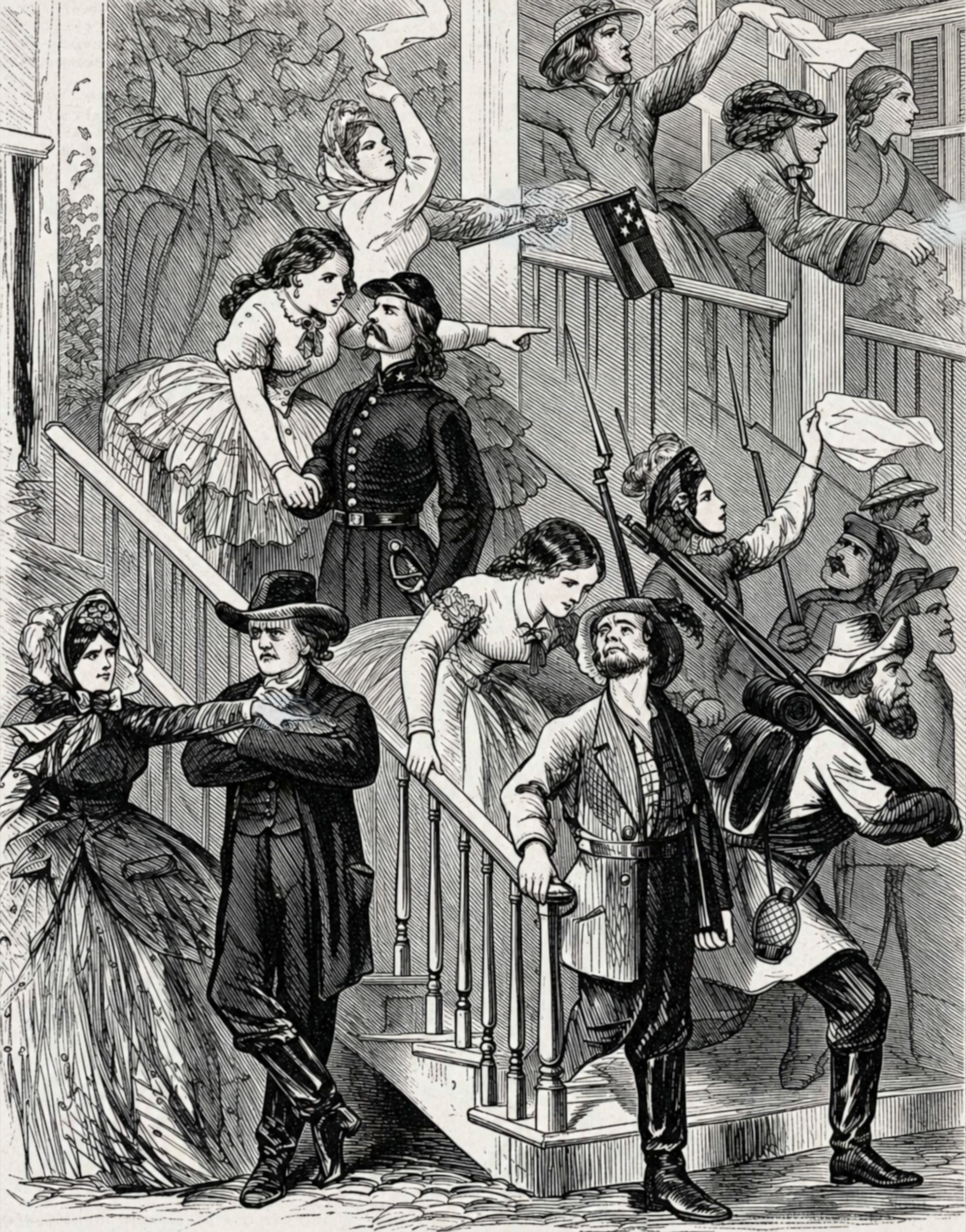 Frank Leslie’s Illustrated Newspaper
During its first months, the war had little impact on southern pacifists like the Quakers. This changed when the Confederate Congress in April 1862 instituted a draft in response to an urgent need for more troops. Shown here: A wartime illustration depicts the early, predraft drive among southern men to join the army.
He was not to be spared. Vestal’s unfolding ordeal offers an extraordinary profile in moral courage as well as a window into the practical dilemma of a would-be nation desperately short of manpower and far from united in popular support for the war. Vestal would carom among Confederate army camps, guard houses, and prisons, adamantly refusing to compromise his pacifism, despite personal abuse, humiliation, and torture. Few of the officers who controlled his fate knew what to make of him. While his experience was hardly typical, it echoed that of many southern men who opposed the Confederate cause and struggled to remain true to their Unionist, or pacifist, convictions.
In a memoir he wrote after the war, Vestal said little about his family’s feelings, apart from one painfully poignant anecdote. His call to report for induction came in February 1863. When he left home, his distraught mother feared “that I might be led into the conclusion that war was right.” At least if soldiers came and shot him down in the yard for refusing to serve, Vestal wrote, “she would know that I did not make a soldier.” Later that day, when he was asked by the local conscription officer if he had paid the $500 tax, Vestal replied, “I consider that nearly equal to doing service. I cannot go to war. Take me, shoot me, if you choose, for I will not go. I am in earnest and I will not fight.”2
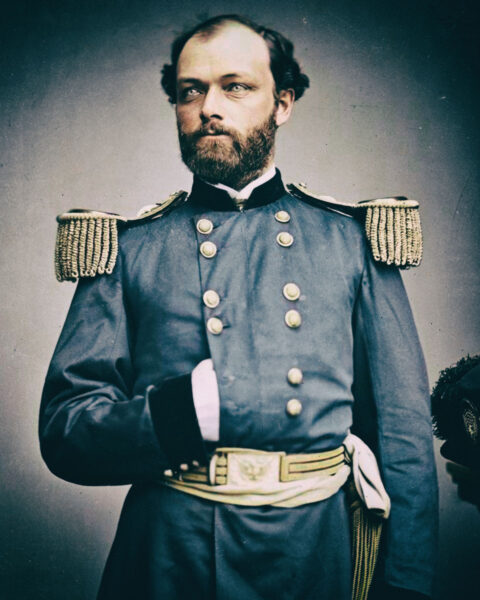
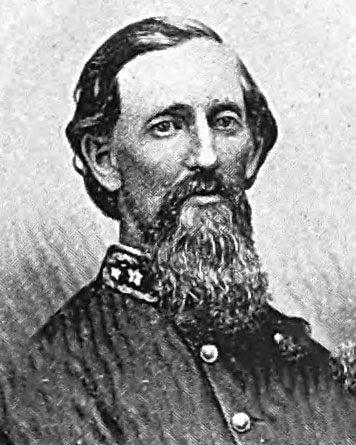 Confederate Military History, Vol. 8 (1899)
Otho Strahl
Vestal was assigned to the 4th Tennessee Infantry, part of Leonidas Polk’s corps of the Army of Tennessee, which was refitting after its severe losses at the battles of Shiloh, Perryville, and Murfreesboro. When “the colonel,” presumably the 4th’s commander, Otho Strahl, ordered Vestal to “step in” with a batch of new recruits, he politely declined, saying, “I cannot do so.” Furious, “the colonel” ordered a lieutenant standing nearby, “Take this fellow to your company, and try and change his faith—I want to see a good soldier made of him.” Vestal wrote, “I was ordered to take a gun, but I did not. I was then ordered to go up to the place for drill and clean it. Having refused to do this, the colonel sent for me, and pointed to [soldiers clearing] some stumps and brush and said, ‘Go out there and help those men to do that work.’” Replied Vestal, “If it is to benefit the drill place, and to aid the war, I cannot comply.” He was then ordered to cook rations for the guards on duty. “[When] I saw they would make a regular cook of me, I refused.”
Vestal was permitted to make a personal appeal to Polk, whose headquarters were nearby and who by then was known as “the fighting Bishop.” Polk had been commissioned as a major general in 1861 after years as an Episcopal cleric. Asked by Polk if he was “southern or northern in his feelings,” Vestal struggled to answer. “This was a close question for me, as I had never expressed any idea of my public principles.” He knew that if he claimed to be a secessionist, his punishment would surely be lighter. But he did not. “I spoke the truth and said, ‘I am never pleased to hear that the Northern men have killed a number of Southerners. At other times, I think that it would be best for the South if it were whipped.’” One of Polk’s aides demanded, “Would you not fight if men came to your house and threatened to kill you?” Vestal quietly replied, “I would not; I would act as nearly like our savior as I knew.”3
At this point, the exasperated Polk surprisingly gave Vestal a three-month pass allowing him to return home. Perhaps Polk felt that with time to reflect, the stubborn Quaker would relent and do what the army expected of him. Vestal gave his word that he would return on the date appointed.
Vestal considered escaping to the North. Many southern pacifists—and non-Quaker Unionists—slipped through the Smoky Mountains to pro-Union East Tennessee, and from there to safety in the North. This dangerous journey could take weeks, or even months, and required eluding capture by home guards and Confederate patrols. Captured fugitives were sometimes strung up by their hands or thumbs in an effort to break their will, and then dragged back to recruitment offices and forced into the army. In some cases, fugitives’ parents were tortured to get them to reveal where their sons were hiding. However, Vestal wrote, “I felt it my duty to remain in the South, and show the people of the neighborhood and army that I could not be forced to give up my opinion, shrink from my faith, and be made to bow to the will of a commander.”4
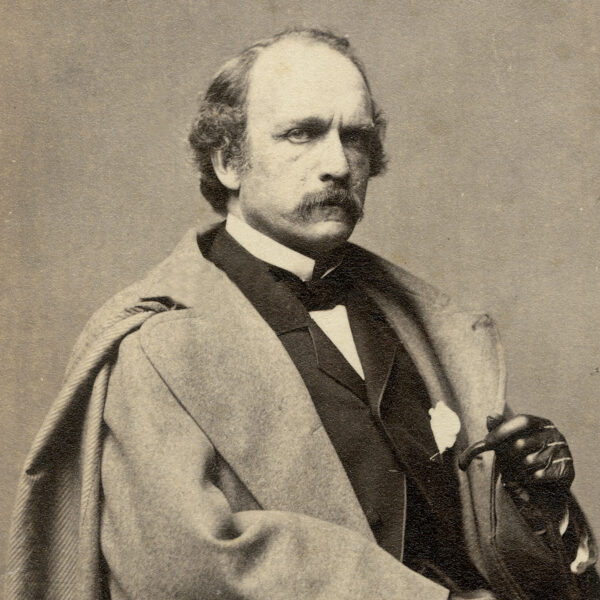
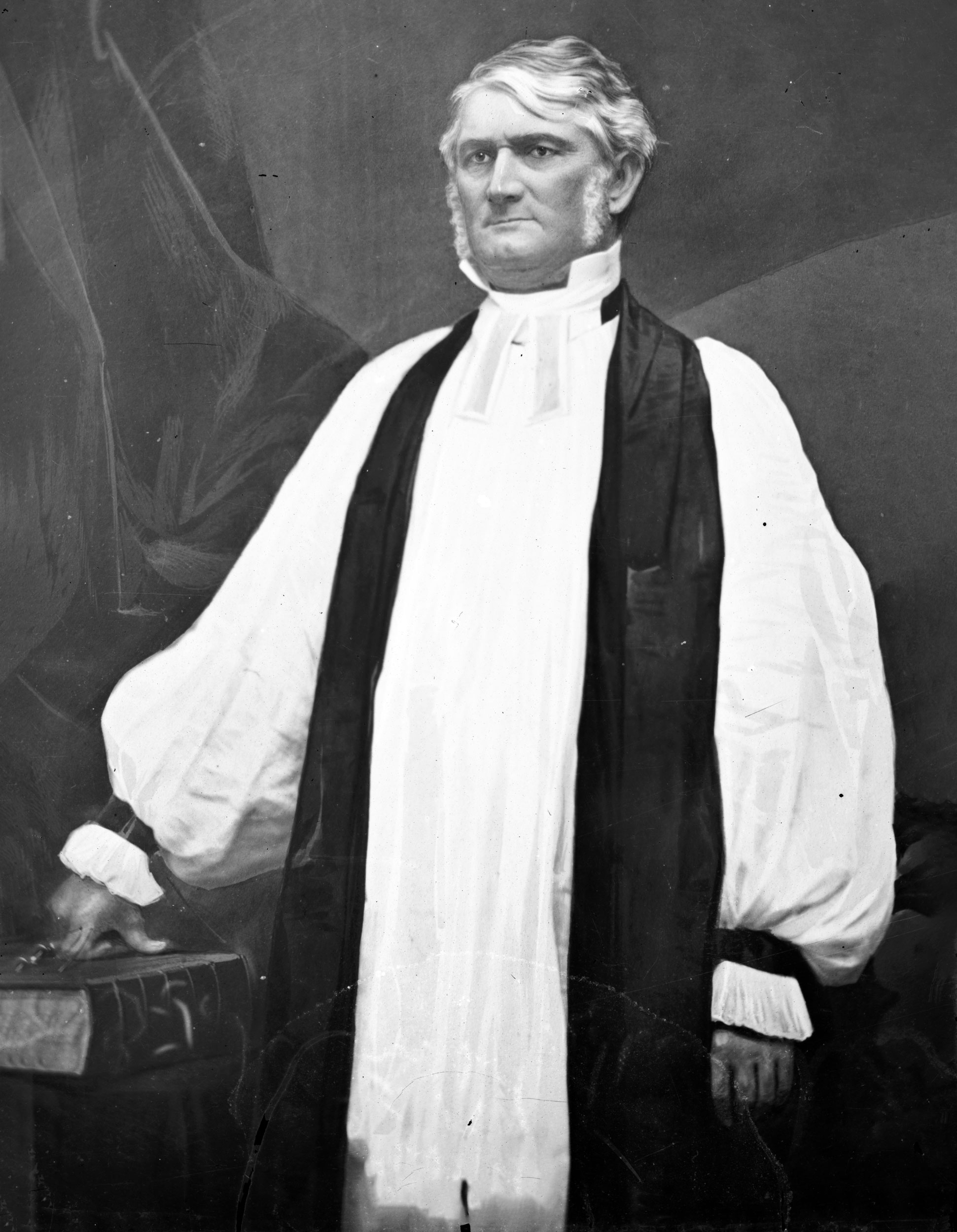 Library of Congress
When pacifist draftee Tilghman Ross Vestal first refused the duties of a soldier, he was sent to Confederate general Leonidas Polk (above), the former Episcopal cleric who commanded the corps in which Vestal’s regiment, the 4th Tennessee Infantry, served. Vestal struggled to answer when asked by Polk if he was “southern or northern in his feelings.”
Vestal’s family and friends urged him to buy his freedom by paying the $500 tax. “But I did not feel satisfied to make a payment even of that kind, notwithstanding my father wished me to do so,” he wrote. “I listened to the advice of all of them, but took my own.” He accepted that the authorities had a legal right to attempt to conscript him. But he also felt that he had a moral, indeed even a spiritual, duty to resist. Even the seemingly innocent act of cooking for soldiers was nonnegotiable. He reasoned that while they were simply fellow men and had to eat whether they were soldiers or not, to serve the army’s needs in any way had the potential to “become a snare” that would inexorably lead him to deeper collaboration in the war.5
Vestal decided that he had no principled choice but to present himself again to the Confederate army at the expiration of his pass, as he had pledged. While he had agonized at home, Braxton Bragg’s Army of Tennessee had retreated southward, leaving the Vestal family home between the opposing forces. Vestal could, if he wished, walk just a few miles to a haven behind Union lines. “My heart was heavy,” he wrote. “It burned within me, [but] I felt that I was in duty bound to fulfill my promise.”6
To reach Bragg’s army, Vestal had to cross the Tennessee River into Georgia—ferries were so crowded with refugees that he had to swim across with his mule, clinging to the side of a canoe—and then back again into Tennessee. He eventually found the army at Tullahoma, west of Chattanooga. When he presented himself at headquarters, Polk interrogated him closely, hoping he had “undergone a change of principles.” Realizing that he had not, Polk tersely “pronounced me a soldier,” Vestal wrote, and ordered him back to the 4th Tennessee. “I arose and departed,” he recalled, “saying, ‘I suppose that when I refuse to do duty, I will be shot.’”7
And so began the most trying period of Vestal’s ordeal. A chaplain was sent to persuade him that “true religion” required him to obey the government. Vestal replied, “You make the religion bend to the government, I am one of those who give religion the preference when there is a conflict.” (On another occasion, a different chaplain attacked Vestal’s Quaker beliefs “in a very rough manner for one so pious as he claimed to be,” ranting that Quakers were the same as Puritans and the abolitionists whom the chaplain blamed for causing the war. Vestal tried to explain Quaker doctrines, which he reported were “not very agreeable” to some of the soldiers, who “were considerably embittered with the idea of my being opposed to slavery.” The angry chaplain finally gave up, telling Vestal that if he did not pay the tax or agree to fight he would be shot, “and that he would be in favor of it.”)8
Soon, Vestal noted, “I was becoming so troublesome that the patience of all the officers was completely worn out.” Shunned by the soldiers, he was denied rations unless he carried a gun, and was left to sleep unsheltered in the brush. Before long, the 4th Tennessee decided to wash its hands of the stubborn Quaker, and dispatched him to a conscript camp at Knoxville. Vestal accepted this change of venue with his usual resolve, still refusing to take part in any kind of activity he considered military. As a result, he was jailed in a guardhouse with “about twenty of the very off-scouring of Tennessee,” where he lay sick for several days, without benefit of medical attention.
When he recovered, Vestal was sent east to the Army of Northern Virginia, which in March 1863 was camped near Orange Courthouse, Virginia. There, he was assigned to the 14th Tennessee Infantry, a veteran regiment that had fought in all the major battles of Robert E. Lee’s army since the Peninsula Campaign of 1862. Vestal told the regiment’s colonel, “You have assigned me to duty without my consent. I did not come here to fight, and I am not going to do duty. His reply was that it made no difference whether I consented or not.” The colonel added ominously, “We have a way to make men do duty here.”9
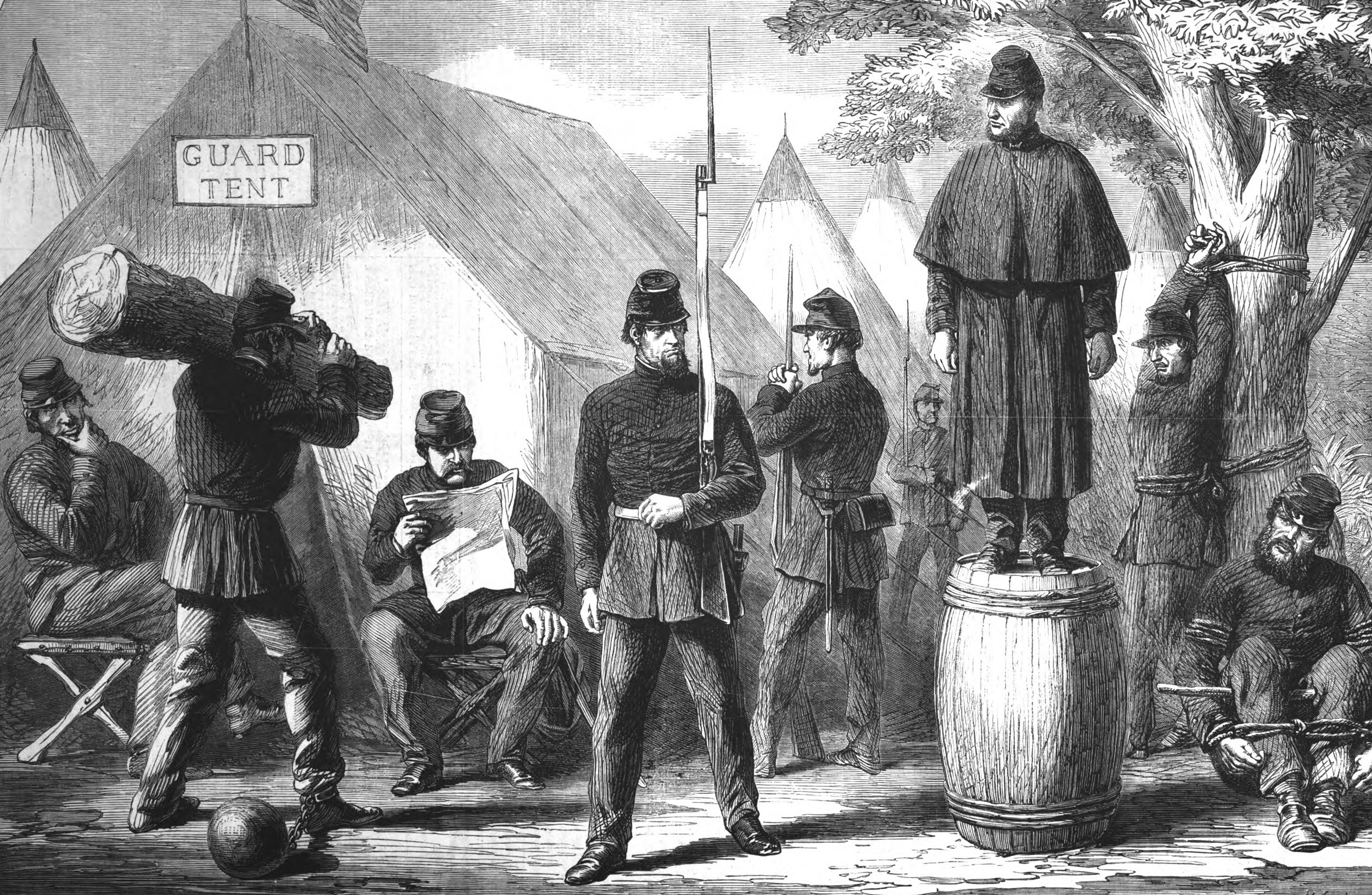 The London Illustrated News
This London Illustrated News illustration depicts a variety of Civil War camp punishments, one of which, “bucking” (depicted), Vestal was subjected to during his army ordeal.
A sergeant and three privates were detailed to force Vestal to perform camp duty. They first ordered him to clean up the camp. Vestal refused. “If you do not, I will make you do it,” the sergeant warned. He then told his men, “Make him take that shovel and remove this pile of dirt.” Vestal wrote, “I was sitting on a log before the tent and they leaned the shovel against my shoulder, drew back their guns and said, ‘If you do not take the shovel, we will pierce you immediately.’ I looked one of them in the face and asked him if he expected me to endanger my soul’s salvation. At this, he thrust the bayonet into my side twice so that I was pushed off the log and stood up. Then one of them pierced my thighs whilst the other held my collar and struck the back of my head with the butt of his musket. Two strokes brought me to the ground, when I cried, ‘God, come to me!’ They jerked me up and continued to pierce [me], saying, ‘You shall fight.’” Vestal heard someone shout, “Kill him!” The soldiers eventually stopped, and dragged Vestal to a pile of leaves, forced his arms around them, and compelled him to carry them away, “but my stiff and stubborn ways vexed them so that they began to pierce [me] as furiously as ever.” Finally, an officer came up and ordered Vestal to sit on a pile of trash with a shovel across his knees and to remain there until he was “subdued.” Recalled Vestal, “I talked to the guard about simple matters, and appeared as cheerful as possible” until “at length I turned sick from my wounds,” and a doctor was called. He found that Vestal had 18 bayonet holes in his body, some of them an inch deep.10
After all this, even hardened veterans took pity on Vestal. When an order was issued to apply the same torture again that evening, wrote Vestal, “This aroused fury in the fourteenth Tennessee regiment, they said it should not be done, and if [anyone] undertook to do it, they would whip him and his whole brigade.”
Such abuse wasn’t rare in the Confederate army. Resisters were commonly subjected to “bucking,” a painful punishment that involved tying a man’s wrists while he sat on the ground, pulling his knees to his arms, and pressing a stout stick over the elbows and under the knees so that he could neither stand nor crawl, for hours at a time, in increasing agony. (Bucking was also used as a punishment for some infractions in the Union army.) Solomon Frazier, another North Carolina Quaker draftee, was imprisoned and suspended by his hands for three hours as punishment for resisting duty. His tormenters then tied a gun to his arm and a heavy piece of wood to his neck. When he collapsed from pain, a soldier poked him with a bayonet, “bucked him down,” and gagged him with a bayonet with the sharp edge against his lips. The Quaker brothers Himelius and William Hockett, also from North Carolina, were repeatedly tortured on officers’ orders in the 21st North Carolina Infantry. Recalled Himelius, “My brother was pierced cruelly with bayonets, when I was hung up by the thumbs almost clear of the ground. I was untied and pierced with a bayonet, though [only] slightly.” Just before the Battle of Gettysburg, soldiers tied a gun onto Himelius and beat him in the head with a rifle butt, and then, as he knelt and prayed, a captain ordered a detail to bayonet him. Fortunately, the reluctant men charged with this awful task jabbed his clothes without puncturing his skin. Other Quakers were forced into line-of-battle without weapons, where they were made to stand under fire. At Winchester, Virginia, Isaiah Macon, for one, was hemmed in among the soldiers so that he couldn’t move. When his company fled the field, he allowed himself to be captured, but died a few days later, possibly from shock.11
Through much of the autumn of 1863 the armies jockeyed back and forth across northern Virginia, maneuvering for strategic advantage, as rumors swirled that Lee would try again to invade Pennsylvania. Although Vestal’s civilian clothes were now in rags, he still refused to take a proffered uniform. “I concluded to suffer with cold rather than appear in a soldier’s garb,” he wrote. As the Army of Northern Virginia neared Bristoe Station in mid-October, Vestal heard the rattle of gunfire, and saw dead men and horses by the roadside. For a time, it seemed certain that he would be trapped in battle: “I started towards the battlefield with a heavy heart and a guilty conscience.” But he was spared at the last minute when the 14th Tennessee was detailed to serve as a reserve.12
Vestal’s case finally came to a head on November 5. After months of uncertainty about his fate, he faced a court-martial at Brandy Station and was formally charged with disobeying orders. “I denied no part of the charge,” wrote Vestal. “I told them that I had not paid the tax and I did not wish to pay it because I did not think it consistent to do so.” The court remanded him to Castle Thunder, a prison in a converted tobacco factory in Richmond, where he found himself incarcerated with Yankee prisoners of war and all manner of unsavory “villains and man slayers,” crowded into rooms where meals were a piece of cornbread and a cup of bad cabbage soup twice a day, and prisoners fought each other for space near the facility’s single stove.13
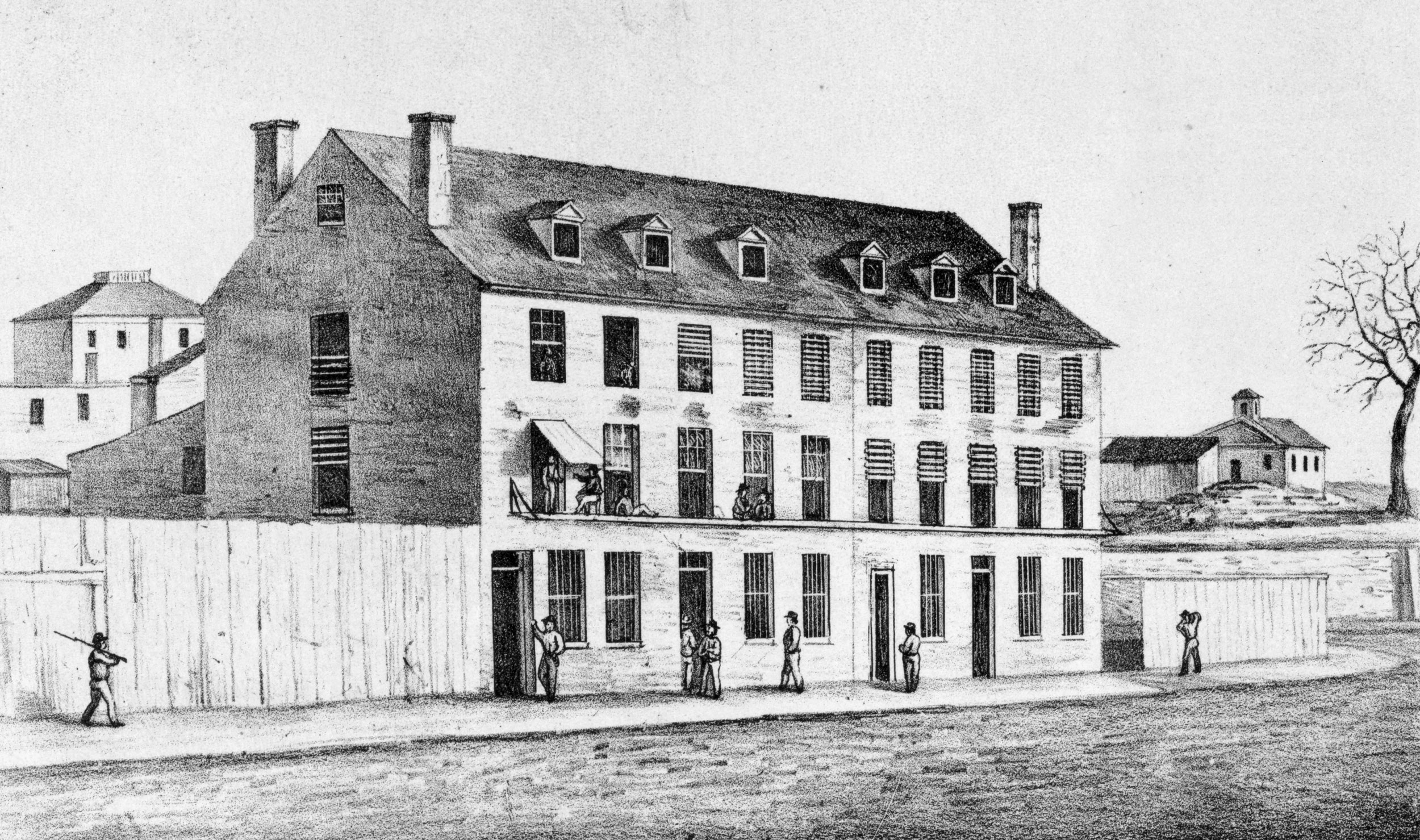 Library of Congress
After he was formally convicted of disobeying orders in November 1863, Vestal was sent to a prison in a converted tobacco factory in Richmond known as Castle Thunder (above), where he met the local Quaker minister who possibly saved his life.
Here Vestal met one of the most remarkable men in the Confederacy, who quite possibly saved his life: John B. Crenshaw, a Quaker minister who was one of the last of the faith to remain in Richmond. (Nearly all the others had long ago departed for the North.) Crenshaw told Vestal, “I wished to go [too], Tilghman, but thought that God required me to remain here. I know not why, [I] simply obeyed. Since the war I have fancied that his secret is disclosed.” Wrote Vestal, “No doubt he was correct, for he was instrumental in securing the release of numbers of prisoners of different denominations who were confined rather than draw the sword.” Crenshaw, whose merciful appeals had won the respect of the Confederate authorities, brought Vestal fresh clothes, food, reading material, and letters from his relatives in North Carolina. He also persuaded Vestal—who though as stoic as ever was suffering from exhaustion, malnutrition, and “something like the mumps”—that to pay the $500 conscription tax need not be seen as a sacrifice of principle. To an uncle, Vestal wrote, “I have come to the conclusion that now is God’s time for me to be released by paying the tax. I do not think that all my trials and sufferings are in vain. I think that it was required of me to go through with this and to refuse to pay until this time.” It seemed, briefly, that Vestal was at last about to become a free man.14
But Crenshaw returned to the prison in tears to report that since Vestal had been convicted of a crime, the Confederate authorities would no longer accept his money: They “decided not to allow thee the privilege of paying out.” Worse yet, Crenshaw learned that Vestal was being transferred to the military penitentiary at Salisbury, North Carolina, second in notoriety only to the virtual death camp at Andersonville, Georgia. On February 2, 1864, along with scores of other prisoners, Vestal was shipped out.
Vestal’s grim new home was a former cotton factory enclosed by 12-foot-high plank fences and guarded by a ragtag and sometimes vicious troop of boys as young as 12 and turncoat Yankee soldiers known as “galvanized” Confederates, who preferred to watch over their former comrades than suffer among them. Different sections of the penitentiary were occupied by northern and southern civilians; Confederate soldier convicts; prisoners of war; Union deserters; and Federal officers. Vestal was initially placed among the convicts, where he was regularly beaten, perhaps because of his Quaker beliefs, or simply because of his refusal to fight back when attacked. Later, however, he was allowed to move to a room inhabited by “trustworthy” prisoners, where he was safe from abuse and, to his great relief, “blessed with the very thing I had been wanting: a chance to study,” presumably books Crenshaw had given him in Richmond.
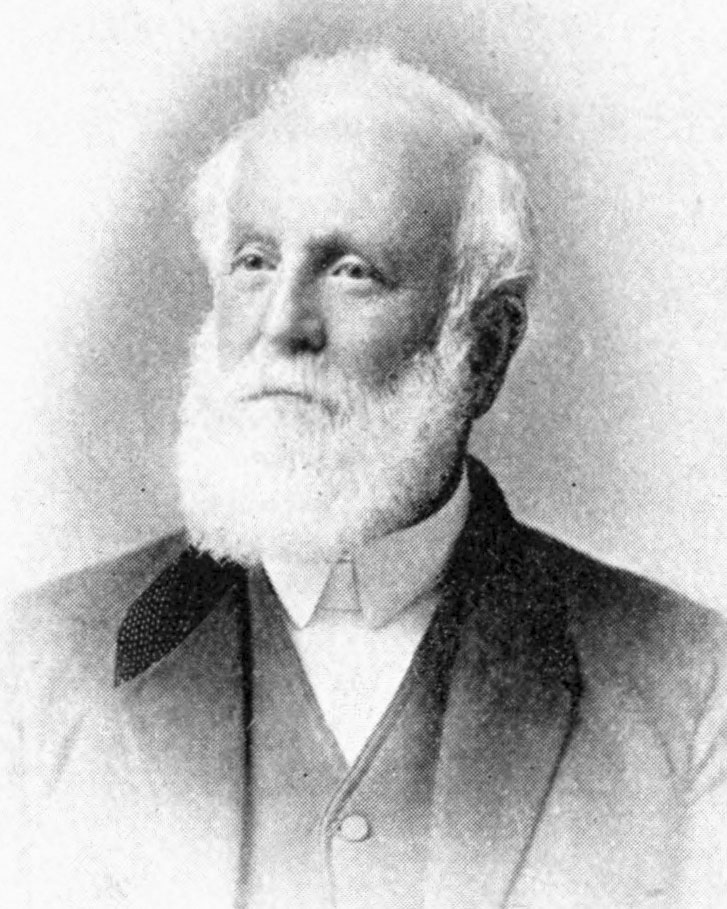 Southern Heroes (1895)
John B. Crenshaw
Meanwhile, the indefatigable Crenshaw continued lobbying the Confederate War Department on Vestal’s behalf. He learned that Vestal could be released if a job could be found for him in a vital trade such as shoemaking, nursing—or pottery-making. As adamant as ever, Vestal reminded Crenshaw that he would not do any work that could be construed as assisting the war effort: “If I had felt willing to do government work, I could have went at it before I was punished, and could have missed all this imprisonment. I chose rather to be punished, and am not sorry that I did so.” Crenshaw reassured him that he had found a workshop that did no work at all for the army, Parr & Son, an old Richmond firm that specialized in stoneware decorated with cobalt blue floral patterns.15
On March 16, more than a year after his ordeal began, Vestal was released from Confederate service and placed under the sponsorship of the Parr family. It should have been a joyful time for him after his many travails. “Parr treated me very kindly [and] his daughter Louisa voluntarily offered to assist me in my studies,” Vestal wrote. However, Vestal almost immediately fell into a deep depression, probably what today would be termed PTSD. “Melancholy feelings enveloped me,” he wrote. “At night, one of the girls read selected poems such as ‘Never Despair’ and ‘All’s for the Best.’ But it was all in vain. The more I thought, the worse I grew until I almost concluded to live a hermit’s life. I sought relief in daily labor, arose early and tried hard to wear off that dismal state of mind.”
Before long, the war came to Richmond. Following the blood-soaked Overland Campaign, Union armies steadily extended their reach to Petersburg, 20 miles south of the capital, and then beyond. Cannon boomed day and night, alarm bells rang, and virtually every available man, young and old, was ordered to the battlefront. With trepidation, Vestal listened to “the dreadful rumbling of the cannon hurling into eternity souls from many a racked and bloody brain to be judged before a just God. Perhaps the same volley sweeps one from each, the next moment they shake hands in heaven where they will love each other forever.” Dreadfully wounded soldiers along with the dead and dying were unloaded wholesale on the James River wharfs not far from Parr’s workshop; during his free hours, Vestal brought bread and coffee to “the poor limbless and helpless.” One day, soldiers entered the workshop and took away all the workers, except for Vestal, whose discharge papers Crenshaw preemptively renewed every few days. With its workers gone, Parr was forced to suspend operations.16
To extricate Vestal from Richmond and its new dangers, Crenshaw managed to secure for him a pass to travel to New Garden, a Quaker community near Greensboro, North Carolina, to attend the famous Quaker school there, today known as Guilford College. Vestal arrived there in July, but would not stay long. With the Confederacy more desperate than ever for manpower, Vestal feared that despite his discharge he might be press-ganged once again into the army, as home guards scoured the countryside, hunting for deserters and conscripts. Teenagers, old men, the ill and infirm—all were liable to be thrown into battle with little or no training. In January 1865, Vestal at last decided to make his way north.
He set out for the nearest Federal military base, on the Atlantic coast. Traveling mostly on foot through woods, swamps, and across open fields, often at night, Vestal found shelter when he could in Quaker homes, with friendly railroad workers, and the cabins of the enslaved. Lost more than once in pelting rain, he prayed for divine aid but “it seemed that everything of a spiritual nature was leaving me.” Confederate lines in the state were collapsing and deserters seemed to be everywhere. He feared that if he were captured by what was left of the army, he would be shot as a spy. Despairing and somewhat to his own astonishment, on March 4—coincidentally the date of Abraham Lincoln’s second inauguration—Vestal finally reached Union-held Fort Anderson, on the outskirts of New Berne, North Carolina, hungry, ragged, and almost penniless. He had traveled a total of 267 miles. He immediately took an oath of allegiance to the United States and applied for transportation to Philadelphia, which he reached on March 11. There, he found shelter and work with fellow Quakers. He was, at last, safe.17
Tilghman Vestal eventually settled in Fall River, Massachusetts, where he married and raised five children who lived to adulthood. He prospered as an insurance agent and the operator of a commercial dairy. Whether the effects of his traumatic wartime experiences continued into his later life he didn’t record. He expressed no bitterness toward those who made him suffer. Nor, as a Quaker of surpassing modesty, did he express personal pride in his powers of endurance. His survival may, perhaps, be seen as a triumph over not just fear and suffering, but over war itself.
In 1892, Vestal had one more brush with history. Among his dairy’s customers was his next-door neighbor, a quiet and friendly woman who, shocking the entire nation, was tried (and acquitted) for the bloody axe murders of her stepmother and father—Lizzie Borden.18
Vestal died in Fall River in 1928, at the age of 83.
Fergus M. Bordewich is the author of a number of books, most recently Centennial: The Great Fair of 1876 and the Invention of America’s Future (Knopf, 2026).
Notes
1. John M. Sacher, Confederate Conscription and the Struggle for Southern Soldiers (Baton Rouge, 2021), 9ff.
2. “Tilghman Ross Vestal’s Journal,” Part 1, Unpublished transcript, 5, Quaker Archives, Guilford College, Greensboro, NC (hereafter cited as Vestal Journal; all references are to Part 1 unless otherwise noted).
3. Ibid., 9ff.
4. Ibid., 12.
5 Ibid., 13.
6. Ibid., 15.
7. Ibid., 25.
8. Ibid., 29, 52.
9. Ibid., 41.
10. Ibid., 43–47.
11. Fernando G. Cartland, Southern Heroes, or The Friends in War Time (Poughkeepsie, NY, 1897), 186, 193, 202–203, 244ff, 254ff.
12. Vestal Journal, 59, 64.
13. Ibid., 67.
14. Ibid., 77ff.
15. Ibid., 99.
16. Ibid., 115–121.
17. Ibid., Part 2, unpublished and unnumbered transcription.
18. Jack Faria, “Another Side of Lizzie Borden,” lizziebordenwarpsandwefts.com.