 Buddy Secor
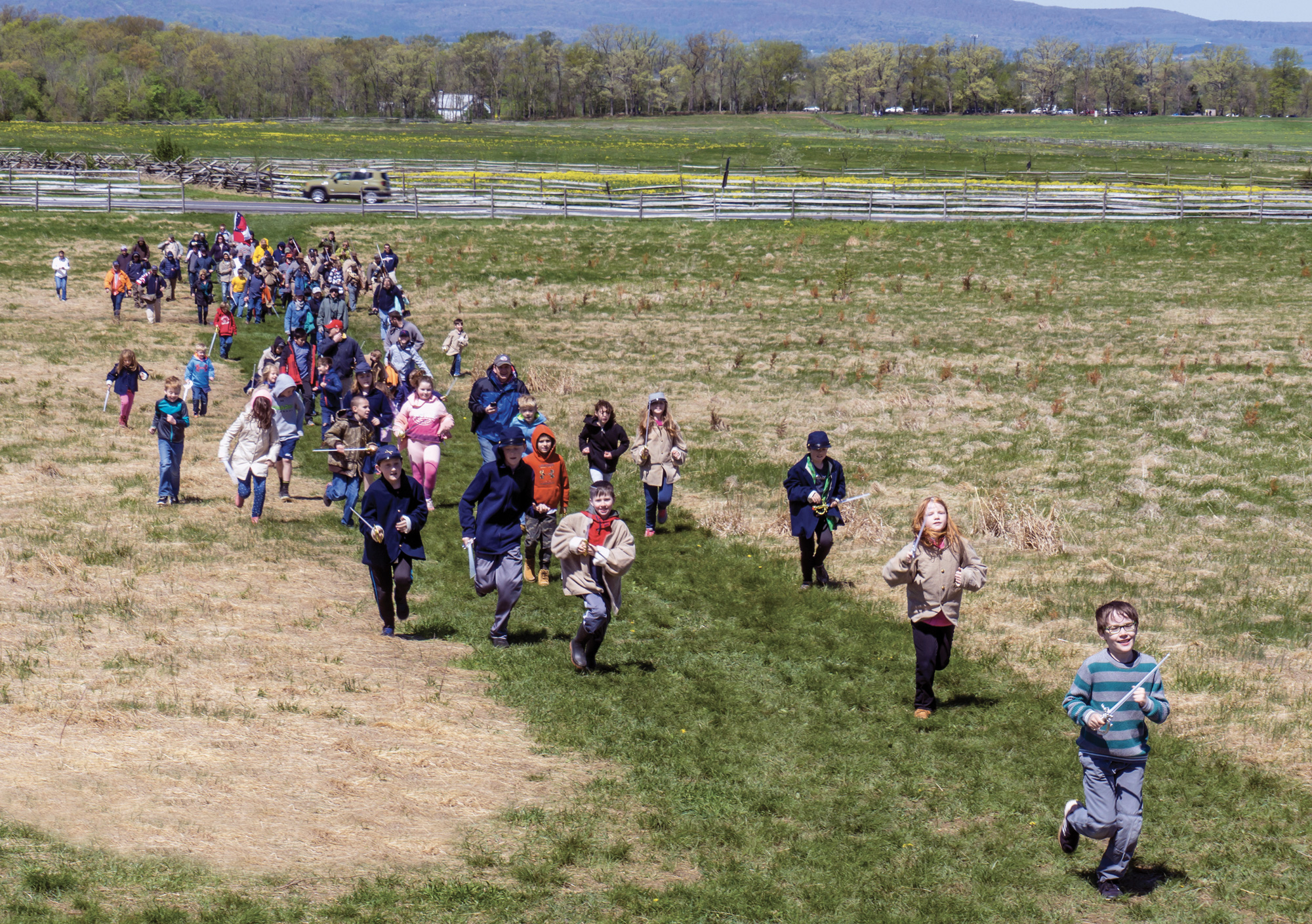
Kids embark on their own Pickett’s Charge during the Trust’s recent youth-centered “Generations” event at Gettysburg, where annual visitation has remained consistently strong over recent decades.
Is Civil War tourism history?
Those of us at the American Battlefield Trust contend that the answer to this question—variations of which made appearances in some prominent media outlets earlier this year—is a decisive no.
While we acknowledge the ever-present challenge of making history relevant to modern audiences, today’s historians and preservationists are rising to meet it, both ably and admirably.
For a piece that it published in May, asserting that Civil War battlefields are losing ground as tourist draws, the Wall Street Journal relied upon data that the National Park Service (NPS) has publicly cautioned is less than reliable. The marquee statistic cited by the paper, for instance, is that visitation to Gettysburg National Military Park in 2018 was down to just 14 percent of what it was in 1970, when the park was said to have hosted nearly 7 million people—more than triple the number of visitors counted at Grand Canyon National Park that same year.
If these numbers sound incredible, it is because they are precisely that—not credible. “Prior to the mid-1980s,” NPS has explained, “no standard Service-wide system existed for counting visitors. As a result, a considerable amount of mathematical errors and double-counting occurred.”
NPS has been working to improve the accuracy of its visitation numbers for decades, developing and implementing site-specific counting instructions for each of its parks. “In raw numbers,” NPS has taken pains to emphasize, “the combined effect of these changes sometimes looked like a decline or increase in visitation, when in fact the change was the result of more accurate counting.”
This helps explain why annual visitation to Gettysburg has consistently averaged between 1 million and 2 million people across the 1980s, 1990s, 2000s, and 2010s alike—a range much more reflective of reality than a 1970s-era outlier.
In fact, more recent and reliable figures actually herald a promising future for battlefield tourism and illustrate the powerful effect of preservation on visitation. A perfect case in point: In the 1990s, Richmond National Battlefield Park encompassed fewer than 1,000 acres and was often host to fewer than 100,000 annual visitors. Now measuring nearly 4,000 acres, the park sees twice the number of visitors.
Virginia experiences tremendous economic benefits from heritage tourism. Whereas travelers to the Old Dominion typically spent $559 per trip in 2018, the Virginia Tourism Corporation found that heritage travelers spent about double that, or $1,116 per trip.
With surveys increasingly signaling that even a basic knowledge of American history can no longer be assumed—only 19 percent of Americans under the age of 45 would pass the U.S. citizenship test, the Woodrow Wilson National Fellowship Foundation recently determined—America’s battlefield parks are a bulwark. They are outdoor classrooms that bring history to life for young and old alike.
Preserving and interpreting these storied sites can certainly be challenging. But the benefits of doing so could not be more clear—or the reasons for doing so more compelling.
O. James Lighthizer is president emeritus of the nonprofit, nonpartisan American Battlefield Trust, which is dedicated to preserving America’s hallowed battlegrounds—Revolutionary War, War of 1812, and Civil War—and educating the public about their significance.