 Civil War Trust
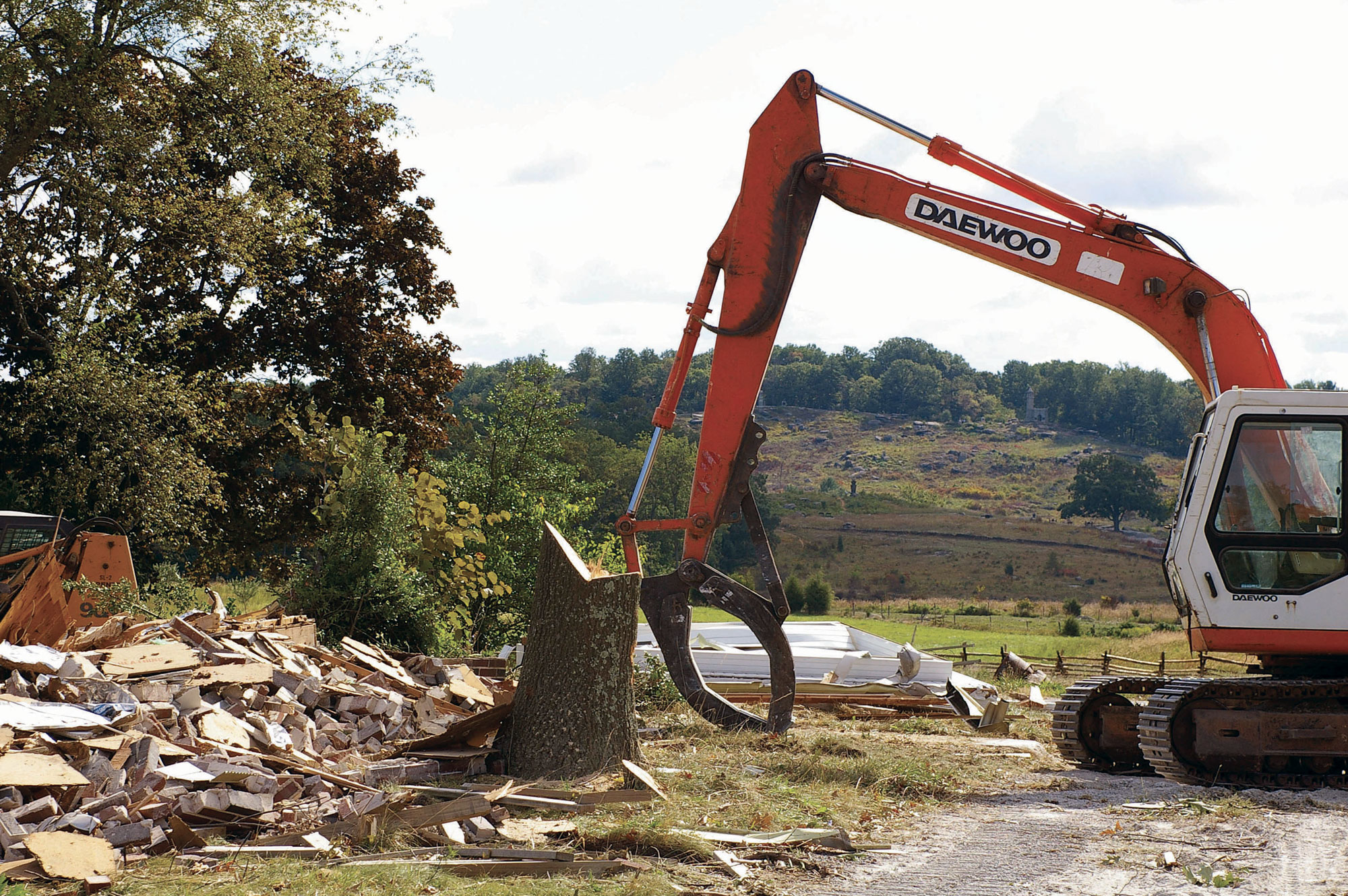
Modern structures on the Trust-purchased Snyder Farm Tract are demolished in 2010 as part of the ongoing effort to return the Gettysburg battlefield to its 1863 appearance.
As the sesquicentennial commemoration continues, we are continually reminded of the feats of valor and sacrifice that transpired on Civil War battlefields. But we must remember that these hallowed grounds are not automatically or effortlessly preserved. They are the product of gradual and ongoing protection, commemoration, and interpretation efforts. Preservation of the Gettysburg battlefield began almost immediately after the fighting ended, when local citizens purchased land on Cemetery Hill to create the Soldiers’ National Cemetery. Driven by Gettysburg veterans and often funded by state governments, land purchases and the placement of unit and state monuments continued through the late 19th century, culminating with the creation of Gettysburg National Military Park in 1895. The growth of the battlefield continues today through the efforts of the National Park Service and private groups including the Civil War Trust, the Conservation Fund, the Gettysburg Foundation, and the Land Conservancy of Adams County.
The Trust has either purchased or assisted in the protection of about 900 acres on the Gettysburg battlefield. It uses a variety of methods: purchasing “inholdings” (small parcels of privately owned property surrounded by existing parkland); coordinating a purchase so that the land is simultaneously—or very nearly so—transferred to the federal government and the national park; or owning and maintaining the land until a transfer is possible.
Other projects are less common but significantly larger in scale. In 2011, a preservation partnership came together to purchase 95 acres that had been the golf course of the Gettysburg Country Club. The land, part of the Emmanuel Harman farm in 1863, had been the largest unprotected parcel on the battlefield. Not only did its protection largely complete the preservation of the first day’s battlefield, it also provided a host of new interpretive opportunities, allowing full access to the length of the Confederate assault across Willoughby Run between Herr’s Ridge and McPherson’s Ridge for the first time.
Landscape restoration—reverting sections of the battlefield to their 1860s appearance—is another strategic goal for both the park and the Trust. The removal of the former park visitors center and cyclorama building from Zeigler’s Grove is the most prominent recent example, but numerous other projects have had dramatic impacts on the battlefield’s look. The Trust has worked closely with the park to remove non-historic structures from parcels it purchases, often before the land’s transfer. For example, the removal of two modern homes on a Trust-purchased parcel that was once part of the Philip Snyder farm along the Emmitsburg road re-established a viewshed between Little Round Top and Seminary Ridge that had been obstructed for decades. And just this March, the Trust removed a non-historic home from a newly purchased property along Taneytown Road, clearing the way for the park to build a walking trail following the land’s imminent transfer.
I hope you will consider joining the Trust as we continue protecting and restoring the Gettysburg battlefield.
O. James Lighthizer is president emeritus of the nonprofit, nonpartisan American Battlefield Trust, which is dedicated to preserving America’s hallowed battlegrounds—Revolutionary War, War of 1812, and Civil War—and educating the public about their significance.