 Harper's Weekly
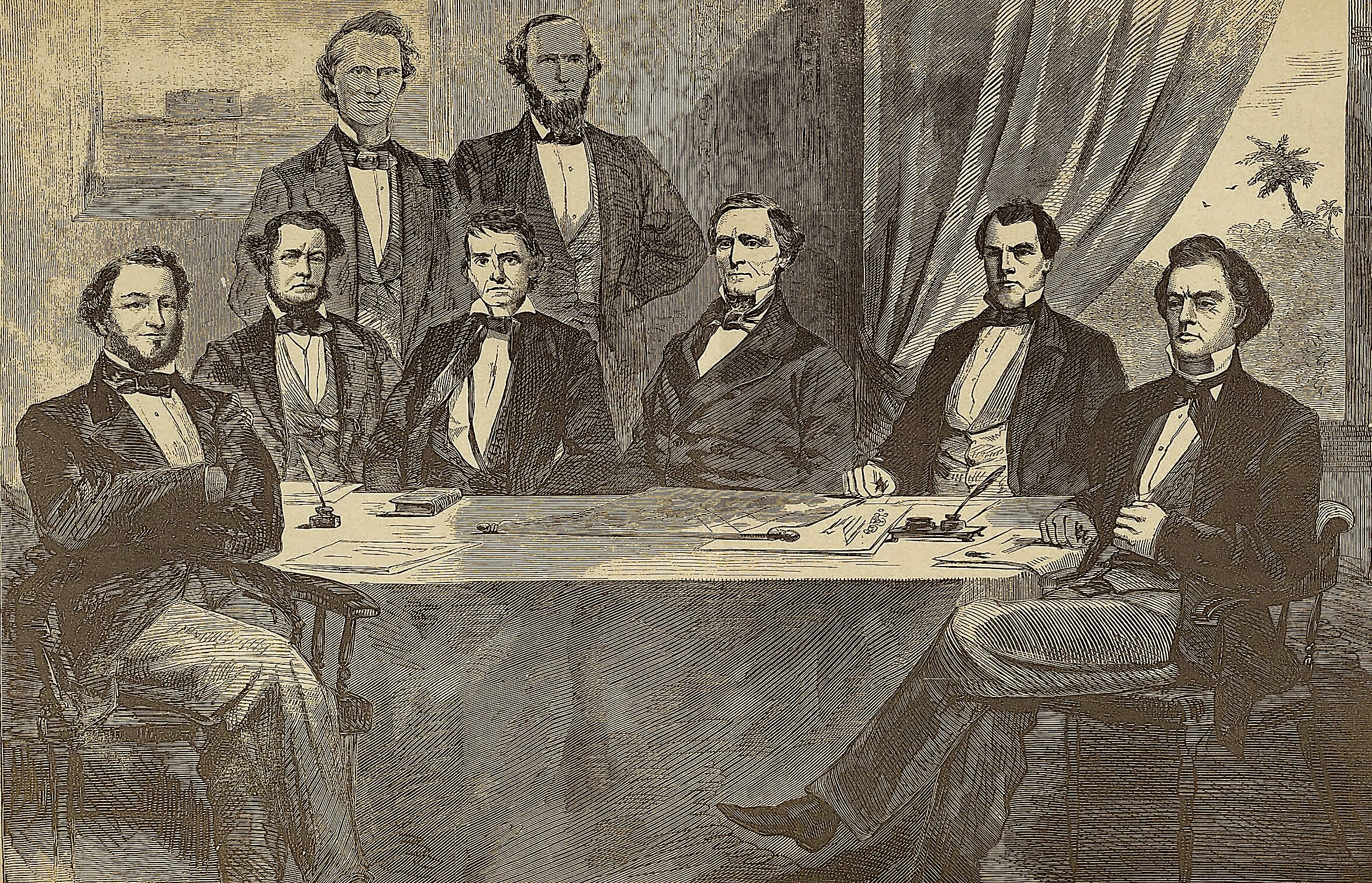
This illustration from Harper’s Weekly depicts Confederate president Jefferson Davis (center) and the members of his Cabinet at Montgomery, Alabama, in 1861.
As the sectional conflict ruptured into civil war, southerners turned to the past to interpret the crisis at hand. They understood the moment as revolutionary, and the closest usable precedent was 1776—an inheritance many Confederates claimed as their own. Just as their forefathers had dissolved a compact with Great Britain, so too, they argued, could they dissolve a compact with the United States. Jefferson Davis sought to mobilize this inheritance at the outset of the Confederacy’s national project, but the appeal proved difficult to sustain. Even as southerners claimed the Founding Fathers’ mantle, they had spent decades deriding the Revolution’s egalitarian premise in the Declaration of Independence. Their appeal to 1776 could be sustained only by narrowing what the founding meant.
 National Portrait Gallery
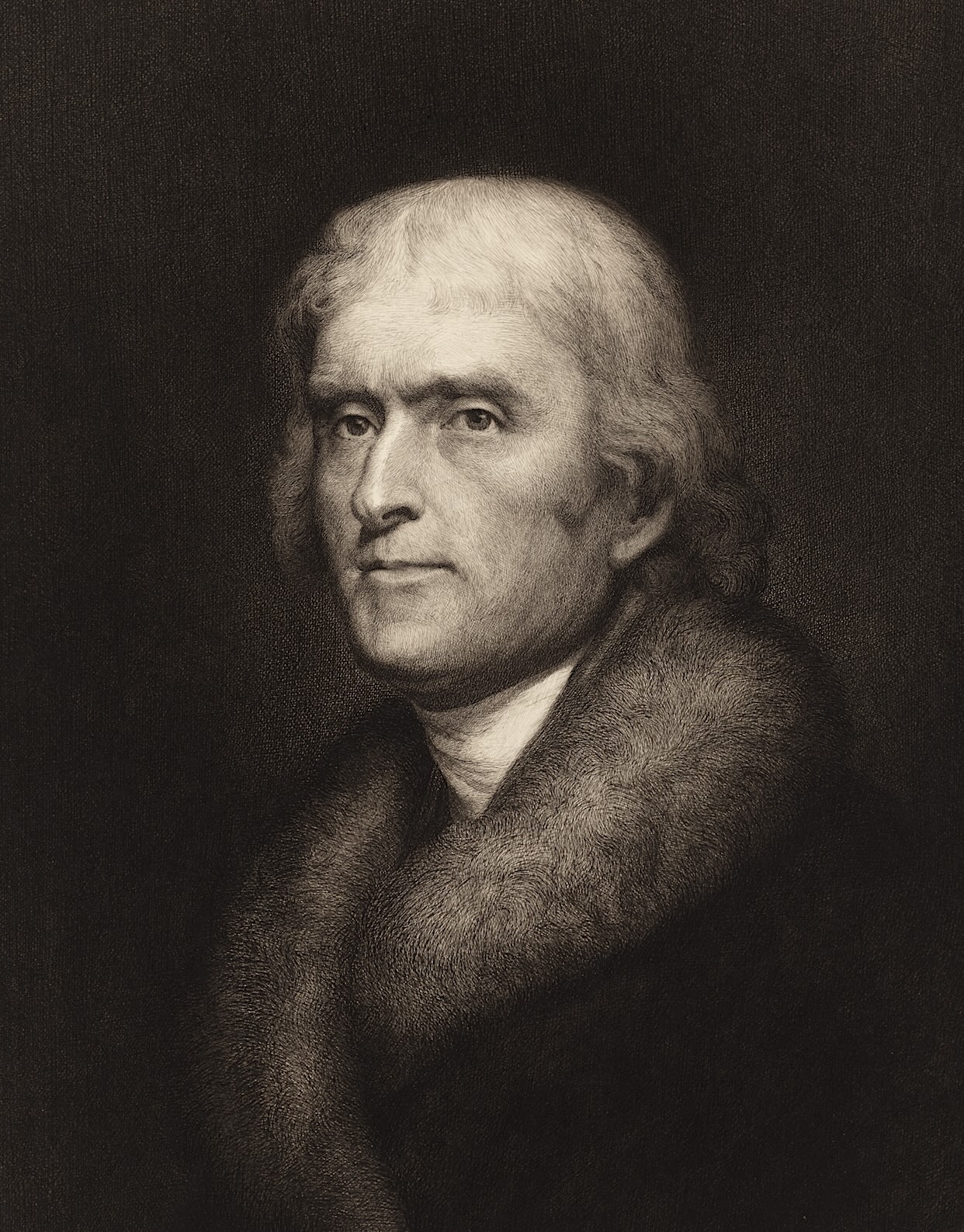
Thomas Jefferson
Southerners often treated Thomas Jefferson as both a touchstone and an instrument. They praised his agrarian sensibilities, and although his First Inaugural Address preached unity, a single passing phrase in it supplied language that could be pressed into the service of disunion. In March 1801, Jefferson cautioned that “if there be any among us who would wish to dissolve this Union … let them stand undisturbed,” a line that could be—and sometimes was—treated as an early sanction for secession. Yet the Jefferson of 1776 proved harder to appropriate. His language of natural rights and the declaration’s egalitarian claims clashed with a slaveholding order that increasingly defended inequality as the basis of social and political stability.1
Once Jefferson’s egalitarian language became a liability, proslavery theorists did not merely reinterpret it; instead, they attacked it. Before the secession crisis, George Fitzhugh of Virginia and John C. Calhoun of South Carolina articulated some of the era’s sharpest repudiations of Jeffersonian equality. In Sociology for the South (1854), Fitzhugh derided the premise that men are “born entitled to equal rights,” insisting that it was “far nearer the truth” that “some were born with saddles on their backs, and others booted and spurred to ride them—and the riding does them good.” He carried the attack to the Declaration of Independence, dismissing it as “exuberantly false” and “arborescently fallacious.”2
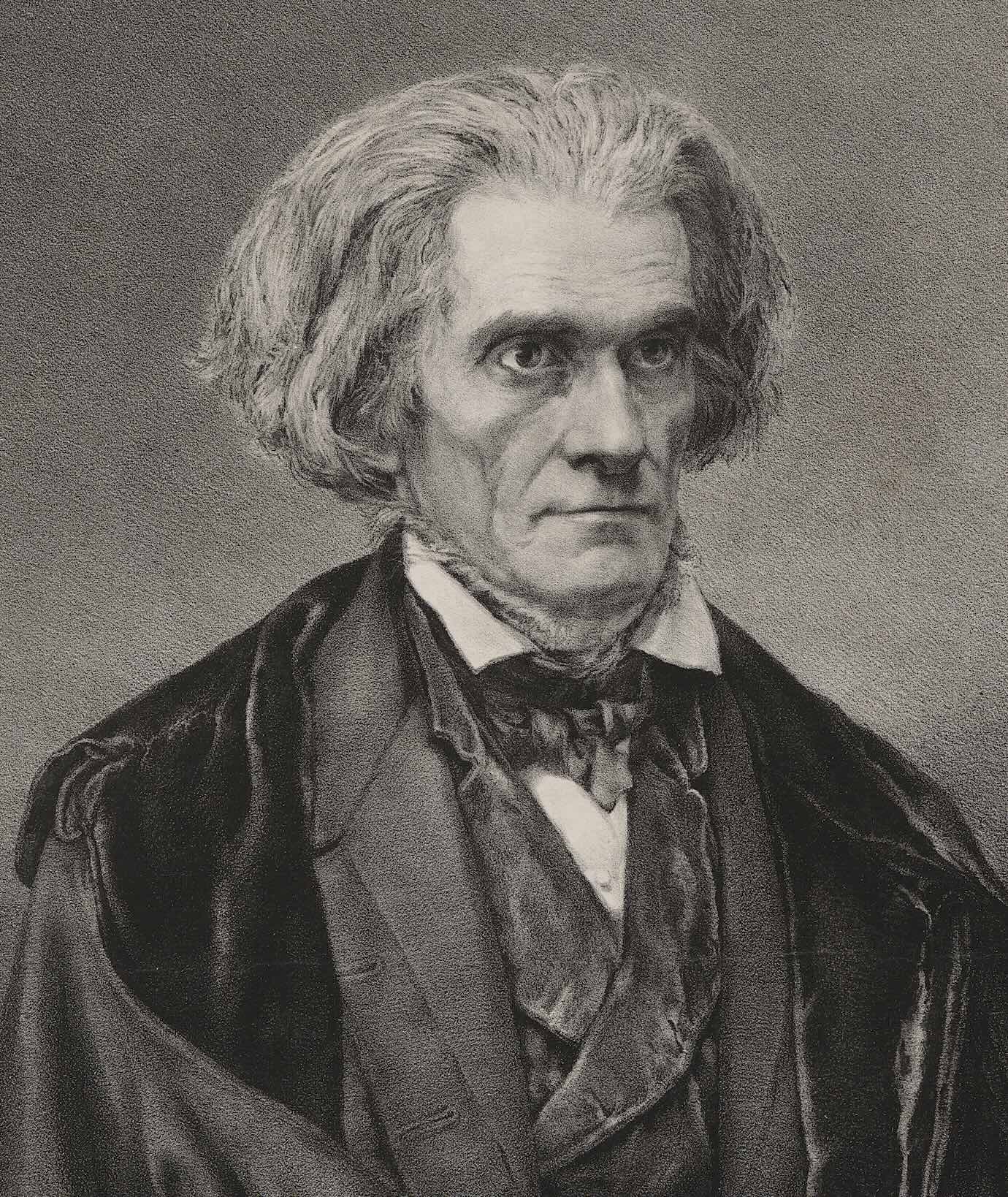
While Fitzhugh made the rejection of Jefferson a provocation, Calhoun made it a principle. In an 1848 Senate speech, he traced sectional agitation to what he called “the most false and dangerous of all political errors”: the proposition—now repeated as “an established and incontrovertible truth”—that “all men are born free and equal.” He insisted that taken “literally (it is in that sense it is understood), there is not a word of truth in it.” Calhoun even mocked the phrase at the level of syntax: “Infants are born. They grow to be men.” What mattered for him was the political work the maxim performed. Liberty and equality, he argued, were not natural endowments but civilizational attainments—“prizes to be won.” Treating them as axioms turned Jefferson’s language into a portable creed. It depicted slavery as illegitimate by definition and made territorial restriction appear as the fulfillment of the founding rather than a repudiation of it.3
Calhoun turned this philosophical objection into an indictment of Jefferson and the declaration’s moral afterlife. Americans, he warned, were only now “begin[ning] to experience the danger of admitting so great an error to have a place in the declaration of our independence.” For a time, the principle “lay dormant,” but it eventually “began to germinate, and produce its poisonous fruits.” Jefferson was the hinge in that story. The axiom, Calhoun claimed, “had strong hold on the mind of Mr. Jefferson.” As a result, Jefferson came to “take an utterly false view of the subordinate relation of the black to the white race in the South.” In Calhoun’s account, that error led Jefferson to treat enslaved people—“though utterly unqualified to possess liberty”—“as fully entitled to both liberty and equality as the latter,” making their exclusion appear “unjust and immoral.” According to Calhoun, Jefferson’s writing was not merely mistaken. Once canonized as founding truth, it became a political weapon, an egalitarian ideal that could authorize restrictionist power and cast southern claims to security as illegitimate by definition.4
 National Portrait Gallery
John C. Calhoun
Even after Fitzhugh and Calhoun had supplied slaveholders with an overt critique of Jefferson’s egalitarian proposition, many of those same men ironically continued to speak as heirs of 1776. They disowned the Revolution’s universal claims while continuing to claim its authority. Edmund Ruffin, writing to the radical Alabama secessionist William L. Yancey in October 1860, praised “our able advocates and orators” for having “maintained fully and properly the rights and interests of the Southern States.” He then in the same breath measured their task against Patrick Henry and his “noble compatriots” who defended the colonies against “oppression” and even “union” with the mother country. Had the South possessed “another Patrick Henry,” Ruffin insisted, its defense “would long before this time have been as successful and complete” as their forefathers’ resistance.5
A decade earlier Yancey had pressed this same analogy into a call for action. If “all united,” southerners might yet “produce a spirit enough to lead us forward,” “to call forth Lexington,” “to fight a Bunker’s Hill,” and to drive the enemy from “the city of our rights.” For the most ardent proslavery secessionists, 1776 survived not as a doctrine of equal rights but as a script of righteous rupture. They converted the defense of slavery into the defense of liberty by relocating “oppression” from the plantation to the Union itself.6
By 1861, Jefferson Davis sought to nationalize that script, reclaiming 1776 for the southern cause and fastening Confederate identity to its symbols of resistance. As he assumed Confederate leadership, he cultivated a republican posture of moderation and disinterested service. In the republican idiom of the founding generation, leaders were to appear as virtuous citizens and impartial judges, not self-seeking officeholders. Davis reinforced that performance by skipping the Montgomery, Alabama, convention in February—where delegates of the seceding states met to organize the Confederate States of America—and awaiting the outcome at his Mississippi plantation, while publicly professing reluctance to serve. Writing to his friend and Montgomery delegate Alex Clayton, he insisted, “I would prefer not have either place, but in this hour of my country’s severest trial will accept any place to which my fellow citizens may assign me.” He thus cast himself as a reluctant statesman, a self-fashioning that historian R. Jarrod Atchison argues was “consistent with the fundamental tenets of the political ideology that helped guide the same American Revolution.”7
 National Portrait Gallery
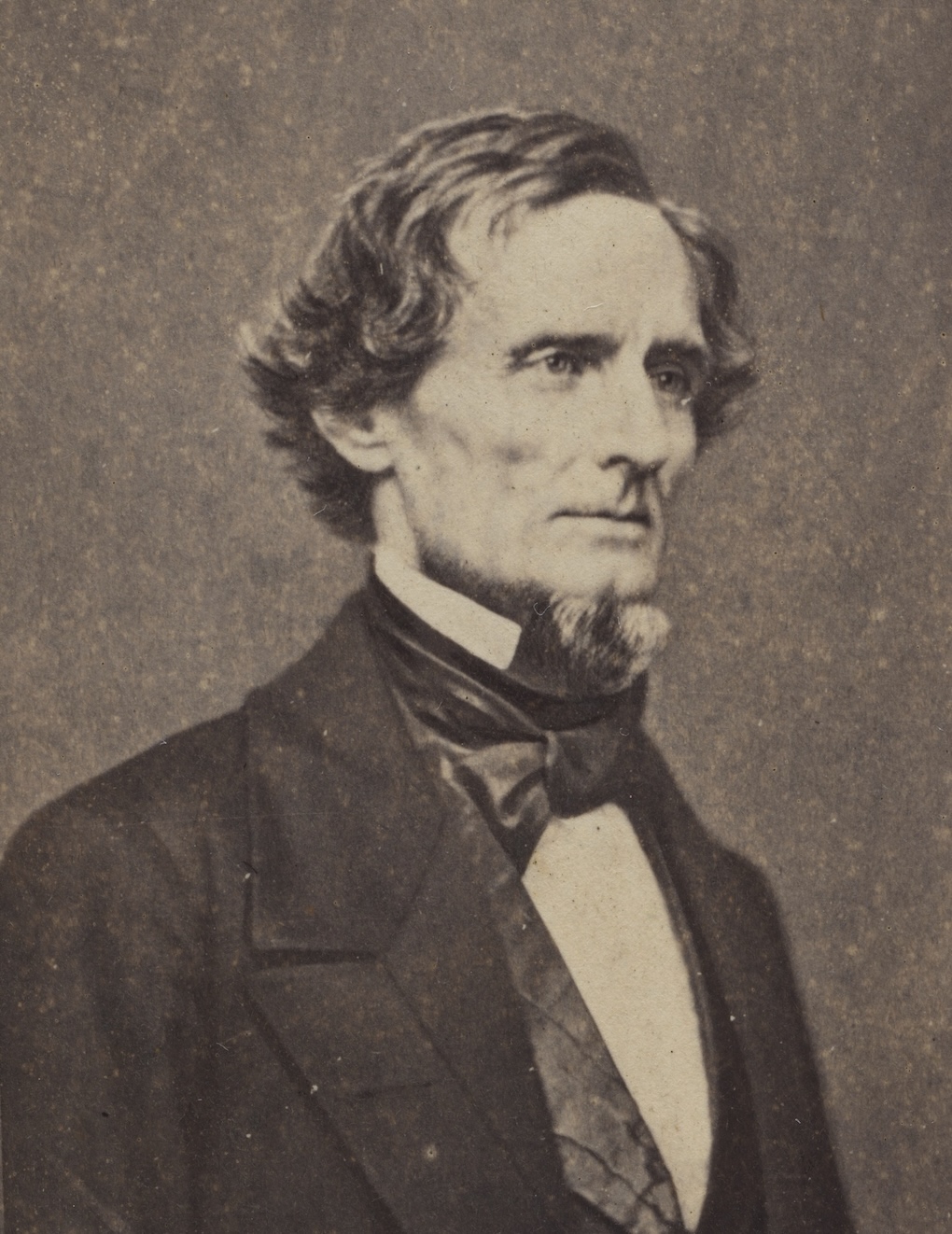
Jefferson Davis
Upon accepting the presidency of the Confederacy, Davis carried that revolutionary political vocabulary beyond personal conduct. He invoked the memory and symbols of the American Revolution to recast secession as a founding act and to forge a distinct Confederate national identity. In a speech after his nomination as provisional president, Davis declared that “our present condition … illustrates the American idea that governments rest upon the consent of the governed,” and that “it is the right of the people to alter or abolish governments whenever they become destructive of the ends for which they were established.” In seceding, he added, southerners had “merely asserted a right which the Declaration of Independence of 1776 had defined to be inalienable.”8
The argument depended on a political tightrope. First, secession was rarely decided through broad-based democratic procedures. Second, while Davis invoked the declaration to legitimize secession, Calhoun and other proslavery thinkers had long denounced the declaration’s egalitarianism as politically dangerous. But Davis could not dwell on that inconsistency. Because secession was a radical act, he needed to present it in conservative terms: not as innovation, but as the preservation of inherited principles. Thus, a region that had long distrusted Jefferson’s language in 1776 now celebrated its redeployment by Davis. As one southern editorialist observed, “Davis’s inaugural address was chiefly based upon the propositions contained in the declaration of the American Independence.”9
Southerners continued to invoke the Revolution in the work of nation-making. George Washington’s likeness appeared on the Great Seal of the Confederacy, and Confederate postage stamps honored not only Davis and Calhoun but also Washington and Jefferson. Davis reinforced that symbolism by choosing Washington’s birthday, February 22, for his 1862 inauguration. He delivered the address in Richmond beneath a statue of Washington. There he declared that the Confederacy hoped “to perpetuate the principles of our revolutionary forefathers,” for “the day, the memory, and the purpose seem fitly associated.” Just as John Dunlap had presented the Declaration of Independence as the moment the United States entered the world of nations, Davis sought recognition for the Confederacy as a nation entitled to stand among “the nations of the earth.”10
Confederate appeals to the founding were instruments of legitimation. They framed secession as both conservative and revolutionary: conservative in claiming to preserve inherited constitutional order, revolutionary in founding a new nation. In doing so, secessionists claimed 1776’s authority while narrowing its meaning for a slaveholding republic. Although the war was fought over slavery, it was also a contest over the founding’s legacy—who could claim it, what it contained, and whether liberty’s language would remain universal or become sectional property in defense of slavery and exclusion. Those questions still echo as the United States turns 250.
K. Howell Keiser Jr. is an American historian specializing in the antebellum South and the Civil War era. He is an Assistant Professor of Humanities at the Hamilton School for Classical and Civic Education at the University of Florida.
Notes
1. Thomas Jefferson, “First Inaugural Address, 1801” in Isaac Kramnick and Theodore J. Lowi, eds., American Political Thought: An Anthology(New York, 2019), 312.
2. George Fitzhugh, Sociology for the South, or, the Failure of Free Society (Richmond, 1854), 179, 182.
3. John C. Calhoun, Speech of Mr. Calhoun, of South Carolina, on the Oregon Bill. Delivered in the Senate of the United States, June 27, 1848(Washington, 1848), 14, 16.
4. Ibid., 16.
5. William Kauffman Scarborough, ed., The Diary of Edmund Ruffin; Volume I: Toward Independence, October 1856-April 1861 (Baton Rouge, 1972), pp. 633–635.
6. Avery O. Craven, The Coming of the Civil War (Chicago, 1966), 277–278.
7. R. Jarrod Atchinson, A War of Words: The Rhetorical Leadership of Jefferson Davis (Tuscaloosa, 2019), 29, 31.
8. Journal of the Congress of the Confederate States of America, 1861-1865 (Washington, D.C., 1904-1905), I, 64–66.
9. “From Montgomery, Ala.,” Daily Nashville Patriot, February 19, 1861.
10. Dunbar Rowland, ed., Jefferson Davis, Constitutionalist: His Letters, Papers and Speeches (Jackson, 1923), V, 198–203.
Related topics: Confederacy, slavery