Ulysses-Grant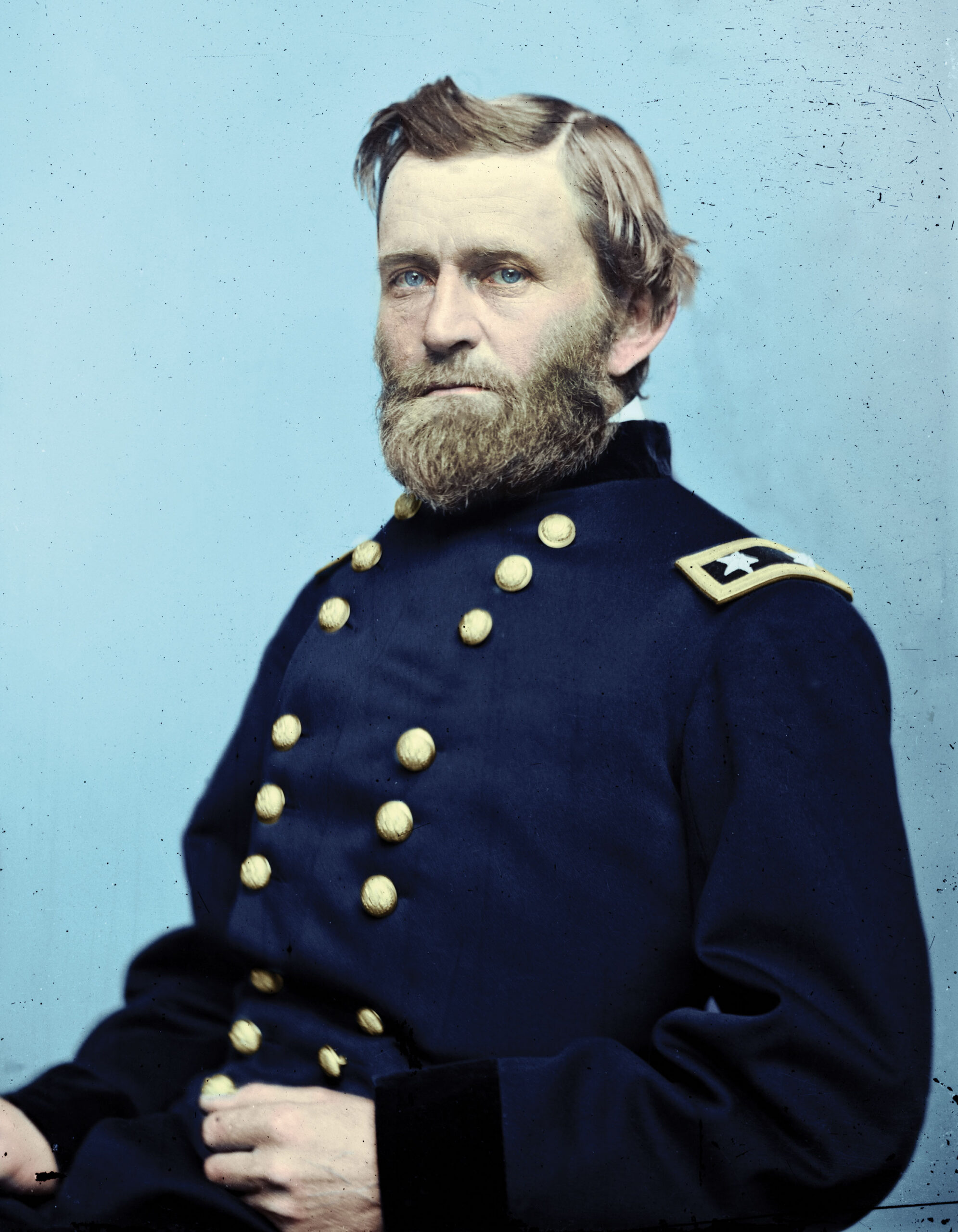 Library of Congress, Colorized by Mads Madsen of Colorized History
On June 15, 1864, Lieutenant General Ulysses S. Grant stood in “profound silence” on a bluff along the left bank of the James River, gazing at the culmination of a remarkable achievement. Before him stood one of the longest military bridges ever constructed. A fleet of transport vessels filled the wide river, two improvised ferries shuttled troops to the south shore, and bands rendered martial tunes as tens of thousands of soldiers in blue waited their turn to cross the water.1
That Wednesday would mark the first of 292 days in which armies under the command of Grant and General Robert E. Lee would battle for control of Petersburg, Virginia. The “Cockade City” was the Old Dominion’s second largest metropolis, and at that moment it held the logistical key to the survival of the Confederacy’s principal army and its capital at Richmond.
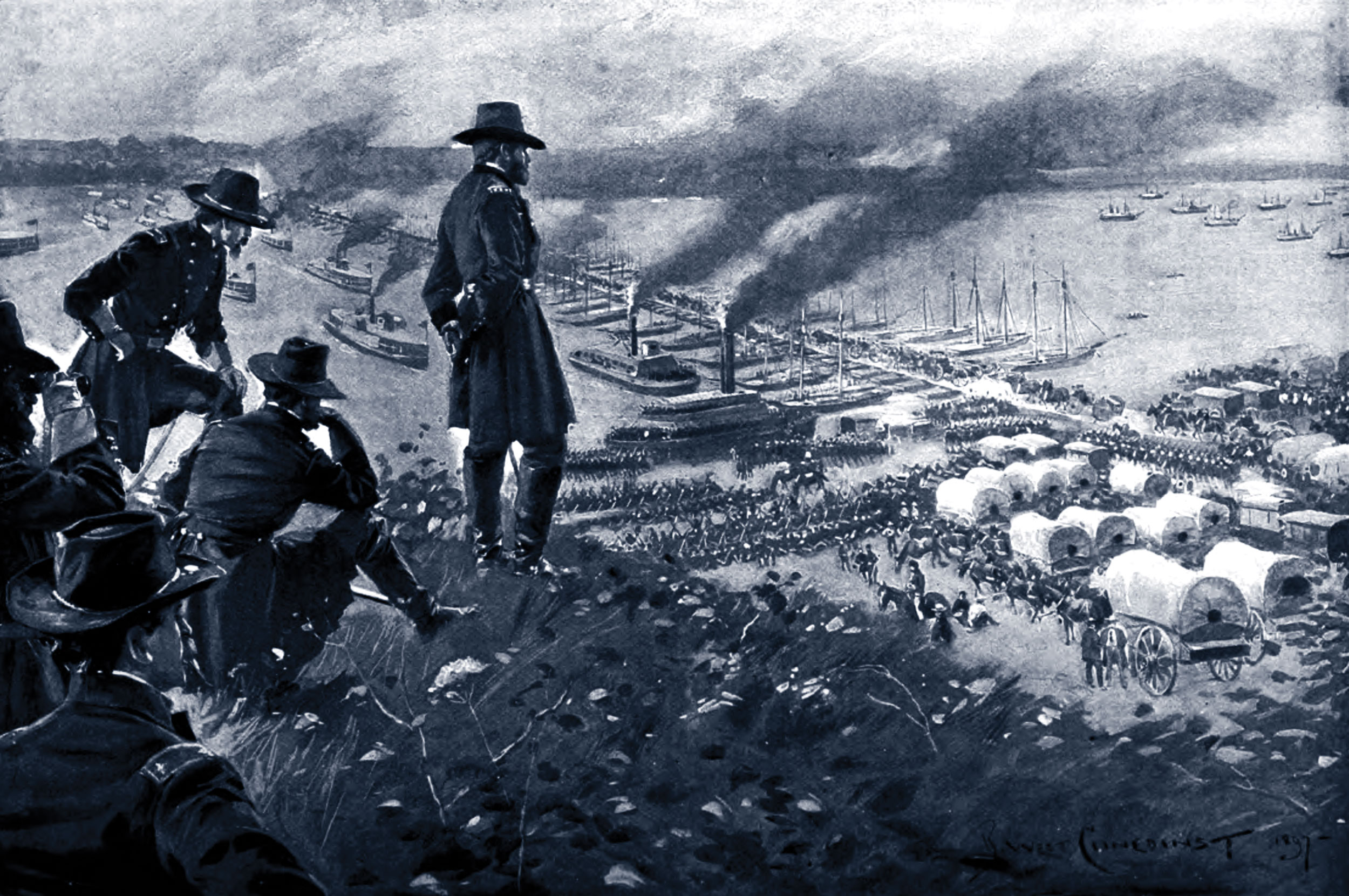 Century Magazine
Lieutenant General Ulysses S. Grant (standing) watches as the massive Army of the Potomac crosses the James River on its way toward Petersburg, Virginia, on June 15, 1864. Poor communication by the general-in-chief would mark the Petersburg Campaign’s first six weeks, during which Grant would leave operational and tactical decisions in the field to his subordinate commanders, George G. Meade and Benjamin Butler
Grant and Lee had first clashed some six weeks earlier nearly 100 miles to the northwest in a tangled landscape styled The Wilderness, and had remained in almost constant contact for the next month, engaged in a series of titanic battles known collectively as the Overland Campaign. Grant, who had been elevated to general-in-chief of all Union armies in March, had hoped this campaign would bring Lee’s Army of Northern Virginia to its knees and thus facilitate the capture of Richmond, but following his calamitous attacks on June 3 at Cold Harbor, 10 miles northeast of the Confederate capital, his bloody operations had failed to achieve either goal. Thus the lieutenant general turned his sights on Petersburg, a railroad hub through which flowed almost all of Richmond’s supplies from the south and west.2
Although securing Petersburg represented Grant’s ultimate objective, his first tasks included disengaging the Army of the Potomac, commanded by Major General George G. Meade, from under Lee’s nose at Cold Harbor, secretly marching it nearly 50 miles to the banks of the tidal James River, and transporting his soldiers, animals, artillery, and equipment to the right bank, all without Lee’s knowledge or interference. Grant also worried about the second component of his army group, Major General Benjamin Butler’s Army of the James, which occupied the Bermuda Hundred peninsula between Richmond and Petersburg and would be vulnerable to an attack by Lee while Meade’s army executed its march to the James. “The operation now contemplated by Grant transcended in difficulty and danger any that he had attempted during the campaign,” thought a member of his staff. “He was to withdraw an army from within forty yards of the enemy’s line, and to march through the difficult swamps of the Chickahominy [River] bottom … then advance to the James … at a point seven hundred yards across; to effect a passage with all the munitions and supplies of a hundred thousand soldiers.” A Confederate observer considered Grant’s movement to the James “the most brilliant stroke in all the Federal campaigns of the whole war.” It is no wonder, then, that Grant watched with silent approbation that sunny morning as his bold gamble realized success.3
Grant could not know, of course, that he would require nine distinct offensive operations over the course of nearly 10 months to conquer Petersburg. The first three of those offensives would occur in June and July 1864. Grant’s generalship during these initial six weeks of the campaign for Petersburg yielded meager results and reflected little credit upon the Union’s ranking soldier. Grant remained largely detached from the operations of his army group, leaving operational and tactical decisions in the field to his subordinate commanders, Meade and Butler. Grant’s strategic vision, while laudably focused on maintaining pressure on his Confederate opponents, vacillated—sometimes wildly—and occasionally descended into the fantastic. The initial effort to capture Petersburg foundered, in large part, due to poor communications by the general-in-chief.
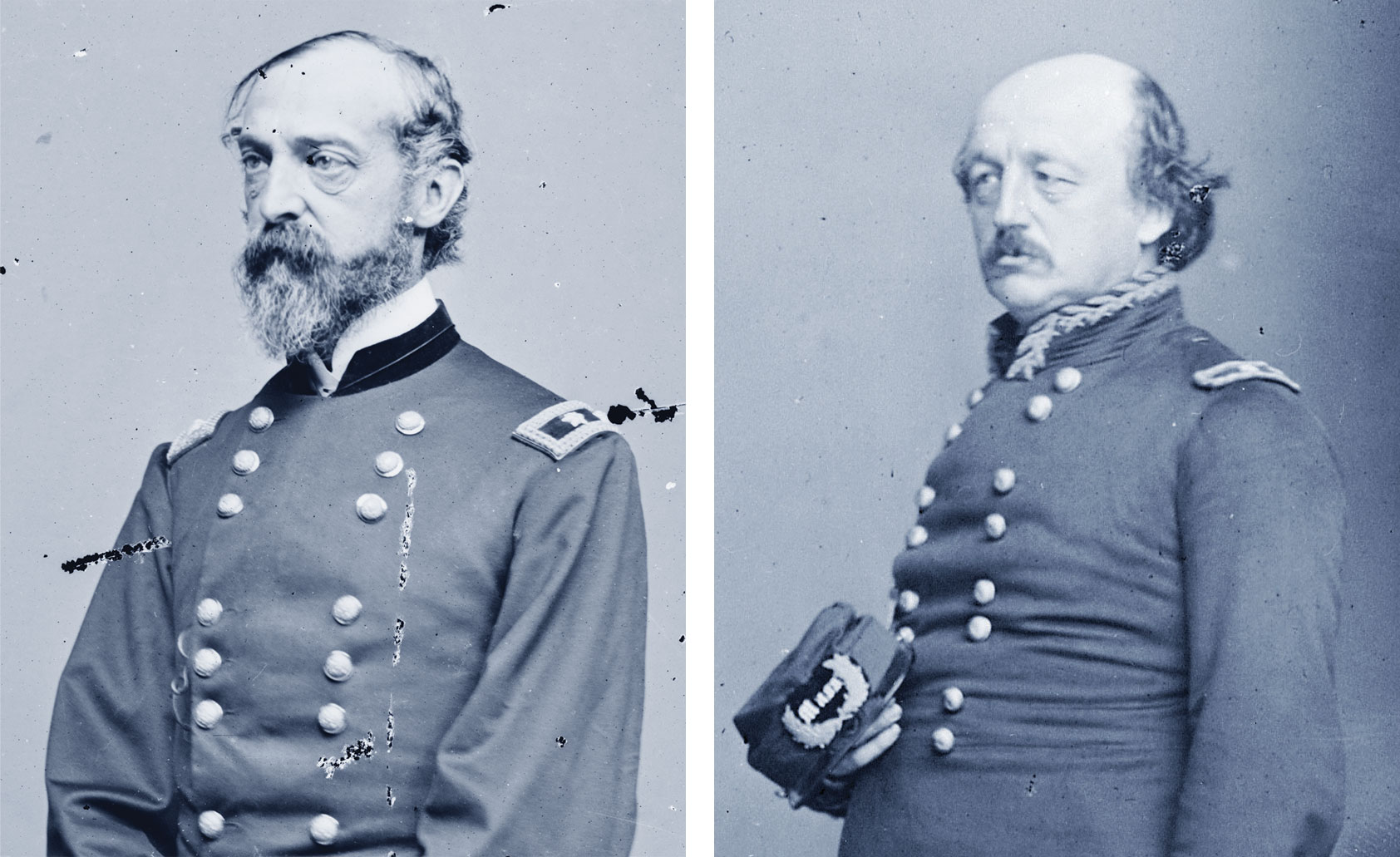 Library of Congress (Meade); National Archives
George G. Meade (left) and Benjamin Butler
The 14,000 men of the XVIII Corps, commanded by Major General William F. Smith, followed a unique path en route toward Petersburg. They had been detached from Butler’s army in late May and assigned to reinforce the Army of the Potomac. While Meade’s forces marched overland to reach their crossing points on the James, the XVIII Corps returned the way it had come—by boat via the Pamunkey and York rivers to Hampton Roads and then up the James to Bermuda Hundred. From there, the plan was for Smith to cross the Appomattox River and assail Petersburg’s vulnerable eastern defenses. He would be supported by the lead element of Meade’s army, Major General Winfield Scott Hancock’s II Corps, which, after ferrying across the James, would march into position on Smith’s left. Grant expected Smith to attack early on the morning of June 15 and that Hancock would reach the Confederate defenses around midday to render whatever aid Smith might require to secure the city.
Unfortunately, Grant failed to clearly articulate these plans to the four officers responsible for executing them: Butler, Smith, Meade, and Hancock. Smith’s brigades trickled into Bermuda Hundred throughout the afternoon and evening of June 14, in no particular order and innocent of any notion that they were to execute an immediate advance. The time required to concentrate the troops, convey instructions for the offensive, march across the pontoon bridge spanning the Appomattox, and negotiate the five miles to the Confederate works rendered Grant’s conception of a dawn assault a logistical impossibility. Smith would not arrive opposite the Rebel fortifications until midday, and then he wiled away the afternoon with reconnaissance and planning.4
Hancock learned of his role in Grant’s plan even later. Confusion over supplying the II Corps with rations they did not need, faulty maps, and enervating heat conspired to delay Hancock’s approach until late in the afternoon, when a messenger found the II Corps commander and handed him Grant’s order to hasten to Smith’s assistance.5
The general-in-chief had established his headquarters at City Point, about five miles from Smith’s location, by mid-afternoon, in plenty of time to ride forward and take personal command of the faltering offensive had he chosen to do so. Instead, he wired Butler for news from Petersburg, expressing about as much interest in the whereabouts of Hancock’s irrelevant rations as in the progress of his corps. Butler remained out of touch at Bermuda Hundred, relying on observations from a distant signal tower and reports from couriers.6
Smith finally began his assault around 7 p.m., and by nightfall he had captured several miles of the Confederate line. He and Hancock, at last united on the field, chose caution over daring and decided not to risk a night advance. Grant’s brilliant maneuvers from Cold Harbor across the James had unlocked the door that could have led to a decisive victory, but logistical, communication, and command lapses prevented him from turning the knob. Strangely, Grant did not seem to notice. He found time on the 15th to write a homely letter to his wife filled with matters of strictly personal interest. As for the progress of the campaign, “so far it has been eminently successful,” the general cheerfully wrote, “and I hope will prove so to the end.”7
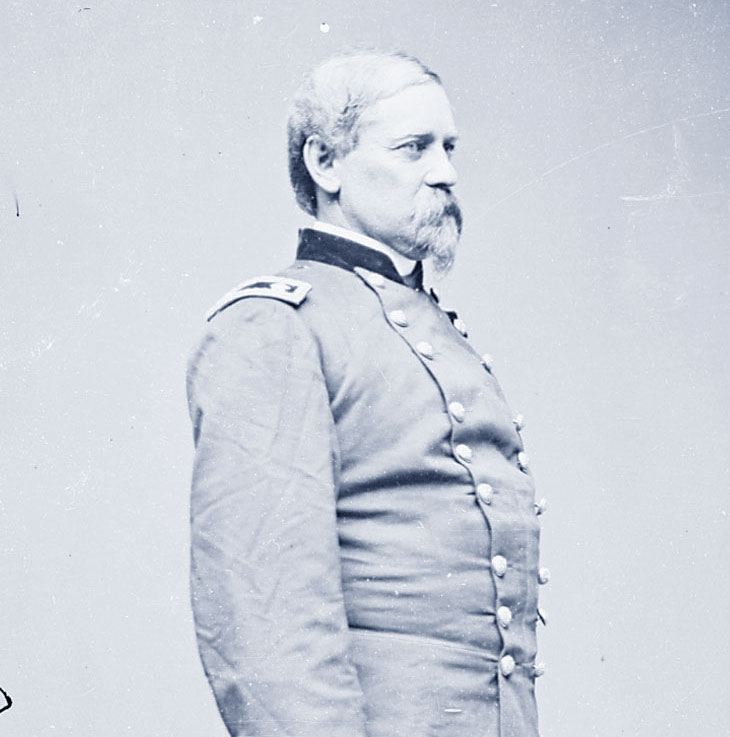 National Archives
William F. Smith
The next morning, Grant instructed Smith to “push the reconnaissance in your front with the view of ascertaining the best point and manner of advancing this evening at 6 p.m.,” adding conservatively that Smith should be alert for any Confederate attempt to turn the Union left. Later in the day, Grant rode forward from City Point to examine Smith’s deployment, impressing one Connecticut captain as a fellow who “does not look like a man to give up a point [but] … smaller … than I supposed.” On his return to headquarters, Grant encountered the recently arrived Meade and his staff riding toward the front. Grant reiterated his earlier instructions regarding a 6 p.m. attack and placed Meade in charge of seeing to its execution. With only a few exceptions, Grant would consistently recuse himself from tactical involvement in all the actions around Petersburg in June and July, delegating that responsibility to his army commanders.8
Meade and Butler conducted a series of assaults during the next three days, which in addition to Smith’s attack on June 15, comprised the First Petersburg Offensive. The Army of the Potomac made incremental gains June 16–18 at appalling human cost and failed to capture Petersburg in the face of stubborn resistance by the outnumbered forces of General P.G.T. Beauregard, aided by the arrival of Lee’s divisions on June 18. North of the Appomattox, Butler’s Army of the James briefly held the vital rail and turnpike arteries linking Richmond and Petersburg, but gave them up much too easily and made only feeble efforts to recover them, content to settle into the fortifications protecting its river landings at Bermuda Hundred.
Grant, still anchored to his headquarters at City Point, seemed unconcerned. “I think it is pretty well to get across a great river, and come up here and attack Lee in his rear before he is ready for us!” Grant beamed to a staff officer, ignoring his armies’ lack of decisive accomplishments. “Too much credit cannot be given the troops and their commanders,” Grant informed Major General Henry W. Halleck, his chief of staff in Washington. While Butler seemingly failed to grasp the importance of breaking the communications between Richmond and Petersburg and Meade struggled to harness cooperation between his corps, Grant busied himself with logistical matters at City Point, such as ordering the repair and construction of wharves at Bermuda Hundred, City Point, and along the Appomattox River, the fabrication of warehouses, and the refitting of the City Point Railroad, suggesting that the general-in-chief did not anticipate a swift conclusion to the present endeavor against Petersburg.9
The failures of the First Offensive revealed for the first time significant cracks in the army’s confidence in Grant. “The feeling here in the army is that we have been absolutely butchered,” wrote Stephen Weld, commanding officer of the 56th Massachusetts Infantry, who blamed careless and reckless officers at the army’s highest levels “who have time and again … wickedly placed us in slaughter pens.” Captain Charles Francis Adams Jr., scion of the famous Massachusetts family and serving in the army’s provost guard with his squadron of the 1st Massachusetts Cavalry, expressed puzzlement in a letter to his father on June 19: “We have assaulted the enemy’s works repeatedly and lost many lives, but I cannot understand it…. Doubtless Grant has his reasons and we must have faith; but certainly, I have never seen the army so haggard and worn, so worked out and fought out, so dispirited and hopeless.” Sergeant Zerah C. Monks of the 62nd Pennsylvania Infantry told a correspondent that “the boys don’t seem to think so much of Gen. Grant now as they did some time ago. They think he has crowded us on their works too hard. It is nothing but charge … and the ones that escape today fall tomorrow.”10
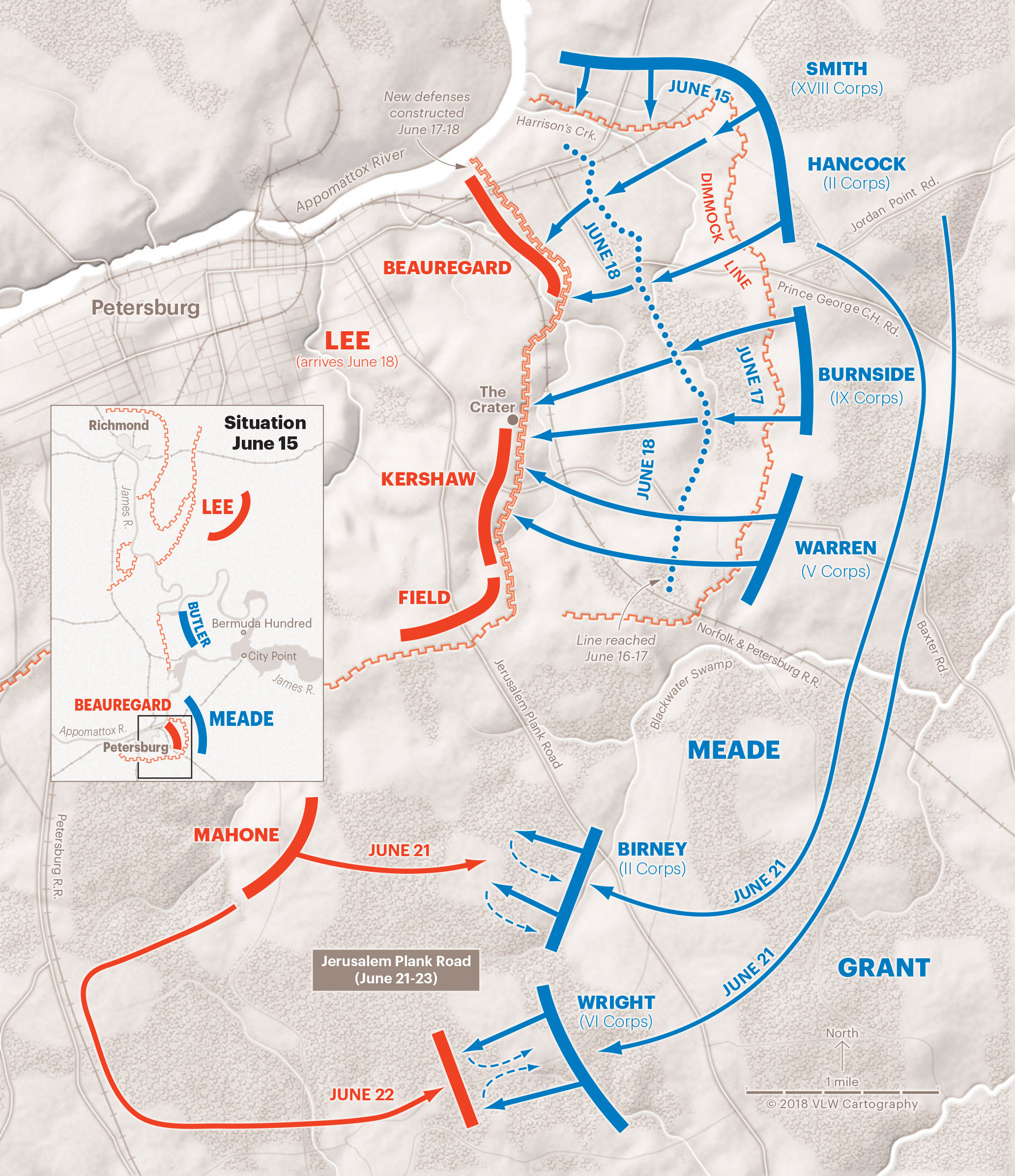
The Struggle for Petersburg, Petersburg, Virginia | June–July 1864 – In June and July 1864, Lieutenant General Ulysses S. Grant launched three offensives against Confederate-held Petersburg, Virginia, through which most of the supplies for Richmond flowed. None of these—the First Offensive (June 15–18) against Confederate defenses east of the city; the Second Offensive (June 21–24) against Confederate defenses south of the city; or the Third Offensive (July 26–30), which concluded with the disastrous Battle of the Crater succeeded in taking Petersburg. Grant would need another eight months of siege operations to accomplish his goal.
The general-in-chief, however, expressed no regrets about the outcome of the First Offensive. “I am perfectly satisfied that all has been done that could be done,” he reassured a disappointed George Meade. “Now we will rest the men and use the spade for their protection until a new vein can be struck.”11
Meade welcomed these sentiments, particularly because he favored commencing formal siege operations in lieu of continued frontal assaults against the powerful defenses created by Lee and Beauregard. But Grant’s period of rest lasted only about 24 hours. By June 20 he began planning a three-pronged operation that would become his Second Petersburg Offensive. That day, he and Butler identified a narrow stretch of the James River opposite Jones Neck called Deep Bottom. Grant directed the army’s engineers to construct a pontoon bridge there and advance troops to the left bank to maintain a bridgehead north of the James, a task that was promptly accomplished.12
More importantly, Grant decided to conduct a massive cavalry raid, using Brigadier General James H. Wilson’s division augmented by Butler’s cavalry under Brigadier General August V. Kautz. These horsemen, Grant hoped, would do great damage to Lee’s railroad communications to the south and west and severely degrade his logistics. Grant also ordered the rest of Meade’s cavalry under Major General Philip H. Sheridan to return to the army from its unsuccessful campaign against the Virginia Central Railroad. Meade warned that bringing Sheridan south of the James would release the Confederate cavalry there to operate against Wilson and Kautz, but Grant dismissed these concerns. He also downplayed Sheridan’s potential role in assuring Wilson’s safe return to Union lines.13
Finally, Grant ordered Meade to take the II and VI Corps west to occupy the Petersburg Railroad and the South Side Railroad and anchor the Union left on the Appomattox, miles above Petersburg. With the railroads destroyed and under the control of Federal infantry (Butler was told to bombard the railroad bridge over the Appomattox, complicating Confederate communications with the capital), Lee would find himself in an untenable position, forced to abandon Richmond and Petersburg or risk an open fight in which the Federals would hold the advantage.14
This outcome proved elusive. While Wilson and Kautz managed to wreak significant havoc on three railroads (including the Richmond & Danville line, which bypassed Petersburg), stiff resistance by a makeshift Confederate force at the bridge spanning the Staunton River and harassing pursuit by southern troopers limited their impact. Moreover, as Meade had predicted, Confederate cavalry from north of the James combined with elements of Lee’s infantry to trap the blue-clad riders south of Petersburg at Reams’ Station, inflicting significant casualties and depriving Wilson of his guns, wagons, and almost all of the fruits of his raid, including hundreds of runaway slaves seized by the Rebels.15
The infantry action resulted in an unmitigated disaster. Both the II and VI Corps suffered severe losses and only briefly touched on the Petersburg Railroad. The Federals managed to extend their lines to Jerusalem Plank Road, a few hundred yards west of where they had started, at a price of more than 2,300 dead, wounded, and captured.16
 Harper's Weekly
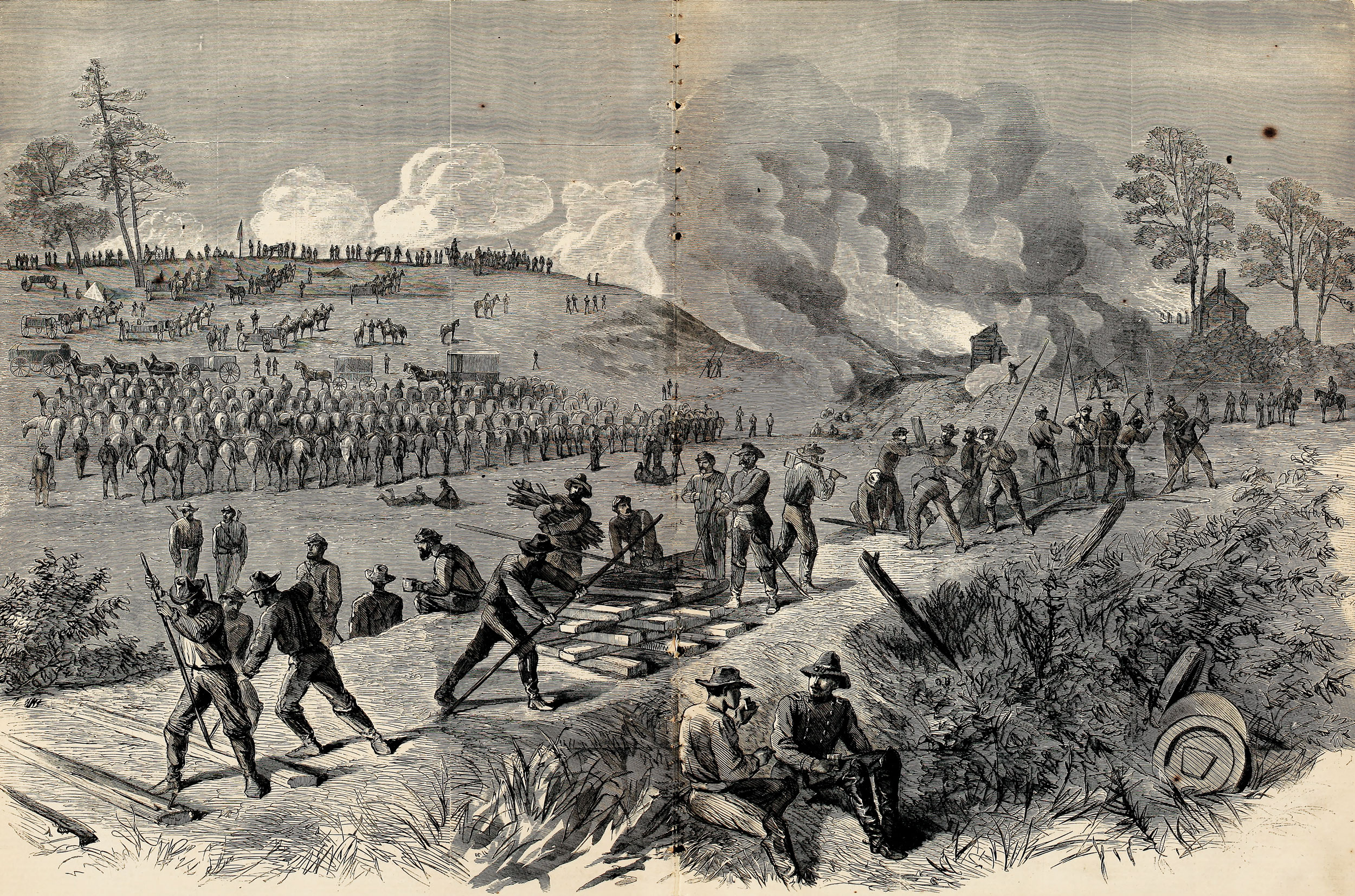
While a cavalry raid by brigadier generals James H. Wilson and August V. Kautz inflicted significant damage on railroads south and west of Petersburg, Grant’s Second Offensive against the city in late June 1864—which also consisted of an assault toward the Petersburg Railroad by two corps of Union infantry—ended much as the first had: with little to show for it, and at significant cost. Above: Wilson’s cavalrymen destroy railroad track during the Second Offensive.
The Second Offensive plunged soldier spirits to a new low. Some in the army laid the blame squarely on the shoulders of the general-in-chief. “Grant has used the army up, and will now have to wait until its morale is restored before he can do anything,” reasoned artillery commander Charles Wainwright. In fact, Grant’s notion in mid-June that two army corps could extend Union control all the way to the upper Appomattox River and be sustained there under semi-siege conditions bordered on the ludicrous. As events would demonstrate, Lee would prevent the Federals from encircling his army south of the Appomattox for the duration of the campaign. Protecting the return route of the cavalry was implicit in Grant’s impractical plan and when added to the nonchalance regarding Sheridan’s potential role in safeguarding Wilson’s return, Grant’s operational myopia contributed significantly to the cavalry’s discomfort.17
Grant’s culpability for the failures of the spring campaign worried Abraham Lincoln. The president, “conscious of the swelling chorus of criticism of the general” and the growing doubts surrounding Grant’s strategic acumen, decided to pay his commander a visit. Accompanied on June 20 by Assistant Secretary of the Navy Gustavus V. Fox, the Marine Band, and his son Tad, Lincoln arrived at Grant’s headquarters unannounced and was denied access to the general’s tent by a vigilant guard who mistook the chief executive for a member of the U.S. Sanitary Commission. Once admitted to Grant’s presence, Lincoln enjoyed a hearty meal, regaling the headquarters crowd with his usual litany of animated stories.18
For the next two days, Lincoln and Grant reviewed the troops and examined the lines. The president returned to Washington perceptively “disappointed at the small measure of success” around Petersburg, but with undiminished confidence in Grant. He informed his Illinois friend, former senator Orville Browning, that Grant had promised him that the army would never be farther away from Richmond than at the present and that he was certain that he would conquer the Confederate capital, although he offered no timetable. Lincoln told a staff officer that “when Grant once gets possession of a place, he holds on to it as if he had inherited it.” The president’s visit cemented the absolute trust that he invested in his general-in-chief, which would serve Grant well during the continued frustrations awaiting him in the following weeks.19
 Harper's Weekly
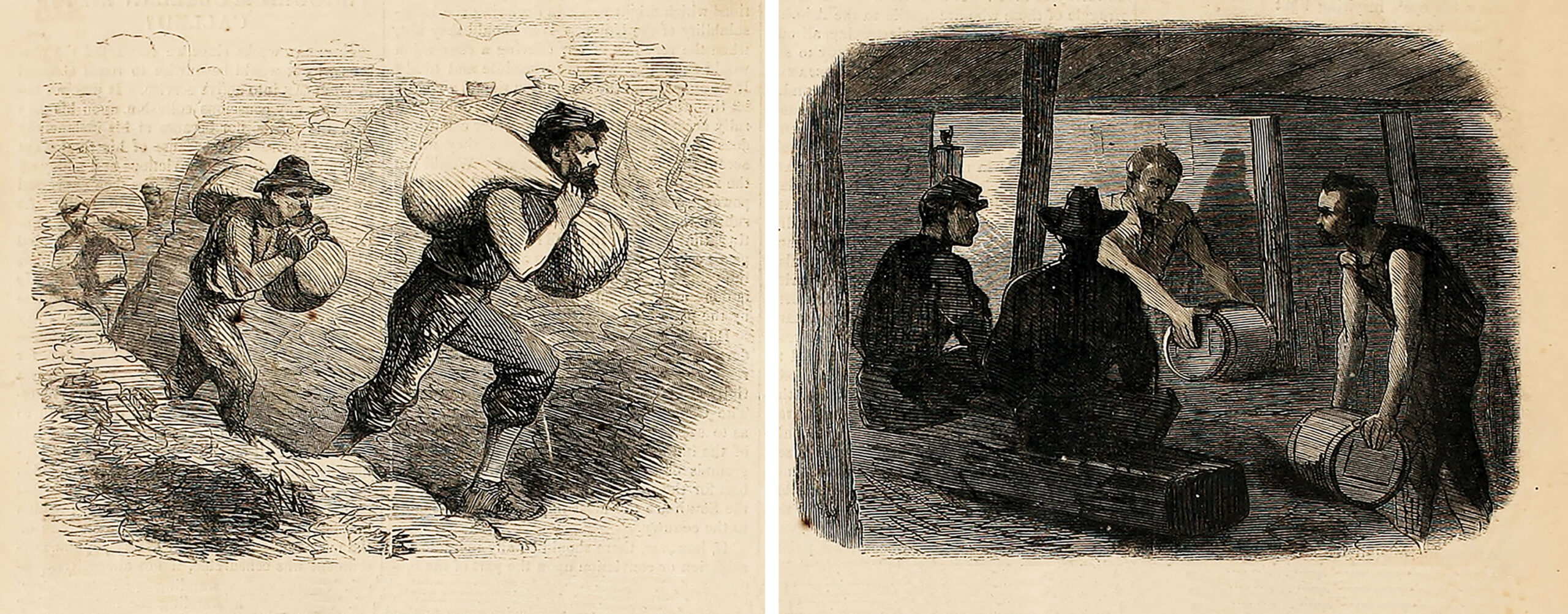
While the armies worked at expanding their defenses in the wake of the Second Offensive, the men of the 48th Pennsylvania Infantry (depicted in these two images from Harper’s Weekly) began digging a mine under the Confederate lines. They would fill it with gunpowder and detonate it in late July.
The armies settled into their ever-expanding fortifications in late June, except for the men of the 48th Pennsylvania Infantry, who began digging a mine under a prominent Confederate bastion that, for the time being, possessed no role in Grant’s strategic thinking. Grant grappled with a number of administrative matters during this period, including deciding what to do with the head of the Army of the Potomac. General Meade had managed to alienate most of his immediate subordinates with his prickly personality and, although Grant harbored no animosity toward his contentious commander, he began talking privately about the wisdom of replacing him, perhaps with General Hancock. Eventually Grant recommended that Meade take charge of Union forces in the Shenandoah Valley, but President Lincoln vetoed this suggestion, fearing that the public would interpret the transfer as an insult to the hero of Gettysburg. Meade would stay.20
Sorting out the leadership of the Army of the James proved thornier still. The most worrisome situation revolved around the dysfunctional relationship between Butler and Smith. The commander of Butler’s largest corps, Smith was among a handful of officers that Grant had brought east with him from the western theater. Smith had impressed Grant with his plan to lift the siege around Chattanooga in 1863 and he had thought that the West Point-trained Vermonter’s command skills would offset Butler’s lack of field experience once the Army of the James began active campaigning. Grant enjoyed a good working relationship with both men, but Smith—who had a track record of denigrating his superiors—informed Grant on July 2 that he could no longer serve under Butler, “who is as helpless as a child on the field of battle and as visionary as an opium eater in council.”21
Despite Smith’s blatantly insubordinate attitude toward Butler, Grant tended to see the matter through Smith’s eyes. Grant had long recognized Butler’s military shortcomings and sought a practical and diplomatic way of divesting himself of that powerful political general. He recommended that Butler be reassigned to a senior command in the Midwest or on the frontier, but Halleck suggested instead that Butler be sent to Fort Monroe, maintaining the titular command of his department, but permitting Smith to command the army in the field. Grant liked this scheme and ordered Halleck on July 6 to “obtain an order assigning the troops of the Department of North Carolina and Virginia serving in the field to the command of … Smith and order Major-General Butler, commanding department, to his Headquarters, Fortress Monroe.” General Orders No. 225 dated July 6 did just that, although its contents were not immediately made public.22
Smith had departed on sick leave and knew nothing of the pending orders that would elevate him to command of the Army of the James. But Butler, through the efforts of a staff officer in Washington, learned of the fateful plan to consign him to military impotency and confronted his superior, brandishing a copy of General Orders No. 225. A surprised Grant disingenuously protested that the order was a mistake. “I don’t want this at all,” Grant exclaimed. “I want Smith to report to you—you to have full command.” By then, Smith had caught wind that something was up and rushed back to the army, only to be told by Grant that he had been relieved and that he and his staff should report to New York to await orders. “Thus did Smith the Bald try the Machiavelli against Butler the cross-eyed, and got floored at the first round!” quipped an officer on Meade’s staff.23
Smith offered a sensational explanation for Grant’s sudden change of heart. In a long letter to his political ally, Senator Solomon Foot of Vermont, Smith related that in late June or early July, Grant and Butler visited his headquarters, where the general-in-chief became roaring drunk, adding in his published memoirs the lurid detail that Grant vomited on his horse’s neck and shoulders. This episode, Smith claimed, provided Butler the grist for blackmail that resulted in his retention and Smith’s dismissal. Most historians reject this story, while acknowledging that Grant did occasionally fall off the wagon that summer. The army’s provost marshal, Brigadier General Marsena Patrick, probably got it right. Patrick confided in his diary on July 21 that “Baldy’s intrigues … for the command of Meade … his intense Selfishness &, finally, his intrigues against Butler … disgusted Grant. He has quarreled with Meade & every one else, ending in an attempt to thrash Grant over Meade’s shoulders, for which Grant shut him up.” Grant rightly understood that either Smith or Butler had to go, but his abrupt disavowal of General Orders No. 225 raises questions regarding Grant’s wavering conduct.24
 Library of Congress
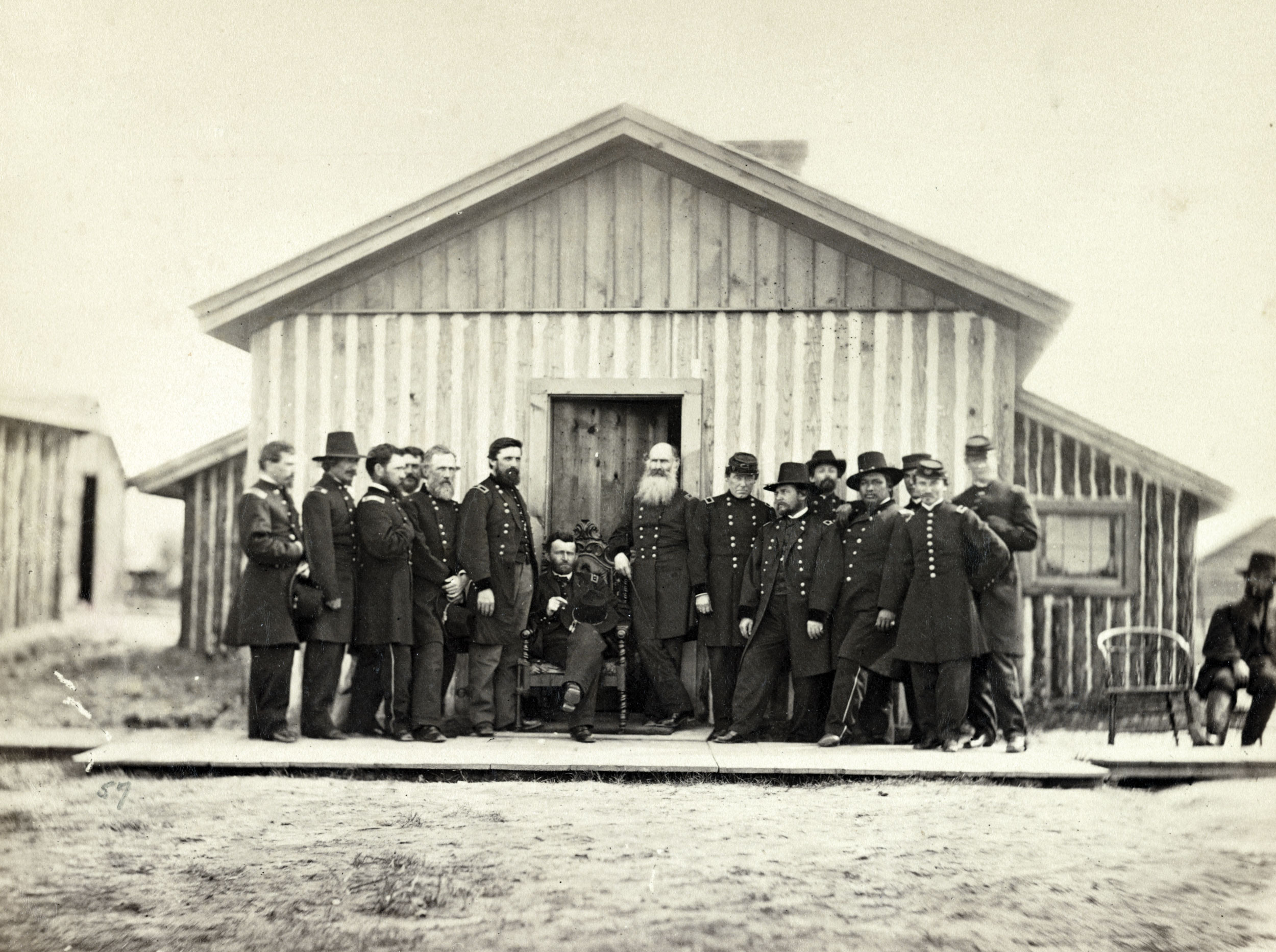
Grant (seated, center) remained strangely detached from the army during the first six weeks of the Petersburg Campaign, which found him regularly anchored at his headquarters at nearby City Point, shown here in March 1865.
Rumors circulated widely throughout the Confederate army in July that Grant had been wounded by a mortar shell and had died from the effects of an amputation. “We have the news here that old Grant is dead and all the boys are rejoiced to think that he is,” gushed Private Davie A. Hampton of the 42nd North Carolina Infantry. “They think that if this be true that we will have peace before long or that we will have rest around Richmond for a while for him and Butler are the chaps that have been doing the work.” Many other Rebels believed this tale, including General Beauregard, but not every Confederate was so credulous. Private Jesse R. Bowles of the 55th Virginia Infantry not only rejected the likelihood of Grant’s demise, but hoped it proved untrue, “for I think he is the best general that the Yankees has ever had for us I don’t think any other general would have made his men charge our works.” A Richmond editor agreed: “No general has ever played so handsomely into our hands, has exposed the lives of his men so frankly in impossible enterprises, or obtained such small results from such enormous means. We might be worsted but could not be bettered and therefore we are unwilling to part with Grant.”25
Grant, of course, remained very much alive. When not engaged in matters of reorganization (he named new commanders to both the XVIII and X Corps, consolidated depleted brigades in the Army of the Potomac, and dispatched the VI Corps to defend Washington), the general-in-chief proposed a series of strategies to end the impasse around Petersburg. Following the failures of the Second Offensive, Grant told Meade that he would rest the troops, acknowledging on June 26 the debilitating effects of “this excessively hot and dry weather.” But, just as a week earlier following the failure of the First Offensive, Grant quickly lost patience with his self-imposed passivity and proposed a new offensive.26
On July 3 Grant sought Meade’s concurrence in launching “a bold and decisive attack, to break through the enemy’s center…. If it is not attempted we will have to give you an army sufficient to meet most of Lee’s forces and march around Petersburg to come in from above,” an expedient that would be deferred until fresh troops, the XIX Corps, arrived from the Gulf. Meade replied the next day that an assault into the heart of Lee’s defenses would not work, recommending instead that “the only plan to dislodge the enemy from this line is by a regular approach”—in other words, formal siege operations.27
Grant agreed, but only briefly did he order actions that could be accurately termed a “siege.” Within three days he retracted this approval, favoring instead an assault on Butler’s front, north of Swift Creek, relegating Meade’s excavation of approaches to a mere diversion. Grant modified these plans by suggesting a combined operation against the Petersburg Railroad “as far as Hicksford,” some 40 miles south of Petersburg, using Sheridan’s cavalry and the II Corps.28
Two days later, Grant suspended these orders on suspicion that Lee had detached additional troops to reinforce the corps he had sent west from Cold Harbor. Meade reconnoitered and found no definitive evidence of a significant reduction in Lee’s forces, but on the basis of a report from a deserter, he told Grant that it was possible that Lieutenant General Ambrose Powell Hill’s corps had decamped. This prompted Grant to change gears once again. “If Hill’s corps has gone we must find out where it has gone and take advantage of its absence,” Grant told Meade on July 11. If the cavalry confirmed a reduction in the enemy force, Grant would order the II and V Corps, along with Sheridan’s cavalry, to turn the Confederate right while the IX Corps and XVIII Corps launched a spoiling attack against Lee’s center on the old June 18 battlefield.29
This initiative withered on the vine as well, as on July 12 Grant began to entertain doubts about Hill’s departure. Fresh intelligence implied that, to the contrary, a large body of Rebel troops might threaten the rear of the Union army. Plans for any offensive were now deferred in favor of securing the army’s own exposed flank. Grant also worried about Lee’s ability to detach troops to the Shenandoah Valley or Georgia, or that General Joseph Johnston, commanding the Confederate army in the Peach State, would shuttle brigades north to reinforce the Army of Northern Virginia. In order to obviate this possibility, Grant resurrected the earlier scheme of sending Sheridan south, accompanied by Hancock, to destroy the railroad connection to North Carolina. Sheridan balked, citing the problems encountered by Wilson and Kautz in returning unhindered to the army, and Grant quickly retracted these instructions.30
Thus within two weeks Grant had proposed a swing around the Confederate right, an attack at Bermuda Hundred, a combined flank and frontal assault with all four corps of his infantry, and a massive cavalry raid—as well as authorizing and then ignoring a plan to conduct siege operations. Nothing came of any of these operational spasms, and the last week of June through the first three weeks of July passed without progress—or even a creditable attempt—toward reducing Petersburg. To call Grant’s thinking during this period fluid would be charitable, although he deserves full credit for the desire to avoid the politically disastrous consequences of operational stasis, while reacting to fluctuating and unreliable intelligence.
In the meantime, the weary men of the 48th Pennsylvania Infantry completed work on their mine under a Confederate strongpoint called Pegram’s or Elliott’s Salient. Grant had not objected to this novel undertaking, but neither had he placed any confidence in its efficacy. In fact, when he completed his plans for the Third Petersburg Offensive, the mine barely registered in his strategic calculus.31
 Harper's Weekly
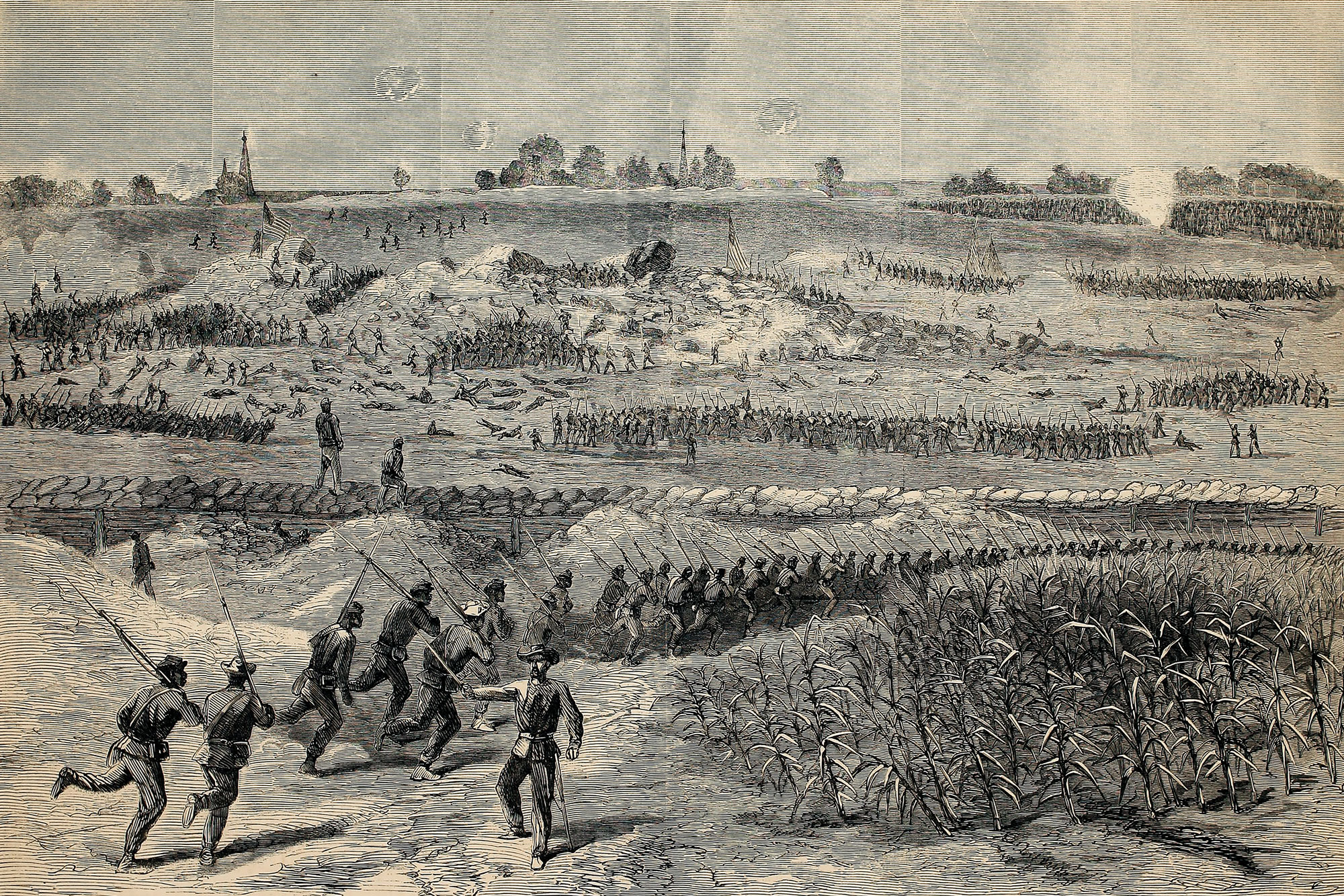
On July 30, the mine dug under Confederate lines and packed with 8,000 pounds of black powder by the men of the 48th Pennsylvania Infantry was detonated. The resulting Battle of the Crater proved disastrous for Union forces, shown above advancing toward the point of the explosion in this sketch from Harper’s Weekly.
Instead, Grant relied on the relatively limited goal of wrecking the Virginia Central Railroad north of Richmond that connected the Confederate capital with the Shenandoah Valley. Sheridan and Kautz would execute the raid with the II Corps along to maintain a secure path for the cavalry’s return. Grant did allow that if Sheridan found Richmond lightly defended, he could, at his discretion, attempt to occupy the city.
These troops departed on July 26 for their crossing of the James, and for the next three days conducted the campaign known as First Deep Bottom. Neither Hancock nor Sheridan displayed the bold generalship their reputations would have suggested, and Grant, during two rare visits to the scene of conflict, had to admit that his scheme had failed.32
This unsuccessful foray did possess one silver lining for the Federals. Lee had detached all but three of his infantry divisions and the bulk of his cavalry to the north side of the James in hopes not only of blunting the Union aggression, but ridding the left bank of the Federal presence once and for all. This diminution south of the Appomattox suddenly imbued the mine with primacy in Grant’s thinking. “We have failed in what I had hoped to accomplish—that is to surprise the enemy, and get on their roads with the cavalry near to Richmond,” Grant confessed upon returning to City Point, but he added, “I am yet in hopes of turning this diversion to account, so as to yield greater results than if the first object had been accomplished.” Grant’s claim in his published memoirs that the First Deep Bottom operations were designed with this in mind is pure fabrication.33
Major General Ambrose Burnside commanded the IX Corps, whose troops had constructed the mine and bore responsibility for exploiting it. Burnside’s corps included a division of United States Colored Troops (USCT). These relatively new soldiers had not been subjected to the martial meat grinder of the previous eight weeks and were eager to demonstrate their worth. Burnside therefore determined to use these African Americans to spearhead the attack that would follow the explosion of 8,000 pounds of black powder packed beneath the Confederate citadel. Meade, however, objected to using the black troops, citing their inexperience and the political repercussions of failure. When Burnside protested that all three of his white divisions were too battered to lead the assault, Meade agreed to place the matter before Grant. Much to Burnside’s disappointment, Grant sustained the army commander.34
The mine was scheduled to explode before dawn on July 30. Grant had given orders to reinforce Meade with elements of the Army of the James and kept Butler apprised of the plan of attack, but otherwise conformed to his hands-off policy, delegating responsibility for the operation to Meade. He did join the army commander early that morning in anticipation of the blast, and when a faulty fuse caused a delay in detonation of the powder, a frustrated Grant recklessly ordered an attack even if the mine failed to explode. Fortunately for Burnside’s men, intrepid volunteers relit the fuse, triggering an eruption the likes of which had never been seen.35
The attacks that followed resonate as one of the war’s most tragic fiascoes. Instead of skirting the crater created by the mine and heading for the high ground that would dominate the Confederate lines, Burnside’s men milled about the destroyed Confederate works or plunged into the crater itself, while the corps’ divisional leadership failed to advance and render guidance. Some 45 minutes after the explosion, Grant ventured forward to see the situation for himself, but declined to intercede with any direction, leaving the conduct of the struggling attacks up to Meade.36
The situation at the crater became increasingly chaotic as Burnside, under orders from Meade, committed his entire corps to the assault, which continued to stall along the irredeemably crowded Confederate works. Grant reappeared at the front around 8 a.m. Assessing the situation as hopeless, he informed the commander of the XVIII Corps, Major General Edward O.C. Ord, to tell Burnside to forgo any more offensive action in favor of entrenching the ground already captured. Soon thereafter, the Confederates executed the first of three powerful counterattacks, prompting Meade to order Burnside to evacuate the crater. The IX Corps commander, desirous of at least maintaining what his men had achieved, rode to Meade’s command post and angrily challenged the order to withdraw. Grant was present at this tense confrontation, but made no comment as Meade modified his instructions only to the extent of permitting Burnside discretion as to how and when to fall back. Both Grant and Meade then retired from the field, leaving Burnside to escape the best he could. At 10 a.m. Grant informed Halleck that the attack had failed. The Confederates recaptured all their lost ground by the middle of the afternoon, inflicting nearly 3,800 casualties, including many USCTs who were butchered after surrendering by Rebel soldiers incensed at fighting former slaves.37
Grant would declare the Battle of the Crater “the saddest affair I have witnessed in the war.”38 In truth, the Federal conduct of the Petersburg Campaign from June 15 through July 30 proved comprehensively cheerless.
Grant squandered his brilliant movement from Cold Harbor to the James and failed to capture Petersburg on June 15 as a result of abysmal communications to and between the relevant commanders. Subsequent attacks during the next three days made incremental gains at the expense of casualties approaching 13,000 men. Grant’s Second Offensive succeeded in establishing a toehold on the north side of the James, but the cavalry component came to grief at Reams’ Station, and the infantry operation, illogical in its conception and poorly managed, failed miserably.
Grant conceived then abandoned a half dozen initiatives between late June and the fourth week of July, eventually settling on a cavalry raid against targets north of Richmond. When that effort also foundered, he finally turned to Burnside’s mine. This expedient ended disastrously.
Grant should be applauded for maintaining the initiative at Petersburg and refusing to allow the campaign to degenerate into a static siege. By doing this he retained the confidence of the president and provided lingering, if diminishing, hope that the stalemate around Richmond and Petersburg might be resolved in the Federals’ favor, although northern public confidence in ultimate victory would find its voice in other theaters.
Ulysses S. Grant was, without doubt, the Union’s premier soldier. His patience and perseverance at Petersburg would eventually bring victory there and with it the fall of Richmond, followed swiftly by the surrender of Lee’s army. However, his generalship during the first six weeks of the Petersburg Campaign revealed little evidence of this future success.

A. Wilson Greene recently retired from a 44-year career in public history and battlefield preservation, much of it spent around Petersburg. Volume 1 of his 3-volume study of the Petersburg Campaign will be published by the University of North Carolina Press in June 2018.
Notes
1. Horace Porter, Campaigning with Grant (New York, 1897), 199–200.
2. A number of fine studies address the Overland campaign, none better than four volumes authored by Gordon C. Rhea: The Battle of the Wilderness, May 5–6, 1864 (Baton Rouge, 1994); The Battles for Spotsylvania Court House and the Road to Yellow Tavern, May 7–12, 1864 (Baton Rouge, 1997); To the North Anna River: Grant and Lee, May 13–25, 1864 (Baton Rouge, 2000); and Cold Harbor: Grant and Lee May 26–June 3, 1864 (Baton Rouge, 2002).
3. Adam Badeau, Military History of General Ulysses S. Grant, from April, 1861 to April, 1865 3 vols. (New York, 1868–1881), 2: 346; Gary W. Gallagher, ed., Fighting for the Confederacy: The Personal Recollections of General Edward Porter Alexander (Chapel Hill, 1989), 419.
4. Herbert M. Schiller, ed., Autobiography of Major General William F. Smith 1861–1864 (Dayton, OH, 1990), 99-100; William Farrar Smith, From Chattanooga to Petersburg Under Generals Grant and Butler (Boston, 1893), 123-124; Major-General William F. Smith, “The Movement Against Petersburg June, 1864,” Papers of the Military Historical Society of Massachusetts 15 vols. (Boston, 1906), 5: 113-114. For a competent overview of Grant’s First Petersburg Offensive, see Thomas J. Howe, Wasted Valor June 15–18 (Lynchburg, VA, 1988). Chapter 1 addresses the movement to the James and the preliminaries to the June 15 attack.
5. Andrew A. Humphreys, The Virginia Campaign of ’64 and ’65 (New York, 1883), 207-209; Francis A. Walker, History of the Second Army Corps in the Army of the Potomac (New York, 1887), 526-530; Thomas L. Livermore, Days and Events, 1860–1866 (Boston, 1920), 360-361; The War of the Rebellion: A Compilation of the Official Records of the Union and Confederate Armies 128 vols. (Washington, D.C., 1880–1901), 40 (1): 304-305 (hereafter cited as OR; all references are to Series 1).
6. John Y. Simon and John F. Marszalek, eds., The Papers of Ulysses S. Grant 32 vols. (Carbondale, IL, 1984), 11: 47; Porter, Campaigning with Grant, 200-201; OR, 40 (2): 73.
7. Simon and Marszalek, eds., Grant Papers, 11: 55.
8. OR, 40 (2): 90-91, 112; Charles M. Coit to “Dear Sis & all,” June 16, 1864, Captain Charles M. Coit Papers, Yale University; George R. Agassiz, ed., Meade’s Headquarters 1863–1865: Letters of Colonel Theodore Lyman from the Wilderness to Appomattox (Boston, 1922), 164; David W. Lowe, ed., Meade’s Army: The Private Notebooks of Lt. Col. Theodore Lyman (Kent, OH, 2007), 206-207; Theodore Lyman, “Crossing of the James and the Advance on Petersburg,” Papers of the Military Historical Society of Massachusetts 15 vols. (Boston, 1906), 5: 29; OR 40 (1): 167-68.
9. Lowe, ed., Meade’s Army, 208; Simon and Marszalek, eds., Grant Papers, 11: 65; OR, 40 (2): 120.
10. Stephen Minot Weld, War Diary and Letters of Stephen Minot Weld, 1861–1865 (Cambridge, MA, 1912), 318; Worthington Chauncey Ford, ed., A Cycle of Adams Letters, 1861–1865 2 vols. (Boston, 1920), 2: 154-55; Zerah Coston Monks to “Dear Hattie,” June 19, 1864, Monks Family Papers, Western Reserve Historical Society.
11. OR, 40 (2): 157.
12. Merlin E. Sumner, comp. and ed., The Diary of Cyrus B. Comstock (Dayton, OH, 1987), 274-275; Walter Graham Diary, June 19, 1864, Vermont Historical Society; OR, 40 (2): 209, 222; Edward G. Longacre, Army of Amateurs: General Benjamin F. Butler and the Army of the James, 1863–1865 (Mechanicsburg, PA, 1997), 164. Good maps of Deep Bottom are in the Atlas to Accompany the Official Records of the Union and Confederate Armies (Washington, D.C., 1891–1895), Plate 65, Maps 6 and Plate 67, Map 7.
13. OR, 40 (2): 231-32; 36 (3): 781, 794-97, (1): 798.
14. Simon and Marszalek, eds., Grant Papers, 11: 94; OR, 40 (2): 233; Edwin C. Bearss, The Petersburg Campaign: The Eastern Front Battles June-August 1864 (El Dorado Hills, CA, 2012), 133-135. The Petersburg Railroad was commonly called the Weldon Railroad by the soldiers.
15. The best treatment of the Wilson–Kautz Raid is Captain Greg Eanes, Wilson–Kautz Raid: Battle for Staunton River Bridge (Lynchburg, VA, 1999).
16. Although there is no monograph covering the Second Offensive, see Bearss, The Petersburg Campaign, 131-200, for a summary. The VI Corps’ fate is dealt with in considerable detail in David Faris Cross, A Melancholy Affair at the Weldon Railroad: The Vermont Brigade, June 23, 1864 (Shippensburg, PA, 2003).
17. Allan Nevins, ed., A Diary of Battle: The Personal Journals of Colonel Charles S. Wainwright 1861–1865 (New York, 1962), 431.
18. David Herbert Donald, Lincoln (New York, 1995), 515-516; Benjamin P. Thomas, ed., Three Years with Grant as Recalled by War Correspondent Sylvanus Cadwallader (New York, 1955), 231-232; Porter, Campaigning with Grant, 216-217.
19. Howard K. Beale, ed., The Diary of Edward Bates, 1859–1866 (Washington, D.C., 1933), 378; Roy P. Basler, ed., The Collected Works of Abraham Lincoln 8 vols. and index (New Brunswick, NJ, 1953–1955), 7: 406; Porter, Campaigning with Grant, 223; T. Harry Williams, Lincoln and His Generals (New York, 1952), 321.
20. Charles Dana to Edwin Stanton, July 7, 1864, Edwin M. Stanton Papers, Library of Congress; Charles A. Dana, Recollections of the Civil War (New York, 1913), 226-228; OR, 37 (2) 433; George Gordon Meade, ed., The Life and Letters of George Gordon Meade 2 vols. (New York, 1913), 2: 218-19. Meade’s difficulties with his corps commanders in 1864 are widely documented. See Freeman Cleaves, Meade of Gettysburg (Norman, OK, 1960) and Ethan S. Rafuse, George Gordon Meade and the War in the East (Abilene, TX, 2003) for examples. His staff officer, Theodore Lyman, sprinkled his journal and correspondence with references to Meade’s unpleasant way of dealing with people, calling him “exceedingly snappy” and possessed of “an eye like a rattlesnake.” Lowe, ed., Meade’s Army, 221, 224.
21. OR, 40 (2): 301, 595.
22. Simon and Marszalek, eds., Grant Papers, 11: 155-156, 176; OR, 40 (2): 558-559, 598, (3): 31, 59, 69; William D. Mallam, “The Grant-Butler Relationship,” Mississippi Valley Historical Review (1954–1955), 41: 262-64. A good overview of this affair is in Brooks Simpson, Ulysses S. Grant: Triumph Over Adversity, 1822–1865 (Boston, 2000), 350-351.
23. Simpson, Grant, 353; Mallam, “Grant–Butler Relationship,” 262-263; Jessie Ames Marshall, comp., Private and Official Correspondence of Gen. Benjamin F. Butler 5 vols. (Norwood, MA, 1917), 4: 481; OR, 40 (3): 114; Schiller, Autobiography, 115-116; Agassiz, ed., Meade’s Headquarters, 193.
24. The text of Smith’s letter is in Simon and Marszalek, eds., Grant Papers, 11: 207-9. See Schiller, ed., Autobiography, 109-16 for the longer version of Smith’s tale. Rejections of Smith’s story are found in Simpson, Grant, 349-350, Howard P. Nash Jr., Stormy Petrel: The Life and Times of General Benjamin F. Butler, 1818–1893 (Rutherford, NJ, 1969), 201-202, and Mallam, “Grant–Butler Relationship,” 263-264. Patrick is quoted in David S. Sparks, ed., Inside Lincoln’s Army: The Diary of General Marsena Rudolph Patrick, Provost Marshal General Army of the Potomac (New York, 1964), 401-402.
25. Davie A. Hampton to “Dear Uncel,” July 21, 1864, Caleb Hampton Papers, Perkins Library, Duke University; Charles Henry Dimmock to his wife, July 24, 1864, Charles Henry Dimmock Papers, Virginia Historical Society; Jesse R. Bowles to “Dear Sister,” July 21, 1864, Bowles Family Papers, Earl Gregg Swem Library, College of William & Mary; Richmond Daily Dispatch, July 19, 1864.
26. OR, 40 (2): 431.
27. OR, 40 (2): 599, 619.
28. OR, 40 (3): 5, 72-73.
29. OR, 40 (3): 124-125, 147.
30. Porter, Campaigning with Grant, 243-244; OR, 40 (3): 241, 246, 255-256.
31. Ulysses S. Grant, Personal Memoirs of U.S. Grant 2 vols. (New York, 1885), 2: 307
32. For a detailed account of these operations, see James S. Price, The Battle of First Deep Bottom (Charleston, SC, 2010).
33. OR, 40 (1): 16; Badeau, Military History, 2: 472; Grant, Personal Memoirs, 2: 310.
34. For this and all aspects of the Battle of the Crater, see Earl J. Hess, Into the Crater: The Mine Attack at Petersburg (Columbia, 2010), 55-56 and passim.
35. Porter, Campaigning with Grant, 262-263; OR, 40 (1), 147, (3): 657, 685; Report of the Joint Committee on the Conduct of the War, Army of the Potomac, Petersburg (Washington, D.C., 1865), 95-96.
36. Agassiz, ed., Meade’s Headquarters, 200; Report of the Joint Committee, 110; Henry Goddard Thomas, “The Colored Troops at Petersburg,” in Robert Underwood Johnson and Clarence Clough Buel, eds., Battles and Leaders of the Civil War 4 vols. (New York, 1956), 4: 564. Grant’s whereabouts during the first few hours after the explosion are speculative, although several witnesses confirm this visit to the front.
37. OR, 40 (1): 708, 64-65, (3): 662-663, 636; William Marvel, Burnside (Chapel Hill, 1991), 406; Report of the Joint Committee, 7-8, 23-24, 74-75; Lowe, ed., Meade’s Army, 242-243; Sumner, comp. and ed., Comstock Diary, 285. Ord is the only source for this chance encounter with Grant that resulted in orders to suspend the assaults. Ord stated that he delivered Grant’s message to Burnside, but Burnside made no mention of receiving such a message.
38. OR, 40 (1): 17.
Related topics: Ulysses S. Grant