 Library of Congress
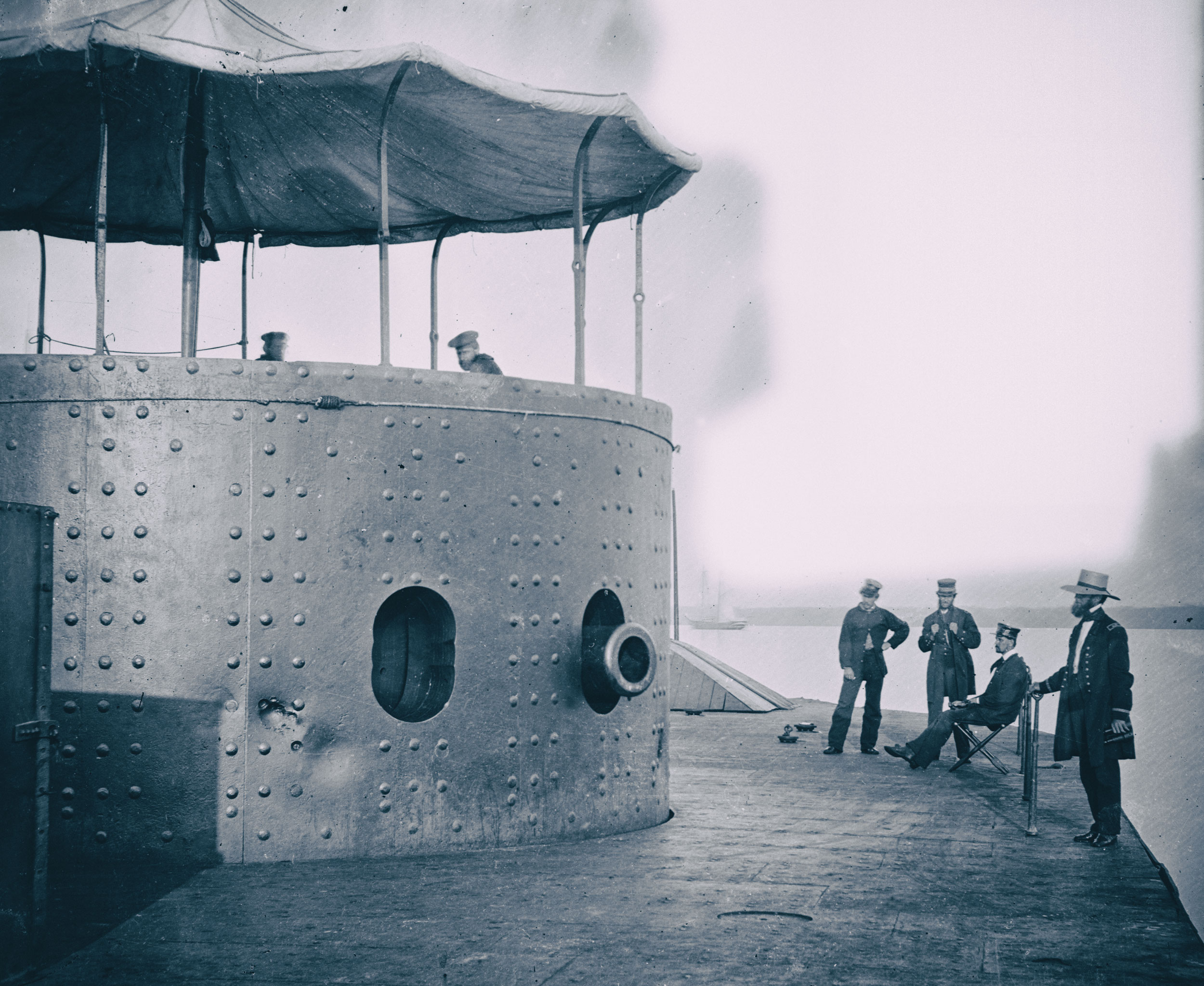
Crew members of USS Monitor stand on the vessel’s deck in this July 1862 photograph by James Gibson. Damage to its rotating gun turret, suffered during the Battle of Hampton Roads, is visible at left.
Union authorities became alarmed in 1861 when they learned that Confederates in Norfolk, Virginia, were converting the salvaged USS Merrimack—a wooden steam frigate scuttled shortly after the outbreak of the war at the Gosport Navy Yard in Portsmouth—into the ironclad warship CSS Virginia. After considering several proposals for an ironclad vessel of their own, Union naval leaders settled on a submission from Swedish inventor John Ericsson—a marvel of design in which all of the vessel’s machinery and living quarters were located underwater. Only the deck, pilothouse, and a cylindrical revolving gun turret would ride above the water line. Abraham Lincoln was captivated by the proposal for the ship, which would be named USS Monitor. According to one of his secretaries, “Mr. Lincoln said he was like the fat girl when she put on her stocking—she thought there was something in it, and so he did, and the building of the Monitor was ordered.”1
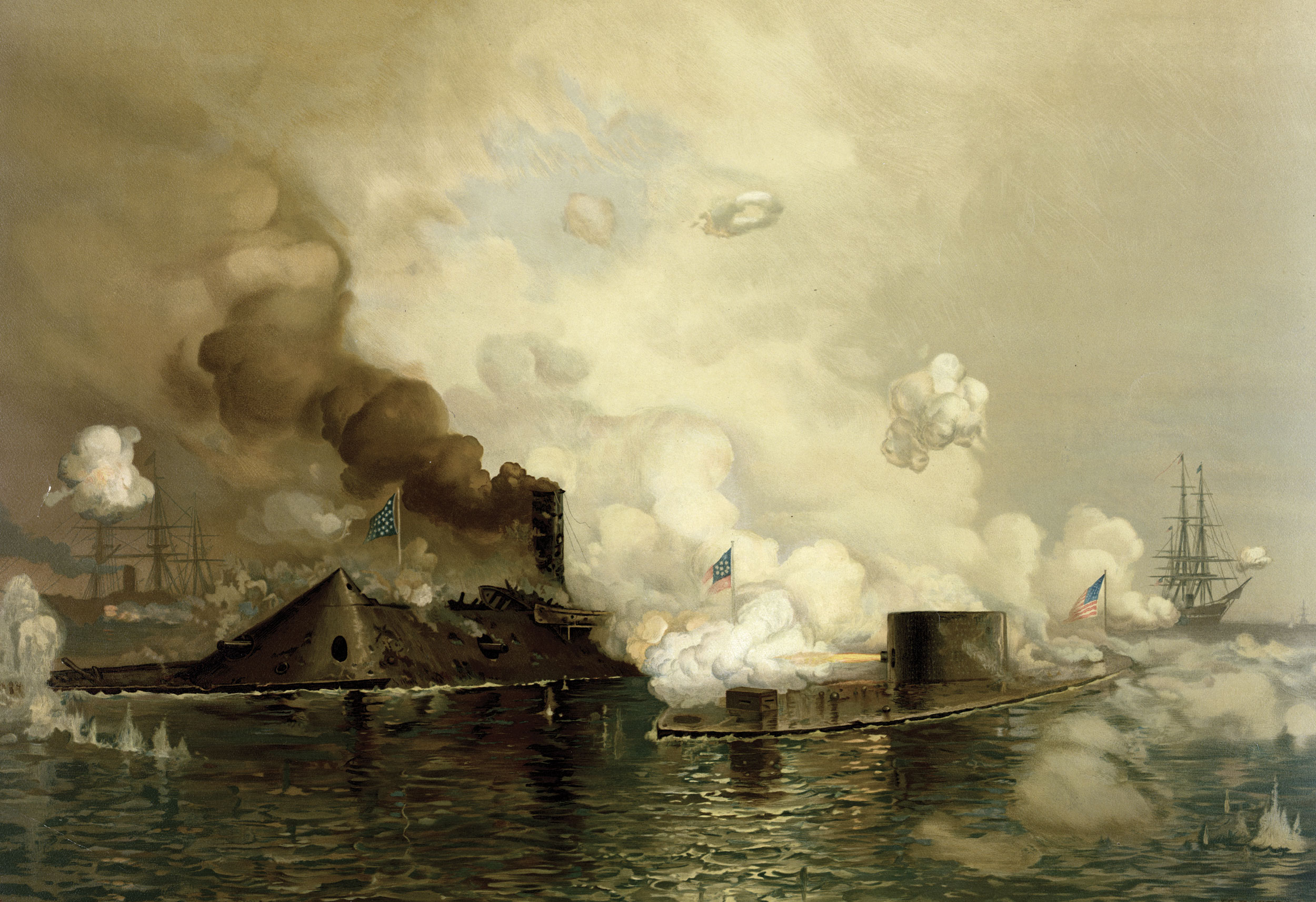
Virginia made her maiden voyage on March 8, 1862. She steamed up the Elizabeth River and rampaged the Union blockading fleet in Hampton Roads, destroying the wooden warships Cumberland and Congress. That night Monitor arrived in Hampton Roads after a difficult journey from New York. The next day the two ironclads battled for four hours to a draw. While neither vessel was able to inflict any permanent damage on the other, the engagement revealed to naval leaders around the world that the age of wooden warships was coming to a close and that navies would now need vessels constructed of iron.2
 Library of Congress
USS Monitor and CSS Virginia battle to a draw at Hampton Roads, Virginia, on March 9, 1862. It was the first-ever battle between ironclad warships and ushered in a new era in naval warfare.
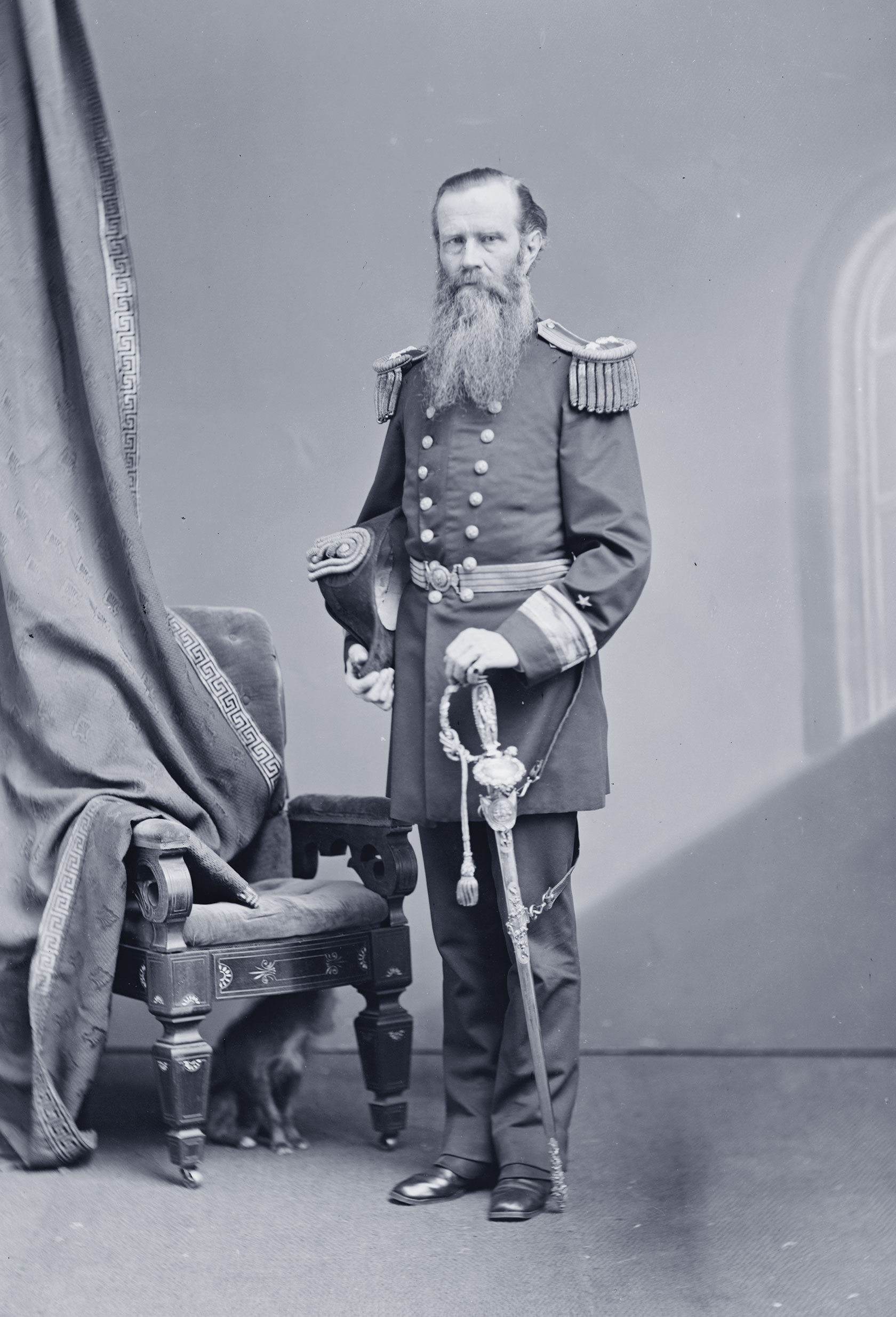
After the battle, Lincoln told his cabinet that he wanted to shake the hand of Monitor’s wounded commander, John L. Worden. Lincoln traveled to the Washington home where Worden was recuperating, his eyes having been temporarily blinded by a shot from Virginia’s rifled stern gun. “You do me great honor, Mr. President, and I am only sorry that I can’t see you,” Worden said to Lincoln as they shook hands. Moved with emotion, Lincoln apparently burst into tears and said, “No, sir, you have done me and your country honor and I shall promote you. We owe to you, sir, the preservation of our navy. I can not thank you enough.” Lincoln then “expressed the warmest sympathy” with Worden’s “suffering, and admiration of his bravery and skill.”3
 Library of Congress
John L. Worden, USS Monitor’s first commander
Over the ensuing months, the presence of the Rebel ironclad in Hampton Roads caused great trepidation for Union leaders. General George B. McClellan’s advance toward Richmond was stalled on the Virginia Peninsula while army and naval forces were making no headway toward capturing Norfolk. Finally, in May, President Lincoln decided to visit Fort Monroe, located at the southern end of the peninsula, in the words of Lincoln’s private secretaries, “to ascertain by personal observation whether some further vigilance and vigor might not be infused into the operations of the army and navy at that point.”4
Just before dark on Monday, May 5, Lincoln traveled down the Potomac River toward the fort with Secretary of War Edwin M. Stanton, Secretary of the Treasury Salmon P. Chase, and Brigadier General Egbert L. Viele on board the U.S. revenue cutter Miami. The weather was rough and the men had difficulty eating their lunches once they reached the waters of Chesapeake Bay. “The President gave it up almost as soon as he began, &, declaring himself too uncomfortable to eat stretched himself at length on the locker,” remembered Chase. “The rest of us persisted; but the plates slipped this way and that; the glasses tumbled over and slid & rolled about; and the whole table seemed as topsy turvy as if some spiritualist were operating upon it.”
 Library of Congress (2)
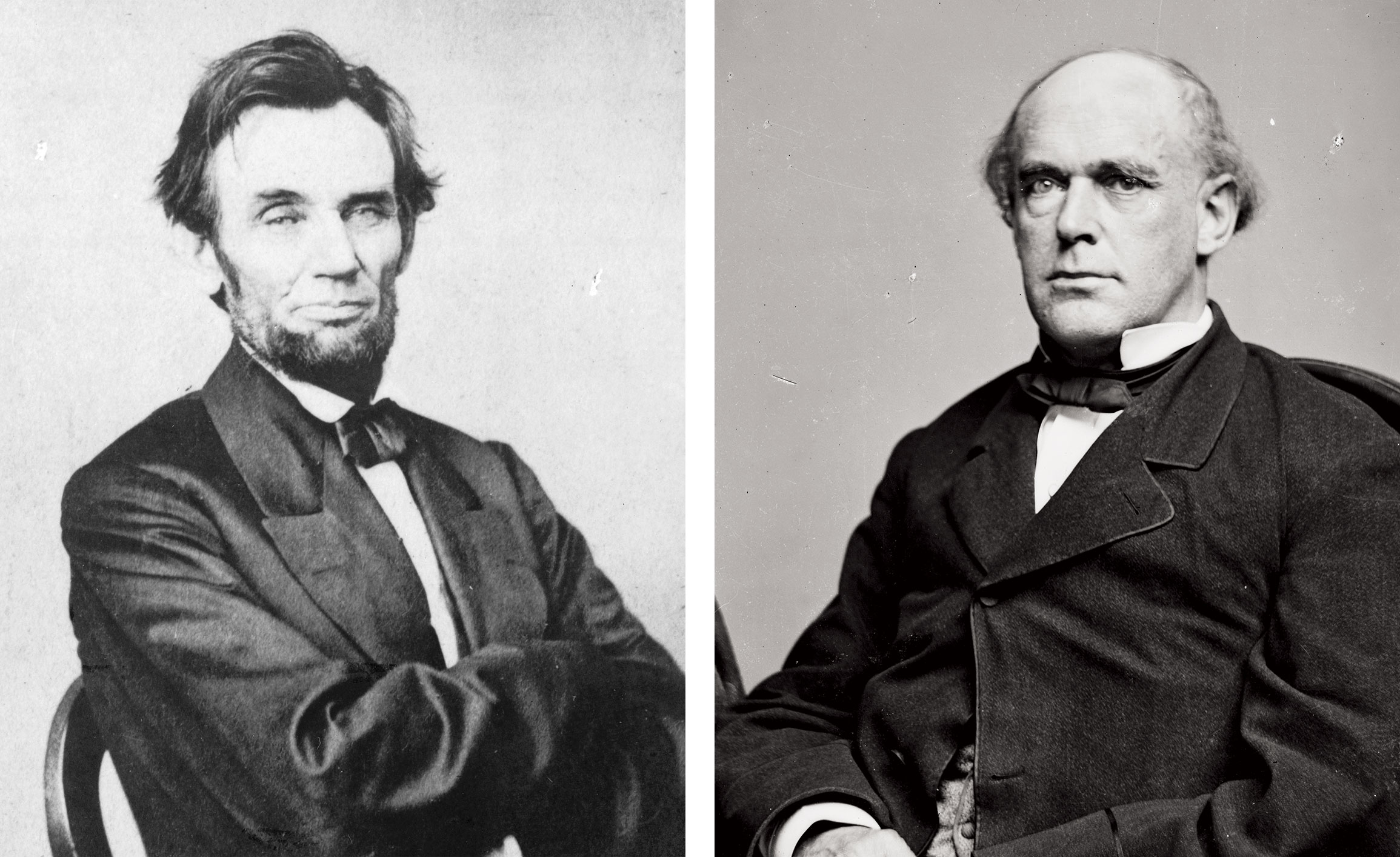
Abraham Lincoln (left) and Salmon Chase.
The men reached Fort Monroe in the evening of May 6, and they went aboard USS Minnesota with Brigadier General John E. Wool, commander of the army’s Department of Virginia, to confer with Flag Officer Louis M. Goldsborough, commander of the North Atlantic Blockading Squadron, about “military & naval movements, in connexion with the dreaded Merrimac.”5 The following day the president and his entourage toured Monitor. The ironclad’s paymaster, William F. Keeler, observed that Lincoln “had a sad, care worn & anxious look in strong contrast with the gay cortege by which he was surrounded.” Keeler noted that as Miami approached his vessel, “every eye” on the president’s boat “sought the Monitor but his own.” The president “stood with his face averted as if to hide some disagreeable sight. When he turned to us I could see his lip quiver & his frame tremble with strong emotion & imagined that the terrible drama in these waters … [during the Battle of Hampton Roads] was passing in review before him.”
After Lincoln boarded the ironclad someone pointed out that Keeler was also from Illinois. The president “was very happy he said to find one from Illinois on board the Monitor,” the paymaster recalled. Lincoln “examined everything about the vessel with care, manifesting great interest, his remarks evidently shewing that he had carefully studied what he thought to be our weak points & that he was well acquainted with all the mechanical details of our construction.” Reflecting upon this moment later in the day, Keeler thought about how different the president was from most visitors to the famous ironclad vessel. “Most of our visitors come on board filled with enthusiasm & patriot-ism ready, like a bottle of soda water, to effervesce the instant the cork is withdrawn, but with Mr. Lincoln it was different. His few remarks as he accompanied us around the vessel were sound, simple & practical, the points of admiration & exclamation he left to his suite.” When offered a glass of whiskey, Lincoln instead asked for a glass of ice water. The crew then mustered on the deck and the president “passed slowly before them hat in hand.” They returned the salute with “three hearty cheers.”6
 Library of Congress
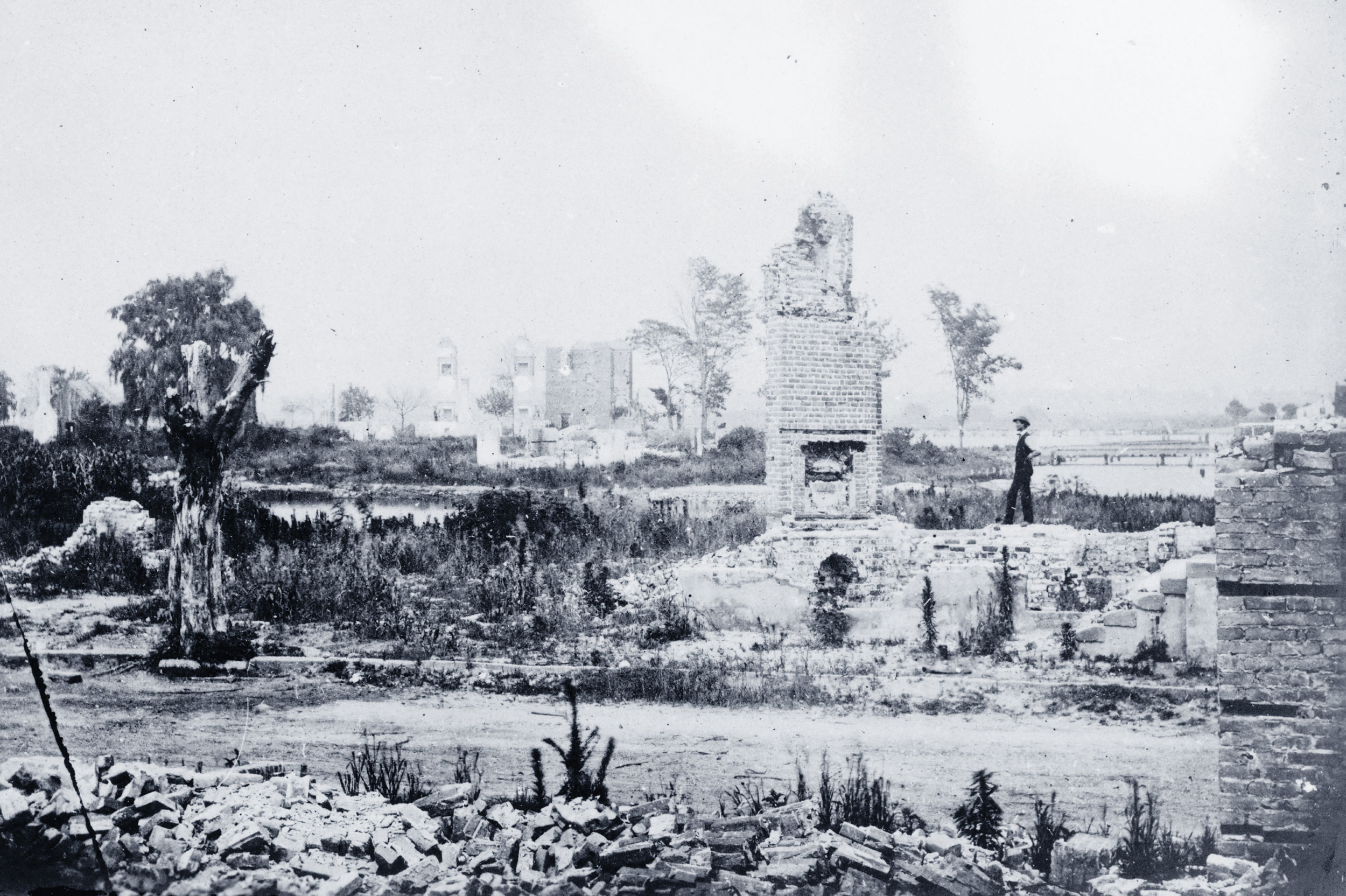
On May 7, 1862, President Lincoln and his entourage—which included Treasury Secretary Salmon P. Chase—toured the devastated city of Hampton, Virginia (shown here), which had been burned by the Confederates in 1861. “I never saw such a ruin—bare, blackened, crumbling walls on every hand,” wrote Chase.
Later in the afternoon, CSS Virginia made an appearance in Hampton Roads, but after she retired General Wool proposed that the president’s entourage ride out to Camp Hamilton—the first camp established by the Union army in Virginia after the state’s secession—“and see what was to be seen.” They saw the remnants of the city of Hampton, which had been burned by the Confederates in 1861. “I never saw such a ruin,” wrote Chase, “—bare, blackened, crumbling walls on every hand—the old Court House almost two hundred years old, but of remarkable beauty for that time—the old Church, amid the graves of generations, a gem of a building—of brick brought from England in the old time—where generation after generation of Virginians had been baptized, confirmed, married, admitted to the Communion, and dismissed with tears and benedictions to their last repose.”
The president and his companions returned from their tour “saddened,” but soon the mood changed. General Wool had ordered a grand review of the troops stationed in Hampton. First the cavalry went by, then “regiment after regiment of infantry, all appearing handsomely and some wonderfully well,” wrote Treasury Secretary Chase. Chase noted that the “troops were gratified by the President who rode along their line alone, uncovered, inspiring great enthusiasm. It is delightful, by the way, to observe every where the warm affection felt and expressed for the President.”7
For many among the troops, this was the first time they had seen the president in person. One New Yorker remarked, “The ex rail splitter is as homely as a stone fence and dresses shockingly, but their [sic] is an appearance about him which indicates great firmness, and strength of character; take him as I saw him, and he is just the picture of a Western hoosier, tall, lank, and gaunt.”8 A Pennsylvanian recalled decades later that Lincoln rode General Wool’s “spirited little bay horse” over to the review. “General Wool was a small man and the little bay and he were well proportioned,” recalled this soldier, “but when Abraham Lincoln, with his long legs, strode the same little bay, the disproportion between rider and horse was very obvious.”9
After their tour of the area and the grand review, Lincoln asked Wool, “Why don’t you take Norfolk?” speculating that “it may be easier taken than the Merrimac; and, once [Norfolk is] in our possession, the Merrimac, too, is captured, not, perhaps, actually, but virtually she is ours.” “Pooh,” replied Wool, “you don’t understand military necessity.”10
Lincoln would soon prove otherwise.
Back at Fort Monroe, the president slept in Colonel Le Grand B. Cannon’s room in Quarters No. 1 from May 8 until the 11th. One night just before dinner Lincoln entered the room while Cannon was dressing. “Why, I think you are making rather an elaborate toilet, Colonel,” said Lincoln. “Of course,” replied the officer. “In such presence I could not do otherwise.” “Well,” said Lincoln, “I don’t know but if you will lend me that brush, I think I will fix up a little, too.” Cannon handed Lincoln a hairbrush made of ivory and a comb made of shell. “Why, I can’t do anything with such a thing as that. It wouldn’t go through my hair,” joked the president. “Now, if you have anything you comb your horse’s mane with, that might do.”
 The Mariners’ Museum, Newport News, Va.
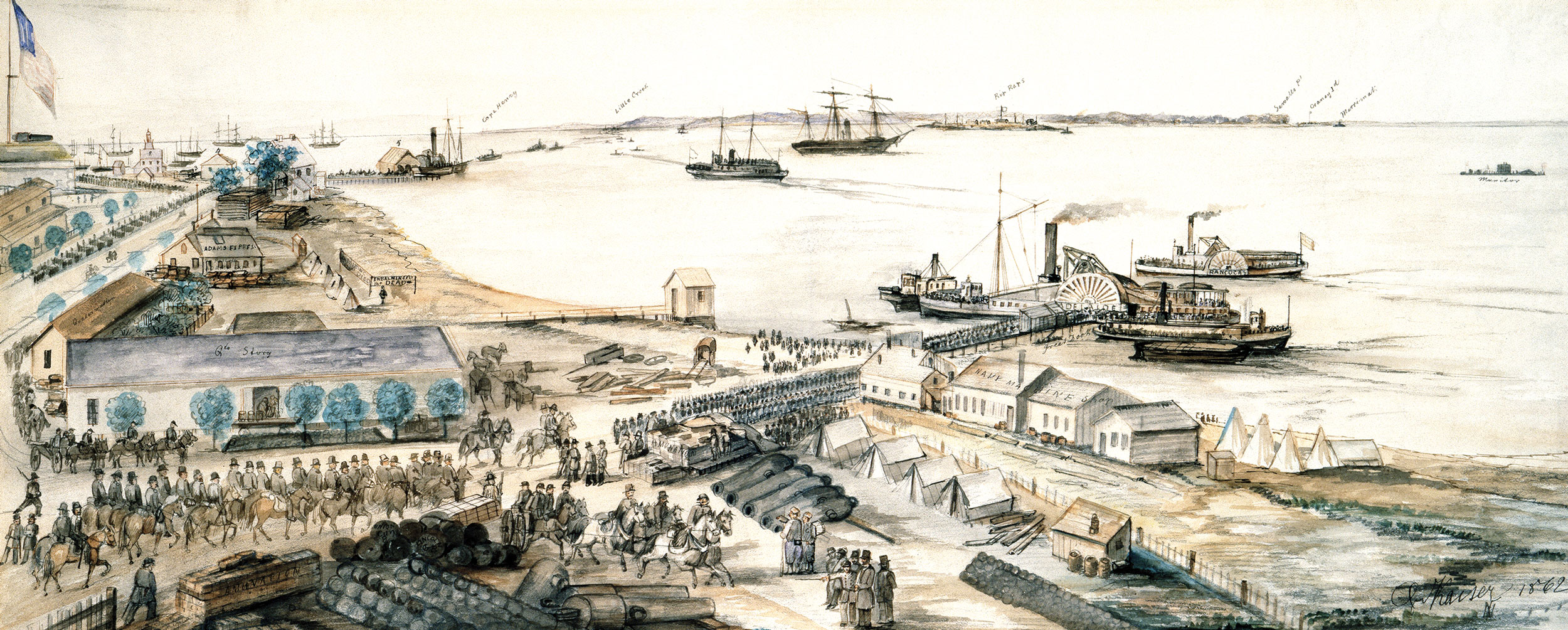
Union troops at Fort Monroe prepare to embark for the invasion of Norfolk, Virginia, under the watchful eye of President Lincoln (visible alongside General John E. Wool and Treasury Secretary Chase at center bottom), who had been involved in the preparations, on May 10, 1862.
At that point Lincoln looked at the colonel and said he must tell him a story about his hair. “When I was nominated for President at Chicago—as much to my surprise as to the surprise of the country—people naturally wanted to see how Abe Lincoln looked,” he began. “I had been up to Chicago a year or two previous, and had been persuaded to have my photograph taken. An enterprising fellow in the Convention knowing of this, went to the photographer and bought the negative, and he was so expeditious about his scheme, that by the time the news got down to Springfield, where I lived, the boys were running through the streets crying: ‘Here’s a likeness of Abe Lincoln. Price, two shillings. Will look a great deal better when he gets his hair combed.’” Lincoln told the story again at dinner to the delight of everyone present.11
Lincoln, however, was not delighted at the visible presence of Confederate batteries at Sewell’s Point, which protected the city of Norfolk. Hoping to press Wool into action, Lincoln personally ordered Flag Officer Louis M. Goldsborough to attack the Rebel batteries in preparation for a federal advance. That same day—May 8—the president and several companions traveled in a tugboat across the channel to Fort Wool, on a small island known as the Rip Raps located at the mouth of Hampton Roads, to see the orders carried out. Several ships, including Monitor, opened fire on the Confederate batteries, as did the larger guns at the Rip Raps. Watching from Fort Monroe, Secretary of War Stanton thought it “was a beautiful sight to witness the boats moving on to Sewell’s Point, and one after another opening fire and blazing away every minute.” After a short while, however, smoke began to curl up above the trees near Sewell’s Point and several men shouted, “There comes the Merrimac.”
The wooden vessels of the Union navy began to depart, but Monitor and another ironclad vessel “held their ground,” according to Chase, as Virginia slowly approached. “Then the great rebel terror paused—then turned back—& having finally attained what she considered a safe position, became stationary again. This was the end of the battle,” wrote Chase. On the Union side, nobody was hurt, but the Confederates had lost at least one powerful battery on the shoreline. “Another certainty is that the rebel Monster don’t want to fight,—& won’t fight if she can help it, except with more advantage than she is likely to have,” noted Chase.12 After witnessing this scene, the president remarked that Virginia “must be destroyed if it took the whole navy to do it.”13
On May 9, Chase, Wool, and several others took Miami across Hampton Roads to scout for a landing point near Norfolk. When they returned to Fort Monroe they found that Lincoln had been conversing with a pilot and studying a chart for landing spots. He believed he had found a nearer one than they had located “and wished to go and see it on the spot.” Chase, Stanton, and the others went to the Rip Raps, where they picked up 20 armed soldiers and then headed toward the shoreline. As they neared the beaches, Lincoln chose another spot that he liked for the landing, although Wool ultimately decided to use the one he and Chase had found earlier in the day. According to one account, the ship came under fire and others aboard urged the president to seek safety below. “Although I have no feeling of danger myself,” he replied, “perhaps for the benefit of our country, it would be well to step aside.”14
 Library of Congress
Edwin Stanton
On the morning of May 10, 1862, 5,000 Union soldiers landed on the shore near Ocean View and began moving inland. According to several accounts, Lincoln (who had remained at Fort Monroe) was upset that Wool did not send as many troops as he could have to capture the city. One Union officer observed the president “rushing about, hollering to someone on the wharf—dressed in a black suit with a very seedy crape on his hat, and hanging over the railing, he looked like some hoosier just starting for home from California, with store clothes and a biled shirt on.”15 In truth, Lincoln needn’t have worried. By 5 p.m. the soldiers had reached downtown Norfolk, where Mayor William Lamb staged an elaborate surrender ceremony that involved presenting the “keys to the city” to the Union commander—a ruse that allowed the remaining Confederate troops time to leave the town and to destroy Gosport Navy Yard. Now without a home, CSS Virginia would have to be scuttled, her commander determined.
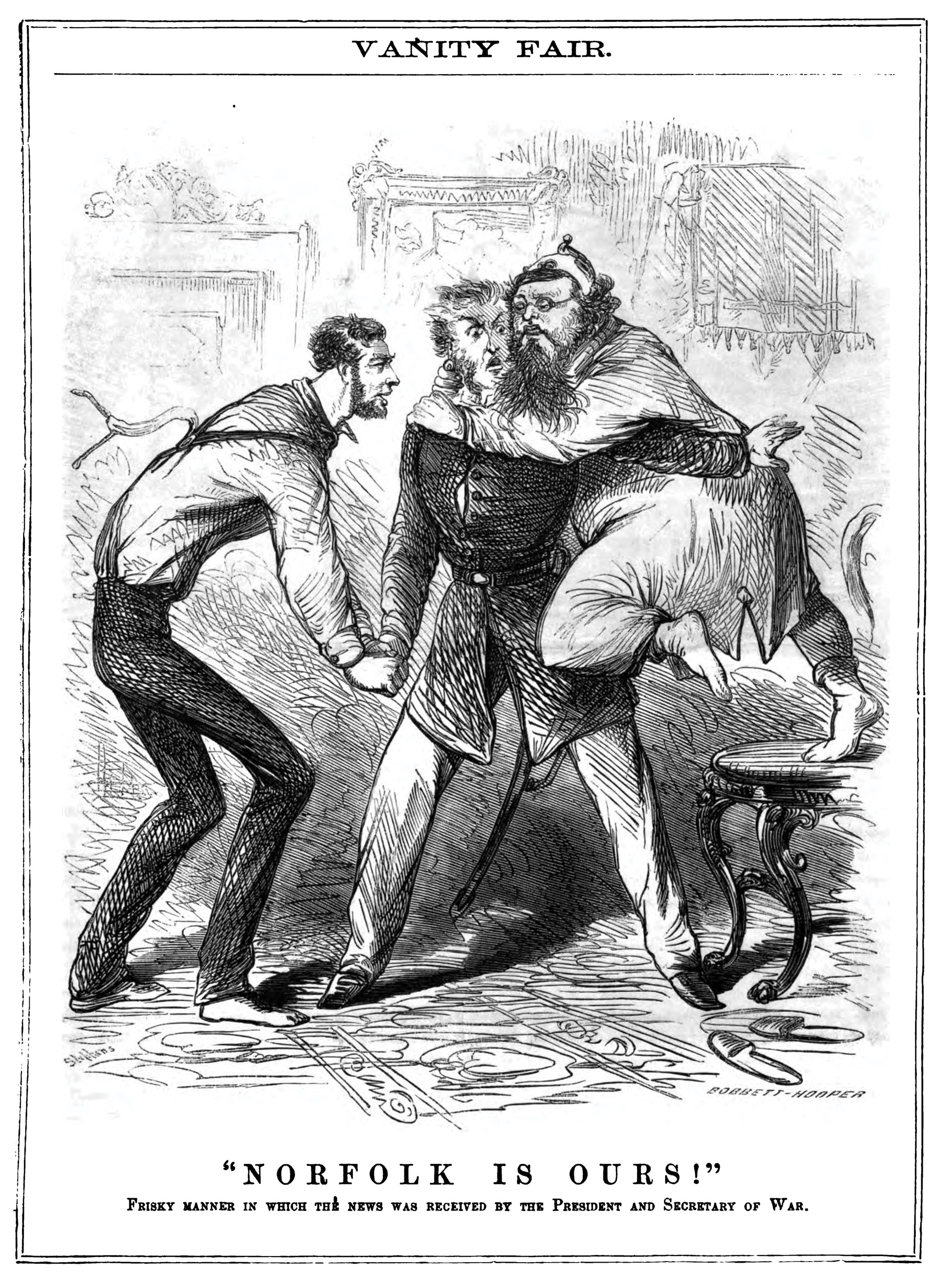
Following the capture of Norfolk, General Wool returned to Fort Monroe, where Lincoln was preparing for bed in Quarters No. 1. When Lincoln heard Wool return, Colonel Cannon observed that he appeared like “six feet of white nightshirt at the French window.” Upon hearing the good news, the president called for Edwin Stanton. “My God!” exclaimed Stanton as he jumped out of bed. The secretary of war then ran to the president’s room, where Cannon recorded what he saw:
President Lincoln was sitting on the edge of the bed. General Wool was there, in full uniform and all covered with dust, and one or two of his officers were also there. Secretary Stanton rushed impetuously into General Wool’s arms in his excitement, and embraced him fervently. The President broke out laughing at seeing the General in full uniform and the Secretary in his nightshirt clasped in each other’s arms, and said: “Look out, Mars! If you don’t, the General will throw you.”
During breakfast the next morning, Lincoln joked that a painting should be made for the U.S. Capitol to commemorate the taking of Norfolk and that “it should be illustrated by a picture showing the meeting of the Secretary of War and General Wool, on the announcement of the capture.”16
At 4:58 a.m. on May 11, the sailors aboard Monitor heard “a very large Explosion,” with one sailor telling his wife that “nothing could be seen of the Merimack [sic] after it.”17 The Confederates had been forced to destroy their own ironclad vessel to prevent it from falling into Union hands. Before leaving Hampton Roads, Lincoln’s party made it a point to see “the point where the suicide had been performed.”18
Reflecting on recent events, Secretary Chase wrote, “So has ended a brilliant week’s campaign of the President; for I think it quite certain that, if he had not come down, Norfolk would still have been in possession of the enemy, and the ‘Merrimac’ as grim and defiant and as much a terror as ever. The whole coast is now virtually ours.”19 Others agreed. “It is extremely fortunate that the President came down as he did—he seems to have infused new life into everything, even the superannuated old fogies begin to shew signs of life & animation,” wrote Keeler, Monitor’s paymaster. “He has been busy today visiting different points—first the Com’re, then us [aboard Monitor for a second time], then to the Rip Raps, then to the Fortress [Monroe], not a place has escaped him where he thought his presence could do any good.”20
 Vanity Fair
This cartoon, published in Vanity Fair, depicts the reaction of Secretary of War Edwin Stanton—who, clad in his nightshirt, has jumped into the arms of General Wool as Lincoln looks on—upon learning of the capture of Norfolk by Union forces.
A local artist—possibly a soldier—had captured the scene at Fort Monroe as Union soldiers were preparing to embark for Norfolk. As hundreds of infantrymen and cavalrymen pass by on their way to steamers that will carry them across the waters of Hampton Roads, a tall figure in a top hat stands in the foreground, at the center of this propitious moment. Lincoln towers over the much shorter General Wool, while Secretary Chase stands behind them. The artist, whose name appears to be either “G” or “O” Kaiser, gave a sense of the movement at Fort Monroe as well as the tension of what lies beyond, as Virginia hovers by the Confederate batteries at Craney Island and Sewell’s Point, and Monitor lies waiting in the water.
By the end of his visit, Lincoln’s demeanor and appearance had improved noticeably. As his vessel steamed by Monitor on May 11, Keeler observed the president “had his hat off bowing, appearing highly pleased at the successful result of his plans.”21 According to a New York Times correspondent, Lincoln returned to Washington “in high spirits, and greatly refreshed and invigorated by his sojourn at the seat of war.”22
Yet for the men aboard Monitor, things would take a turn for the worse over the ensuing months. During the remainder of McClellan’s Peninsula Campaign, which would end in defeat on the outskirts of Richmond, the ironclad’s crew found themselves doing river duty on the James, with temperatures below decks reaching 165 degrees. Chief Engineer Isaac Newton complained that “the inevitable Monitor” was going to be “dragged along up this dirty shoal river, gracious only knows for what purpose except to be stuck & abandoned.” Monitor, he continued, proved to be “a mighty hot concern in warm weather.”23
The vessel’s officers also chafed under the command of Flag Officer Goldsborough, a man “whose principal qualifications are immense size, big feet & the faculty of using neat, heavy round oaths when the occasion permits,” thought Newton. Monitor’s crew especially resented that Goldsborough was “quietly rusticating on board the Minnesota in Norfolk Harbor” while they were sweltering in an iron coffin on the James.24
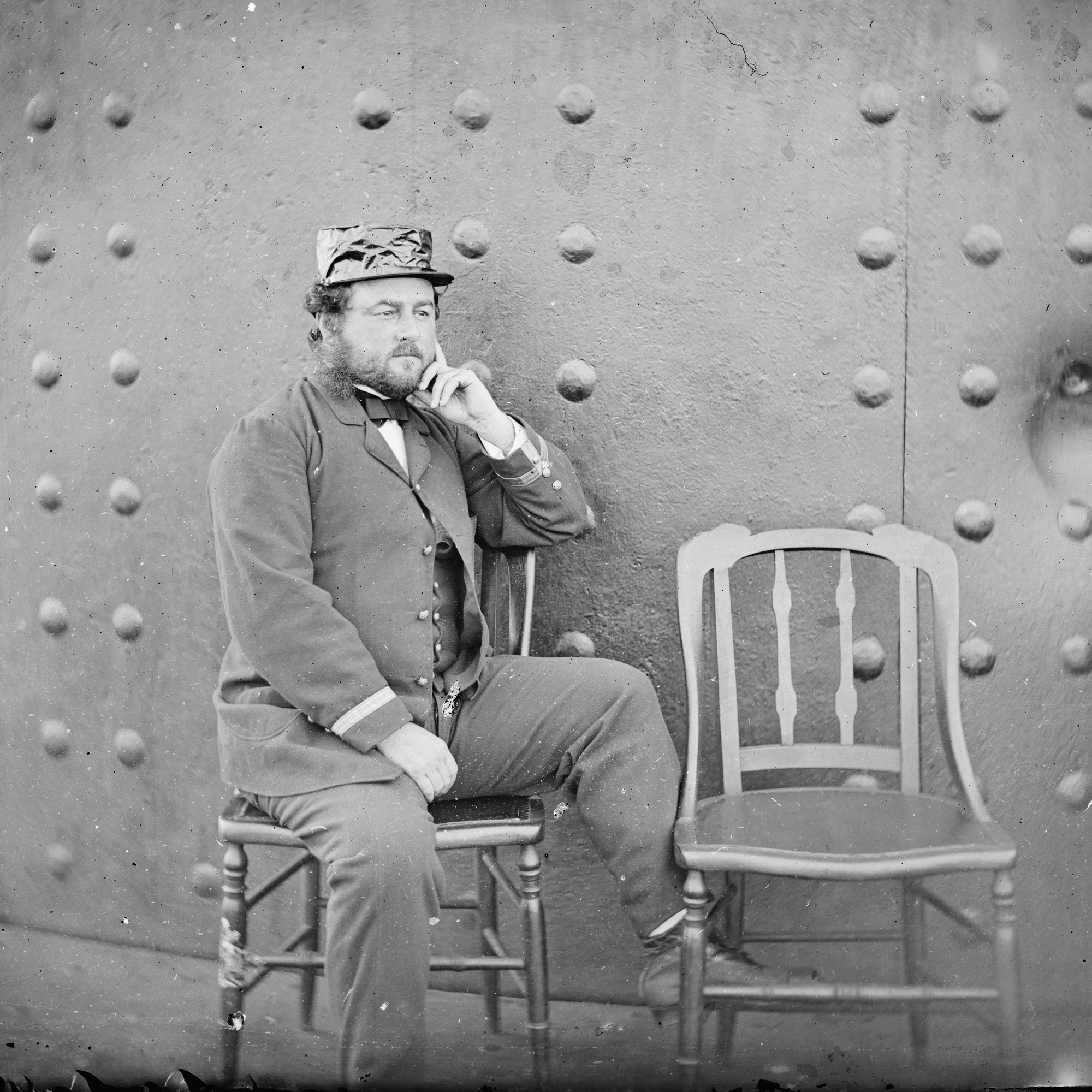
Lincoln would again visit Monitor on July 9, 1862—this time to relieve Goldsborough of command. Also visiting that day was James F. Gibson, a Scottish photographer who had worked with Mathew Brady and Alexander Gardner. Unfortunately Lincoln was gone by the time Gibson arrived. Gibson took eight photographs of the ship’s officers and crew aboard the deck of Monitor. Most featured the men in groups of various sizes—sitting or standing on the decks, talking, reading letters or newspapers, playing games, and cooking. One image featured a former slave, Siah Carter, who had recently joined the crew. And in one was the commander of the vessel, Captain William N. Jeffers—a solitary figure sitting alone next to an empty chair.
 Library of Congress
USS Monitor captain William N. Jeffers sits next to an empty chair on the ironclad’s deck in this July 1862 photo by James F. Gibson.
The officers and crew loathed Captain Jeffers. One engineer aboard the ship believed him to be “the personification of selfishness,” while another member of the crew called him a “damd old Gluttonous Hogg,” adding, “I hope the curse of Hell will rest on him.” For his part, Paymaster Keeler lamented Jeffers’ “extreme selfishness & his want of decisive energetic action,” as well as the “most supreme contempt” Jeffers showed toward volunteer officers. Still, Keeler suspected that the president might like him. “Mr. Lincoln evidently respects Capt. J.’s opinions,” Keeler wrote to his wife, “& I am inclined to think will give him his support if his plans appear at all reasonable or feasible.”25
It very well may be that the empty chair next to Jeffers was one he had reserved for the president, hoping he could have his photo taken in front of the ironclad’s dented turret next to the commander-in-chief of the army and navy. If Kaiser’s painting of Fort Monroe on May 10 captured the activity and optimism of that day, Gibson’s portrait of Jeffers next to an empty chair meant for Lincoln belied the gloom and discouragement of the summer of 1862. The war would take another three years to close, and that would not be until after Lincoln visited Hampton Roads again in 1865.
Anna Gibson Holloway, the former curator of the USS Monitor Center at The Mariners’ Museum in Newport News, Virginia, is director of museum services for SEARCH Inc. in the D.C. area. Jonathan W. White is an associate professor of American studies at Christopher Newport University and the author or editor of several books about Abraham Lincoln and the Civil War. They are co-authors of “Our Little Monitor”: The Greatest Invention of the Civil War (Kent State University Press, 2018).
Notes
1. William O. Stoddard, Inside the White House in War Times: Memoirs and Reports of Lincoln’s Secretary, ed. Michael Burlingame (Lincoln, 2000), 20.
2. See Anna Gibson Holloway and Jonathan W. White, “Our Little Monitor”: The Greatest Invention of the Civil War (Kent, OH, 2018).
3. Michael Burlingame, Abraham Lincoln: A Life 2 vols. (Baltimore, 2009), 2:307–308.
4. John G. Nicolay and John Hay, Abraham Lincoln 10 vols. (New York, 1890), 5:234.
5. Salmon P. Chase to Janet “Nettie” Chase, May 7, 1862, in John Niven, et al., eds., The Salmon P. Chase Papers 5 vols. (Kent, OH, 1993–1998), 3:186–87.
6. William F. Keeler to Anna, May 7, 1862, in Robert W. Daly, ed., Aboard the USS Monitor: 1862: The Letters of Acting Paymaster William Frederick Keeler, U.S. Navy, to His Wife, Anna (Annapolis, 1964), 106.
7. Chase to Nettie, May 8, 1862, in ibid., 189–90.
8. William Lee Monegan to Joseph Monegan, May 7, 1862, William Monegan Papers (MS0014), The Mariners’ Museum Library, Newport News, Virginia (hereafter TMM).
9. Samuel S. Thompson, Some Personal Experiences at Fortress Monroe in 1862 (Philadelphia, 1915), 10–11.
10. Burlingame, Abraham Lincoln, 2:312.
11. Le Grand B. Cannon, Personal Reminiscences of the Rebellion, 1861–1866 (New York, 1895), 168-72; Chester D. Bradley, “President Lincoln’s Campaign against the Merrimac,” Journal of the Illinois State Historical Society Vol. 51 (Spring 1958): 77–84.
12. United States War Department, The War of the Rebellion: A Compilation of the Official Records 129 vols. (Washington, 1880-1901), Ser. 1, Vol. 11, 148, 153, 155–56 (hereafter cited as OR); draft of Chase to Nettie, May 8, 1862, in Niven, Chase Papers, 1:339.
13. Isaac Newton to William Kelly, July 19, 1862, Isaac Newton Papers (MS13), TMM.
14. Chase to Nettie, May 11, 1862, in Niven, Chase Papers, 3:193-96; Burlingame, Abraham Lincoln, 2:312.
15. OR, Ser. 1, Vol. 11, 162; Burlingame, Abraham Lincoln, 2:313.
16. Cannon, Personal Reminiscences, 161–168.
17. George Geer to Martha, May 11, 1862, George S. Geer Papers, TMM; OR, Ser. 1, Vol. 11, 163–164.
18. Chase to Nettie, May 11, 1862, in Niven, Chase Papers, 3:197.
19. Ibid.
20. Keeler to Anna, May 9, 1862, in Daly, Aboard the USS Monitor, 115.
21. Keeler to Anna, May 12, 1862, in Daly, Aboard the USS Monitor, 121.
22. The New York Times, May 13, 1862.
23. Newton to mother, May 14–19, and June 30, 1862, Newton Papers.
24. Newton to mother, June 30, 1862, Newton Papers.
25. Newton to mother, June 30, 1862, Newton Papers; George S. Geer to Martha Geer, July 1, 1862, George S. Geer Papers (MS10), TMM; Keeler to Anna, May 7 and June 23, 1862, in Aboard the USS Monitor, 108, 162.
Related topics: Abraham Lincoln, naval warfare