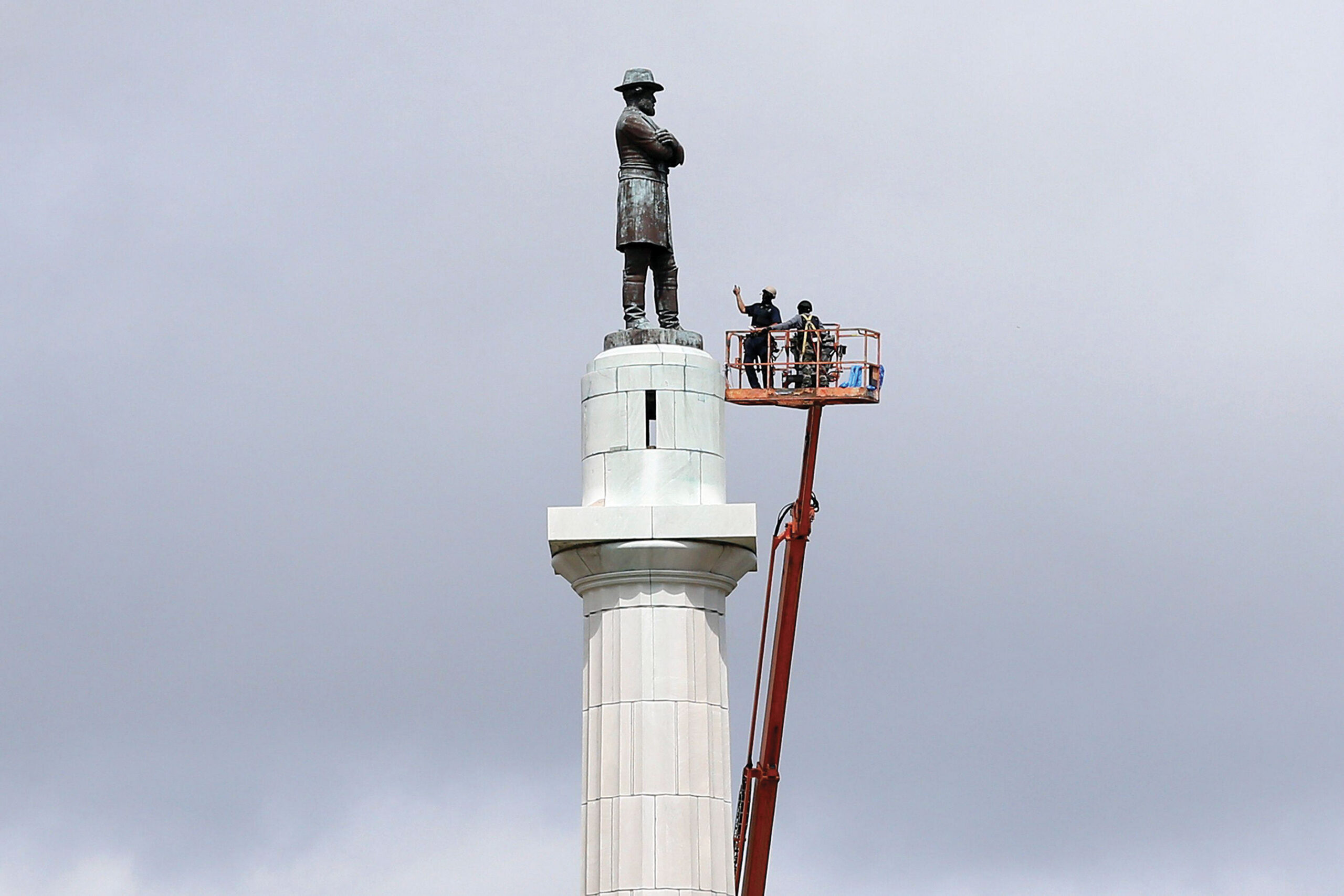
 REUTERS / Alamy Stock Photo
Workers prepare a monument of Robert E. Lee for removal in New Orleans, Louisiana, in May 2017.
If We Care About Monuments, We Should Take Care of Them
by Sarah Beetham
America’s monuments are in trouble. In the summer of 2020, in the midst of nationwide protests against police brutality following the death of George Floyd in Minneapolis, Minnesota, dozens of monuments were removed from their pedestals in American towns. Some were Confederate monuments, but other statues honored important people from dark moments in the nation’s past. And while many statues were taken down by local governments, others were toppled in symbolic acts of iconoclasm, video of which was shared over and over again on social media. There is much to debate about what should be done with controversial monuments and what this means for the public memorial landscape. But the events of the summer have revealed another big problem: After decades of neglect and exposure, America’s monuments are crumbling. Because of shoddy materials, inadequate foundations, structural flaws, and more, many statues are easy targets for toppling. While some have linked the poor quality of Confederate statues with the morally bankrupt ideology they represent, this is a problem that does not solely affect Confederate monuments. At this moment of monumental reckoning, it is important to think about what the condition of our statues says about what we value, and whether it is time to take some statues down while making a commitment to care for those we hope to preserve.
Civil War monuments were erected at a time when the entire American sculptural industry was in transition. From the first European contact with North America through the early 19th century, colonial Americans had few resources available for monuments. Almost all of the sculptures produced during this period were either gravestones or carvings for furniture, and the few examples of public statuary were imported from Europe. In the early 19th century, some American-born artists began to travel abroad to Italy to learn how to sculpt in marble, and by the 1850s, the first bronze foundries for fine art casting began to appear in the United States. But even as the capacity to produce sculpture for American cities grew, there was little funding available for expensive statue projects, and the few examples that were erected tended to honor famous American statesmen.
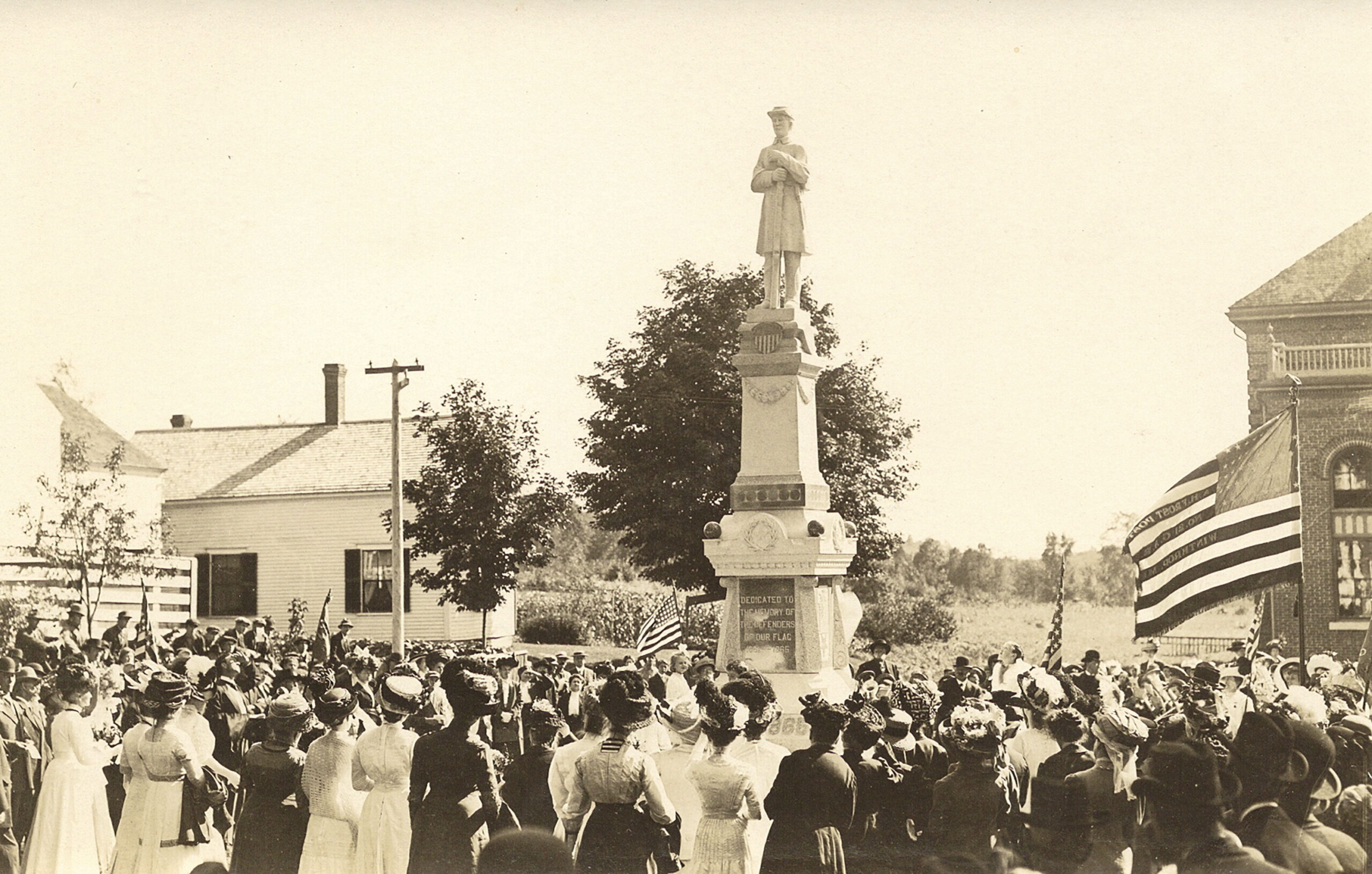 Maine.gov
A crowd gathers to watch the unveiling of a Civil War monument on May 30, 1911, in Winthrop, Maine. While some of the monuments dedicated around the country to Union and Confederate veterans in the decades after the war were made by artisans using high-quality materials, many others were not, and were susceptible to decay over time.
The Civil War changed everything. As soon as the war ended, northern cities began to clamor for statues honoring the war’s heroes and commemorating its major events. The former Confederate states followed suit a few decades later, after the economy improved and the political situation tilted in favor of white southerners. While some of these statues were erected in honor of military or political leaders, the vast majority recognized the rank-and-file soldiers who fought on both sides of the war. This was a new phenomenon in European and American history and was a response to the staggering losses suffered by northern and southern armies. For the first time, citizen soldier monuments featuring a soldier at parade rest documented the role that ordinary Americans played in the war and stood in as surrogate gravestones for soldiers whose bodies were never recovered. The demand for these statues was strong, and they were erected first in cemeteries, and later in town squares and other civic sites.
American and European manufacturers rose to meet the massive demand for memorial statuary, and their solutions were not always built to last. While the majority of monuments to particular individuals were unique commissions sculpted by academically trained artists and cast from bronze in fine art foundries, few of the statues to rank-and-file soldiers were created under these conditions. Many of the earliest northern statues were carved locally out of granite or sandstone by artisans who also produced gravestones. By the end of the 19th century, massive businesses such as the Monumental Bronze Co. of Bridgeport, Connecticut, or Chicago’s American Bronze Co., began to flood the market with cheap metal statues made out of zinc or other alloys. Some of the zinc statues were cast from molten metal in many pieces and then welded together, but others were stamped from thin sheets of cold metal. Few statues were made locally in the South, although many statues purchased elsewhere were erected on bases carved from local stone. Some of these purchased statues came from large northern firms, but many others were the products of Italian marble yards, which were also responsible for a great deal of the marble sculpture in 19th-century American cemeteries.
The materials used to manufacture these mass-produced statues are more prone to the effects of weather and exposure than traditional bronze, and evidence of this is visible wherever these monuments can be found. Granite statues are generally relatively stable, but softer stones tend not to fare well outdoors without regular maintenance. Italian marble is particularly susceptible, as it absorbs pollutants from automobile exhaust and de-icing treatments, leading to discoloration and sugaring, in which the surface breaks down into sugary granules. Zinc statues are prone to creeping, in which elements that were once welded together separate at the seams, and heavier areas cause the sculptures to sag. For instance, the most popular soldier statue sold by Monumental Bronze Co., which was used for more than 80 Union and Confederate monuments, has one heavy point where the cape is flung over the shoulder, causing each of these soldiers to lean precariously backward over time. Even bronze statues need regular treatment to protect the surface patina and to prevent weather damage. But the great majority of America’s statues do not receive the conservation treatment they need as often as they should, if ever, and the result is a fragile memorial landscape ever teetering on the edge of ruination.
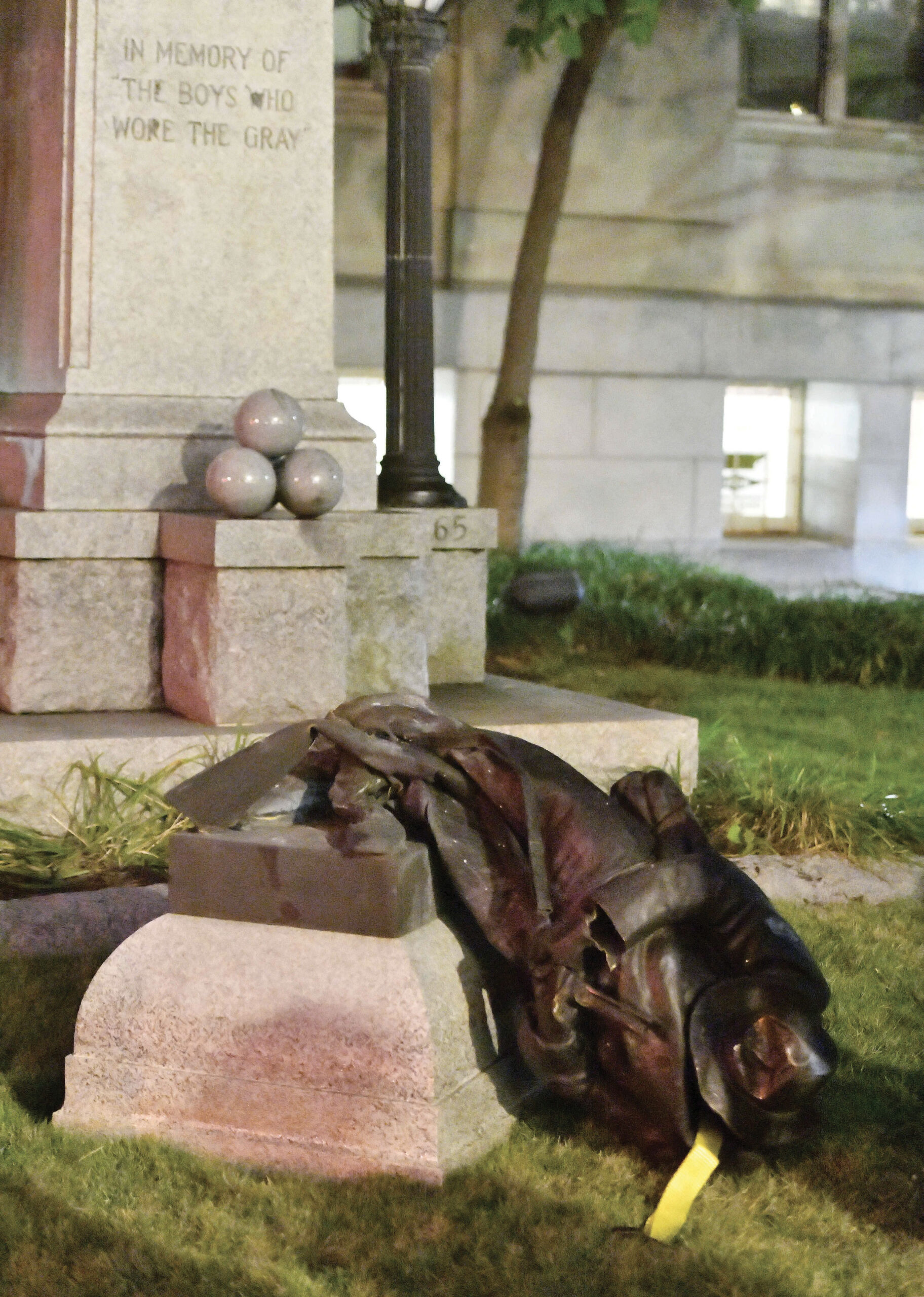 Zuma Press Inc./Alamy Stock Photo
The Confederate monument in Durham, North Carolina, lies toppled by protesters in August 2017. The topmost section of the granite pedestal fell with the stamped metal statue, the bolts holding it to the base having long since eroded.
The recent wave of acts of iconoclasm directed at Confederate monuments and other statues has revealed just how precarious the situation is. In August 2017, just after the “Unite the Right” rally in Charlottesville, Virginia, a crowd of protesters toppled a Confederate monument in Durham, North Carolina. In a video that quickly went viral, the statue tumbled from its base, crunching hopelessly out of shape when it hit the ground. The topmost section of the granite pedestal came with it, revealing that if there ever had been bolts holding the base together, they had long since eroded, leaving the monument standing only by the strength of its own weight. The force of the granite block was too much for the stamped metal statue, which had only a fraction of the structural integrity of similar statues made of cast metal. In the summer of 2020, this process was repeated over and over, with statues plummeting too easily to the ground in the midst of widespread protests. And even in times before the recent unrest, too many statues have been destroyed by car crashes, weather events, falling trees, and other accidents. Because they have been allowed to degrade so much over time, America’s monuments are too easily susceptible to ruinous damage from both random and purposeful sources.
The recent monument debates have forced us to ask ourselves what we value, both in terms of the stories that we want to see enshrined in our public spaces and the objects that have stood in those spaces over time. Many opposed to the removal of monuments call it “erasing history,” and consider it a desecration of places dedicated to historical memory. But the condition of America’s monuments suggests that we have long failed to respect history or objects, or to put in the time, care, and money necessary to protect these statues. In short, it seems that we do not care about them at all. At this moment when the use of public space is so central in the national consciousness, it is time to take a hard look at the condition of our memorial landscape and to ask ourselves what it will take to make these spaces reflect our shared values, and ensure that the statues that are worth preserving will continue to endure for future generations.
Sarah Beetham is the Chair of Liberal Arts and Assistant Professor of Art History at the Pennsylvania Academy of the Fine Arts, specializing in American art and particularly the monuments erected to citizen soldiers after the Civil War. Her current book project, Monumental Crisis: Accident, Vandalism, and the Civil War Citizen Soldier, considers the long history of damage and alteration of Civil War monuments in the context of the recent debate over Confederate memory.
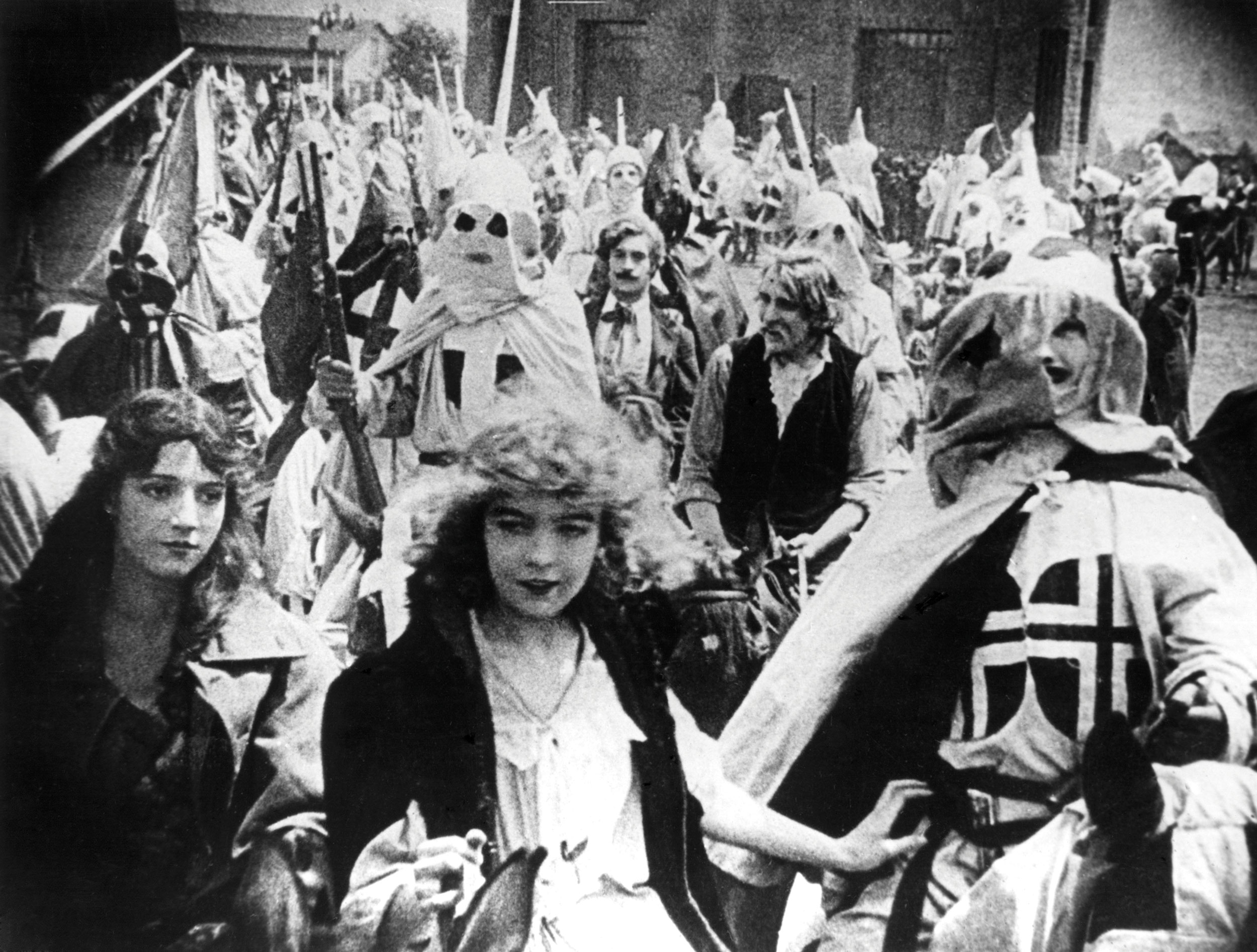 Glasshouse Images/Alamy Stock Photo
The Birth of a Nation
Black Americans and the Legacy of Confederate Memory
by Robert Greene II
The questioning of Confederate memorials honoring the defeated has long bothered American society. Years ago, black cadets at West Point felt they needed to speak out against a possible planned memorial to a Confederate soldier on the academy’s grounds. In an interview for Ebony magazine, one cadet said, “It’s incredible.… Those men violated their West Point oath, defied the Constitution and fought against the United States. Yet there’s talk of honoring them.” That story ran in December 1971.
While the debate over Confederate statues and memorialization has become starkly visible in the last five years, energized by Black Lives Matter and the Charleston church massacre in 2015, it would be a mistake to assume that black Americans were ever content with valorization of the Confederate cause. NAACP boycotts of the films The Birth of a Nation in 1915 and Gone With the Wind in 1939 were in response to both movies’ celebration of the Confederacy and their ignoring of the slavery the Confederacy wished to preserve. In 1940, the editors of The Crisis magazine said about Gone With the Wind, “The film is the story of the Civil War from the Deep South point of view. It portrays what a caption describes as an ‘era of chivalry and gracious living,’ now gone with the wind. It should be, for it was an era in which only the smallest minority enjoyed ‘gracious living’—and that made possible by human slavery.”
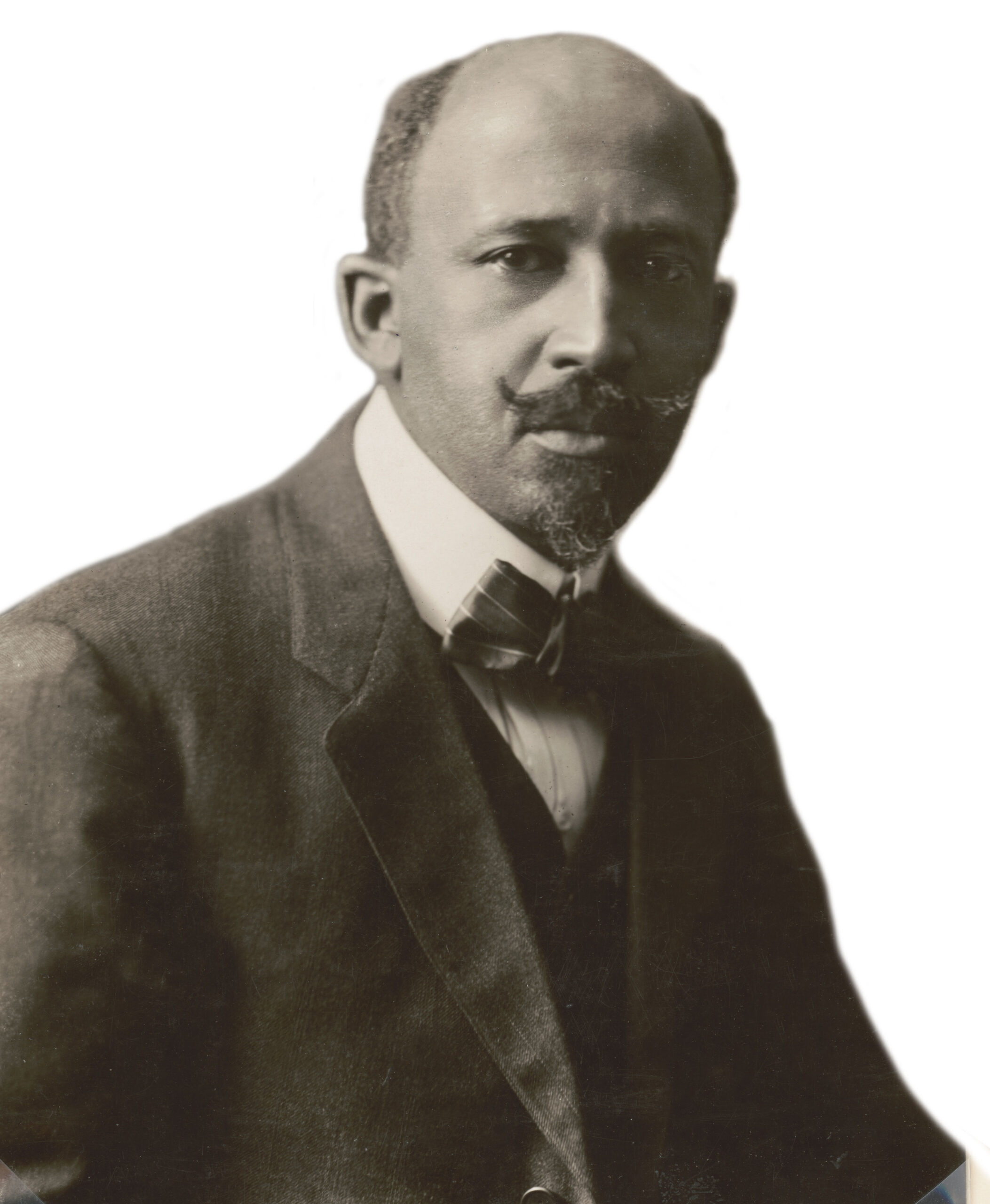
Black Americans often viewed the Civil War and Reconstruction as an era of both hope and missed opportunity—not only for themselves, but for the entire nation. “For its own sake white Dixie, even while cheering a nostalgic excursion into the past, ought to be glad the whole business is going with the wind,” The Crisis editors argued. The battle against the memorialization of the Confederacy had many different targets. W.E.B. Du Bois, a cofounder of The Crisis, on numerous occasions battled against Confederate memory through the pages of his magazine. “The most terrible thing about war, I am convinced, is its monuments,” he argued in 1931, lamenting the presence of so many Confederate memorials across the southern landscape.
 Library of Congress
W.E.B Du Bois
Du Bois refused to let even Robert E. Lee out of his sights. In 1928 in the magazine, Du Bois condemned the growing hagiography around Lee and his battlefield exploits. For Du Bois, it was “the inescapable truth that Robert E. Lee led a bloody war to perpetuate slavery.” He believed setting the record straight on Lee, the Confederacy, and the very cause of the Civil War was critical if the nation was to move forthrightly on the issue of civil and human rights in the 20th century. On Lee, Du Bois was clear: “He surrendered not to Grant, but to Negro Emancipation.”
This argument about the centrality of slavery and black freedom to the Civil War was the heart of Du Bois’ magnum opus, Black Reconstruction in America, in 1935. The book is a direct response to the Dunning School of Reconstruction historiography, which argued that Reconstruction was a mistake and served to prove that black Americans were unworthy of democracy. The book was just part of Du Bois’ lifelong argument against glorifying the Confederate States of America and the memorialization of their war effort.
All across the nation, blacks resisted efforts to memorialize the Confederate war effort and its cause of defending slavery. From the moment of its unveiling in Charleston, South Carolina, in 1887, the John C. Calhoun monument was derided by blacks. According to Ethan J. Kytle and Blain Roberts, authors of Denmark Vesey’s Garden, black Charlestonians used numerous methods to mock or desecrate the statue. The original monument would be replaced in 1896 by the better-known Calhoun monument, which itself came down in 2020. The new Calhoun memorial was raised just as black civil and political rights reached their low points in the 1890s, the oft recalled “nadir” of black freedom after the Civil War. Nonetheless, even the fall—and rise—of the Calhoun memorial offers an interesting lesson. For Kytle and Roberts, it was “though marginalized by Redemption and Jim Crow, local blacks found unconventional means to resist a statue they viewed as a symbol of racial oppression.”
By the time of the Civil Rights Movement of the 1950s and 1960s, activists and intellectuals alike continued to criticize the valorization of the Confederacy. At the same time, they pushed their interpretation of the American Civil War as one for both union and emancipation—and one whose mission of black freedom was not yet complete. In 1960, in Madison, Wisconsin, Martin Luther King Jr. gave a speech titled “The Burning Truth of the South.” In it, he referred to “the incomplete revolution of the Civil War,” saying so right as commemorations of the war were being planned throughout the nation.
As part of those commemorative ceremonies, the state of South Carolina erected the Confederate battle flag on the state capitol dome in Columbia on April 11, 1961. It was added, in the words of The State (SC) newspaper, “as part of the commemoration of the 100th anniversary of the War Between the States.” By the following year, the flag was kept there—and would remain until 2000. In those intervening years, black activists and their allies repeatedly pushed for the flag to be brought down.
In the aftermath of King’s assassination in 1968, activists in the city argued for the removal of the flag. Dr. Benjamin F. Payton, then-president of Benedict College, a historically black college in Columbia, argued for taking down the flag. In a memorial service, Payton said, “Dr. King’s life and death calls to Southerners to give up the lost cause.” He went a step further, reminding his audience that most black people were also southerners. “And Dr. King was a proud Southerner,” he lamented. At the time, the flag had been taken down from the capitol dome for several days—purportedly for cleaning. Soon it returned to its place of prominence.
In recent decades, the debate over Confederate memorialization across the South has taken a variety of forms. Since the Civil Rights era, many southern communities have found it easier to simply celebrate new southern heroes—many of them black—who led the way in the “Second Reconstruction” of the 1950s and 1960s. For example, when in 1994 the city of Richmond, Virginia, debated adding a statue of tennis legend and human rights advocate Arthur Ashe to “Monument Row”—the part of the city filled with statues mostly of Confederate leaders—it reawakened among black Americans their disappointment with the city honoring those leaders. City Councilmember Henry W. “Chuck” Richardson lamented the city’s fascination with Confederate statues: “You wouldn’t request the Jewish community to accept the glorification of Nazi Germany today.”
The debate over Confederate iconography only increased in the 1990s and 2000s, as the political power of black Americans across the South rose, and more Americans accepted slavery’s importance to the Civil War. The flag came off the capitol dome in Columbia in 2000—although it was given another place of prominence on the statehouse grounds, to remain there until after the Charleston church massacre in 2015. Georgia’s state flag, which had become an amalgamation of the state seal and the Confederate battle flag in 1956, had been changed in 2001. These flag debates became culture war flashpoints across the South in the 1990s and 2000s, rivaled in intensity only by the ongoing debates about Confederate statues.
These most recent debates have been fueled by two events: the Black Lives Matter movement of the 2010s, and the church massacre. On June 17, 2015, Dylann Roof shot and killed nine black men and women inside Emanuel African Methodist Episcopal Church. The following day, Ta-Nehisi Coates wrote an essay in Atlantic magazine titled, “Take Down the Confederate Flag—Now.” He argued, in a tradition of largely black protest against Confederate iconography, that “Roof’s crime cannot be divorced from the ideology of white supremacy which long animated his state nor from its potent symbol—the Confederate flag.”
Almost immediately, coupled with the rising tide of Black Lives Matter protests across the nation, Confederate monuments were targeted for vandalism and Confederate flags were lowered. Companies such as Walmart stopped selling the flag. The governor of Alabama quickly took down the flag from capitol grounds, arguing that it was “the right thing to do.” The South Carolina Legislature opened debate over permanently removing the flag from statehouse grounds, a debate that would have been unimaginable a year before. In 2014, Governor Nikki Haley, running for reelection, argued during a debate that there was no problem with the flag being up because “not a single CEO” had complained about it during her administration. Less than a year later, there was no question the flag had to come down.
When victories are counted, it would be remiss to forget the long, often lonely struggle of black Americans against Confederate statues and flags. South Carolina State Representative Joe Neal spoke out against the flag in 2015 and summarized the legacy of this struggle. “When that flag stands out front, the entire African-American community feels a pain, and that pain is intensified when things happen like Charleston; when groups like the Ku Klux Klan and the Conservative Citizens Council and other groups use that flag as a banner, and use it as an excuse to hate and to kill and to burn and to bomb.” Black Americans have always been willing to ask uncomfortable questions about American history—precisely to remind everyone of what that history means for our quest to create a more perfect union.
Robert Greene II is an Assistant Professor of History in the Department of Humanities at Claflin University. He has published several articles and book chapters on the intersection of memory, politics, and African American history, and has written for numerous popular publications, including The Nation, Oxford American, Dissent, Scalawag, Jacobin, In These Times, Politico, and The Washington Post.
 Library of Congress
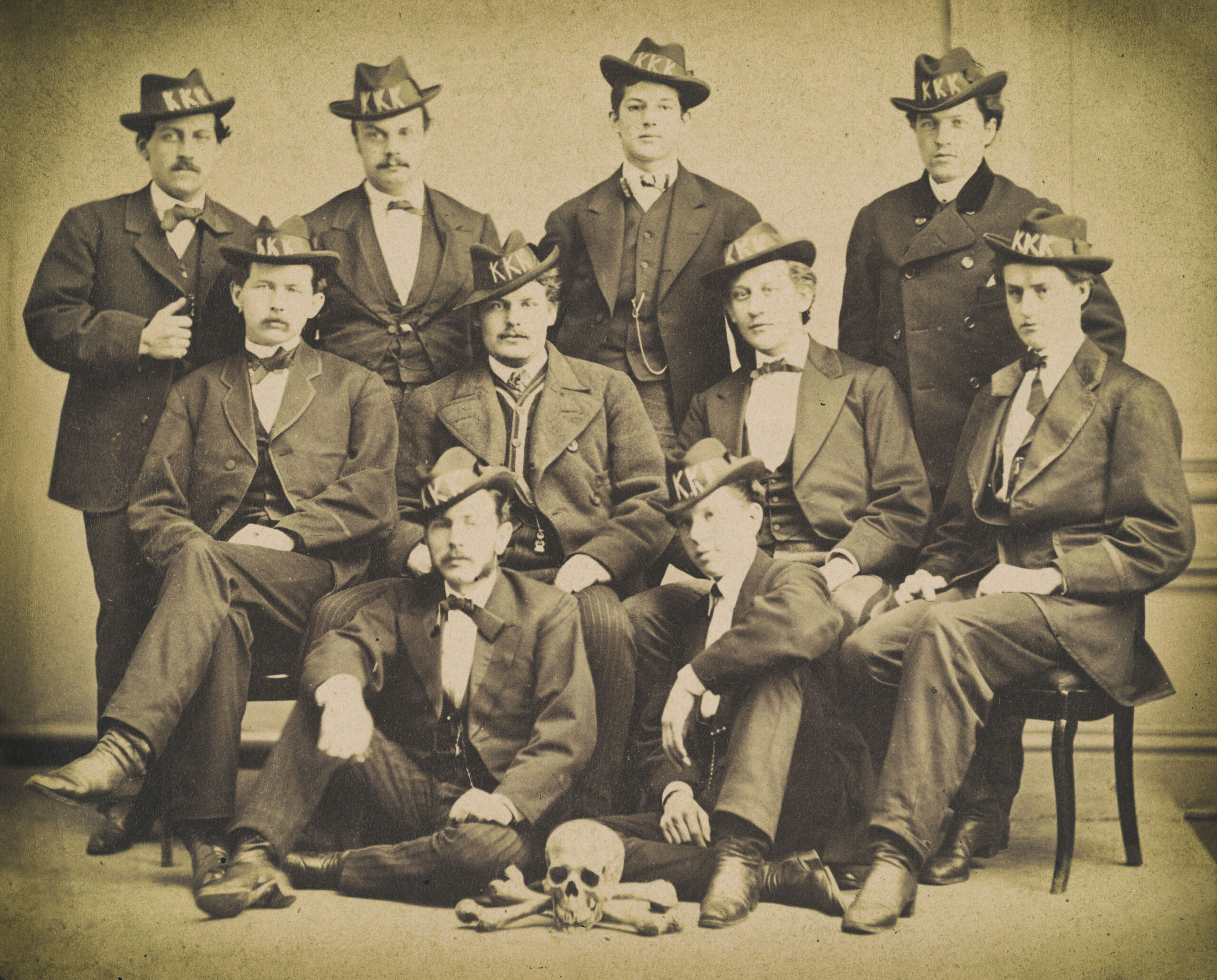
Members of the Watertown, Massachusetts, Division of the Ku Klux Klan in 1870. In the years after the Civil War, the KKK targeted not only blacks, but also whites who joined the republican Party or advocated for African-American civil rights, including former Confederates like John Winsmith.
Removing Confederate Monuments Does Not Erase History
by Kevin M. Levin
In 1911 the city of Spartanburg, South Carolina, dedicated a Confederate monument at a prominent downtown intersection. The mostly white crowd gathered there included Confederate veterans and members of the Red Shirts—the paramilitary arm of the Democratic Party involved in violently overturning Reconstruction in South Carolina in the 1870s. The veterans served as living reminders to the younger generation of its responsibility, a point reinforced in the monument’s inscription: “Let this monument teach our children and our children’s children to honor the memory and the heroic deeds of the Southern Soldier, who fought for rights guaranteed him under the Constitution.”
Confederate soldiers, according to monument inscriptions across the South, were brave in the face of the enemy, clear-eyed about what they were fighting for, and enjoyed unwavering support for the duration of the conflict by loved ones back home. And the South’s slave population? It had remained loyal to their masters and to the war effort.
Confederate monuments dedicated in prominent public spaces such as intersections, public parks, and court house squares between 1880 and 1930, the height of the Jim Crow era, offered communities a sanitized and distorted picture of the war and its aftermath. They tell us more about how communities chose to remember the past and the values white Americans hoped to reinforce and instill in future generations than they say about the historical record.
Appreciating this distinction between memory and history undermines claims by those who today insist that the removal of Confederate monuments is tantamount to “erasing history.” The story of a prominent father and son in Spartanburg bears this out.
Few families in Spartanburg District were more excited about the prospects of an independent Confederacy than John Winsmith and his son, John Christopher. Winsmith was one of the wealthiest slaveholders in the area and an early advocate for disunion. In 1851 he upheld the right of a state to secede as a means to “shield her citizens against the unholy crusade which has been waged upon their vital institution” of slavery. A state representative in 1860, Winsmith offered the first resolution in the General Assembly calling for secession just days after Abraham Lincoln was elected president. His election, Winsmith charged, was “based upon principles of an open and avowed hostility to the social organization and peculiar interests of the slaveholding states of this Confederacy.”
For John Christopher there was never any question he would fight for an independent Confederacy. Born in 1837, he came of age during the height of the sectional conflict of the 1850s. He followed political events closely in the newspapers and in correspondence with his father. Days after the firing on Fort Sumter in April 1861, Christopher left a new law practice for service in the army, eventually attaining the rank of captain in the 1st South Carolina Infantry.
Christopher was an unwavering Confederate nationalist, who maintained it was “the duty of the whole South to make common cause against the hordes of abolitionists who are swarming Southwards.” In the army Christopher witnessed or took part in some of the bloodiest battles of the war, including Second Manassas, Antietam, Fredericksburg, Chickamauga, as well as the Overland Campaign and the first four months of the Petersburg Campaign, before being wounded at the Battle of Fort Harrison on September 30, 1864.
Even after the point where many Confederates acknowledged the likelihood of defeat, Christopher maintained a stoic faith in independence. Accompanied by at least five body servants or camp slaves throughout the war (though one ran off in 1862), Christopher was convinced that the South’s enslaved population would remain loyal.
Captain Winsmith supported harsh army disciplinary measures, including, even late in the war, executions of deserters. John Winsmith assisted his son by inquiring into the whereabouts of locals who were reported to have deserted and then took steps to have them returned to the unit and the possibility of military charges.
By the turn of the century, wartime records like Christopher Winsmith’s were celebrated at monument dedications across the South. His record of bravery and devotion to the Confederacy was undeniable and fit the foundation of the Lost Cause—the belief that the Confederate cause was just and that the institution of slavery was moral—that took shape in the immediate aftermath of defeat and emancipation. But it is an incomplete history of this Confederate stalwart. Within five years of war’s end both Winsmiths had joined the Republican Party.
Why is unclear, but what is clear is that their joining the “Party of Lincoln” and supporting black civil rights constituted a betrayal of the Confederate cause. That was brought home to John Winsmith on March 22, 1871, when the Ku Klux Klan confronted him on his back porch in the middle of the night. The assault—he survived seven gunshots—may have been in response to his offer of Saturdays and Sundays off to his black tenants and his determination to establish a school on his property for the education of former slaves.
Christopher’s postwar path was no less fraught. During his tenure as a major general in the state militia, Christopher used his military authority to protect black tenants residing on his father’s plantation home by placing guards around the perimeter. In court he argued that debts involving formerly enslaved individuals could no longer be collected. He subsequently paid for the publication of his closing argument in pamphlet form, which suggests his loyalty to the Republican Party was well known.
As racial violence increased across South Carolina in the 1870s, Christopher appealed to President Ulysses S. Grant for more military intervention in response to vigilante groups such as the Red Shirts, who terrorized blacks who joined the Republican Party or attempted to exercise their civil rights. In a speech delivered to a gathering of black and white Republicans in his home town on the eve of elections in 1876, Christopher denounced the cause of the Confederacy and called on Americans to continue the work “to establish upon a basis which can never be shaken freedom and equal rights for all men.”
The path taken by the Winsmiths threatened claims made by Lost Cause apologists that white southerners stood unified during and after the war in their defense of the Confederacy, and in their opposition to military occupation during Reconstruction and black political action. The presence of Red Shirts at the Spartanburg ceremony testified to the much longer war that many Confederate veterans waged against Reconstruction and its aims.
Captain Winsmith’s wartime record may have given succor to white southerners as they faced their many postwar challenges, but a more accurate accounting of his military and political record during Reconstruction would have undermined the broader goal of maintaining, by whatever means, the racial status quo.
Far from explaining the past, monument dedications scrubbed the historical record clean of anything—Unionists, dissenters—that might have challenged the consensus Lost Cause narrative. Thousands of enslaved men who ran off, joined the United States Army, and helped to defeat the Confederacy were instead celebrated as “loyal slaves” on monuments in Fort Mill, South Carolina, and in Arlington National Cemetery.
From this perspective, the removal of Confederate monuments may help begin the process of correcting the record by making room for stories that are not only more inclusive but also more accurate. Whether these monuments should remain calls for deciding whether or not they represent the collective memory and values of their entire living communities.
Kevin M. Levin is a historian and educator based in Boston. He is the author of numerous articles and books about the Civil War, including most recently Searching for Black Confederates: The Civil War’s Most Persistent Myth. He is currently at work on a biography of John Christopher Winsmith.
 Albert Knapp / Alamy Stock Photo
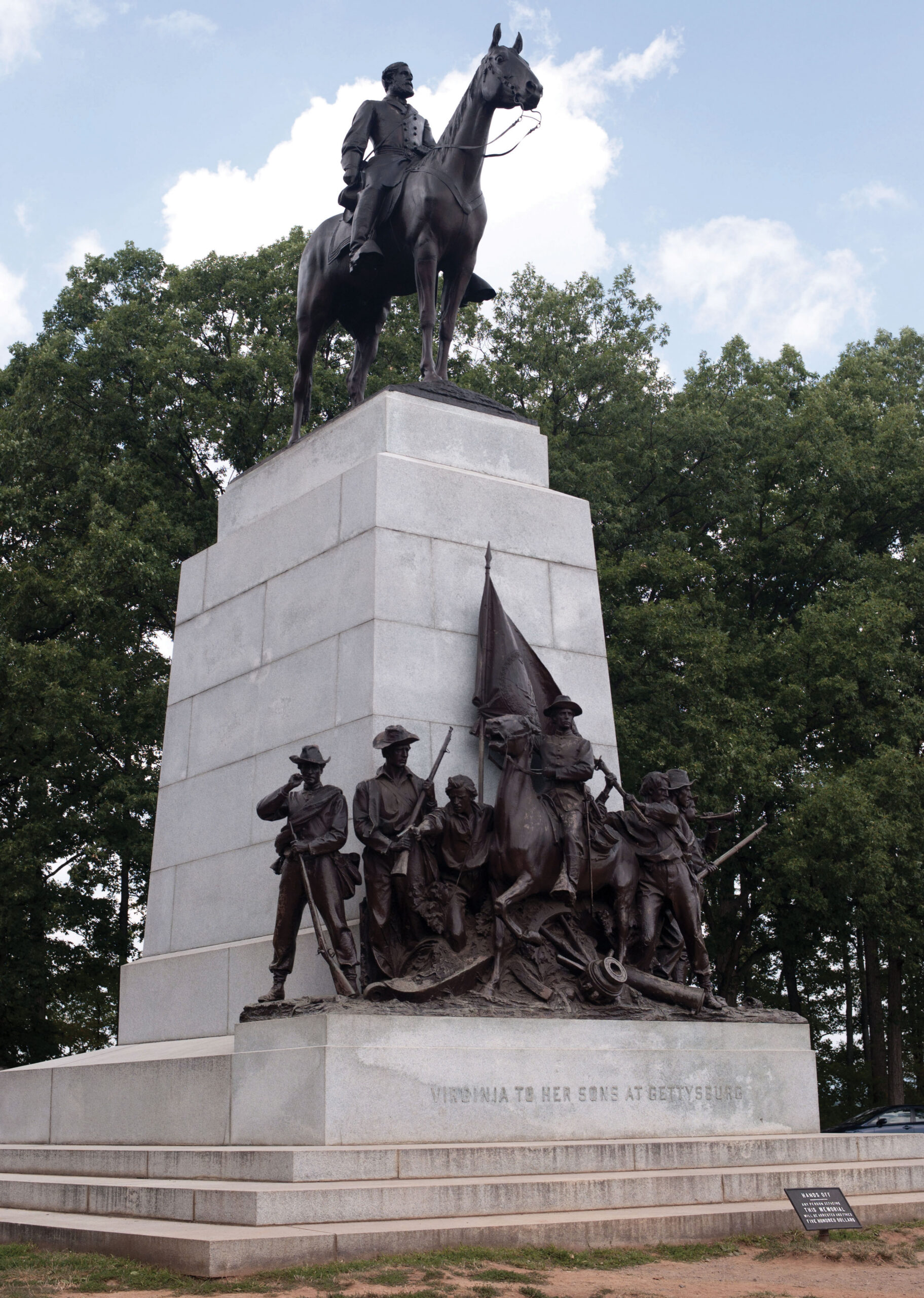
The Virginia Monument at Gettysburg National Military Park
Let Them Stand But Not Alone: Contextualizing Confederate Monuments at National Parks
by Peter S. Carmichael
In the aftermath of George Floyd’s killing, countless Confederate monuments came crashing down. Will activists calling for the eradication of the Confederate memorial landscape turn their attention to Civil War battlefields next, demanding that any memorial associated with the southern cause be relocated to a museum or simply destroyed? The debate over whether to keep or remove Confederate memorials in front of courthouses, at local parks, and along historic boulevards is dead. Statues and busts honoring Confederates will continue to fall, schools and roads will continue to be renamed, but uncertainty clouds over national military parks where the final battle over Confederate memorialization will be fought.
If Democrats in the House of Representatives have their way, it appears that Confederate monuments at national parks are headed for cultural exile. The proposed 2021 appropriation for the Department of Interior calls for the National Park Service to “remove from display all physical Confederate commemorative works, such as statues, monuments, sculptures, memorials, and plaques.” The political obtuseness of this measure is breathtaking. At a time when a few hotly contested Senate seats in the South could give Democrats the majority, House Democrats have given Republicans rhetorical fodder to portray their opponents as enforcers of political correctness bent on erasing the past. Regardless of the November election’s outcome, it is clear that the House Democrats are wildly out of step with large numbers of Americans who make the crucial distinction between a historic site dedicated to education, and a public space where monuments reside outside political and cultural centers of power and give sanction to social and civic inequalities.
Although people of all backgrounds tend to agree that Confederate monuments should stay on battlefields, there is a concern that these marble edifices, if left to speak for themselves, will sustain the romanticism and racism of the Lost Cause for generations to come. For instance, the Virginia Monument at Gettysburg evades the cause or consequences of the Civil War, yet draws thousands of visitors every year. It is a celebration of martial glory, with a bronze General Robert E. Lee on horseback commanding the field, appearing calm and resolved while watching his troops prepare for their charge. Below him are six bronze soldiers from the three branches of service—infantry, cavalry, and artillery—assuming military poses around a central equestrian figure waiving the Confederate flag. At the base of the pedestal read the words, “Virginia to her sons at Gettysburg.”
There is not a single interpretive marker at the base of the Lee equestrian to awaken visitors from this monument-induced Lost Cause dream. Surprisingly few people find the 14-foot-high pedestal honoring the defeated Rebel chieftain as even somewhat odd, given that it towers over the field of his greatest defeat. The absurdity of memorializing a Rebel officer on northern soil at the site of a dramatic Union victory vanishes in a bucolic setting that can seduce visitors into imagining war without savagery, killing without sordid politics, and soldiers fighting without fear. Of the countless Gettysburg tours that I have led over 30 years, only one visitor, who happened to be 11 years old, was bewildered when she saw the immense Lee monument rising above the trees of Spangler Woods. She could not understand why the equestrian monument to George Gordon Meade, the victor of Gettysburg, was tucked away on the back side of Cemetery Ridge, looking small and insignificant in comparison to his adversary.
Not all visitors look at historical landscapes with as critical an eye as the precocious girl I took around the battlefield. How to encourage visitors to think historically, when the imagination often runs free while standing at evocative battlefield sites like Gettysburg, is a challenge. On the one hand, respecting the right of people to form their own opinions about the past is elemental to good teaching and the cornerstone of intellectual freedom. On the other hand, historians have an obligation to create a challenging learning environment to encourage audiences to question their own assumptions, even if they are deeply personal and long cherished. When monuments are properly contextualized, people will be more open to seeing history as more than a single story of truth, but as a narrative including the stories of many historical actors who occupied the same historical space, at the same historical moment, but understood those experiences in very different ways.
Recovering the multiplicity of historical voices animated the Society of Civil War Historians’ call to action in September 2019, when members, who are mostly academic historians, rallied together at battlefields to provide contextualization or correction to Confederate monuments. At Gettysburg’s Eternal Peace Light, historians carried signs with quotes and passages from sources that demonstrated how slavery drew unyielding support ranging from Confederate privates to General Lee. Professor Scott Hancock of Gettysburg College, one of the organizers, did an impressive job of reaching out to visitors without antagonizing them. The efforts of everyone that day demonstrated the value of historians appealing to general audiences, but it also showed the limitations of well-intentioned academics whose posters’ effects were more confrontational than conversational. One historian had a sign around his neck reading: Robert E. Lee “whipped his slaves hard.” Effective public interpretation, whether it be in person or through signage, seeks dialogue, not confrontation, with the public.
In the end, the call to action by the society did meaningful work in showing that Confederate monuments are in need of contextual waysides. This is not news to park service historians, who have for some time understood the challenge in getting visitors to see battlefields as commemorative landscapes. They have had successes and have made impressive strides in addressing issues of slavery and race in museum displays and public programs. Interpretive signage is next, and Chris Gwinn, the chief of interpretation at Gettysburg National Military Park, has been working with his staff in designing waysides that offer visitors the Lost Cause context to memorials like the Virginia Monument. At Antietam National Military Park, the visitor center is undergoing an interpretive overhaul to show how enslaved people—in addition to the battle’s outcome—led to the Preliminary Emancipation Proclamation. And Chickamauga and Chattanooga National Military Park routinely offers programs that explore the complicated issues of race and reconciliation at their site. To suggest that the park service has intentionally or unintentionally silenced the historical experience of African Americans is an unfair allegation. More can be done to help visitors understand the historical origins of Confederate monuments, and how their messages have evolved over time, but patience is needed, given that NPS budgets are virtually barren of funds for historical interpretation.
To topple Confederate monuments at national military parks would be a grievous mistake, particularly at a time when white Americans have demonstrated a surprising willingness to learn about slavery, to discuss the Lost Cause, and to confront the contested legacies of the Civil War. At the same time, we must not define Confederate monuments as exclusively declarations of white supremacy and nothing more. In their zeal to combat racism today, some historians have lost the complex reasons for the raising of Confederate monuments that expressed feelings of mourning, fidelity to comrades, admiration for civilians, and a desire for national unity. Without question, these monuments were inextricably linked to the slaveholders’ gambit for southern independence. But to conclude that Confederate monuments only promoted a dominant and all-controlling message of white supremacy would suggest that people are puppets of elite messaging. Today as in the past, people bring their own ideas, their own experiences, and their own unique historical visions to form their own judgments about the past while visiting historic landscapes.
Monuments of any era never go silent; they speak in a visual language that is ever-changing, never static, and always resistant to simplistic interpretation. Preserving Confederate statues and plaques on battlefields keeps the dialogue alive while also preserving invaluable civic spaces where conversations will prevail, not lecturing, where discussions will occur, not inculcation, and where people will feel free to share their understandings of the past while trying to make sense of the present.
Peter S. Carmichael is the Fluhrer Professor of Civil War Studies at Gettysburg College and director of the Civil War Institute. He is the author of The War for the Common Soldier: How Men Thought, Fought, and Survived in Civil War Armies.
 Nikreates / Alamy Stock Photo
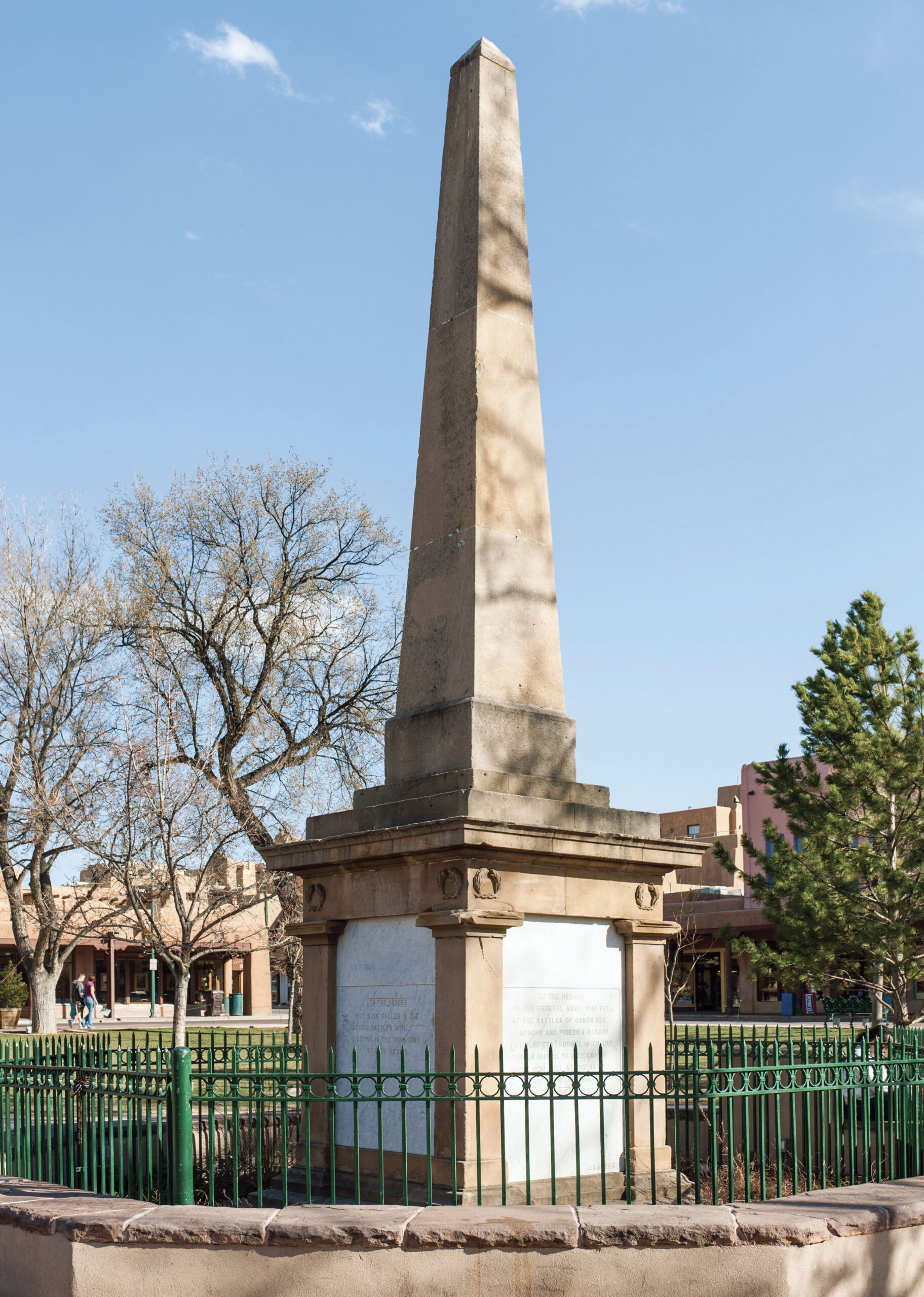
The Union Soldiers’ Monument in Santa Fe, New Mexico, as it appeared before being partially torn down in October 2020.
The Union Soldiers’ Monument, Santa Fe
by Megan Kate Nelson
October 24, 1867. Santa Fe, New Mexico.
As the McGee brothers—builders of foundations, mills, cellars, and private dwellings—laid the cornerstone of the monument to Union soldiers in the center of Santa Fe Plaza, John Clark watched with satisfaction. Clark was the surveyor general of New Mexico Territory and had been since October 1861. In March 1862, he fled Santa Fe as a victorious army of Confederate Texans approached, and he returned only after Union troops defeated the Confederates at the Battle of Glorieta Pass and forced their retreat back to San Antonio. Although Clark had criticized the Union army’s leadership and its Hispano soldiers in those first disastrous months of the Civil War in the far West, he had come to appreciate all the work they had done since to protect the territory from Confederate invasion—and to wrest New Mexico from Apache and Navajo peoples.
The monument, which was completed in June 1868, lauded the Union soldiers of New Mexico for all these achievements. Over the next eight months, the McGee brothers installed four marble plaques on the base of an obelisk that towered 30 feet above the plaza. Three of them recognized those who fought and died in the battles against Confederates at Valverde (February 1862), Apache Canyon and Glorieta Pass (March 1862), and Peralta (April 1862).
“To the heroes who have fallen,” the fourth plaque read, “in various battles with savage Indians in the Territory of New Mexico.”
In the far western theater, the Civil War became an “Indian war” as the Union army launched a series of campaigns against multiple Indigenous communities beginning in the fall of 1862. The intent was to force tribal nations to surrender to the Union so that they could then be forcibly removed from their lands and imprisoned on reservations.
In the midst of these campaigns, Union soldiers also engaged in targeted acts of violence against Indigenous peoples. Volunteers serving under Colonel Patrick Edward Connor and Colonel John Chivington massacred peaceful Shoshone, Cheyenne, and Arapaho men, women, and children at Bear River, Idaho (January 1863), and Sand Creek, Colorado (November 1864).
Soldiers in the far West who took part in these actions saw them as an essential element of their service to the Union—as did the state legislature of New Mexico, which funded the construction of the monument to their sacrifices in these campaigns. For many soldiers and civilians in the Southwest (including John Clark), the Union cause became the cause of white supremacy. The military and political battles they waged against Native Americans would clear the way for Anglo migration to the West during and after the Civil War, as part of a larger national project to make these lands productive through farming, ranching, and mining.
But there are several elements of the war in the West that complicate this argument—and along with it, the current conversation about what should be done with the monument to Union soldiers in Santa Fe.
First, there were Anglo soldiers who protested the ferocity and violence of these Union campaigns. One of them, Captain Silas Soule, refused to participate in the Sand Creek Massacre and in 1865 testified against Chivington in a Congressional investigation. Several months later, Soule was shot and killed in Denver; many locals suspected that the assassins were Union veterans loyal to Chivington.
Second, many of the soldiers fighting in Union campaigns in the Southwest were Hispanos. The 1st New Mexico Infantry, a large regiment under the command of Colonel Kit Carson, fought at Valverde and in numerous campaigns against Indigenous people, and was mostly composed of Hispano volunteers and militia. Carson also had Zuni and Ute scouts and spies under his command during the relentless pursuit of the Navajo in 1863–1864, while Mescalero Apache and Navajo volunteers joined his regiment in an attack on a Kiowa and Comanche encampment at Adobe Walls in November 1864.
The Union army in New Mexico was the most diverse fighting force in all theaters of the Civil War. The monument to them in Santa Fe does not acknowledge this fact. It does, however, recognize the nature of the war in this theater, and the fact that while the Union fought for emancipation in the East, it fought for removal and extermination of Indigenous peoples in the West.
This past summer, the nationwide protests sparked by the killing of George Floyd in Minneapolis brought protesters to Santa Fe Plaza, calling attention to the laudatory narrative that monument tells about the Union army’s campaigns against “savage Indians.” Protesters overwrote the monument, tagging it with the term “racist” and reclaiming it as sitting on “Tewa [Pueblo] Land.”
This was not the first time Indigenous activists had targeted the monument. In the 1970s, a member of the American Indian Movement disguised himself as a construction worker and, in broad daylight, walked up to the monument and chiseled out the word “savage” on the fourth plaque. Protesters in 2020 filled in the space left behind with the word “resilient.”
In July, the mayor of Santa Fe announced that the monument should be removed. He created a commission to make the final decision and, in the meantime, the monument’s four plaques have been covered with plywood, to which community members have affixed artworks and poetry. Indigenous activists continued to press for the monument’s removal.
“We’re hoping that those steps are being actualized,” members of the grassroots organization Three Sisters Collective have stated, “because [the monument] is problematic and it’s going to continue to be problematic until it’s gone.”
On October 12 (Indigenous Peoples’ Day), protesters made this vision a partial reality. After a scuffle with police in the plaza, they climbed the monument and, using bracing beams and a chain, pulled down all three pieces of the obelisk. The base, with its plaques, remains.
Although the monument is more complicated than it at first appears given the diverse nature of the Union army in this theater, a memorial lauding their efforts to eradicate Indigenous peoples is problematic and polarizing. The city of Santa Fe should remove it. And in its place local residents should work together to create a public artwork that recognizes the complex and dynamic communities that have long existed in New Mexico, and in the larger West—particularly its tribal nations—as well as the darker parts of their histories.
Every monument to our nation’s past—not just those commemorating the Confederacy—deserves scrutiny. And the American people deserve a discussion about monuments that moves well beyond “keep or remove,” and considers creative and meaningful ways to depict the past in our public spaces.
Megan Kate Nelson is a writer and historian living in Boston. She is the author, most recently, of The Three-Cornered War: The Union, the Confederacy, and Native Peoples in the Fight for the West (Scribner, 2020).
 Library of Congress
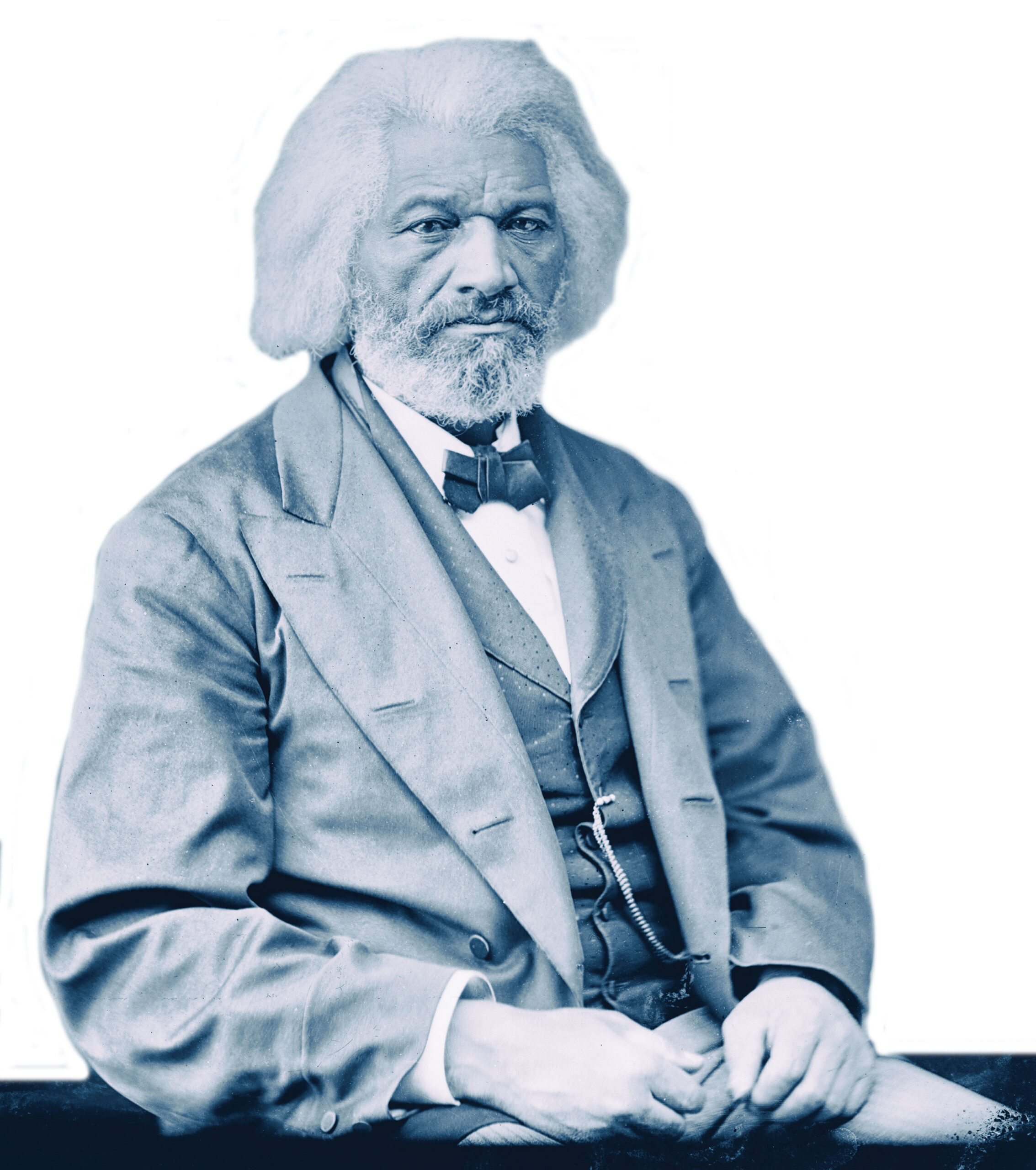
Frederick Douglass
“There Is Room … for Another Monument”
by Jonathan W. White
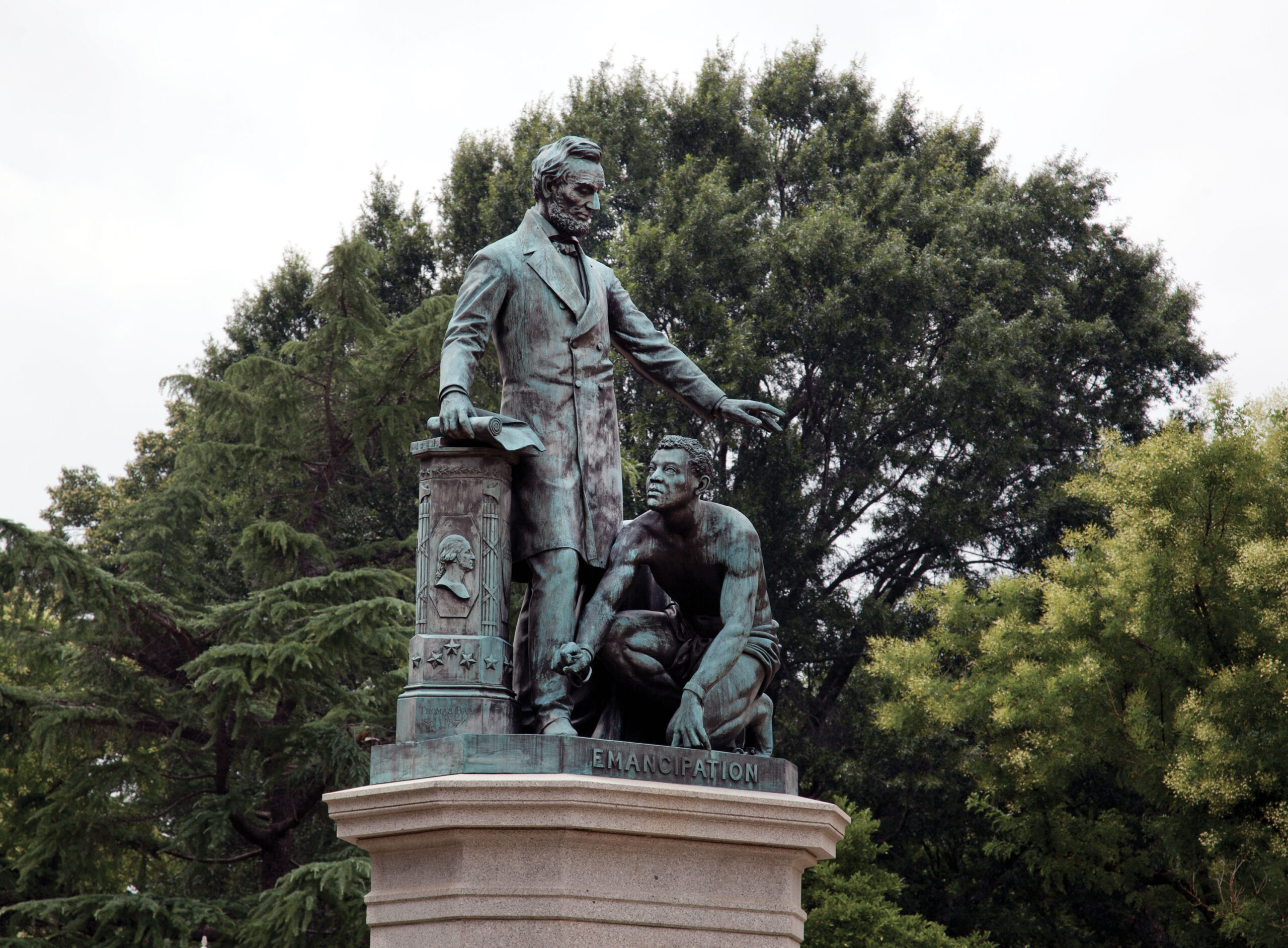
“No one monument could be made to tell the whole truth of any subject which it might be designed to illustrate.” So wrote Frederick Douglass to the editor of the Washington, D.C., National Republican in April 1876, shortly after delivering the dedicatory remarks at the unveiling of the Emancipation Memorial at Lincoln Park. As “admirable” as Douglass considered Thomas Ball’s statue—which depicts Abraham Lincoln holding a copy of the Emancipation Proclamation while standing over a kneeling slave he has freed, his shackles broken—he maintained, “it does not, as it seems to me, tell the whole truth.” From Douglass’ perspective, “The mere act of breaking the negro’s chains was the act of Abraham Lincoln, and is beautifully expressed in this monument.” But giving African-American men the right to vote, he continued, “was pre-eminently the act of President U.S. Grant, and this is nowhere seen in the Lincoln monument.”
In his letter, Douglass expressed reservations about the pose of Ball’s freed slave. “The negro here, though rising, is still on his knees and nude,” he wrote. “What I want to see before I die is a monument representing the negro, not couchant on his knees like a four-footed animal, but erect on his feet like a man.” Douglass concluded, “There is room in Lincoln park for another monument, and I throw out this suggestion to the end that it may be taken up and acted upon.”
Douglass was calling for more historical context so that visitors to Lincoln Park could gain a better understanding of emancipation. He hoped to add to the scene, not replace it just because it offered an incomplete perspective of how freedom had come to the nation’s black people. Sadly, no one took up his suggestion. And indeed, his letter—which is particularly relevant today—was lost for 144 years.
Before writing his letter to the National Republican, Douglass had delivered the main address at the unveiling of Ball’s Emancipation Monument on April 14, 1876—the eleventh anniversary of Lincoln’s assassination. In the audience were members of Congress and the Supreme Court along with President Grant and his cabinet. Unfortunately, that speech is often misunderstood. On social media this summer, during which the push to remove Confederate statues intensified across the country, several prominent historians pointed to Douglass’ words as evidence that the statue in Lincoln Park should likewise come down. Again, context is everything.
Douglass reminded the audience of why they were there: “to express, as best we may, by appropriate forms and ceremonies, our grateful sense of the vast, high, and preeminent services rendered to ourselves, to our race, to our country, and to the whole world by Abraham Lincoln.” But, Douglass continued, Lincoln “was not, in the fullest sense of the word, either our man or our model. In his interests, in his associations, in his habits of thought, and in his prejudices, he was a white man.” In fact, rather than see Lincoln as emphatically the black man’s president (which is how Douglass had eulogized Lincoln in June 1865), Douglass said, “He was preeminently the white man’s President, entirely devoted to the welfare of white men.” Lincoln was not a radical abolitionist, but merely an opponent to the extension of slavery. He was slow to bring freedom to the slaves, instead prioritizing the restoration of the Union. He had even pledged in his first inaugural address to enforce the notorious Fugitive Slave Act of 1850. “You are the children of Abraham Lincoln,” Douglass told his predominantly white audience. “We are at best only his stepchildren; children by adoption, children by force of circumstances and necessity.”
Throughout the war Lincoln’s actions had often sorely disappointed members of black communities. Douglass alluded to Lincoln’s infamous colonization meeting with a delegation of black men in August 1862, reminding his audience of “when he strangely told us that we were the cause of the war,” and “when he still more strangely told us that we were to leave the land in which we were born.” Yet, Douglass declared, “Our faith in him was often taxed and strained to the uttermost, but it never failed.” He continued:
I have said that President Lincoln was a white man, and shared the prejudices common to his countrymen towards the colored race. Looking back to his times and to the condition of his country, we are compelled to admit that this unfriendly feeling on his part may be safely set down as one element of his wonderful success in organizing the loyal American people for the tremendous conflict before them, and bringing them safely through that conflict. His great mission was to accomplish two things: first, to save his country from dismemberment and ruin; and, second, to free his country from the great crime of slavery. To do one or the other, or both, he must have the earnest sympathy and the powerful cooperation of his loyal fellow-countrymen. Without this primary and essential condition to success his efforts must have been vain and utterly fruitless. Had he put the abolition of slavery before the salvation of the Union, he would have inevitably driven from him a powerful class of the American people and rendered resistance to rebellion impossible. Viewed from the genuine abolition ground, Mr. Lincoln seemed tardy, cold, dull, and indifferent; but measuring him by the sentiment of his country, a sentiment he was bound as a statesman to consult, he was swift, zealous, radical, and determined.
Here was a reasoned assessment of Lincoln’s statesmanship—one that recognized the political realities that constrained Lincoln’s actions as commander in chief during the Civil War. Lincoln had long wanted to push the nation forward toward universal freedom, but he could not do so until he convinced the people of the rightness of his cause. In the end, Douglass recognized the monumental nature of Lincoln’s accomplishments. In the face of opposition from all sides, Lincoln had persevered. He was limited in the options he could take; yet he found a way to free the slaves. Douglass, in short, was publicly acknowledging that Lincoln had been right in his approach, and that he (Douglass) had been unfair in his wartime criticisms. (For example, in 1861 Douglass had called Lincoln the abolitionist movement’s “most powerful enemy” and “an excellent slave hound” who had “complete loyalty to slavery.”) Thus, Douglass concluded, “infinite wisdom has seldom sent any man into the world better fitted for his mission than Abraham Lincoln.”
Douglass closed his remarks with words of congratulations to the audience—particularly its black members. “We have done good work for our race today,” he said. “In doing honor to the memory of our friend and liberator, we are doing the highest honors to ourselves and those who come after us. We have been fastening ourselves to a name and fame imperishable and immortal.” He wished that when future generations denigrated black Americans, “we can calmly point to the monument we have this day erected.”
Selective readings of Douglass’ speech can lead modern Americans to think that he was offering a harsh rebuke of Lincoln. One recent piece in The Washington Post called it “a reality check” and “a 32-minute rapid-fire discourse on the conflicted legacy of Lincoln” in which “Douglass exposed Lincoln’s legacy”—that is, showed that Lincoln’s heart was not really in emancipation. In like manner, Lincoln’s famous August 1862 letter to newspaper editor Horace Greeley is also often quoted out of historical context to suggest that Lincoln did not really care about the plight of American slaves.
 Library of Congress
Thomas Ball’s Emancipation Monument at Lincoln Park in Washington D.C.
Taken as a whole, however, Douglass’ speech and letter reveal that his views of the monument (and the man) were complex—and not altogether negative, as they are often portrayed. In fact, Douglass grew to have great admiration for Lincoln as he came to understand how heartfelt and genuine Lincoln’s desire was to end slavery. After meeting with Lincoln in August 1864 to discuss how to free as many slaves as possible, Douglass wrote, “What he said on this day showed a deeper moral conviction against slavery than I had ever seen before in anything spoken or written by him.”
Even if Douglass did not like the black man’s pose in the Emancipation Monument, it is not at all clear that many of his African-American countrymen shared the sentiment. In the weeks following the dedication ceremonies, the People’s Advocate, a newly established black newspaper in Alexandria, Virginia, offered new subscribers a photograph of the Lincoln statue, which the editors called “a work of art … unsurpassed for beauty and grandeur.”
On June 26, 2020, I published a piece in The Hill entitled “Let Abraham Lincoln Stand,” in which I argued that protesters should not tear down the Emancipation Monument, as they were threatening to do. I pointed out the role African-American leaders had played in raising money for the monument, that the imagery of the statue was based on historically abolitionist symbolism, and that the first $5 had been donated by a formerly enslaved woman. Charlotte Scott said after learning of Lincoln’s assassination in 1865, “The colored people have lost their best friend on earth. Lincoln was our best friend and I will give five dollars of my wages toward erecting a new monument to his memory.” I described the pride the black community of Washington felt on the day of its unveiling—how they paraded through the streets for hours. At the ceremony, a young African-American poet named Henrietta Cordelia Ray read a poem she had written for the occasion, entitled “Lincoln,” that offered the statue as “a loving tribute” to the “Emancipator, hero, martyr, friend!” And though it had been 11 years since the tragic night at Ford’s Theatre, she wrote, “We see thee still, responsive to our gaze, / As ever to thy country’s solemn needs.”
The controversy surrounding the monument sparked a lively email debate among the members of the board of directors of the Abraham Lincoln Institute (on which I serve) that spilled over into a private text message exchange between me and my friend Scott Sandage of Carnegie Mellon University. At issue between us was whether or not Douglass disliked the monument. The best evidence for this—and the only thing that any historian had cited—was a recollection published in 1916 by a white member of the audience who claimed that Douglass made an offhand negative comment about it during his speech. No contemporary document has been discovered to corroborate that account. The next morning, Scott started searching on Newspapers.com for evidence of how Douglass thought about the monument in 1876, when it was unveiled. After a bit of searching, he discovered the letter to the National Republican.
Scott and I wrote about the letter for Smithsonian Magazine and it immediately gained traction in the media. The Wall Street Journal did a lengthy story about our discovery, and many newspapers and websites linked to our Smithsonian piece, including articles in The New York Times, the Guardian, and The New York Review of Books. We were interviewed on numerous radio programs and podcasts, including NPR’s All Things Considered. It was thrilling to see how the discovery of an old letter might influence a current public policy debate.
We closed our Smithsonian piece by drawing from Douglass’ suggestion: that adding new monuments of African Americans like Douglass or Charlotte Scott to Lincoln Park—“erect on his feet, like a man”—would help tell something closer to “the whole truth” in that space than the Lincoln statue can do on its own. This would be a way to preserve the legacy of Scott and the many former slaves who helped create that monument, while also presenting to the public a more complete picture of emancipation. I hold out hope that Frederick Douglass’ solution may yet prevail.
Jonathan W. White is associate professor of American Studies at Christopher Newport University and author or editor of 10 books about the Civil War, including Emancipation, the Union Army, and the Reelection of Abraham Lincoln (2014) and Midnight in America: Darkness, Sleep, and Dreams During the Civil War (2017).