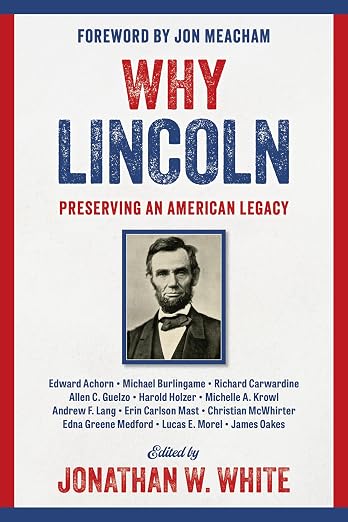
In Why Lincoln, the amazingly prolific Jonathan W. White collects a dozen essays from leading Lincoln scholars and public historians reflecting on their personal relationship with our sixteenth president—as well as Lincoln’s meaning and relevance today. White invited his all-star cast of contributors to “be as autobiographical as they liked”; the best essays in the collection “pull back the curtain for readers” and reveal as much about the historical profession as they do about Lincoln (xi).
Harold Holzer opens the volume by recalling his serendipitous selection of Lincoln as the subject for a fifth-grade composition. Holzer discovered—and then devoured—Richard Nelson Current’s classic The Lincoln Nobody Knows [1958] as he researched his essay. That chance encounter in a Queens library began a “self-motivated quest to learn more about Abraham Lincoln” that has spanned more than six decades (6-7). Two-time Lincoln Prize-winner Richard Carwardine notes that he was “attracted by the questing open-mindedness” and the “moral dimension” of Lincoln’s speeches in the 1850s (19). Reflecting on a distinguished career that produced a penetrating, psychological portrait of Lincoln; an encyclopedic, two-volume Lincoln biography; as well as a small shelf of edited volumes collecting the writings of Lincoln associates, Michael Burlingame concludes that “working on Lincoln has, I like to think, made me a better historian—and a better person” (44). Rounding out the book’s first section, Edward Achorn, a recent comer to Lincoln studies, pays tribute to the “pragmatic, freedom-loving Lincoln,” whose “ideas about human nature and freedom remain extremely pertinent” (58).
Essays from a trio of public historians comprise the next section. Christian McWhirter reflects on his decade at the Abraham Lincoln Presidential Library and Museum in Springfield, Illinois, where, as the “Lincoln historian,” he was frequently called upon “to authenticate some object, image, fact, or phrase” (63). McWhirter notes that Lincoln “transformed for me from a fascinating historical personality whom I mostly respected to a sort of totemic figure who was always just out of focus but whom the world nonetheless expected me to see with absolute clarity” (64). Michelle A. Krowl, the Civil War and Reconstruction specialist in the Manuscript Division at the Library of Congress, discusses how documents allow us to access the human Lincoln. Among Krowl’s favorites are the letter a fuming commander-in-chief penned (but opted not to send) to George Meade after Robert E. Lee fled across the Potomac following the battle of Gettysburg and the “cut-and-paste reading copy of Lincoln’s famous Second Inaugural Address” (81). Considering that Lincoln “contained multitudes,” it should follow that his “legacy cannot be so easily contained in one place,” writes Lincoln Presidential Foundation CEO Erin Carlson Mast, who concludes her smart survey of Lincoln sites by celebrating how “public history inspires civic engagement and strengthens our democracy” (84, 95).
The essays in the next section mostly foreground their authors’ engagement with Lincoln’s ideas. James Oakes and Edna Greene Medford each recall their wrestling with Lincoln’s ideas about race and slavery. Lucas Morel argues that “Lincoln’s foundations in the American founding as the lodestar for his political thought remain the key for uniting a free people,” while Andrew F. Lang calls attention to the “gratitude” that “clarified Lincoln’s purpose as he navigated the barbed thickets of sectional discord” (132, 136). Finally, Allen Guelzo finds in Lincoln’s humility, patience, resilience, and humor a reflection of the very values that have braced our democracy (157-158).
While clocking in at just under two-hundred pages, Why Lincoln packs a considerable punch that will repay any reader interested in Lincoln’s life or legacy.
Brian Matthew Jordan is Professor of Civil War History, Chair of History, and Co-Director of the Civil War Consortium at Sam Houston State University.