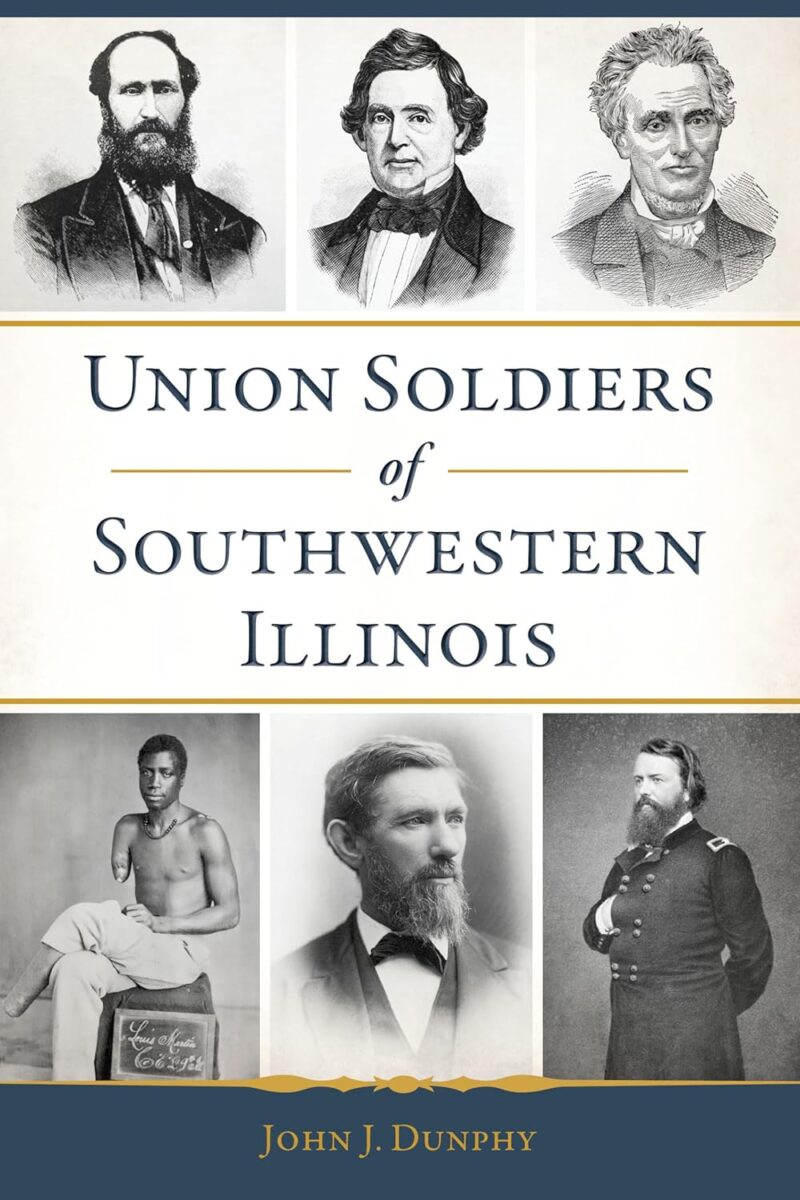
During the U.S. Civil War, Southern Illinois became known as “Little Egypt” for some of its residents’ sympathies toward the Confederate cause. While the loyalty of the region has long been questioned, author John J. Dunphy’s Union Soldiers of Southwestern Illinois argues that “few regions of the United States were stronger in their support of the Union during the Civil War than southwestern Illinois” (9). Highlighting the colleges, towns, and individuals of the region, Dunphy attempts to make the case that loyalty to the Union was nearly universal in southwestern Illinois.
Dunphy’s book features four short chapters. The first trains the spotlight on the students of Shurtleff and McKendree Colleges. After providing readers with useful background information on each institution of higher learning, the author discusses how these schools shaped support among their student bodies for the Union cause. While figures like John Pope, John Palmer, and John Cook are noteworthy as they attended Shurtleff College, lesser-known figures are also discussed.
In the second chapter, Dunphy shifts his gaze to the towns of Elsah, Alton, and Bunker Hill. Much of the author’s discussion within this chapter focuses on Alton, which would ultimately support the raising of the 7th and 144th Illinois Volunteer Infantry Regiments and contribute soldiers to the 29th U.S. Colored Infantry. Perhaps one of the more remarkable accounts related is that of Lewis Martin from Upper Alton, who served in the 29th U.S. Colored Infantry. After escaping slavery, Martin enlisted in the Union army and found his way to the siege lines of Petersburg. He had the misfortune to be present at the Battle of the Crater on July 30, 1864. While he survived that sanguinary contest, Martin suffered an injury that resulted in the amputation of his right arm. He sat for a photograph that prominently displayed the exposed stump: what the author describes as “one of the most poignant photographs from the post-Civil War era” (38). Dunphy argues that as a disabled veteran, Martin was ostracized by postwar civilian society. Indeed, his obituary announced: “Louis Martin, a Colored Man, Dies Alone” (40).
The last two chapters focus on a brood of individuals neglected by the historical record. The third chapter, “Southwestern Illinois Men Who Merit Recognition,” proves the weakest of the lot. By recalling the work of organizations like the Sons of Liberty (which consistently sought to undermine the Union war effort in Illinois), the author largely contradicts his own argument about the region’s loyalty. The fourth and final chapter focuses on southwestern Illinois men who became prisoners of war. Recounting the horrors of Andersonville and other notorious Confederate prison pens, Dunphy demonstrates how their time as prisoners impacted these men for the rest of their lives.
Union Soldiers of Southwestern Illinois offers much biographical information, but in a style that often proves cumbersome. Occasionally, the author includes additional information that distracts the reader from the individual he is focusing on. Further, many of the sources cited come from websites, rather than monographs or journal articles. Notwithstanding these shortcomings, Union Soldiers is valuable for providing readers with insights into some the lesser-known residents of a region best known for pro-Confederate fealties.
Riley Sullivan is a Ph.D. student in the Department of History at the University of Houston.